
What Is the Difference Between Treasury Bills and Government Bonds?
When Indian investors seek stability and capital protection, government-backed securities inevitably top the list. For decades, these instruments were the exclusive domain of commercial banks, insurance companies, and massive provident funds. Today, the landscape has transformed. Retail investors can directly participate in sovereign debt markets.
However, as you browse the available options, you will consistently encounter two primary instruments: Treasury Bills (T-Bills) and Government Bonds (Dated G-Secs).
While the Government of India issues both to raise capital, they function entirely differently. The core differences lie in their investment tenure, how they generate returns, and their sensitivity to market interest rates. Treasury Bills are short-term instruments that do not pay periodic interest. Government Bonds are long-term commitments that provide regular income.
Welcome to RupeeMoney. Choosing the wrong instrument can misalign your cash flow and expose you to unexpected market volatility. In this comprehensive guide, we will break down exactly how T-Bills and Government Bonds work, how their returns are calculated, and which one aligns best with your personal financial goals.
What Are Treasury Bills (T-Bills)?
Treasury Bills, commonly referred to as T-Bills, are short-term sovereign debt instruments issued by the Government of India. The government utilizes T-Bills to manage its short-term liquidity needs and bridge temporary mismatches in its cash flow.
Because they are designed for short-term parking of capital, Treasury Bills are issued in exactly three specific maturity periods:
- 91 days
- 182 days
- 364 days
How Returns Work in Treasury Bills
The most unique characteristic of a Treasury Bill is its interest structure. T-Bills are “zero-coupon” securities. This means they do not pay any regular interest into your bank account while you hold them.
Instead, they are issued at a discount to their face value and redeemed at their full face value upon maturity. Your profit is simply the difference between what you paid and what you receive at the end of the term.
For example, imagine you want to invest in a 364-day Treasury Bill with a face value of ₹1,00,000.
- The government might issue this T-Bill at a discounted price of ₹93,500.
- You pay ₹93,500 upfront.
- You hold the instrument for exactly 364 days.
- At maturity, the government credits your bank account with the full ₹1,00,000.
Your absolute return is ₹6,500. Because the tenure is short and the maturity value is guaranteed by the sovereign, T-Bills are considered one of the safest financial instruments available in the Indian market.
What Are Government Bonds?
Government Bonds (officially known as Dated Government Securities or Dated G-Secs) are long-term debt instruments. The government issues these bonds to finance massive, multi-year projects like national infrastructure development, highway construction, and broad fiscal deficit management.
Unlike T-Bills, Government Bonds carry significantly longer maturities, ranging anywhere from 5 years up to 40 years.
How Returns Work in Government Bonds
Government Bonds are designed for investors seeking regular, predictable income. Therefore, they carry a fixed “coupon rate” (the financial term for an interest rate).
These bonds pay interest at regular intervals, typically twice a year (semi-annually), directly into your linked bank account. At the end of the bond’s long tenure, the government returns your initial principal investment.
For example, suppose you purchase a 10-year Government Bond with a face value of ₹1,00,000 carrying a fixed annual coupon of 7.10%.
- You invest ₹1,00,000 today.
- Every six months, the government deposits ₹3,550 into your bank account (half of the 7.10% annual interest).
- This regular income continues for the entire 10-year period.
- At the end of year 10, you receive your final interest payment plus your original ₹1,00,000 principal back.
Treasury Bills vs Government Bonds: Key Differences
To make an informed decision, it helps to view the structural differences side-by-side.
| Feature | Treasury Bills (T-Bills) | Government Bonds (Dated G-Secs) |
| Investment Horizon | Short-term (Under 1 year) | Medium to Long-term (5 to 40 years) |
| Typical Maturities | 91 days, 182 days, 364 days | 5, 10, 15, 30, or 40 years |
| Interest Payment Method | Issued at a discount, redeemed at face value. | Pays periodic coupon interest (usually semi-annually). |
| Cash Flow Profile | Single lump-sum payment at maturity. | Regular income stream plus principal at maturity. |
| Interest-Rate Sensitivity | Very low. | High (Prices fluctuate significantly before maturity). |
| Primary Risk Profile | Sovereign-backed (Zero default risk). | Sovereign-backed (Zero default risk). |
| Best Suited For | Parking emergency funds or short-term surplus cash. | Generating long-term pension-like regular income. |
Understanding Interest-Rate Risk and Market Volatility
A common misconception among beginners is that because a security is issued by the government, it carries absolutely no risk. While these instruments carry zero credit risk (the government will not default on its payments), they absolutely carry interest-rate risk.
Bond prices and prevailing market interest rates share an inverse relationship. When broader economic interest rates rise, the market prices of existing bonds fall. When interest rates drop, the prices of existing bonds rise. To understand how central banks manipulate these rates, read our guide on what is the repo rate.
Why This Matters for Government Bonds
Because Government Bonds have long maturities (e.g., 10 or 20 years), they are highly sensitive to these rate changes.
Suppose you buy a 10-year bond paying 7%. Two years later, the RBI increases interest rates to fight inflation, and the government starts issuing new bonds at 8%. Suddenly, your 7% bond looks less attractive to other investors. If you decide to sell your bond in the secondary market before it matures, you will have to sell it at a discount (a capital loss).
If you want to understand the broader economic forces driving these rate changes, explore our article on what is inflation and why does it matter.
Why T-Bills Avoid This Problem
Treasury Bills mature in less than a year. Because your capital is locked up for such a short duration, changes in national interest rates barely have time to impact the instrument’s market price. If rates rise, you simply wait a few months for your T-Bill to mature, collect your cash, and reinvest at the new, higher rates.
Who Should Consider Treasury Bills?
Treasury Bills are phenomenal tools for highly conservative cash management. You should consider investing in T-Bills if you:
- Have surplus cash that you will definitely need within the next 3 to 12 months.
- Are building an emergency fund and want returns slightly better than a savings account while maintaining absolute sovereign safety.
- Do not require a monthly or semi-annual income stream.
- Want to shield your capital from the volatility of the equity markets while waiting for the right time to invest.
If you are comparing safe, short-term parking spots, you might also want to evaluate traditional Fixed Deposits.
Who Should Consider Government Bonds?
Government Bonds serve an entirely different financial purpose. They are robust wealth-preservation and income-generation tools. You should consider Dated G-Secs if you:
- Are nearing retirement and require a highly predictable, sovereign-guaranteed income stream to cover living expenses.
- Have a long-term investment horizon (10+ years) and intend to hold the bond until its maturity date to avoid market price fluctuations.
- Want to diversify a highly aggressive, equity-heavy portfolio by adding a bedrock of absolute capital safety.
- Can tolerate secondary market price fluctuations without panicking.
For younger investors focusing heavily on aggressive growth, locking capital in 10-year bonds might drag down overall portfolio compounding. Such investors might prefer reading about Building Wealth in Your 20s.
How Can Indian Investors Buy Treasury Bills and Government Bonds?
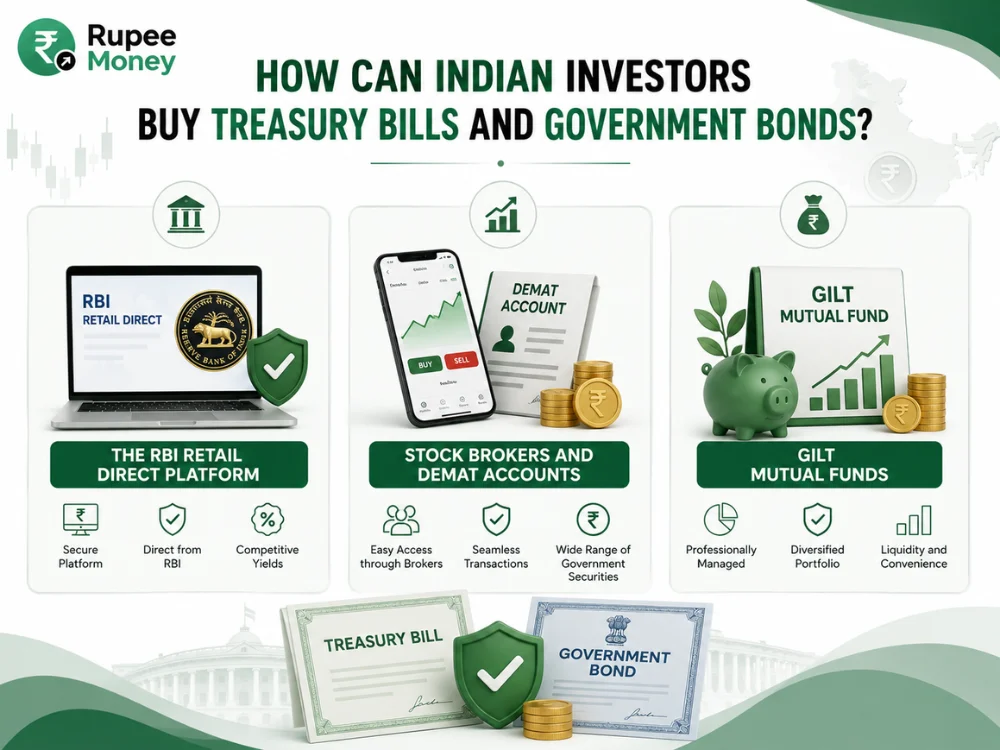
Historically, retail investors found it nearly impossible to buy government debt directly. Today, the process is entirely digitized and highly accessible.
The RBI Retail Direct Platform
The Reserve Bank of India launched the RBI Retail Direct Scheme to democratize the bond market. Retail investors can now open a Retail Direct Gilt (RDG) Account online, completely free of charge.
Through this portal, you can participate directly in primary government auctions to buy T-Bills, Government Bonds, and State Development Loans (SDLs). The minimum investment required on this platform is just ₹10,000, making it highly accessible for everyday investors.
Stock Brokers and Demat Accounts
Most modern discount brokers in India now offer a dedicated “Government Securities” or “Bonds” section on their trading apps. You can place an order using your standard trading account, and the T-Bills or Bonds will be credited directly to your existing Demat account, sitting right alongside your equity shares.
Gilt Mutual Funds
If you prefer not to manage individual bonds, track maturity dates, or navigate the secondary market, you can invest in Gilt Mutual Funds. These debt mutual funds pool money from thousands of investors and invest exclusively in government securities. While they provide professional management and high liquidity, remember that Gilt funds carry significant interest-rate risk because they constantly trade long-term bonds.
If you are evaluating systematic investment strategies, you can use our SIP Calculator to project how automated investments into mutual funds can grow over time.
Taxation of Treasury Bills and Government Bonds
Understanding how your returns are taxed is vital, as taxes directly impact your net takeaway.
In India, the returns generated from both Treasury Bills (the discount earned) and Government Bonds (the semi-annual coupon interest) are classified as “Income from Other Sources.”
This means your earnings are added to your total annual income and taxed according to your applicable income tax slab rate. If you fall into the 30% tax bracket, your bond returns will be taxed at 30%. There are currently no special tax exemptions or indexation benefits for holding direct government securities. Therefore, individuals in lower tax brackets naturally enjoy a higher post-tax yield from these instruments.
Conclusion
Treasury Bills and Government Bonds both provide retail investors with the incredible safety of lending money directly to the Government of India. However, they are engineered for distinctly different financial seasons.
Treasury Bills are the ultimate short-term parking instrument. They generate returns through a discount-to-face-value structure, mature within a year, and shield your capital from the volatile swings of national interest rates.
Government Bonds are long-term anchors. They provide a reliable, predictable stream of coupon income over many years, making them ideal for retirement planning or balancing out a high-risk equity portfolio.
The key lesson is simple: Do not chase the highest quoted yield blindly. Choose a Treasury Bill when you need your cash back soon, and select a Government Bond when you want steady income for the long haul.
FAQs
Are Treasury Bills better than Government Bonds?
Neither instrument is universally better; they simply serve different purposes. T-Bills are superior for short-term liquidity management (under 1 year) because they protect you from interest-rate fluctuations. Government Bonds are superior for locking in long-term, predictable income over a decade or more.
Do Treasury Bills pay regular interest?
No. Treasury Bills do not pay monthly, quarterly, or semi-annual interest. They are issued at a discount to their face value. Your entire profit is realized on the exact day of maturity when the government pays you the full face value.
Can I sell a Government Bond before maturity?
Yes, Government Bonds can be traded in the secondary market. However, liquidity for specific bonds can sometimes be low. More importantly, if prevailing market interest rates have risen since you bought your bond, you may have to sell it at a loss. If you hold the bond until maturity, you avoid this market risk entirely.
Are Treasury Bills completely risk-free?
T-Bills are "credit risk-free," meaning the Government of India guarantees the payment, and the chance of default is virtually zero. Because their maturity is so short, they also carry almost zero interest-rate risk. This makes them one of the safest financial assets available.
What is the minimum investment for T-Bills and Government Bonds?
If you invest directly through the RBI Retail Direct platform, the minimum investment amount for both Treasury Bills and Government Bonds is ₹10,000. Any subsequent investments must be made in exact multiples of ₹10,000.
Can beginners invest in Treasury Bills?
Absolutely. T-Bills are highly suitable for beginners who want to experience the debt market without taking on long-term commitments or market volatility. The process of buying them via demat accounts or the RBI portal is straightforward and highly secure.
T-Bills are “credit risk-free,” meaning the Government of India guarantees the payment, and the chance of default is virtually zero. Because their maturity is so short, they also carry almost zero interest-rate risk. This makes them one of the safest financial assets available.
Disclaimer: The content provided on RupeeMoney is strictly for educational and informational purposes only. We are NOT a SEBI-registered Research Analyst or Investment Adviser and do not provide buy/sell recommendations, trading advice, or personalized financial planning. Investments in the securities and debt markets are subject to market risks; read all related documents carefully before investing. Past performance of any bond, mutual fund, or government security does not guarantee future returns. Please conduct your own independent research or consult a SEBI-registered financial advisor before making any investment decisions.
ABOUT THE AUTHOR

