
How Do India’s Leading Solar Companies Make Money?

India’s solar industry has moved far beyond the simple concept of selling rooftop panels. Today, the sector is a complex financial ecosystem. Companies now generate massive revenue streams through advanced solar manufacturing, massive Engineering, Procurement, and Construction (EPC) projects, independent power generation, and long-term energy services.
This business expansion runs parallel to India’s aggressive renewable energy targets. According to the Ministry of New and Renewable Energy (MNRE), India’s cumulative solar capacity hit a remarkable 164.59 GW by July 31, 2026. This capacity is broadly divided into ground-mounted projects (122.57 GW), rooftop solar (30.74 GW), hybrid setups (4.77 GW), and off-grid solutions (6.51 GW).
Such explosive growth has paved multiple avenues for businesses to profit. A manufacturer thrives on module sales, an EPC contractor earns through project execution, and a power producer profits from selling electricity. So, how exactly does the money flow? Let’s break down the major revenue models driving giants like Adani Green Energy, Tata Power, and Waaree Energies.
How Do Solar Companies Make Money in India?
There is no single blueprint for making money in the solar sector. Because the industry value chain is so vast, the largest conglomerates often operate across multiple segments simultaneously to maximize their profit margins and reduce dependency on a single revenue source.
A typical solar enterprise can generate revenue through solar panel and cell manufacturing, executing EPC contracts, generating electricity, developing entire solar parks, or even exporting equipment internationally. Operations and maintenance (O&M) also provide a steady stream of recurring revenue.
The specific business model depends entirely on where a company positions itself. For instance, a manufacturer needs heavy capital for factories, whereas an EPC firm needs top-tier engineering talent and logistics. For investors evaluating these firms on the NSE or BSE, this distinction is vital. Two companies in the same sector can exhibit vastly different debt levels, cash flow cycles, and profit margins.
How Do Solar Panel Companies Make Money?
Solar panel manufacturers operate at the very beginning of the supply chain. Their primary revenue engine is the production and sale of photovoltaic (PV) modules. The manufacturing sequence flows from raw materials to solar cells, which are then assembled into solar modules, and finally distributed to solar developers or rooftop installers.
These companies sell their finished products to a diverse clientele, including massive utility-scale developers, commercial businesses, and international distributors. A manufacturer’s top-line revenue is dictated by its production volume, global module pricing, factory capacity utilization, and overall operational efficiency.
Solar Cell Manufacturing
Solar cells are the fundamental building blocks of the PV ecosystem. Manufacturers utilize complex processes to convert semiconductor materials (like silicon) into individual cells capable of generating electricity from sunlight. A company may consume these cells internally to build its own panels or sell them at a premium to third-party module manufacturers.
Solar Module Manufacturing
Modules are essentially multiple solar cells wired together and encased in a protective panel. Companies earn their revenue when these finished modules are shipped to EPC contractors or retail customers. However, this space is fiercely competitive. A company’s profitability is constantly tested by fluctuating raw material costs, the pace of technological upgrades, and the pricing pressure from cheap international imports.
How Do Solar Companies Make Money From EPC Projects?
EPC stands for Engineering, Procurement, and Construction. Under this model, a company acts as the master contractor, taking full responsibility for turning an empty plot of land into a fully functional solar plant. The timeline includes engineering design, buying the necessary equipment, managing civil construction, installing the grid connections, and final commissioning.
Their clients range from government utilities to private renewable energy developers. EPC companies earn their money through staggered milestone payments outlined in the project contract. Profitability here is a tightrope walk; it depends entirely on how well the company manages labor costs, logistics, and project timelines. While a massive order book signals strong future revenue, execution delays or unexpected inflation in material costs can quickly erode an EPC firm’s profit margins.
How Do Solar Companies Earn From Selling Electricity?
This model is entirely different from manufacturing or construction. Independent Power Producers (IPPs) develop, own, and operate massive solar farms. Instead of selling physical equipment, they sell the actual electricity generated by their assets.
The financial backbone of this model is the Power Purchase Agreement (PPA). A PPA is a long-term contract often spanning 20 to 25 years where a buyer (like a state electricity board) agrees to purchase power at a predetermined fixed tariff. This guarantees long-term revenue visibility, making it highly attractive for securing project financing. A smart producer will lock in a majority of its capacity under PPAs while leaving a small percentage for merchant sales, allowing it to capitalize on fluctuating open-market power prices.
How Do India’s Top Solar Companies Make Money?
India’s corporate giants rarely stick to just one lane. By diversifying their operations, they protect themselves against segment-specific downturns. Understanding these varied approaches is essential before deciding how to invest in solar energy stocks.
Adani Green Energy
Adani Green primarily operates as a renewable power producer. By developing and owning large-scale solar, wind, and hybrid assets, its revenue is generated directly from the sale of electricity. In FY2025-26, the company generated 37,567 million units of electricity, bringing in ₹11,602 crore in power supply revenue. This is a classic asset-heavy model: massive upfront capital expenditure followed by decades of steady cash flow.
Tata Power
Tata Power operates a deeply integrated model. Its portfolio spans utility-scale generation, EPC services, solar cell and module manufacturing, and residential rooftop installations. In FY2026, their operational renewable capacity hit 6,533 MW, while simultaneously producing over 3,700 MW of solar cells. This diversification allows Tata Power to capture profit margins at almost every stage of the energy transition.
Waaree Energies
Waaree is a dominant force in the manufacturing space. Operating across PV module and cell manufacturing, it leverages its massive production capabilities to drive revenue. In FY2026, Waaree reported revenue of ₹26,536.77 crore, marking incredible year-on-year growth. By building an installed manufacturing capacity of over 25.8 GW for modules, Waaree proves how lucrative a manufacturing-first approach can be when domestic demand is surging.
Top 5 Solar Companies in India and Their Revenue Models
Labeling the “top 5” companies depends entirely on what metric you use—be it market capitalization, revenue, or physical capacity. However, a comparative look at their core business structures offers much more value to potential investors:
| Company | Major Business Model | Main Revenue Source |
| Adani Green Energy | Renewable power generation | Sale of long-term electricity |
| Tata Power | Integrated (Generation, EPC, Manufacturing) | Electricity, projects, and solar products |
| Waaree Energies | Manufacturing, EPC, and project development | Solar equipment sales and EPC contracts |
| ACME Solar Holdings | Renewable power generation | Sale of electricity |
| NTPC Green Energy | Renewable power generation | Sale of renewable electricity |
Understanding this table is far more useful than simply chasing the company with the highest share price.
How Solar Companies Earn From Solar Power Projects
For solar project developers, the business is purely asset-based. The lifecycle begins with land acquisition and securing environmental approvals. Next comes the complex task of arranging debt financing, procuring tier-1 equipment, and ensuring grid connectivity.
Once the plant is live, revenue is entirely dependent on power generation. The actual electricity output is influenced by solar irradiation (sunlight quality), plant availability, and the efficiency of the panels. For instance, Adani Green reported a 24% capacity utilization factor (CUF) and 99.2% plant availability for FY2026. High operational efficiency means more units of electricity sold and higher Return on Assets (ROA) for the company.
How Solar EPC Companies Make Money
When an industrial client wants to build a 100 MW solar park, they hire an EPC contractor. The EPC firm manages the entire headache of construction—from procuring steel and modules to pouring concrete and wiring electrical systems.
The EPC firm earns its margin by completing the project below the contracted budget. While rapid industry growth leads to overflowing order books, EPC companies face severe working-capital challenges. They often have to pay suppliers and construction workers long before the client settles the final invoice. For investors, this means keeping a sharp eye on a company’s cash flow statements, not just their top-line revenue announcements.
How Solar Companies Make Money From Rooftop Solar
Rooftop solar is a decentralized, high-volume business. Companies target residential houses, schools, commercial buildings, and factory rooftops. Revenue is generated upfront through the sale of the equipment and the installation service, often supplemented by annual maintenance contracts.
Tata Power is a market leader in this space, having installed over 4.8 GWp of cumulative rooftop capacity across more than 3.7 lakh installations by FY2026. As more homeowners utilize specialized Home Loans or government subsidies to finance green energy, the rooftop segment provides solar companies with a highly scalable, retail-facing revenue stream distinct from their massive utility-scale projects.
How Solar Companies Make Money From Solar Manufacturing
Manufacturing revenue is straightforward but operationally complex. Vertically integrated manufacturers produce their own cells and modules rather than relying entirely on third-party suppliers. This allows for tighter quality control and better protection against global supply chain shocks.
Profitability in manufacturing is dictated by economies of scale. High production volumes lower the per-unit cost. However, manufacturers must constantly defend their margins against fluctuating raw material prices (like silver and polysilicon) and the pricing pressure from massive Chinese imports.
Solar Companies vs Solar Stocks: What’s the Difference?
It is crucial to understand that a company involved in solar energy is not always a “pure-play” solar stock. A prime example is Tata Power. While it is a heavyweight in the renewable sector, its total FY2026 revenue of ₹63,681 crore also includes traditional coal generation, power transmission, and municipal distribution.
If you are looking for pure solar exposure, you must read the company’s segment reporting. Look closely at exactly what percentage of their revenue comes from green energy before investing. Evaluate their stock volatility in relation to their core business operations.
Which Solar Business Model Can Be More Profitable?
There is no definitive “best” model, as each carries unique capital requirements and risks:
| Business Model | Revenue Pattern | Capital Requirement | Major Risk Factor |
| Manufacturing | Product sales | High | Global price competition |
| EPC | Project-based | Moderate | Execution delays and inflation |
| Power Generation | Long-term (25 years) | Very High | Heavy debt and interest rates |
| Rooftop Solar | Upfront installation fees | Moderate | High customer acquisition costs |
An EPC firm can post incredible numbers during an economic boom, while a power generation firm offers stable, predictable cash flows regardless of short-term market panic.
What Affects Solar Company Profits?
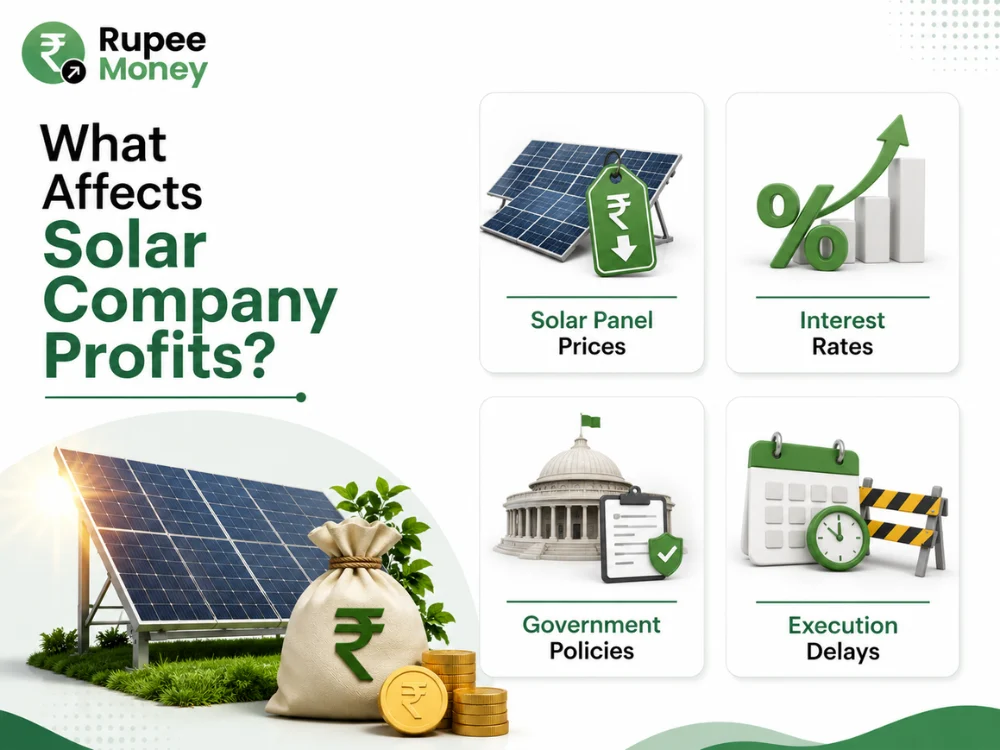
Several macroeconomic and operational factors dictate the bottom line of solar companies:
- Solar Panel Prices: Falling prices hurt manufacturers but greatly improve the profit margins of EPC contractors and power developers.
- Interest Rates: Solar parks require massive loans. If the RBI raises the Repo Rate, borrowing costs spike, squeezing profit margins for debt-heavy developers.
- Government Policies: Tariffs on imported modules, domestic manufacturing subsidies, and land-use regulations directly shape the industry landscape.
- Execution Delays: Bureaucratic red tape or supply chain delays increase construction costs and push back the date when a project can start generating revenue.
How Is India’s Solar Market Growing?
The scale of India’s solar ambition is staggering. Adding 14.33 GW of capacity in just the first four months of FY2026 highlights the sheer velocity of the sector.
This growth acts as a rising tide that lifts all boats. Manufacturers are forced to expand their factory lines, EPC companies are bidding on increasingly larger mega-parks, and rooftop installers are seeing record retail demand. As the grid modernizes, new sub-sectors like battery energy storage systems (BESS) are opening up entirely new revenue verticals for these companies.
How Can Investors Invest in Solar Energy Companies?
Retail investors have multiple pathways to capitalize on this boom.
If you understand financial statements, buying direct Solar Stocks allows you to target specific business models (like generation vs. manufacturing). If direct stock picking is too risky, you can invest in Sectoral Mutual Funds that focus on energy transition. Using a Systematic Investment Plan (SIP) in these funds allows you to build wealth steadily while maintaining strong portfolio diversification. Additionally, the recent surge in Solar IPOs offers a way to invest in companies as they hit the public markets, though investors must read the prospectus carefully rather than blindly following grey market premiums.
Are Solar Energy Stocks Profitable in India?
Yes, they can be highly profitable, provided you look at the right fundamentals. Waaree Energies reported a massive PAT (Profit After Tax) of ₹3,884.15 crore in FY2026, while Adani Green posted ₹5,399 crore in cash profit.
However, profitability is not guaranteed simply by being in a green industry. Smaller, over-leveraged companies can easily go bankrupt if they mismanage their working capital or fail to secure long-term PPAs. Profitability is a function of strong management, not just a trendy sector.
What Should Investors Check Before Buying Solar Stocks?
Before committing your capital, conduct thorough financial planning and due diligence. Look beyond the hype and verify:
- Consistent Revenue Growth: Is the company actually growing its top line year over year?
- Debt-to-Equity Ratio: Because the sector is capital intensive, ensure the company is not drowning in unmanageable debt.
- Order Book Visibility: For EPC firms, a robust, multi-year order book guarantees future cash flow.
- Cash Flow vs. Profits: A company might show accounting profits, but are they actually generating positive operational cash flow?
- Valuations: Are you paying a reasonable price for the stock relative to its earnings?
Why India’s Solar Business Could Keep Growing
India’s thirst for electricity is growing exponentially alongside its GDP. As conventional coal plants face strict environmental regulations, solar is stepping in to fill the void.
Furthermore, the business is evolving. Companies are no longer just building solar panels; they are heavily investing in round-the-clock hybrid projects (combining wind and solar), battery storage, EV charging infrastructure, and green hydrogen facilities. Tata Power’s ₹6,500 crore commitment to a new ingot and wafer manufacturing facility proves that domestic companies are preparing for decades of sustained, multi-layered growth.
Conclusion
Understanding how India’s leading solar companies make money requires looking past the shiny solar panels and diving into their core business structures. Whether a company is selling physical equipment, executing massive construction contracts, or generating gigawatts of electricity, their financial health is governed by entirely different metrics.
The industry’s macroeconomic tailwinds are undeniable, with India’s installed capacity surging past 164.59 GW. However, a rapidly growing sector does not mean every stock is a guaranteed winner. Smart investors must bypass the market hype, thoroughly analyze how a company generates its cash flow, and ensure its valuation justifies its future growth potential.
FAQs
How do solar companies make money?
They generate revenue based on their specific role in the value chain. Manufacturers sell hardware (cells/modules), EPC firms get paid to construct projects, and power developers earn by selling the electricity their plants generate.
How do solar panel companies make money?
They manufacture photovoltaic cells and modules, selling them in bulk to utility-scale developers, commercial businesses, and international distributors.
Is ACME Solar a solar company?
Yes, ACME Solar Holdings is an Independent Power Producer (IPP). Its primary business model involves developing renewable energy assets and earning revenue by selling that electricity under long-term commercial contracts.
Which solar business model is best?
There is no "best" model. Power generation offers safe, predictable, long-term revenue, while manufacturing offers rapid scaling but carries higher pricing risks. The best choice depends entirely on your investment risk tolerance.
What should investors check before buying solar stocks?
Always scrutinize the company's debt levels, order book visibility, capacity utilization, operating profit margins, and overall market valuation before investing.
There is no “best” model. Power generation offers safe, predictable, long-term revenue, while manufacturing offers rapid scaling but carries higher pricing risks. The best choice depends entirely on your investment risk tolerance.
Always scrutinize the company’s debt levels, order book visibility, capacity utilization, operating profit margins, and overall market valuation before investing.
Disclaimer: This article is strictly for educational and informational purposes and does not constitute financial or investment advice. Stock prices, corporate metrics, and sector regulations fluctuate constantly. Always conduct your own comprehensive research or consult a SEBI-registered financial advisor before making investment decisions.
ABOUT THE AUTHOR

