
IPhone Price Hike in India: Why iPhones Are Getting Expensive and iPhone vs Samsung
Buying an iPhone in India demands a heavier financial outlay in 2026. What makes the current market unusual is not just the cost of Apple’s newest releases, but a rare trend where older models are seeing steep price hikes.
Following the rollout of its latest smartphone lineup, Apple bumped up price tags across its existing portfolio. The iPhone 17, originally launched in 2025 at ₹82,900, now commands a starting price of ₹99,900 for the 256GB variant—a 20.5% increase.
This upward revision breaks a long-standing buying habit. For years, Indian shoppers relied on waiting for a new iPhone to drop, then buying the previous generation at a steep discount. Today, the exact opposite is unfolding.
The forces driving these hikes stretch far beyond Apple. A global squeeze on memory chips fueled by the artificial intelligence boom, fluctuating currency exchange rates, high import duties, and strict local taxes are squeezing the supply chain. This brings up a serious question regarding personal financial planning: Have flagship smartphones become too expensive, and will these costs push buyers toward Samsung alternatives or the refurbished market?
iPhone Prices in India: What Has Changed?
Apple’s recent price revisions have entirely rewritten its product hierarchy in the Indian market.
| iPhone Model | Earlier India Price | Current India Price | Approx. Increase |
| iPhone 17 256GB | ₹82,900 | ₹99,900 | ₹17,000 |
| iPhone 17 512GB | ₹1,02,900 | ₹1,24,900 | ₹22,000 |
| iPhone 17e | ₹64,900 | ₹79,900 | ₹15,000 |
| iPhone 16 | ₹79,900 | ₹89,900 | ₹10,000 |
| iPhone Air 256GB | ₹1,19,900 | ₹1,49,900 | ₹30,000 |
| iPhone 18 Pro | N/A | From ₹1,64,900 | Premium positioning |
India faced some of the steepest Apple price adjustments worldwide, with select models absorbing hikes as high as 41%. You can no longer rely on last year’s model to become your budget-friendly upgrade path.
Why Are iPhones Getting More Expensive in India?
There is no single culprit behind these soaring costs. It is a combination of global and local economic pressures.
1. Memory and Storage Costs Are Rising
Modern handsets demand massive amounts of NAND storage and DRAM. However, the explosion of artificial intelligence has triggered massive appetite for these exact components to power cloud servers. Mobile manufacturers are now actively bidding against AI infrastructure firms for limited factory output, pushing base costs higher.
2. The Indian Rupee Matters
Smartphone pricing is tied to foreign exchange rates. Processors, camera sensors, and specialized manufacturing equipment are priced in US dollars. When the Indian Rupee weakens, the cost to import these vital components climbs, forcing noticeable retail price hikes.
3. Taxes and Import Costs
The final retail sticker price carries the weight of strict customs duties on imported electronic components, layered with an 18% Goods and Services Tax (GST). While India has scaled up local iPhone assembly, the import tariffs on sub-components and the 18% GST ensure that Indian iPhone prices remain visibly higher than US counterparts.
4. Apple’s Own Pricing Strategy
Apple meticulously manages its brand image and profit margins. By widening the price gap between entry-level phones and its “Pro” or “Air” models, Apple actively pushes its brand further into the luxury category to protect its premium profit margins.
Why Are Older iPhones Becoming More Expensive?
Historically, when Apple unveiled a new phone, previous iterations received an official price cut. That cycle is broken. The iPhone 17 (256GB), which cost ₹82,900 at its 2025 launch, is practically touching the ₹1 lakh barrier despite being a year old.
Beyond the official MRP hikes, retail discounts are vanishing. Apple has scaled back its aggressive cashback offers and retailer-funded discounts on older models, resulting in a heavier hit to your bank account.
iPhone vs Samsung: Which Is More Affordable in India?
Apple’s steepest competition in the premium segment comes directly from Samsung’s Galaxy S series.
Current Premium Phone Price Comparison
| Model | India Starting Price | Positioning |
| iPhone 17 | ₹99,900 | Premium flagship |
| iPhone 18 Pro | ₹1,64,900 | High-end flagship |
| Samsung Galaxy S26 | ₹87,999 | Premium flagship |
| Samsung Galaxy S26+ | ₹1,19,999 | Premium flagship |
| Samsung Galaxy S26 Ultra | ₹1,39,999 | Ultra-premium flagship |
Looking strictly at the base models, the Galaxy S26 undercuts the iPhone 17 by ₹11,901. At the ultra-premium end, the Galaxy S26 Ultra is priced ₹24,901 below the iPhone 18 Pro.
A Consumer-Finance Comparison
| Factor | iPhone | Samsung Galaxy |
| Entry price | Higher | Lower for comparable flagship |
| Premium positioning | Very strong | Very strong |
| Financing | EMI and exchange offers | EMI, exchange and ownership programmes |
| Refurbished demand | Very strong | Strong |
| Resale ecosystem | Strong | Strong |
| Older-model affordability | Under pressure | Varies by model and discounts |
Both brands deploy aggressive trade-in bonuses and financing schemes. Samsung promotes its “Galaxy Forever” program in India, offering structured upgrades and assured buybacks. Buyers must evaluate the total cost of ownership over two to three years rather than just the initial checkout price.
Rising iPhone Prices Drive the Refurbished Market
As new retail prices skyrocket, the secondary market is experiencing a massive boom. Counterpoint Research shows that refurbished smartphone sales in India surged by 13% year-on-year in the first half of 2026, while brand-new smartphone shipments dropped by about 11%.
A buyer who previously budgeted ₹80,000 for a brand-new device is now buying a pristine, two-year-old flagship for half the cost. Samsung dominated the organized refurbished space in H1 2026 with a 30% market share, followed closely by Apple at 23%.
Apple’s grip on the secondary market comes down to longevity. iPhones receive software updates for years and retain their financial resale value far better than average Android devices. The iPhone 13 remains one of the most highly sought-after refurbished models in the country.
Used vs Refurbished
A used phone is typically bought directly from a previous owner through classifieds, coming as-is. A refurbished phone has been professionally inspected, cleaned, factory-tested, and repaired by a registered business, often including a limited warranty. When buying refurbished, always check battery health, screen condition, IMEI status, and the seller’s return policy.
What Does the Price Hike Mean for Consumers?
The Indian smartphone market is splitting into two distinct camps:
- Premium buyers: Shoppers with deep pockets will leverage high-value exchange bonuses and zero-cost EMIs to absorb the price shock. Apple’s overall revenue in India can still climb in 2026 due to higher margins on Pro models.
- Price-sensitive buyers: The average consumer will likely hold onto their current phone longer, downgrade to an older model, switch to a premium Android alternative, or buy from the refurbished market.
Will Smartphone Prices Keep Rising?
Several indicators suggest prices won’t drop anytime soon. Stubbornly high memory costs, relentless AI industry demand for silicon, weak local currency exchange rates, and high import taxes all push prices upward.
Building new semiconductor foundries takes years, meaning supply constraints driven by AI could keep consumer electronics prices inflated well past the current launch cycle.
What Should Consumers Do Before Buying?
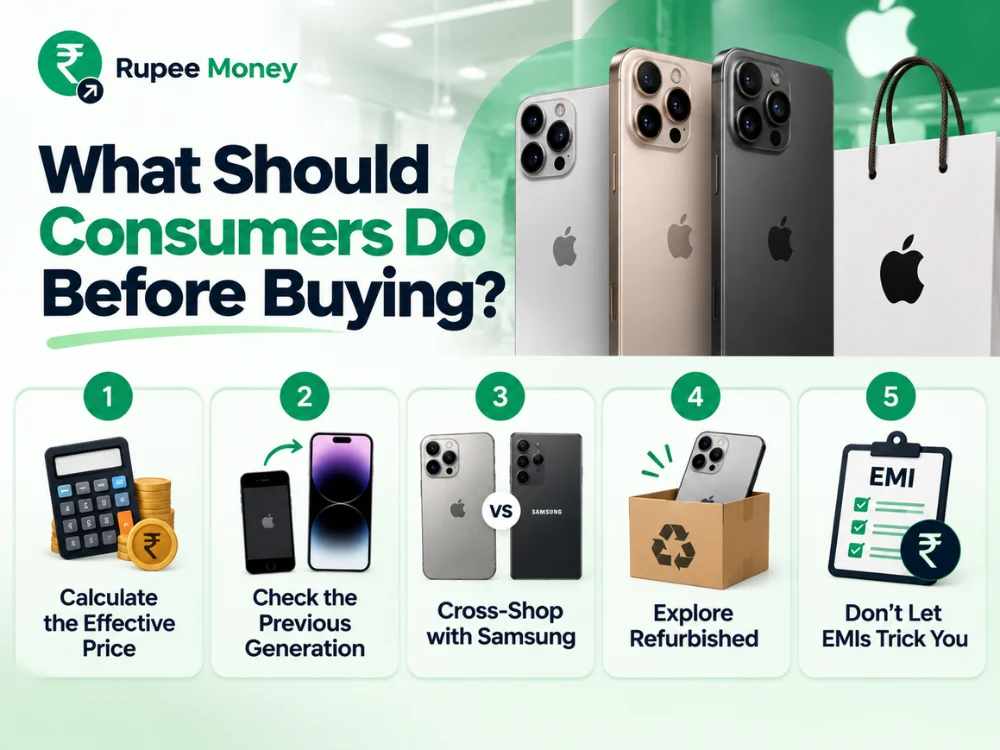
With prices touching the stratosphere, impulsive buying is a terrible idea.
- Calculate the Effective Price: Ignore the massive MRP. Calculate what you will actually pay: MRP minus your old phone’s exchange value, minus bank card cashbacks.
- Check the Previous Generation: See if a previous “Pro” model offers 90% of the features for a fraction of the cost of the newest release.
- Cross-Shop with Samsung: Physically test a Samsung Galaxy S26 alongside the iPhone 17. Buy the one that offers the best utility for your specific needs.
- Explore Refurbished: Look into certified refurbished platforms. You might find a mint-condition flagship that saves you ₹40,000.
- Don’t Let EMIs Trick You: Retailers use EMIs to make ₹1.5 lakh feel like ₹5,000 a month. Before using an EMI calculator to check your monthly outflow, ensure the device justifies the total debt.
RupeeMoney View
The 2026 iPhone price hike in India is a masterclass in inflation, supply chain economics, and consumer psychology. When the iPhone 17 leaps from an ₹82,900 launch price to ₹99,900, it permanently breaks the unspoken rule that older models automatically become cheaper.
A toxic mix of AI-driven chip shortages, currency strain, and aggressive corporate margin protection is forcing buyers to rethink upgrade cycles. The explosive growth of the secondary market – with refurbished phone sales jumping 13% – proves Indians are hunting for value. Apple’s price hikes have also handed Samsung a golden opportunity to win over frustrated buyers with aggressively priced base models in the Galaxy S26 lineup.
The smartest move is evaluating the effective cost of ownership, trade-in values, and actual daily utility. A premium phone is a great tool, but only if the price tag makes genuine financial sense for your wallet.
FAQs
Why are iPhones getting more expensive in India?
Prices are climbing due to surging global memory chip costs, massive semiconductor demand from the AI industry, a weaker Indian Rupee, high import taxes, and Apple’s strategy to maintain premium profit margins.
Why did the iPhone 17 price increase in India?
The iPhone 17 (256GB) launched at ₹82,900 in 2025 and currently sells for ₹99,900. Apple passed elevated DRAM and NAND storage costs down to the consumer, while pulling back on retailer discounts.
Is Samsung cheaper than iPhone in India?
When comparing base models, yes. The Samsung Galaxy S26 starts at ₹87,999, which is cheaper than the ₹99,900 iPhone 17. The Galaxy S26 Ultra starts at ₹1,39,999 compared to the ₹1,64,900 iPhone 18 Pro.
Are refurbished smartphones becoming popular in India?
Yes. In the first half of 2026, refurbished smartphone sales grew by 13% year-on-year, while brand-new device sales dropped by roughly 11%.
Which has a bigger refurbished market share, iPhone or Samsung?
As of H1 2026, Samsung leads the organized Indian refurbished market with a 30% share, while Apple follows closely behind at 23%.
Is AI responsible for higher smartphone prices?
Indirectly. Massive AI data centers require the same high-speed memory chips used in premium smartphones. This intense competition for chip manufacturing capacity has driven up the base cost of building a phone.
Disclaimer: This article is intended for educational and informational purposes only. It does not constitute financial, investment, or consumer-credit advice. Smartphone prices, promotional offers, exchange values, taxes, and retailer discounts are subject to change. Readers should independently verify the final retail price and financing terms with the manufacturer or an authorized seller before making a purchase.
ABOUT THE AUTHOR

