
15 Startup Loan Schemes for New Businesses by Indian Government In 2026
Starting a new business in India requires substantial capital for machinery, inventory, shop setup, employee salaries, and daily working capital. For first-time entrepreneurs, securing this funding through traditional private lenders can be incredibly challenging due to high interest rates and collateral requirements.
To solve this, the Government of India and its associated financial institutions offer multiple government loan schemes for new businesses, credit guarantees, and startup subsidies. It is crucial to understand that while some schemes provide direct loans through banks, others offer credit guarantees, interest subventions, or seed funding. If you are searching for a reliable startup loan for a new business by the Indian government, this comprehensive guide covers 15+ vital schemes, their specific purposes, their target audiences, and how you can leverage them to build your enterprise.
What Are Government Loan Schemes for New Business in India?
Government loan schemes for new businesses are specialized financial assistance programmes designed to democratize access to credit for entrepreneurs, MSMEs, DPIIT-recognised startups, artisans, women entrepreneurs, SC/ST business owners, and street vendors.
These schemes recognize how small businesses help India’s economy by driving job creation and grassroots innovation. They provide diverse types of financial support, including:
- Direct business loans and working capital finance
- Long-term machinery and term loans
- Credit-linked capital subsidies
- Credit guarantees (acting as collateral replacement)
- Seed funding for prototyping
- Interest subvention (lowering the effective interest rate)
- Technology-upgradation financial support
The ideal scheme for you depends entirely on your business model, geographical location, enterprise stage, demographic category, and precise funding requirement. A local retail shop owner might benefit most from the PM Mudra Yojana, whereas a deep-tech software startup would be better suited for Startup India funding programmes.
Who Can Get a Government Startup Loan in India?
There is no single, universal eligibility criterion for every government startup loan scheme. Because these programmes target different sectors of the economy, the eligible applicant pool varies widely.
Depending on the specific programme, eligible applicants can include:
- First-time, new entrepreneurs
- Micro, Small, and Medium Enterprises (MSMEs)
- DPIIT-recognised innovative startups
- Women entrepreneurs looking to scale operations
- SC/ST entrepreneurs starting greenfield projects
- Traditional artisans and generational craftspeople
- Street vendors and urban micro-entrepreneurs
- Food-processing and agriculture-allied enterprises
Before applying, entrepreneurs must identify the exact scheme that matches their business profile rather than blindly applying for every available government loan. Additionally, understanding what affects your loan eligibility is a crucial first step before approaching any bank or nodal agency.
15+ Startup Loan Schemes for New Business by Indian Government
1. Pradhan Mantri Mudra Yojana (PMMY)
The Pradhan Mantri Mudra Yojana (PMMY) stands out as one of the most widely utilized government-backed credit programmes for micro and small businesses in India. PMMY facilitates collateral-free loans through commercial banks, NBFCs, and microfinance institutions. The loan categories are divided into Shishu (up to ₹50,000), Kishor (up to ₹5 lakh), Tarun (up to ₹10 lakh), and the newly introduced Tarun Plus (up to ₹20 lakh). Tarun Plus is specifically reserved for borrowers who have successfully and fully repaid an earlier Tarun loan. PMMY is ideal for entrepreneurs involved in manufacturing, trading, retail services, and eligible agriculture-allied activities.
Best for: Small retail businesses, service providers, and micro-enterprises.
2. Credit Guarantee Fund Trust for Micro and Small Enterprises (CGTMSE)
It is important to note that CGTMSE is not a direct loan provider. Instead, it offers credit guarantee support to eligible lending institutions, drastically reducing the bank’s risk and helping MSEs secure collateral-free institutional credit. The current CGTMSE framework provides guarantee coverage on eligible credit facilities up to several crores, with the coverage percentage varying according to the loan size and the borrower’s category. Women entrepreneurs and enterprises located in specific geographic regions (like the North East) can receive enhanced guarantee coverage.
Best for: Micro and small enterprises seeking large collateral-free institutional credit.
3. Stand-Up India Scheme
The Stand-Up India scheme is a powerful initiative that supports greenfield (brand new) enterprises promoted exclusively by SC/ST entrepreneurs and women entrepreneurs. Under this scheme, eligible greenfield non-farm enterprises can secure loans ranging from ₹10 lakh to ₹1 crore. This scheme is particularly relevant for entrepreneurs establishing a new manufacturing unit, a scalable service business, or a large trading operation. It ensures that underrepresented demographics get the financial backing needed to enter the entrepreneurial ecosystem.
Best for: Women and SC/ST entrepreneurs starting a new, eligible greenfield enterprise.
4. Prime Minister’s Employment Generation Programme (PMEGP)
PMEGP is a highly popular credit-linked subsidy programme explicitly designed to support the establishment of new micro-enterprises while generating sustainable rural and urban employment. The scheme provides robust margin-money subsidy support. Project limits and the exact subsidy percentages depend heavily on the sector, the beneficiary’s demographic category, and the location of the business (rural vs. urban). Currently, the project limits are up to ₹50 lakh for the manufacturing sector and ₹20 lakh for the services sector, with the government subsidy generally ranging from 15% to 35% of the project cost.
Best for: Entrepreneurs setting up new micro-enterprises requiring capital subsidies.
5. Startup India Seed Fund Scheme (SISFS)
Unlike traditional MSME loans, the Startup India Seed Fund Scheme is meticulously tailored for early-stage, innovation-driven startups. It provides critical financial assistance for early-stage activities where traditional banks refuse to lend, such as proof of concept validation, prototype development, extensive product trials, initial market entry, and commercialisation. To be eligible, the startup must be recognised by the DPIIT.
Best for: DPIIT-recognised early-stage startups developing innovative, technology-driven products.
6. PM Vishwakarma Scheme
The PM Vishwakarma scheme places its focus firmly on traditional artisans, generational craftspeople, and skilled workers involved in eligible trades (like carpentry, pottery, blacksmithing, etc.). This holistic scheme combines modern skill development, advanced toolkit support, vital marketing assistance, and concessional collateral-free credit to help artisans modernize and sustainably expand their generational businesses. It acts as a major financial lifeline for the unorganized traditional sector.
Best for: Traditional artisans, independent craftspeople, and skilled trades workers.
7. Credit-Linked Capital Subsidy Scheme (CLCSS)
CLCSS operates differently from a standard working capital startup loan. It is structured to support eligible small-scale industries (SSIs) with critical technology upgradation. The scheme achieves this by providing an upfront capital subsidy linked to institutional credit, allowing businesses to purchase state-of-the-art machinery and replace obsolete technology without bearing the full financial burden. Businesses should treat CLCSS primarily as a technology-upgradation support mechanism.
Best for: Eligible MSEs looking to modernize their manufacturing technology and operational equipment.
8. SIDBI SMILE Scheme
SIDBI’s SMILE (SIDBI Make in India Soft Loan Fund for Micro Small and Medium Enterprises) initiatives are designed to aggressively support eligible MSMEs through specialized financing structures, including soft loans and long-term loans for business growth. This scheme is highly relevant when a functioning MSME requires substantial funding for capacity expansion, purchasing heavy machinery, upgrading equipment, or meeting other large-scale growth requirements under the ‘Make in India’ framework.
Best for: Eligible, functioning MSMEs requiring structured growth and modernization finance.
9. Udyogini Scheme
The Udyogini Scheme is heavily associated with providing financing support exclusively for women entrepreneurs involved in small-scale businesses, agriculture, and retail. Depending on the implementing financial institution and the specific state government’s policies, eligible women can receive highly concessional or subsidized credit support to gain financial independence. Because local implementation conditions and limits can differ, applicants must verify the current terms with their relevant government agency or participating bank.
Best for: Women entrepreneurs looking to start or expand eligible small retail and agriculture-allied businesses.
10. MSME Loan in 59 Minutes
The “MSME Loan in 59 Minutes” is best understood as a revolutionary digital lending platform rather than a standalone government loan scheme. It was developed to radically simplify access to business credit by allowing eligible MSMEs to seamlessly submit their GST, income tax, and bank statement data online. The system’s algorithms process this data to provide an in-principle loan approval decision in under an hour. The actual loan amount and whether it carries a fixed vs floating interest rate is ultimately determined and provided by the participating financial institution. Before applying, you can use an EMI Calculator to estimate your potential monthly obligations.
Best for: MSMEs looking for a rapid, digitized route to secure business credit.
11. National SC-ST Hub Scheme (NSSH)
The National SC-ST Hub supports SC/ST-owned businesses not just through financial assistance, but through comprehensive subsidies, capacity building, government procurement support, and entrepreneurship development programmes. It is specifically designed to help eligible entrepreneurs participate more effectively in lucrative public procurement (government tenders) and fundamentally strengthen their operational capacity.
Best for: SC/ST entrepreneurs and MSMEs seeking to scale through government procurement.
12. Credit Guarantee Scheme for Startups (CGSS)
The Credit Guarantee Scheme for Startups is crucial for DPIIT-recognised startups seeking heavy debt financing rather than equity dilution. The scheme provides a powerful guarantee cover to eligible lending institutions against the loans they extend to startups. The current framework has generously increased the maximum debt eligible for guarantee cover to ₹20 crore per borrower. Startups can confidently approach eligible banks and NBFCs, knowing the government backs a significant portion of the lender’s risk.
Best for: High-growth DPIIT-recognised startups looking for massive collateral-free debt funding.
13. Agriculture Infrastructure Fund (AIF)
The Agriculture Infrastructure Fund provides medium to long-term debt financing support for eligible agricultural infrastructure projects. This includes funding for post-harvest management infrastructure and community farming assets (like cold storage, warehouses, and sorting/grading units). It is highly relevant for entrepreneurs, agritech startups, and organizations developing modern infrastructure connected directly to agricultural supply chains.
Best for: Agri-entrepreneurs, post-harvest businesses, and farm-gate infrastructure developers.
14. NSIC Support for MSMEs
The National Small Industries Corporation (NSIC) provides varied forms of critical support to micro and small enterprises. This includes assistance related to raw material procurement, marketing support, technology incubation, and comprehensive business development. Because NSIC support is much broader than a conventional startup loan, entrepreneurs should explore the specific NSIC portals to match their exact operational business requirements.
Best for: Micro and small businesses needing operational, marketing, and raw material procurement support.
15. PM SVANidhi Scheme
PM SVANidhi is a special micro-credit facility designed specifically for street vendors, hawkers, and urban micro-entrepreneurs whose businesses were historically unbanked. It provides affordable working-capital support through a highly structured lending programme. To encourage the digital economy, it rewards vendors who accept digital payments—a great reason for small businesses to understand the nuances of digital finance, such as choosing between UPI or Credit Card for everyday transactions.
Best for: Street vendors, hawkers, and eligible urban micro-businesses.
16. PM Formalisation of Micro Food Processing Enterprises (PMFME)
For entrepreneurs looking to start or significantly upgrade a micro food-processing business, PMFME is an indispensable option. The official PMFME framework provides a generous 35% credit-linked capital subsidy, capped at a maximum of ₹10 lakh per eligible individual unit. Additionally, it offers financial support for creating common community infrastructure, branding, and marketing, ensuring local food businesses can compete on a larger scale.
Best for: New and existing micro food-processing enterprises.
Which Government Loan Scheme Is Best for Starting a New Business?
There is no single “best” government loan scheme for a startup business because the ideal programme depends entirely on the nature of your enterprise.
| Business Requirement | Scheme to Consider |
| Small shop or general micro business | PMMY (Mudra) |
| New manufacturing/service micro-enterprise | PMEGP |
| Woman starting a new greenfield business | Stand-Up India |
| SC/ST entrepreneur | Stand-Up India / NSSH |
| DPIIT-recognised tech/innovative startup | SISFS / CGSS |
| Traditional artisan or craft business | PM Vishwakarma |
| Food-processing business | PMFME |
| MSME needing technology/machinery upgrade | CLCSS / SIDBI SMILE |
| Agriculture/Post-harvest infrastructure | Agriculture Infrastructure Fund |
| Street vending operations | PM SVANidhi |
The most important step is to rigorously compare the basic eligibility, maximum loan amount, available subsidy percentages, repayment terms, and the complexity of the application process before committing to a scheme.
Government Startup Loan vs Government Grant: What Is the Difference?
A government loan operates like standard debt; it has to be fully repaid along with interest according to the lender’s predetermined terms and schedule.
A subsidy, on the other hand, is financial assistance that reduces a portion of the eligible project or financing cost. You do not repay the subsidized amount.
A credit guarantee does not mean the government deposits money into your bank account. Instead, it provides a safety net to the lending institution. If your business fails, the government repays a portion of the loan to the bank, which makes the bank more willing to offer you collateral-free credit in the first place.
Seed funding, like the SISFS, is intended for very early-stage startup activities (prototyping and trials) and often comes with different equity or debt terms compared to a standard bank loan. Understanding these distinct differences will prevent entrepreneurs from choosing a scheme simply because it is marketed online as a “government startup loan.”
How to Apply for a Government Startup Loan in India?
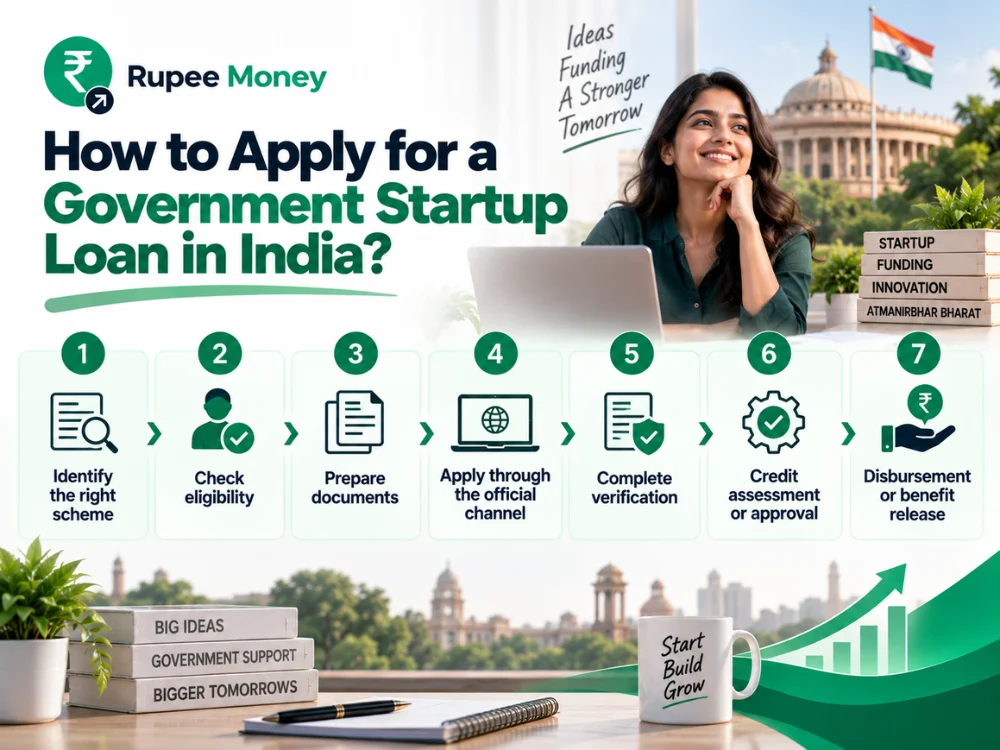
While the exact application process depends on the specific scheme, a successful application generally follows these steps:
- Identify the right scheme: Choose a programme strictly based on your business type, sector, and exact funding requirement.
- Check eligibility: Scrutinize the age, business vintage, demographic category, location, and sector restrictions.
- Prepare documents: Assemble your identity proofs, business registration documents, audited bank statements, and comprehensive project reports.
- Apply through the official channel: Submit your application via the designated government portal (like JanSamarth), or directly to the participating bank, NBFC, MFI, or implementing agency.
- Complete verification: The lender or nodal organisation will thoroughly review your application and often conduct a physical verification of your business premises.
- Credit assessment or approval: For loan schemes, the financial institution will evaluate your repayment capacity, business viability, and credit score.
- Disbursement or benefit release: Following formal approval and the signing of legal documents, the loan amount or subsidy is released to your business account.
Sound financial planning is essential during this process to ensure you are borrowing an amount your business can comfortably service. Always use official government portals and authorized financial institutions rather than paying unofficial, third-party “loan agents.”
What Documents Are Required for a Government Business Startup Loan?
While the exact documentation varies heavily by scheme and loan size, applicants should commonly prepare:
- Government-issued Identity Proof (such as PAN card and Aadhaar)
- Valid residential and commercial address proof
- Official business registration documents (Partnership deed, MoA/AoA)
- Udyam Registration certificate (highly recommended for all MSMEs)
- GST registration and recent returns (where applicable based on turnover)
- Last 6 to 12 months of business bank statements
- Income Tax Returns (ITR) or robust financial records
- A detailed project report or structured business plan
- Quotations from authorized vendors for machinery/equipment purchases
- Details of any existing personal or business loans
- Caste/Category certificate (if applying under special schemes like Stand-Up India)
- DPIIT recognition certificate (strictly for eligible startup schemes like CGSS or SISFS)
A mathematically strong and highly realistic project report is particularly critical when applying for larger business finance, as it proves to the bank that you have a viable path to profitability.
Can You Get a Government Startup Loan Without Collateral?
Yes, several government-supported schemes are specifically designed to provide collateral-free credit. However, this absolutely does not mean every applicant is guaranteed a loan.
For instance, PMMY provides collateral-free credit through participating lenders, and CGTMSE provides guarantee support for eligible MSE credit. Similarly, the Credit Guarantee Scheme for Startups (CGSS) supports lending to eligible DPIIT-recognised startups without demanding physical collateral.
Despite the lack of collateral, the lending bank will still rigorously assess the financial risk. They will deeply analyze your credit history which is why knowing how to improve your CIBIL score is so important as well as your business viability, future cash flows, repayment capacity, and the specific purpose of the loan.
Conclusion
For an ambitious entrepreneur searching for a startup loan for a new business by the Indian government, the biggest strategic mistake is hunting for one universal, guaranteed government loan.
India’s financial ecosystem boasts multiple government-backed financing options, but each one serves a highly specific economic purpose. PMMY is a lifeline for everyday micro-businesses; PMEGP provides the necessary margin money for new manufacturing micro-enterprises; Stand-Up India specifically uplifts women and SC/ST entrepreneurs; PM Vishwakarma protects traditional artisans; and Startup India schemes fuel high-growth tech startups. Furthermore, credit-guarantee (CGTMSE) and subsidy programmes make institutional financing vastly easier without functioning as direct government handouts.
Before applying, take the time to compare the eligibility criteria, maximum loan limits, subsidy benefits, repayment structures, and the exact application processes. Most importantly, ensure you borrow strictly according to your business’s actual cash flow and true repayment capacity, rather than simply maximizing the advertised loan amount. As your business grows, ensure you are simultaneously focusing on personal wealth creation; resources like building wealth in your 20s can help you secure a robust financial future alongside your enterprise.
FAQs
What is the best startup loan for a new business by the Indian government?
There is no single "best" scheme. The PM Mudra Yojana (PMMY) may suit general micro-businesses, PMEGP is excellent for manufacturing micro-enterprises seeking subsidies, and DPIIT-recognised tech startups should heavily consider the Startup India Seed Fund Scheme (SISFS).
Which government loan is available for starting a new business?
PMMY and PMEGP are two of the most accessible options for eligible new businesses. Sector-specific programmes, such as PMFME, are specifically tailored for eligible new and existing food-processing businesses.
Can I get a startup loan from the government without collateral?
Yes, several government-supported schemes (like PMMY and CGTMSE-backed loans) facilitate collateral-free credit, but final loan approval remains strictly subject to your eligibility and the commercial lender's risk assessment.
What is the maximum government startup loan?
There is no single maximum cap, as each scheme operates with different financial limits. For example, PMMY currently offers up to ₹20 lakh for eligible Tarun Plus borrowers, Stand-Up India offers up to ₹1 crore, while CGSS can support guarantee cover for eligible startup debt up to an impressive ₹20 crore per borrower.
Can a new business apply for an MSME loan from the government?
Yes, eligible new businesses can easily apply for applicable MSME schemes and credit programmes, provided they obtain their Udyam Registration and their specific business activity aligns with the scheme's core mandate.
Is a government startup loan the same as a government grant?
No. A loan is a debt instrument that generally has to be fully repaid with interest. Grants and capital subsidies operate under completely different financial conditions and usually do not require repayment.
There is no single “best” scheme. The PM Mudra Yojana (PMMY) may suit general micro-businesses, PMEGP is excellent for manufacturing micro-enterprises seeking subsidies, and DPIIT-recognised tech startups should heavily consider the Startup India Seed Fund Scheme (SISFS).
Yes, several government-supported schemes (like PMMY and CGTMSE-backed loans) facilitate collateral-free credit, but final loan approval remains strictly subject to your eligibility and the commercial lender’s risk assessment.
Yes, eligible new businesses can easily apply for applicable MSME schemes and credit programmes, provided they obtain their Udyam Registration and their specific business activity aligns with the scheme’s core mandate.
Disclaimer
This article is provided for educational and informational purposes only. Government schemes, exact eligibility criteria, loan limits, subsidy percentages, interest rates, and digital application procedures are subject to frequent updates and modifications over time. Not every scheme listed above is a direct government loan; some operate as credit guarantees, capital subsidies, seed-funding programmes, or digital lending mechanisms. Applicants are strongly advised to verify the latest eligibility conditions and terms on the relevant official government portal, implementing agency, or participating commercial lender before submitting an application.
ABOUT THE AUTHOR

