
What Happens If You Don’t Get an IPO Allotment? Reasons, Refund Process and Next Steps
Imagine applying for a popular IPO with real hopes, only to get zero shares. Many first-time investors face this exact situation. It genuinely stings, especially when an IPO draws heavy attention beforehand.
Here’s the good news, though. Missing out on an IPO allotment never means you lose your money. In most cases, your blocked amount releases automatically under the standard IPO process.
At RupeeMoney, we believe investors deserve clarity on what happens after an IPO application. Knowing the refund process, common rejection reasons, and your next steps builds real confidence. If you’re still new to IPOs generally, start with What Is an IPO? before reading further.
This guide explains everything in plain language for Indian investors.
What Does IPO Allotment Mean?
IPO allotment is the process of assigning shares to investors once the IPO closes. The company and its registrar review every application together after collection ends. If an IPO receives fewer applications than available shares, most eligible investors get full allotment. Curious how the company set that price in the first place? Read How Is an IPO Share Price Decided? for the full picture.
Popular IPOs, though, usually draw applications far higher than the shares on offer. In these oversubscribed cases, the registrar follows SEBI’s rules strictly. It runs a computerised lottery specifically for retail investors. As a result, many valid applicants may still receive zero shares.
Why You May Not Get an IPO Allotment
Several factors can keep you from receiving IPO shares. Here are the most common reasons behind non-allotment.
Oversubscribed IPO
This remains the single biggest reason for missing out entirely. When an IPO draws applications several times its available shares, demand simply outstrips supply. Say an IPO receives 50 lakh applications, but only 5 lakh investors can get shares. Many applicants miss out here, despite submitting perfectly valid applications. This scenario plays out often with genuinely popular IPOs.
Lottery System for Retail Investors
Many retail investors assume applying early boosts their chances somehow. This assumption is simply wrong. Once the IPO closes, every valid retail application gets equal consideration together. If demand exceeds available shares, the registrar runs a computerised lottery instead. This lottery randomly selects eligible investors, following strict SEBI guidelines.
Incorrect IPO Application Details
Application errors can trigger outright rejection too. Common mistakes include an incorrect PAN number or wrong Demat Account details. A mismatch between your PAN and Demat records causes real problems. So does an unlinked PAN-Aadhaar pair, an invalid UPI ID, or incomplete KYC. Submitting multiple applications from the same PAN in one category also backfires. Always double-check every detail before you submit your IPO application.
UPI Mandate Not Approved in Time
Retail investors applying through UPI must approve their payment mandate promptly. Miss that approval deadline, and your entire application turns invalid. You then won’t participate in the allotment process at all. Approve your UPI mandate the moment it arrives, ideally, since last-minute approvals fail more often than any other step.
What Happens If You Don’t Get IPO Shares?
Many beginners genuinely worry their money will vanish somehow. Fortunately, that never actually happens under the current system.
If you don’t receive an IPO allotment, your blocked amount simply releases back to you. No shares appear in your Demat Account in this case. Your bank balance becomes fully available again shortly after. You can then use that money for another investment freely.
Technically, nothing gets deducted unless shares actually land in your account. This entire process runs automatically through the ASBA system and UPI mechanism together.
How Does the IPO Refund Process Actually Work?
The IPO refund process has become genuinely faster in recent years. Investors no longer wait around for physical refund cheques anymore. Instead, banks simply unblock your application amount if shares don’t get allotted.
SEBI compressed the entire listing timeline from six working days down to three. This T+3 rule applies to every IPO opening on or after December 1, 2023. Here’s roughly how the days break down. The registrar usually finalises the Basis of Allotment on T+1. Banks then unblock funds for unsuccessful applicants around T+2. Successful applicants see shares credited to their Demat Account by T+2 or T+3. The stock finally starts trading on T+3, the fastest listing cycle SEBI has ever mandated.
Exact release timing can still vary slightly by bank. Smaller private or cooperative banks sometimes take a bit longer to process the release.
How to Check Your IPO Allotment Status
You don’t need to wait around for a message from your broker. Several official platforms let you check your allotment status directly. These include the IPO registrar’s website, run by firms like KFin Technologies, Link Intime, or Bigshare. The BSE and NSE both run dedicated IPO allotment pages too. Your stockbroker’s app and your Demat Account also show this information.
You’ll generally need your PAN number and application number handy. Your DP ID and Client ID come in useful here too. Checking your status early tells you clearly whether shares got allotted, or your funds are on their way back.
Can You Apply for Another IPO After Non-Allotment?
Yes, absolutely. No restriction stops you from applying for another IPO after missing out. Once your blocked amount becomes available again, you can redeploy it freely. Consider another IPO application, investing in mutual funds through an SIP, or buying listed shares directly.
Many experienced investors apply for multiple IPOs across the year deliberately. Allotment largely comes down to demand and pure luck in oversubscribed issues. If you’d rather diversify beyond IPOs entirely, How to Start Investing in Gold and Silver is worth reading too.
Tips to Improve Your IPO Allotment Chances
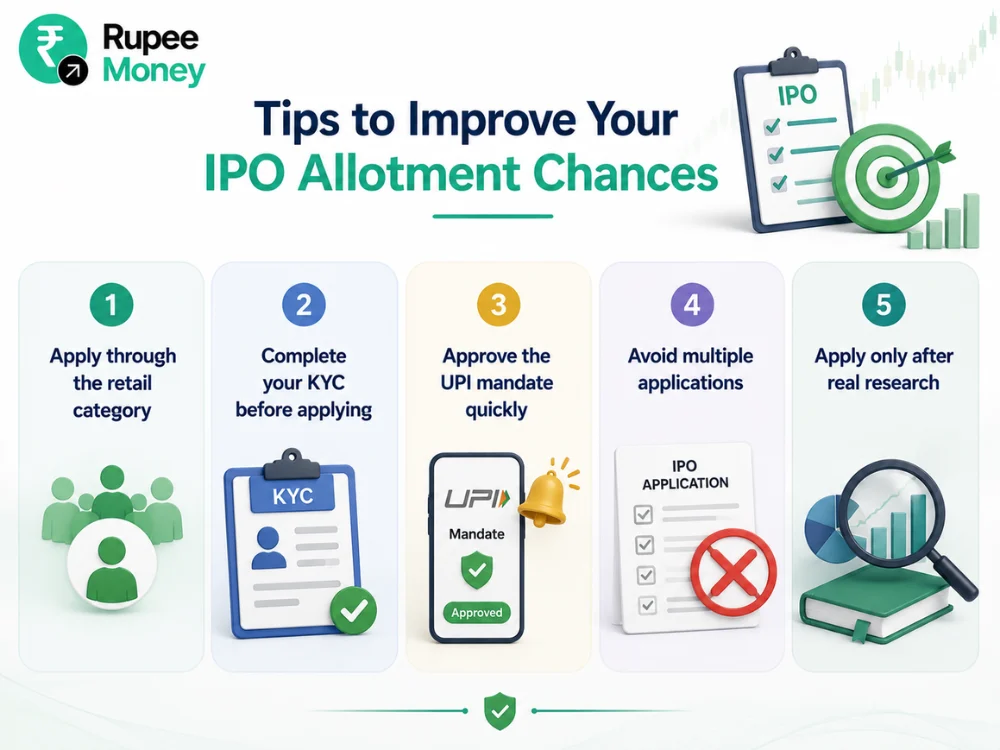
No strategy guarantees IPO allotment, honestly. A few smart practices, though, can genuinely improve your odds.
Apply through the retail category if your investment falls within that limit. Retail allotment follows SEBI’s rules, giving every eligible application equal weight in the lottery.
Complete your KYC before applying, keeping PAN, Aadhaar, bank, and Demat details all current. Correct information meaningfully cuts your rejection risk.
Approve the UPI mandate quickly the moment it lands in your app. An unapproved mandate makes your entire application invalid instantly.
Avoid multiple applications using the same PAN within one category. Registrars reject duplicate applications outright, without exception.
Apply only after real research, not because of market hype alone. Study the company’s financials, valuation, and business model before committing money. Check its Return on Assets and other fundamentals directly, rather than chasing headlines.
Common Myths About IPO Allotment
Many first-time investors believe things that simply aren’t true.
Myth 1: Applying on the first day boosts allotment chances. This is a myth entirely. Your application date doesn’t matter, as long as you apply before the IPO closes.
Myth 2: Applying through one broker gives better odds. This is incorrect too. Brokers never decide allotment outcomes. The IPO registrar follows SEBI’s prescribed process strictly.
Myth 3: Bigger demand guarantees listing profit. A heavily subscribed IPO doesn’t always deliver listing gains. Market conditions and company fundamentals still decide future performance.
Myth 4: Non-allotment means your money is lost. This is false, plain and simple. Your money stays blocked only temporarily. The bank releases it automatically if you don’t get shares.
Key Takeaways on IPO Non-Allotment
- Missing an IPO allotment is common, especially with heavily subscribed issues.
- Non-allotment never means your application actually failed.
- Oversubscription remains the single most common reason behind it.
- SEBI’s T+3 timeline means refunds and unblocking happen fast, usually by T+2.
- You can reuse the refunded money for another IPO or investment immediately.
- Complete KYC and approve your UPI mandate promptly every time.
- Research the company properly instead of chasing market excitement blindly.
Frequently Asked Questions (FAQs)
What happens if I don’t get an IPO allotment?
Your investment amount never gets deducted permanently. Under ASBA or UPI, your bank simply releases the blocked amount once allotment finishes. You won’t receive shares in your Demat Account, but your money becomes usable again quickly, following SEBI’s T+3 timeline.
How long does it take to receive an IPO refund?
Refunds happen automatically once the Basis of Allotment gets finalised, typically around T+2. Banks generally unblock funds well within SEBI’s mandated T+3 listing window. Exact timing can vary slightly by bank, but you usually regain access before the stock even starts trading.
Why do popular IPOs have low allotment chances?
Popular IPOs often draw applications many times higher than available shares. Since applicants far exceed available allotments, the registrar runs a computerised lottery for retail investors. Even a perfectly valid application can miss out purely due to high demand.
Can I apply for another IPO after not getting shares?
Yes, without any restriction whatsoever. Once your blocked amount frees up, you can apply again immediately. Many investors participate in several IPOs yearly, since allotment depends on subscription levels, not your application history.
Can incorrect details cause IPO rejection?
Yes, definitely. Incorrect PAN details, mismatched Demat information, an unlinked PAN-Aadhaar pair, incomplete KYC, duplicate applications, or a missed UPI mandate approval can all trigger rejection. Always verify every detail carefully before submitting your application.
Conclusion
Missing an IPO allotment happens to a huge number of investors, especially with popular issues. Understanding why it happens, and how the T+3 refund process actually works, removes a lot of unnecessary worry. Your money stays genuinely safe throughout, whether you receive shares or not.
Instead of feeling discouraged, use that refunded capital wisely for your next move. If you’re building a broader financial plan beyond individual IPOs, Building Wealth in Your 20s is worth reading next. Curious about post-listing rules too? The IPO lock-in period explains what happens to shares that do get allotted. Try the SIP Calculator to explore systematic investing while you wait for the next IPO opportunity, the Lumpsum Calculator to estimate how your refunded amount might grow elsewhere, or the FD Calculator if you’d rather compare a fixed deposit against market-linked options entirely.
Disclaimer: This article provides general educational information about IPO allotment and the refund process. It does not offer investment advice or recommend participating in any specific IPO. Always read the company’s Draft Red Herring Prospectus, Red Herring Prospectus, and other official documents before investing. Consult a qualified financial advisor if you need personalized investment guidance.
ABOUT THE AUTHOR

