
Sukanya Samriddhi Yojana: Eligibility, Interest Rate, Benefits & How to Open an Account

Planning for a daughter’s education, career, and future milestones becomes significantly more manageable when parents begin saving early. The Sukanya Samriddhi Yojana (SSY) is a highly popular, government-backed small savings scheme tailored specifically to secure the financial future of a girl child in India.
Launched on 22 January 2015 under the flagship Beti Bachao, Beti Padhao campaign, the Sukanya Samriddhi Yojana encourages parents and legal guardians to systematically build long-term wealth for their daughters. The scheme offers a highly attractive government-notified interest rate, powerful tax exemptions under the Income Tax Act, and a structured, disciplined long-term savings horizon.
As of September 2026, the Sukanya Samriddhi Account interest rate stands at an impressive 8.2% per annum, calculated and compounded yearly. However, because the government reviews small-savings interest rates every quarter, this rate is subject to change.
A parent or legal guardian can open a Sukanya Samriddhi Account for an eligible girl child, provided they meet the scheme’s age and documentation rules. The account requires deposits only for the first 15 years, while the account naturally matures after 21 years from the date of opening.
If you are wondering why opening a savings account for your child can be a smart financial move, this comprehensive guide breaks down everything you need to know about the Sukanya Samriddhi Yojana eligibility, current interest rate, deposit limits, maturity timeline, withdrawal rules, tax benefits, and the step-by-step process to open an SSY account today.
What Is Sukanya Samriddhi Yojana?
Sukanya Samriddhi Yojana, frequently referred to as the Sukanya Samriddhi Account (SSA), is a specialized, government-guaranteed savings scheme created explicitly for the financial empowerment of girl children in India.
The primary objective of this scheme is to motivate families to accumulate a dedicated financial corpus for major future milestones, such as:
- Higher education and university fees
- Professional or specialized education courses
- Marriage expenses
- Other long-term financial requirements of the girl child
The account is exclusively opened in the name of the girl child. However, it is actively operated by her natural or legal guardian until she reaches the age of 18, after which she can take control of the finances herself.
As part of India’s robust small savings framework, the scheme’s interest rate is governed by the Ministry of Finance. It is not permanently fixed for the entire 21-year period, meaning the returns can fluctuate based on broader economic policies.
Sukanya Samriddhi Yojana Interest Rate 2026
The current Sukanya Samriddhi Yojana interest rate for 2026 is an attractive 8.2% per annum.
Interest is calculated on the lowest balance in the account between the close of the 5th day and the end of the month, and it is compounded annually at the end of every financial year. The interest rate is notified by the Government of India and is routinely reviewed and revised on a quarterly basis.
When comparing fixed vs floating interest rate investments, it is crucial to understand that parents should not assume the 8.2% rate will remain completely unchanged for the entire 21-year duration of the account.
Sukanya Samriddhi Yojana interest rate at a glance:
| Particular | Details |
| Current interest rate | 8.2% per annum |
| Interest calculation | Yearly on minimum monthly balance |
| Compounding | Annual |
| Rate decided by | Government of India (Ministry of Finance) |
| Rate guaranteed for 21 years? | No (Subject to quarterly revisions) |
| Scheme type | Government small savings scheme |
Sukanya Samriddhi Yojana Eligibility
Understanding the Sukanya Samriddhi Yojana eligibility criteria is the first critical step before visiting a bank or post office. The scheme is designed with strict parameters to ensure the benefits reach the intended demographic.
Key eligibility conditions:
- Age Limit: The girl child must be below 10 years of age at the time of account opening. A grace period of one year is often provided, but applying early is highly recommended.
- Account Holder: The account must be opened explicitly in the name of the girl child, not the parent.
- Guardian’s Role: A natural parent or legally appointed guardian must open and operate the account on behalf of the minor.
- One Account Per Child: Only one Sukanya Samriddhi Account can be opened in the name of a single girl child across all banks and post offices in India.
- Family Limit: Normally, a family is permitted to open SSY accounts for a maximum of two girl children. (Exceptions are made in the case of twin or triplet girls born in the second birth).
- Residency: The account is strictly intended for resident Indian girl children.
- Vital Documentation: The official birth certificate of the girl child is a mandatory requirement for opening the account.
Who Can Open a Sukanya Samriddhi Account?
A natural parent (mother or father) or a court-appointed legal guardian can open the account on behalf of an eligible girl child.
It is important to remember that this is not an ordinary joint savings account. The girl child is the sole beneficiary and account holder. The guardian merely acts as the operator while she is a minor.
Once the girl reaches 18 years of age (attains majority), she can submit the prescribed KYC documentation to the bank or post office and take full operational control of her Sukanya Samriddhi Account.
Sukanya Samriddhi Yojana Minimum and Maximum Deposit
One of the greatest features of this scheme is its financial flexibility. Parents do not need to commit to massive investments to secure their daughter’s future.
- Minimum Deposit: The current rules mandate a minimum annual deposit of just ₹1,000.
- Maximum Deposit: The maximum allowable deposit is ₹1,50,000 per financial year.
- Multiples: Deposits can be made in convenient multiples of ₹100.
| Deposit Rule | Amount |
| Minimum annual deposit | ₹1,000 |
| Maximum annual deposit | ₹1,50,000 |
| Deposit frequency | Flexible (Lump sum or installments) |
| Deposit period | First 15 years from the date of account opening |
The ₹1.50 lakh annual ceiling applies to the maximum amount that qualifies for interest and tax benefits. Any accidental deposits exceeding this limit will not earn interest and will be refunded to the depositor.
Is monthly investment compulsory?
No. Monthly SIP-style investments are not mandatory. Parents can deposit funds according to their cash flow, provided the minimum annual contribution of ₹1,000 is met before March 31st each year.
How Long Do You Need to Deposit Money in Sukanya Samriddhi?
A prevalent misconception is that parents are locked into depositing money for the full 21 years. That is incorrect.
Deposits are strictly required only for the first 15 years from the date the account is opened. After the 15th year, no further deposits are required or permitted. However, the accumulated balance continues to earn compound interest at the prevailing government rates until the account fully matures at the 21-year mark.
Sukanya Samriddhi Yojana Maturity Period
The standard maturity period for a Sukanya Samriddhi Account is exactly 21 years from the date of opening.
At maturity, the entire principal balance, along with the accumulated tax-free interest, becomes fully payable to the girl child. This extensive maturity period makes the scheme highly effective when parents start saving early.
Example: If a parent opens an account when their daughter is 3 years old, they will make deposits until she is 18. The account will then sit and compound for another 6 years, finally maturing when she is 24 years old—perfectly timed for higher education or marriage.
Sukanya Samriddhi Yojana Withdrawal Rules
Recognizing that education costs cannot always wait 21 years, the government allows for partial withdrawals specifically for the girl’s higher education.
A girl can withdraw up to 50% of the balance available at the end of the preceding financial year. However, this is only permitted after she reaches the age of 18 or successfully passes her Class 10 board examinations (whichever occurs earlier).
Important withdrawal conditions:
- Maximum withdrawal is strictly capped at 50% of the eligible balance.
- The funds must be used for higher education purposes.
- Documentary proof, such as a confirmed college admission offer or an official fee structure from an educational institution, must be submitted.
- Withdrawals can be taken as a lump sum or in annual installments (up to 5 years).
Can Money Be Withdrawn for Marriage?
Yes. The scheme features a provision allowing the premature closure of the account for the girl’s marriage.
The account can be fully closed after the girl attains 18 years of age, provided the closure request is submitted no more than 1 month before or 3 months after the date of marriage. Valid age proof and marriage declarations are required.
Because of these strict rules, the SSY should never be treated as a liquid emergency fund. It is a dedicated vault for your daughter’s most critical life milestones.
Sukanya Samriddhi Yojana Tax Benefits
A massive driver of the scheme’s popularity is its unbeatable tax treatment. The SSY falls under the highly coveted “EEE” (Exempt-Exempt-Exempt) tax category:
- Investment Phase: Contributions made to the SSY account (up to ₹1.50 lakh annually) are fully eligible for tax deduction under Section 80C of the Income Tax Act.
- Accumulation Phase: The interest earned annually is completely exempt from income tax.
- Maturity Phase: The final maturity amount withdrawn by the girl child is 100% tax-free.
To optimize these tax advantages, integrate this scheme into your broader financial planning strategy. Note: Tax benefits are most relevant to those opting for the Old Tax Regime.
How Does Sukanya Samriddhi Yojana Work?
The lifecycle of an SSY account is straightforward:
Girl Child Born → Account Opened (Before Age 10) → Deposits Made for 15 Years → Interest Compounds Annually → Partial Education Withdrawal (At Age 18) → Full Tax-Free Maturity (After 21 Years)
Because it is a long-term compound interest vehicle, consistency is key. The earlier you start, the harder the interest works for your daughter’s future.
Sukanya Samriddhi Yojana Example
Assume a parent commits to depositing ₹50,000 at the start of every financial year for 15 years.
- Total Contributions: ₹50,000 × 15 years = ₹7,50,000.
- Accumulated Interest: Because the interest compounds annually, the final maturity value will be substantially higher than the invested principal.
(Note: Because the Government adjusts the SSY interest rates periodically, exact maturity calculations assuming a flat 8.2% rate are purely illustrative. Actual returns will vary based on future rate notifications).
Sukanya Samriddhi Yojana Benefits
- Sovereign Guarantee: Backed completely by the Government of India, carrying zero market risk.
- High Returns: At 8.2%, it consistently outperforms traditional bank FDs and standard savings accounts.
- EEE Tax Status: Completely tax-free across the investment, accumulation, and maturity stages.
- Dedicated Purpose: Psychologically and legally ring-fences funds specifically for the girl child.
- Financial Flexibility: Allows varied deposit amounts ranging from ₹1,000 to ₹1.50 lakh per year based on the family’s changing financial health.
Sukanya Samriddhi Yojana Disadvantages
While exceptional, the scheme does have limitations:
- Rigid Lock-in Period: The 21-year maturity period makes the funds highly illiquid.
- Deposit Cap: The ₹1.50 lakh annual limit means parents who want to invest more aggressively must look elsewhere. (For wealth building beyond this limit, learning what is a SIP (Systematic Investment Plan) in mutual funds is a great next step).
- Fluctuating Rates: The interest rate is not locked in; a declining rate environment could lower expected returns over two decades.
- Exclusive Demographics: It is strictly limited to households with a girl child under the age of 10.
How to Open a Sukanya Samriddhi Account
You can open an SSY account at any authorized commercial bank (SBI, HDFC, ICICI, etc.) or any recognized India Post office branch.
Required Documents:
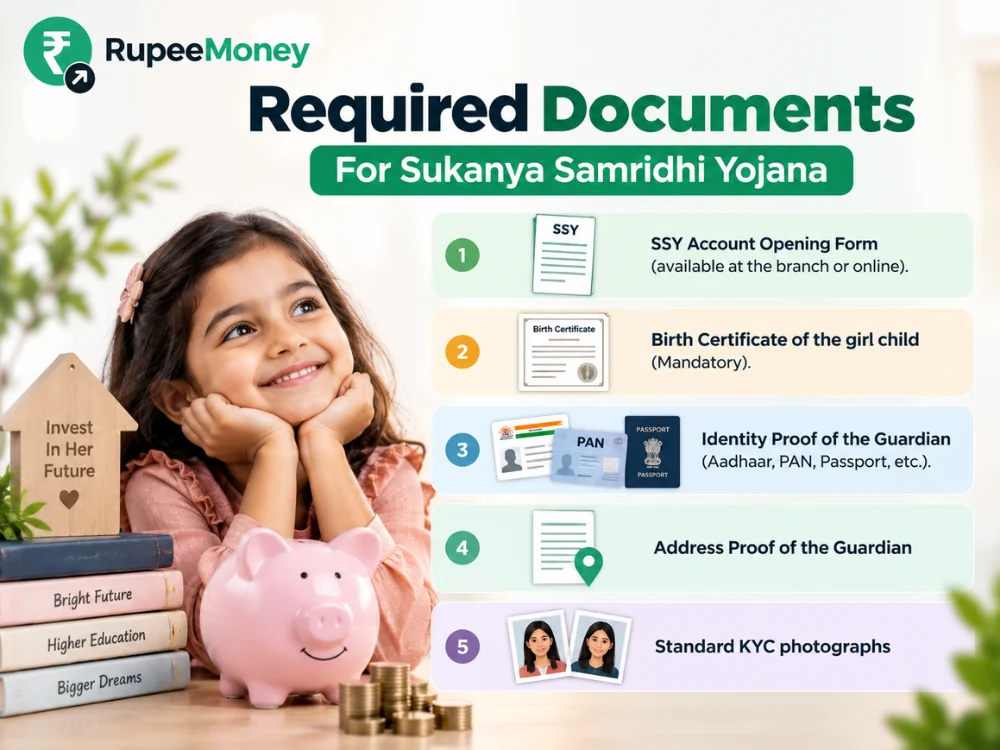
- SSY Account Opening Form (available at the branch or online).
- Birth Certificate of the girl child (Mandatory).
- Identity Proof of the Guardian (Aadhaar, PAN, Passport, etc.).
- Address Proof of the Guardian.
- Standard KYC photographs.
Step-by-step process:
- Check eligibility: Verify the child is under 10 years old.
- Choose a branch: Visit your preferred post office or authorized bank.
- Fill the form: Complete the account opening and KYC forms.
- Submit documentation: Hand over the birth certificate, Aadhaar, and PAN copies.
- Make the initial deposit: Deposit a minimum of ₹1,000 to activate the account.
- Collect your passbook: The bank will issue a dedicated SSY passbook to track your deposits and interest.
Can Sukanya Samriddhi Account Be Opened Online?
Currently, the initial account opening generally requires a physical visit to the bank or post office to verify the original birth certificate and KYC documents. However, once the account is established, it can easily be linked to your standard net banking profile.
Banks and India Post now allow seamless online deposits into active SSY accounts via NEFT, RTGS, or proprietary mobile banking apps, removing the need to visit a branch to make your annual contributions.
What Happens If the Minimum Deposit Is Not Made?
If a guardian fails to deposit the minimum ₹1,000 in a given financial year, the account is classified as a “default account.”
A defaulted account will continue to earn interest, but to regularize it, the guardian must pay a penalty of ₹50 per defaulted year, along with the minimum ₹1,000 deposit for each missed year.
Can NRIs Open a Sukanya Samriddhi Account?
No. The Sukanya Samriddhi Account is exclusively for resident Indians.
Non-Resident Indians (NRIs) cannot open this account. Furthermore, if a girl child becomes an NRI after the account is opened, the guardian must inform the bank within one month, and the account will be closed prematurely with the balance returned.
Sukanya Samriddhi Yojana vs PPF
If you are debating between the SSY and the Public Provident Fund (PPF), here is a quick comparison:
| Feature | Sukanya Samriddhi Yojana (SSY) | Public Provident Fund (PPF) |
| Target Audience | Eligible girl child (Under 10) | Any resident Indian individual |
| Current Interest Rate | 8.2% (Subject to change) | 7.1% (Subject to change) |
| Annual Max Deposit | ₹1.50 lakh | ₹1.50 lakh |
| Maturity Period | 21 years from account opening | 15 years (extendable in 5-year blocks) |
| Tax Benefit | Section 80C (EEE Status) | Section 80C (EEE Status) |
For general retirement or long-term wealth planning, you might prefer the PPF. You can project your potential returns using the RupeeMoney PPF Calculator. However, for a daughter’s education, the SSY usually offers a superior interest rate.
Sukanya Samriddhi Yojana Latest Update 2026
The SSY remains a massive success in promoting financial security for women. Recent Ministry of Finance data from early 2026 indicates that over 4.53 crore Sukanya Samriddhi accounts are actively operational, holding a staggering ₹3.33 lakh crore in deposits. The government has maintained the attractive 8.2% interest rate for the current quarter, reinforcing its commitment to the Beti Bachao, Beti Padhao initiative.
Conclusion
The Sukanya Samriddhi Yojana 2026 remains one of the safest and most rewarding long-term debt investments available to Indian parents today. By combining a sovereign guarantee with an exceptional 8.2% interest rate and an unbeatable EEE tax status, it provides an incredible foundation for a daughter’s future.
However, parents must approach this scheme with clarity regarding its liquidity. The SSY locks away your funds for up to 21 years, with strict withdrawal rules tied directly to higher education and marriage. Therefore, it should be treated as a dedicated, specialized vault within your portfolio, rather than a general-purpose savings account. Avoid banking entirely on today’s interest rate remaining static for two decades; diversify your investments, secure adequate insurance, and let the SSY serve as the safe, compounding anchor in your daughter’s financial journey.
FAQs
What is Sukanya Samriddhi Yojana?
It is a government-backed small savings scheme designed specifically to help families build a tax-free, long-term financial corpus for an eligible girl child.
What is the Sukanya Samriddhi interest rate in 2026?
The current interest rate is 8.2% per annum, compounded annually. Rates are reviewed quarterly by the government.
Who can open a Sukanya Samriddhi Account?
A natural or legally appointed guardian can open the account for a girl child who is below 10 years of age.
What are the deposit limits?
The minimum annual deposit is ₹1,000, and the maximum is ₹1.50 lakh per financial year.
Is monthly investment compulsory in Sukanya Samriddhi?
No, you can deposit money as a lump sum or in flexible installments, as long as the ₹1,000 annual minimum is met.
Can I withdraw money from Sukanya Samriddhi?
Yes. You can withdraw up to 50% of the balance for the girl's higher education once she turns 18 or passes Class 10.
Is Sukanya Samriddhi tax-free?
Yes. It enjoys "EEE" status. Deposits are tax-deductible under Section 80C, and both the interest earned and the final maturity amount are completely tax-free.
Yes. You can withdraw up to 50% of the balance for the girl’s higher education once she turns 18 or passes Class 10.
Yes. It enjoys “EEE” status. Deposits are tax-deductible under Section 80C, and both the interest earned and the final maturity amount are completely tax-free.
Disclaimer: This article is for educational and informational purposes only and does not constitute financial or tax advice. Interest rates, tax provisions, and withdrawal rules are subject to change by the Government of India. Always verify the latest rules with your authorized bank or India Post before investing.
ABOUT THE AUTHOR

