
How Do Global Markets Affect the Nifty 50?

You wake up, check the financial news, and see that Wall Street fell sharply overnight. By 9:15 AM, the Indian stock market opens, and the Nifty 50 is painted in red.
For a beginner, this is often confusing. Why does a market thousands of kilometres away dictate the opening bells of Dalal Street?
The answer lies in the deeply interconnected nature of modern financial markets. US stock performance, crude oil prices, global interest rates, the strength of the US dollar, and foreign institutional flows directly influence Indian equities.
Welcome to RupeeMoney. In this guide, we will break down exactly how international markets impact the Nifty 50, why certain sectors react differently, and what you should watch before the Indian market opens.
The Global Connection: Why the Nifty 50 Cares
The Nifty 50 index tracks the 50 largest and most liquid companies listed on the National Stock Exchange (NSE). These companies are not purely domestic. They have massive exposure to international markets through exports, imported raw materials, foreign capital, and global commodity prices.
When international markets experience sharp volatility, the ripple effect hits India through several distinct channels:
- Global investor sentiment and risk appetite
- Foreign Portfolio Investment (FPI) flows
- US Federal Reserve interest rate decisions
- Crude oil and commodity price shocks
- Currency exchange rates (USD/INR)
Let us explore exactly how each of these factors moves the Indian stock market.
How US Stock Markets Dictate Morning Sentiment
The US stock market is the ultimate financial barometer for the world. Major American indices like the S&P 500, Nasdaq, and Dow Jones close hours before the Indian market opens.
When US equities suffer a sharp decline, it creates a “risk-off” mood globally. International investors become anxious and reduce their exposure to riskier emerging markets, including India. This panic almost always causes the Nifty 50 to open with a gap-down.
Conversely, strong overnight gains on Wall Street boost global confidence, leading to a positive opening for Indian stocks. However, morning sentiment is just the beginning; the Nifty frequently changes direction later in the day based on local Indian data.
The US Federal Reserve and Global Capital
The decisions made by the US Federal Reserve (the American central bank) drastically affect Indian equities.
When the US Fed raises interest rates, safe dollar-denominated assets like US government bonds become highly attractive. Global investors naturally pull their money out of emerging markets like India and move it to the US to earn higher, risk-free returns. This capital flight puts intense selling pressure on the Nifty 50.
When US rates fall, money flows back into emerging markets, boosting Indian stocks. To understand how central banks manipulate these rates to control the economy, read our simple guide on what is the repo rate.
Crude Oil Prices: India’s Biggest Vulnerability
Crude oil is the most critical global commodity for India because the country imports over 85% of its oil requirements.
When global crude prices spike, India’s national import bill explodes. Higher oil prices immediately trigger:
- Higher transportation and logistics costs
- A widening trade deficit
- Depreciation of the Indian Rupee
- Severe inflationary pressure
Recent market action shows how fast this works. In mid-August 2026, Brent crude approached $92 a barrel due to escalating geopolitical tensions in the Middle East. Consequently, the Nifty 50 extended its losing streak as investors worried about rising corporate costs.
To dive deeper into how rising prices erode purchasing power, read our explainer on what is inflation and why does it matter.
The US Dollar vs. Indian Rupee (USD/INR)
The exchange rate between the US Dollar and the Indian Rupee is a vital link between global markets and Dalal Street.
A weaker Rupee (e.g., moving from ₹83 to ₹84 against the dollar) creates a mixed impact on the Nifty 50:
- The Winners (Exporters): Indian IT software giants and pharmaceutical companies earn revenue in dollars. A stronger dollar means their foreign earnings translate to more rupees, boosting their profits.
- The Losers (Importers): Companies that import raw materials—like FMCG, paints, and aviation companies—face higher input costs, which compresses their profit margins.
FIIs and DIIs: The Tug-of-War
Foreign Institutional Investors (FIIs) inject billions of dollars into Indian large-cap companies. Because they hold massive positions in Nifty 50 stocks, their trading behaviour moves the index heavily.
When global panic sets in, FIIs sell Indian equities aggressively to raise cash. However, India’s market structure has evolved beautifully. Today, Domestic Institutional Investors (DIIs)—fueled by retail mutual fund SIPs—often absorb this foreign selling. If you are looking to build stable wealth regardless of FII selling, consider exploring large-cap mutual funds.
GIFT Nifty: The Early Morning Indicator
If you watch business news channels at 7:30 AM, you will constantly hear about the GIFT Nifty.
GIFT Nifty is an offshore futures contract that trades before the Indian cash market opens. Global traders use it to hedge or speculate on the Nifty’s direction. If GIFT Nifty is trading 100 points lower at 8:00 AM, it is a highly reliable indicator that the actual Nifty 50 will open in the red at 9:15 AM.
Does the Nifty 50 Always Follow Global Markets?
No. While global markets dictate the opening bell and overall sentiment, they do not control India’s long-term destiny.
Indian markets frequently decouple from global cues because of incredibly strong domestic factors. A crashing US market will not keep the Nifty down for long if India reports robust GDP growth, excellent corporate earnings, and supportive RBI monetary policies.
Global Cues vs Domestic Drivers
| Market Factor | Origin | Primary Impact on Nifty 50 |
| Wall Street Performance | Global | Sets the immediate opening sentiment. |
| US Treasury Yields | Global | Dictates if foreign capital enters or leaves India. |
| Crude Oil Prices | Global | Drives domestic inflation and corporate operating costs. |
| Corporate Earnings | Domestic | Drives the actual long-term valuation of Nifty stocks. |
| Retail SIP Inflows | Domestic | Provides heavy liquidity that stops deep market crashes. |
How Indian Investors Can Track Global Market Signals
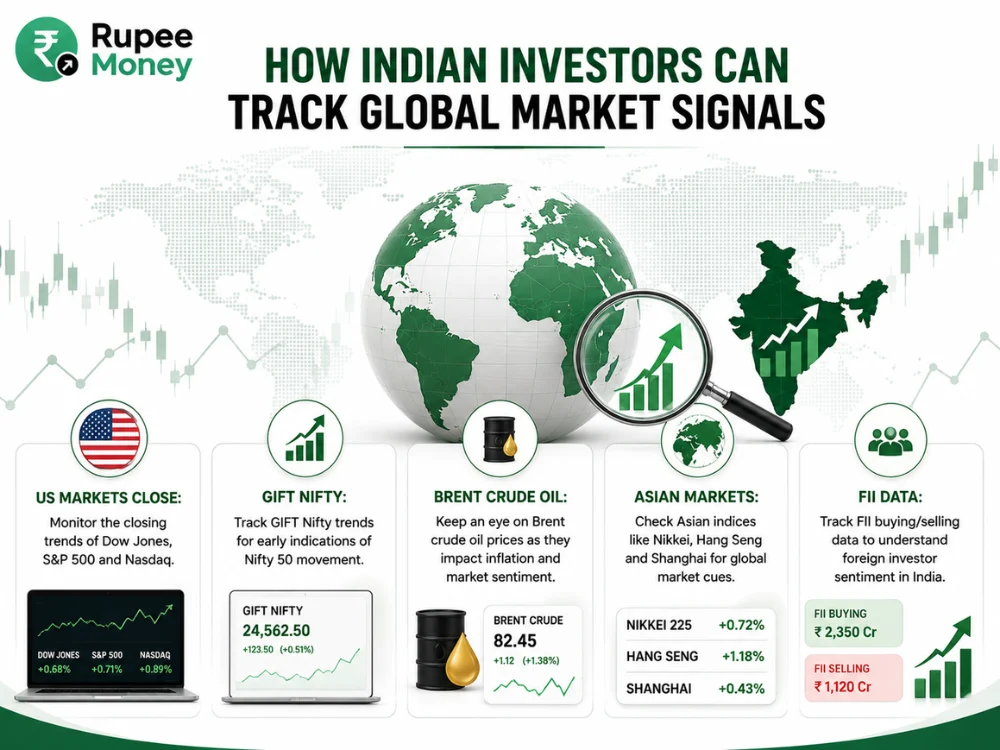
You do not need to sit in front of six screens tracking every global index. To understand how the Nifty 50 might behave today, just check these five things before 9:00 AM:
- US Markets Close: Did the S&P 500 and Nasdaq close in the green or red?
- GIFT Nifty: Is it indicating a gap-up or gap-down opening?
- Brent Crude Oil: Are oil prices spiking past dangerous levels (e.g., over $90/barrel)?
- Asian Markets: How are the Japanese (Nikkei) and Hong Kong markets performing this morning?
- FII Data: Did foreign investors buy or sell heavily in yesterday’s trading session?
Conclusion
Global markets deeply influence the Nifty 50 because the Indian financial system is tightly integrated with international capital, commodity pricing, and currency valuations. Wall Street alters daily sentiment, the US Fed dictates capital flows, and crude oil heavily influences domestic inflation.
However, the Nifty 50 is not a mere shadow of the US markets. Strong domestic earnings, robust retail SIP liquidity, and sensible RBI policies routinely override global panic. For smart retail investors, the best approach is to use global markets as a tool to understand daily volatility, while basing long-term investment decisions strictly on India’s underlying economic strength.
FAQs
Why does the Nifty 50 follow the US market?
The US has the largest financial market in the world. When Wall Street falls, global investors panic and reduce their exposure to riskier emerging markets, including India. Because US markets close just hours before Indian markets open, Dalal Street naturally reacts to the overnight American sentiment.
Does the Nasdaq specifically affect the Nifty 50?
Yes, the Nasdaq heavily influences Indian markets, specifically the IT sector. The Nasdaq is packed with global tech giants. Since Indian IT companies (like TCS and Infosys) rely heavily on US corporate tech spending, a crash in the Nasdaq usually triggers an immediate sell-off in Nifty IT stocks.
How does crude oil affect the Nifty 50?
India imports a vast majority of its crude oil. When global oil prices rise, India's import bill swells, the Rupee weakens, and inflation rises. This hurts the profit margins of manufacturing, aviation, and logistics companies, creating downward pressure on the broader Nifty 50.
What is GIFT Nifty?
GIFT Nifty is a futures contract based on the Nifty 50 index that trades in the Gujarat International Finance Tec-City (GIFT City). Because it opens hours before the regular Indian stock market, traders use it as a highly accurate early indicator of whether the Nifty 50 will open higher or lower.
Does a US market crash always cause a Nifty crash?
No. A severe US market decline causes immediate selling pressure in India, but the Nifty frequently recovers if Indian domestic conditions are strong. Robust corporate earnings and massive buying by Indian retail mutual funds can easily absorb foreign selling and help the Nifty decouple from a US crash.
Should I stop my investments when global markets fall?
No. Attempting to time the market based on global news is a poor strategy for wealth creation. Market dips driven by global panic actually allow your systematic investments to buy mutual fund units at cheaper prices. Maintain your financial discipline unless your personal financial goals have fundamentally changed.
India imports a vast majority of its crude oil. When global oil prices rise, India’s import bill swells, the Rupee weakens, and inflation rises. This hurts the profit margins of manufacturing, aviation, and logistics companies, creating downward pressure on the broader Nifty 50.
Disclaimer: The content provided on RupeeMoney is strictly for educational and informational purposes only. We are NOT a SEBI-registered Research Analyst or Investment Adviser and do not provide buy/sell recommendations, stock tips, or trading calls. Investments in the securities market are subject to market risks; read all related documents carefully before investing. Past performance and global market correlations do not guarantee future returns. Please conduct your own independent research or consult a SEBI-registered financial advisor before making any investment decisions.
ABOUT THE AUTHOR

