
Who Can Invest in Government Securities in India?
Government securities (G-Secs) often look like complex investments reserved purely for banks and massive financial institutions. However, that perception is outdated today.
Individual retail investors can now effortlessly invest in Government Securities in India. This includes buying short-term Treasury Bills, long-term dated G-Secs, and State Development Loans (SDLs) directly through the RBI Retail Direct platform.
Simultaneously, the Reserve Bank of India (RBI) allows hundreds of institutional investors to participate through structured financial channels.
Welcome to RupeeMoney. If you are wondering whether a normal individual can buy government bonds, who exactly is eligible, how much capital is required, and where to buy them, you are in the right place. Let us explore the complete landscape of government security investors in India.
Introduction to Government Securities
Government securities are official debt instruments issued by the Central Government and respective State Governments to raise capital for public infrastructure and operational needs.
For many decades, investors associated G-Secs almost exclusively with commercial banks, life insurance companies, and giant mutual funds. However, a major structural reform changed everything. Retail investors can now access these sovereign government securities directly through the RBI Retail Direct Scheme.
This revolutionary scheme allows eligible Indian individuals to open a Retail Direct Gilt (RDG) Account absolutely free of cost. Investors can use this account to buy or sell government securities through the RBI’s secure online portal.
But individual citizens are certainly not the only market participants. Commercial banks, mutual funds, insurance companies, provident funds, private trusts, and corporate bodies actively participate in the G-Sec market based on specific RBI regulations.
So, who exactly can invest in government securities today? The precise answer depends heavily on the specific type of investor and the financial route used.
Who Can Invest in Government Securities?
The Indian Government Securities market features an incredibly broad and diversified investor base. The primary categories of eligible investors include:
- Individual retail investors
- Eligible Non-Resident Indians (NRIs) under FEMA rules
- Commercial and Co-operative Banks
- Asset Management Companies (Mutual Funds)
- Insurance Companies
- Pension and Provident Funds
- Private Companies and Corporate Bodies
- Registered Trusts
- Non-Banking Financial Institutions
- Primary Dealers
- Approved Foreign Portfolio Investors (FPIs)
The exact investment limits and eligibility criteria fluctuate depending on the specific security type and the chosen investment route.
Can Individuals Invest in Government Securities?
Yes, absolutely. Individual retail investors can now directly invest in eligible government securities through the official RBI Retail Direct Scheme.
The Reserve Bank of India introduced the Retail Direct framework explicitly to grant individual citizens a direct, transparent route into the sovereign bond market. Eligible individuals can open an RDG account directly with the RBI and use it to participate in primary bond auctions or trade in the secondary market.
The Retail Direct platform currently covers highly secure sovereign instruments such as:
- Treasury Bills (T-Bills): Short-term debt instruments.
- Government of India Dated Securities: Long-term bonds paying fixed interest.
- State Development Loans (SDLs): Bonds issued by state governments.
- Sovereign Gold Bonds (SGBs): Digital gold bonds (subject to fresh issuance schedules).
Note: The availability of specific instruments depends heavily on the government’s current borrowing calendar and RBI notifications.
Who Can Open an RBI Retail Direct Account?
An individual investor generally needs the following to open an RDG account:
- An active Indian Rupee savings bank account
- A valid Permanent Account Number (PAN)
- An officially valid KYC document (Aadhaar, Passport, etc.)
- A valid email address
- A registered mobile number linked to Aadhaar
If you are exploring alternative safe investments, you might also consider comparing G-Secs with traditional Fixed Deposits.
Can NRIs Invest in Government Securities?
Yes. Eligible Non-Resident Indians (NRIs) can invest in Indian Government Securities, subject strictly to applicable foreign exchange regulations.
The RBI specifically includes eligible non-resident retail investors within the Retail Direct framework, provided their investments comply with the Foreign Exchange Management Act (FEMA) provisions.
However, NRIs must thoroughly review the applicable FEMA guidelines, as repatriation rules and taxation conditions differ significantly from those applied to resident Indian citizens.
Can Companies Invest in Government Securities?
Yes. Private companies and corporate bodies actively participate in the massive Government Securities market.
The RBI’s framework for non-competitive bidding explicitly includes firms, private companies, corporate bodies, and registered institutions among eligible participants.
Corporate treasuries frequently utilize Government Securities for strategic financial purposes, including:
- Managing idle surplus cash safely
- Maintaining strict corporate liquidity
- Diversifying corporate investment portfolios safely
- Meeting mandatory regulatory capital requirements
The investment route and maximum capital limits depend strictly on the institution’s legal structure and the specific security being auctioned.
Can Banks Invest in Government Securities?
Commercial banks rank among the absolute largest participants in India’s G-Sec market.
Banks aggressively buy and hold government securities as a massive part of their core investment portfolios. More importantly, banks purchase these sovereign bonds to satisfy mandatory regulatory requirements, such as the Statutory Liquidity Ratio (SLR) mandated by the RBI.
Banks actively participate in Government Securities auctions primarily through competitive bidding. Unlike retail investors who accept the average auction price (non-competitive bidding), massive institutional investors submit bids dictating the exact price or yield they are willing to accept.
Can Mutual Funds Invest in Government Securities?
Yes, mutual funds invest heavily in Government Securities according to their specific scheme mandates and SEBI regulations.
Debt Mutual Funds (specifically Gilt Funds) aggressively invest in long-term government bonds and short-term Treasury Bills. This structure provides retail investors with an indirect, professionally managed route to gain exposure to government debt without purchasing the underlying bonds themselves.
However, investing through a mutual fund operates differently from holding a G-Sec directly via Retail Direct. In a mutual fund, you own units of the scheme, not the actual sovereign bond. If you want to understand mutual fund classifications better, read our guide on Large-Cap Mutual Funds.
Can Insurance Companies and Pension Funds Invest?
Yes. Life insurance companies and massive pension funds represent a critical institutional pillar in the Government Securities market.
Because these institutions manage long-term public liabilities (like paying out pensions 20 years from now), they desperately need incredibly safe, long-term assets to match those liabilities. Government debt fits this requirement perfectly.
Furthermore, the RBI’s non-competitive bidding framework specifically permits recognized provident funds to participate seamlessly alongside other eligible investors.
Can Trusts Invest in Government Securities?
Yes. Private and charitable trusts can participate in Government Securities, subject strictly to their internal trust deeds and specific investment mandates.
The RBI specifically lists registered trusts among the eligible entities permitted to use the non-competitive bidding framework. This makes G-Secs highly relevant for conservative trusts seeking incredibly stable, sovereign-backed debt investments.
What Government Securities Can Retail Investors Buy?
Through the RBI Retail Direct platform, retail investors can access four primary categories of sovereign debt:
Treasury Bills (T-Bills)
Treasury Bills are short-term debt instruments issued exclusively by the Government of India. They carry short maturities (91 days, 182 days, or 364 days) and never pay periodic interest. Instead, you buy them at a discount to their face value and receive the full face value upon maturity. The difference represents your profit.
Government Dated Securities (G-Secs)
These are long-term Government of India bonds carrying maturities stretching from 5 to 40 years. They pay a fixed, predetermined interest rate (called a coupon) at specified half-yearly intervals and return the principal amount entirely upon maturity.
State Development Loans (SDLs)
State Governments issue SDLs to raise funds for regional infrastructure and development. Retail investors can seamlessly access eligible SDLs through the Retail Direct platform, often enjoying a slightly higher yield compared to central government bonds.
Sovereign Gold Bonds (SGBs)
SGBs are unique government securities directly linked to the market price of 24-karat physical gold. They pay an additional fixed interest rate annually. However, SGB availability depends entirely on periodic Government issuance notifications. You cannot buy fresh SGBs from the RBI unless a specific series is currently open.
What Is the Minimum Investment in Government Securities?
The required minimum investment makes G-Secs incredibly accessible for normal citizens.
Under the RBI Retail Direct framework, the minimum investment amount is officially set at ₹10,000 for Treasury Bills, dated Government Securities, and State Development Loans. Any subsequent investments must be made in exact multiples of ₹10,000.
This low entry barrier ensures that Government Securities are accessible even to retail investors who cannot commit massive institutional capital.
Where Can Individuals Buy Government Securities?
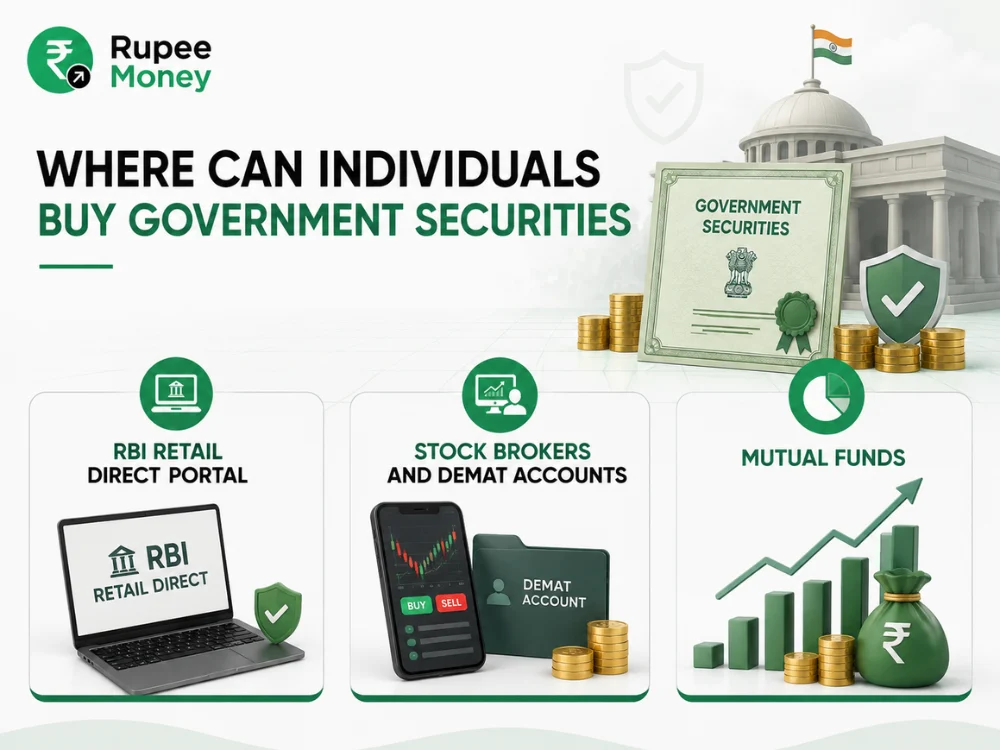
Individual investors can purchase G-Secs through a few primary channels:
RBI Retail Direct Portal
This remains the most direct, cost-free route. Investors can participate directly in primary RBI auctions and trade existing bonds in the secondary market without paying heavy brokerage fees.
Stock Brokers and Demat Accounts
Many modern discount brokers allow retail investors to bid for G-Secs and T-Bills directly through their trading applications. These securities are then credited directly into your existing Demat account alongside your equity shares.
Mutual Funds
Investors who prefer professional management can simply buy units in Gilt Mutual Funds, which invest exclusively in government securities on behalf of thousands of retail investors.
To understand how to manage investment capital systematically, explore our SIP Calculator.
Can Beginners Invest in Government Securities?
Yes. You absolutely do not need to be a professional bond trader to invest in Government Securities. However, absolute beginners must understand a few critical financial concepts before deploying capital:
- Maturity Date: The exact date the government repays your principal amount.
- Coupon Rate: The fixed interest percentage the bond pays annually.
- Yield: The actual return an investor earns if they buy the bond at the current market price and hold it until maturity.
- Interest-Rate Risk: The reality that bond market prices fall when broader economic interest rates rise.
- Liquidity: How easily you can sell the bond in the secondary market before it matures.
While sovereign bonds carry virtually zero default risk (the government will not default on its own currency), their secondary market prices absolutely fluctuate. If you sell a 10-year bond after just two years, you may face a capital loss if prevailing interest rates have risen. To understand broader economic forces, read our guide on what makes the stock market go up or down.
Government Securities vs. Bank Fixed Deposits (FDs)
Beginners frequently compare Government Securities directly with Bank FDs. While both offer fixed income, they function very differently.
| Feature | Government Securities (G-Secs) | Bank Fixed Deposits (FDs) |
| Issuer | Central or State Government | Commercial Banks |
| Credit Risk | Extremely Low (Sovereign Guarantee) | Low (Subject to DICGC insurance limits) |
| Maturity Profile | Can extend up to 40 years | Usually capped at 10 years |
| Secondary Market Trading | Yes, eligible bonds can be traded | No, cannot be traded |
| Interest-Rate Risk | Yes, if sold before maturity | No, principal is fixed |
| Direct RBI Access | Yes, via RBI Retail Direct | No |
Choosing between the two depends entirely on your investment horizon, taxation bracket, and need for mid-term liquidity.
Who Should Consider Government Securities?
Government Securities provide excellent portfolio stability. They are highly suitable for investors who:
- Demand absolute safety of principal capital (Zero default risk).
- Require predictable, fixed cash flows through half-yearly coupon payments.
- Have clear medium-to-long-term investment horizons (5 to 30 years).
- Want to diversify and stabilize an aggressive, equity-heavy portfolio.
- Understand the mechanics of interest-rate movements and bond pricing.
However, retail investors should select specific bonds based on their exact maturity needs rather than blindly chasing the highest available yield.
What Are the Risks of Government Securities?
While sovereign bonds carry zero credit risk, investors still face several market-related risks.
Interest Rate Risk
Bond prices inherently move inversely to market interest rates. If the RBI raises national interest rates, newly issued bonds will offer higher yields. Consequently, the market price of older, lower-yielding fixed-rate bonds will fall.
Liquidity Risk
While primary issuance is smooth, secondary market liquidity for specific G-Secs can be extremely low. If you urgently need to sell a 30-year bond after three years, you might struggle to find a buyer at a fair market price.
Reinvestment Risk
When a bond pays its half-yearly interest, you might have to reinvest that cash at a significantly lower prevailing market rate, dragging down your overall compounding speed.
Inflation Risk
Because G-Secs pay a fixed nominal return, aggressive inflation can quietly destroy your actual purchasing power over a 15-year period. Learn why inflation matters to understand how this erodes fixed-income wealth.
Government Securities Investor Eligibility at a Glance
The table below provides a high-level summary of eligible market participants.
| Investor Category | Eligible to Invest? | Typical Market Route |
| Resident Individuals | Yes | RBI Retail Direct, Demat Brokers, Mutual Funds |
| Eligible NRIs | Yes (Subject to FEMA) | Authorized Banking Channels / Retail Direct |
| Commercial Banks | Yes | Competitive Bidding / Institutional Market |
| Mutual Funds | Yes | Institutional Market |
| Insurance Companies | Yes | Institutional Market |
| Provident & Pension Funds | Yes | Non-Competitive / Institutional Framework |
| Private Companies | Yes | Non-Competitive Bidding |
| Registered Trusts | Yes | Non-Competitive Bidding |
| Foreign Portfolio Investors | Yes (Subject to FPI limits) | Permitted Institutional Routes |
Conclusion
Government Securities are absolutely no longer restricted to mega-banks and giant financial institutions. Today, individual retail investors, eligible NRIs, private companies, trusts, provident funds, and mutual funds can participate actively across various structured routes.
For retail investors, the revolutionary RBI Retail Direct Scheme has democratized the sovereign debt market. By opening a free RDG account, you can securely invest in Treasury Bills, dated Government Securities, and State Development Loans with just ₹10,000.
The key takeaway is simple: You do not need to be an institutional heavyweight to buy government debt. What truly matters is understanding interest-rate dynamics, meeting the basic KYC requirements, and choosing a specific security that aligns perfectly with your financial goals and maturity horizon.
If you are planning a lump sum allocation into fixed-income or equity assets, you can estimate future portfolio growth using our free Lumpsum Calculator.
FAQs
Can a normal person invest in Government Securities?
Yes. Any normal individual retail investor can invest directly in government bonds through the RBI Retail Direct Scheme, provided they meet standard KYC requirements and hold an active Indian savings bank account.
What is the minimum amount to invest in Government Securities?
Through the RBI Retail Direct platform, the minimum investment requirement for Treasury Bills, dated Government Securities, and State Development Loans is officially set at ₹10,000. Further investments must be made in multiples of ₹10,000.
Can NRIs buy Government Securities in India?
Yes, eligible Non-Resident Indians (NRIs) can invest in Government Securities through permitted routes. However, all investments must strictly comply with the applicable Foreign Exchange Management Act (FEMA) regulations regarding repatriation and taxation.
Can private companies buy Government Bonds?
Yes. Private companies and corporate bodies can participate heavily in the Government Securities market. They generally utilize the RBI's non-competitive bidding framework to deploy surplus corporate cash safely.
Can mutual funds invest in Government Securities?
Yes. Debt mutual funds (specifically Gilt Funds) invest heavily in sovereign bonds according to their SEBI-approved investment mandates. Buying a Gilt fund is the easiest way for beginners to gain indirect exposure to government debt.
Are Government Securities completely risk-free?
No financial asset is entirely risk-free. While Indian Government Securities carry virtually zero "default risk" (sovereign guarantee), they carry significant "interest-rate risk." If you sell a bond in the secondary market before its maturity date, its price will fluctuate based on prevailing economic interest rates, potentially leading to a capital loss.
Can I buy Government Securities directly from the RBI?
Yes. By opening a free Retail Direct Gilt (RDG) account on the official RBI Retail Direct portal, eligible retail investors can bid directly in primary sovereign bond auctions without paying any intermediary brokerage fees.
Yes. Private companies and corporate bodies can participate heavily in the Government Securities market. They generally utilize the RBI’s non-competitive bidding framework to deploy surplus corporate cash safely.
No financial asset is entirely risk-free. While Indian Government Securities carry virtually zero “default risk” (sovereign guarantee), they carry significant “interest-rate risk.” If you sell a bond in the secondary market before its maturity date, its price will fluctuate based on prevailing economic interest rates, potentially leading to a capital loss.
Disclaimer: The content provided on RupeeMoney is strictly for educational and informational purposes only. We are NOT a SEBI-registered Research Analyst or Investment Adviser and do not provide buy/sell recommendations, stock tips, or trading advice. Investments in the securities market are subject to market risks; read all related documents carefully before investing. Past performance of any bond or security does not guarantee future returns. Please conduct your own independent research or consult a SEBI-registered financial advisor before making any investment decisions.
ABOUT THE AUTHOR

