
Futures vs Options Trading: What’s the Difference
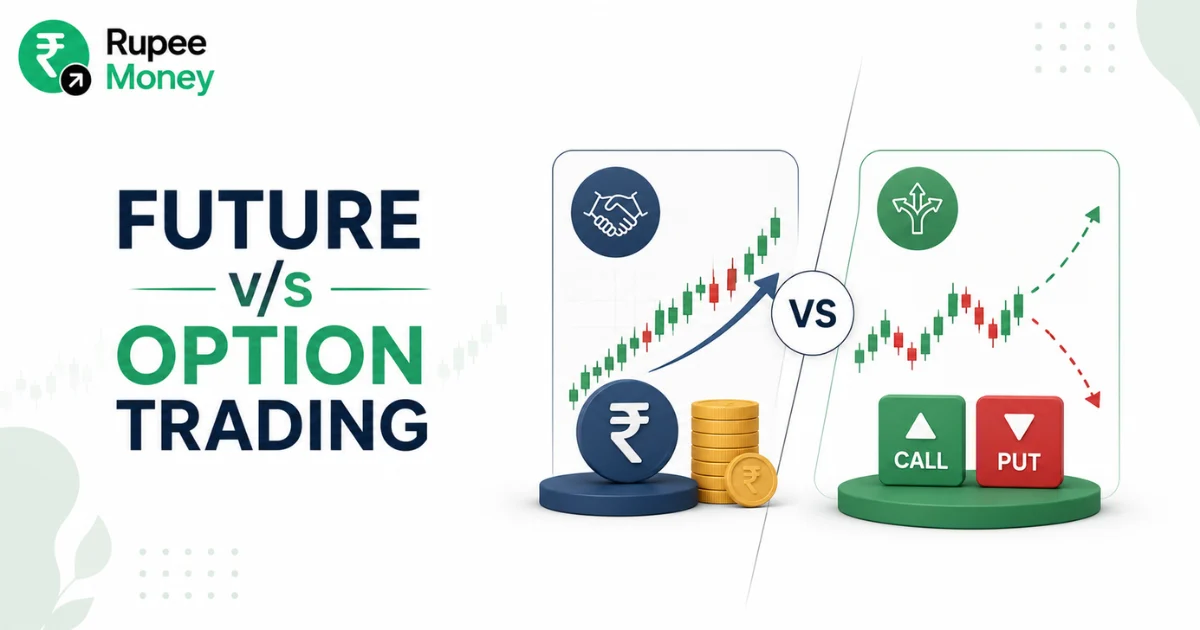
A lot of people discover the stock market after hearing traders talk about Futures and Options Trading. These instruments have picked up real popularity since they let you benefit from market movements without directly buying shares. But beginners often struggle to tell the two apart.
Futures and Options both sit in the Derivatives market, yet they work quite differently — different risk levels, capital requirements, and trading strategies. Getting these differences straight matters before you step into the derivatives segment on the National Stock Exchange (NSE) or the Bombay Stock Exchange (BSE).
At RupeeMoney, we think every investor should understand the basics before trading derivatives. This guide breaks down how Futures and Options work, compares their features side by side, and helps you figure out which fits your financial goals and risk appetite.
What Are Derivatives?
Before you can understand Futures and Options, it helps to know what a derivative actually is.
A derivative is a financial contract whose value depends on the price of another asset — commonly shares, stock market indices, commodities, currencies, or bonds. Instead of buying the actual asset, you buy or sell a contract based on how you expect its price to move.
Derivatives help traders hedge risk, speculate on price movements, and manage their portfolios more actively. But they also carry higher risk, since even small price changes can significantly swing your profits and losses.
What Is Futures Trading?
Futures Trading involves a contract obligating both buyer and seller to complete a transaction at a fixed price on a specific expiry date. Once you enter a futures contract, both sides must honour it unless they close the position before it expires.
Say you expect a company’s share price to rise — you buy a futures contract. If the market moves your way, you profit; if it moves against you, you take a loss.
Since futures contracts create a binding obligation, you typically maintain a margin account with your broker instead of paying the entire contract value upfront.
What Is Options Trading?
Options Trading gives you, as the buyer, the right but not the obligation to buy or sell an underlying asset before or on the expiry date. Unlike futures, you can simply skip exercising the contract if the trade doesn’t go your way.
To get that right, you pay a premium to the option seller. This limited obligation is what sets options apart: if the trade doesn’t move as expected, you generally lose only the premium paid, while the option seller can face much higher risk depending on their position.
Because of this flexibility, many traders lean toward options for managing risk and running different strategies.
Call Option vs Put Option
Options split into two broad categories.
What Is a Call Option?
A Call Option gives you the right to buy the underlying asset at a fixed price before expiry. Traders typically buy call options when they expect prices to rise, if the price climbs above the agreed level, you may benefit from the difference after accounting for the premium you paid.
What Is a Put Option?
A Put Option gives you the right to sell the underlying asset at a fixed price before expiry. Traders generally buy puts when they expect prices to fall. If prices do drop as expected, the option’s value may rise, letting you benefit from that downward move.
Futures vs Options: Key Differences
Both instruments sit in the derivatives market, but they diverge in several important ways.
| Feature | Futures | Options |
| Contract Type | Obligation to buy or sell | Right, but not obligation |
| Upfront Cost | Margin required | Premium paid by buyer |
| Risk for Buyer | Potentially unlimited | Limited to premium paid |
| Risk for Seller | High | Can also be significant |
| Flexibility | Lower | Higher |
| Best Suited For | Experienced traders, hedging | Hedging, income strategies, directional trading |
| Expiry | Mandatory settlement or closure | Buyer decides whether to exercise |
| Capital Requirement | Generally higher | Usually lower for buyers |
Knowing these differences helps you pick the instrument that actually matches your strategy and risk tolerance. If you’d rather explore other ways to participate in the stock market first, our guide on unlisted shares covers a very different, less leveraged approach.
Important Terms in Futures and Options Trading
A handful of key terms make Futures and Options much easier to follow:
- Premium: the price you pay as an option buyer to purchase the contract essentially the cost of acquiring your right to buy or sell.
- Margin account: lets you deposit just a portion of the total contract value when trading futures and certain options positions; your broker blocks the required margin based on exchange rules and market risk.
- Expiry date: the final date a futures or options contract stays valid, after which it expires or settles per the exchange’s rules.
- Time decay: mainly affects options as expiry approaches, an option’s time value gradually shrinks, even if the underlying asset’s price stays flat. This effect gets sharper in the final days before expiry.
- Liquidity: how easily you can buy or sell a contract without causing a major price shift; higher liquidity usually means better execution and tighter bid-ask spreads.
Where Can You Trade Futures and Options?
Futures and Options trade on recognised exchanges around the world.
- National Stock Exchange (NSE): India’s largest derivatives exchange by trading activity, offering contracts on stocks, indices, and several other instruments.
- Bombay Stock Exchange (BSE): also offers a platform for trading derivatives, including index and stock-based contracts.
- New York Stock Exchange (NYSE): one of the world’s largest exchanges, primarily known for equities, though derivatives linked to listed securities trade through associated markets.
- NASDAQ: a major global exchange listing many technology companies, whose price movements often shape global market sentiment.
Why Traders Choose Futures or Options
Both instruments serve different purposes across the financial markets:
- Hedging market risk: businesses and investors use them to soften the impact of unfavourable price moves in stocks, indices, and commodities.
- Portfolio diversification: some investors use derivatives as part of a broader strategy to manage overall portfolio risk.
- Market opportunities: both instruments let you participate in rising and falling markets through different strategies.
- Flexible strategies: options offer several combinations using calls and puts, while futures give you a more direct way to take bullish or bearish positions.
- Better liquidity: heavily traded futures and options contracts generally offer stronger liquidity, making it easier to enter and exit positions.
If you’d like to study a company’s fundamentals before trading its derivatives, our explainer on Return on Assets (ROA) is a useful starting point.
Futures vs Options: Which Is Better for Beginners?
There’s no single right answer; it depends on your financial goals, trading experience, and risk tolerance.
Many beginners find options easier to grasp, since buying one caps your maximum loss at the premium paid. That said, options trading still demands understanding time decay, implied volatility, and contract pricing.
Futures, on the other hand, involve a contractual obligation to buy or sell the underlying asset. Since you trade through a margin account, even small market moves can lead to bigger gains or losses making futures better suited to experienced traders who understand leverage and market risk.
Before picking either instrument, learn how derivatives actually work, practise with small positions, and never trade without a clear strategy. If active derivatives trading feels too intense right now, our guide on building wealth in your 20s lays out a steadier path you can build alongside your learning.
Advantages of Futures Trading
Futures contracts offer real benefits for traders and businesses managing risk or speculating on price movements:
- Simple contract structure: buyers and sellers agree to trade the asset at a fixed price on the expiry date, with no added complexity.
- High liquidity: popular contracts attract heavy trading activity, helping you enter and exit efficiently.
- Hedging opportunities: businesses and investors use futures to reduce the impact of price swings in shares, indices, and commodities.
- Market exposure through margin: a margin account lets you participate in larger contracts without paying the full value upfront — improving capital efficiency, though it also raises risk.
Advantages of Options Trading
Options offer greater flexibility since buyers get the right, not the obligation, to execute the contract:
- Limited risk for buyers: you generally risk only the premium paid if the trade doesn’t move your way.
- Flexible strategies: you can combine calls and puts to build strategies suited to different market conditions.
- Portfolio protection: many investors use options to cushion their portfolios against adverse market moves.
- Lower initial capital: buying options usually needs less upfront capital than a futures contract, since you’re only paying the premium.
Risks of Futures and Options Trading
Derivatives open up real opportunities, but they carry real risks too:
- Market volatility: rapid price swings can create substantial gains or losses in a short window.
- Leverage risk: trading through a margin account amplifies both profits and losses, so understand leverage thoroughly before entering any position.
- Time decay in options: an option’s value gradually erodes as expiry nears, so buyers need to factor this into their planning.
- Complexity: options strategies often juggle multiple variables, making them more complex than straightforward delivery-based investing.
- Emotional trading: fear and greed can cloud judgment sticking to a disciplined trading plan helps keep emotional decisions in check.
Futures and Options in Commodities
Derivatives aren’t limited to shares and stock indices; traders also use Futures and Options to participate in the commodities market, covering assets like gold, silver, crude oil, natural gas, copper, and various agricultural commodities.
Businesses use commodity derivatives to manage price fluctuations, while traders use them to profit from changing prices. Understanding the underlying commodity and current market conditions matters a lot before trading these contracts. If commodities interest you, our guides on how commodities and inflation are connected and how crude oil prices influence natural gas rates dig deeper into what moves these markets.
Where India’s Derivatives Market Is Headed
India’s derivatives market keeps evolving, with growing retail participation and stronger regulatory oversight. The NSE and BSE regularly roll out operational improvements to boost market efficiency and investor protection.
SEBI continues strengthening risk management measures, improving transparency, and encouraging responsible participation in the derivatives segment. Stay updated on the latest exchange circulars, margin requirements, and regulatory guidelines before you trade Futures or Options.
Key Takeaways
- Futures and Options are financial derivatives based on underlying assets.
- Futures create a contractual obligation, while options give buyers a right without obligation.
- A call option benefits from rising prices; a put option benefits from falling prices.
- Premium, margin account, expiry date, liquidity, and time decay are core concepts to know.
- Futures generally carry higher risk because of leverage and contractual obligations.
- Beginners should understand derivatives thoroughly before entering the market.
Frequently Asked Questions (FAQs)
What’s the difference between Futures and Options?
The main difference is the contractual obligation. A futures contract requires both parties to honour the agreement unless they close early. An options contract gives the buyer the right, not the obligation, to buy or sell. This shapes risk and capital needs — futures carry higher risk since you must honour the contract, while option buyers cap their loss at the premium paid.
Which is better for beginners: Futures or Options?
Many beginners start with options since buying one caps the maximum loss at the premium paid. Still, options trading requires understanding time decay, pricing, and volatility. Futures involve more leverage and a binding obligation, better suited to traders experienced with market risk.
What’s a Call Option and a Put Option?
A call option gives you the right to buy the underlying asset before expiry at a fixed price — traders buy these expecting prices to rise. A put option gives you the right to sell before expiry — traders use these expecting prices to fall. Both need solid market analysis to use well.
Can I trade Futures and Options on the NSE and BSE?
Yes. Both exchanges offer Futures and Options on selected stocks and indices under SEBI’s regulatory framework. You’ll need a trading account with a registered broker and must meet the applicable eligibility and margin requirements first.
Are Futures and Options suitable for long-term investing?
Not really — they mainly serve short-term trading and hedging. Long-term investors generally prefer delivery-based equity investing, mutual funds, or government-backed options. Our beginner’s guide to SIP investing covers a steadier route, and you can project growth using our SIP Calculator or Lumpsum Calculator.
Conclusion
Futures and Options play a real role in today’s financial markets, letting traders manage risk and take positions based on where they expect prices to head. Though both sit in the derivatives segment, they differ significantly in obligations, flexibility, capital requirements, and risk.
Beginners should focus on learning the basics before stepping into derivatives. Understanding premium, margin accounts, expiry dates, time decay, and liquidity goes a long way toward making informed decisions. Building a disciplined approach and using proper risk management matters just as much for long-term success.
Disclaimer: This article is for educational and informational purposes only. Futures and Options trading involves substantial market risk and may not suit every investor. Nothing here should be considered investment, legal, or tax advice. Exchange rules, margin requirements, and SEBI regulations may change over time, so always do your own research or consult a qualified financial advisor before trading derivatives.
ABOUT THE AUTHOR

