
Mukesh Ambani: How Many Companies Are Under the Reliance Group?
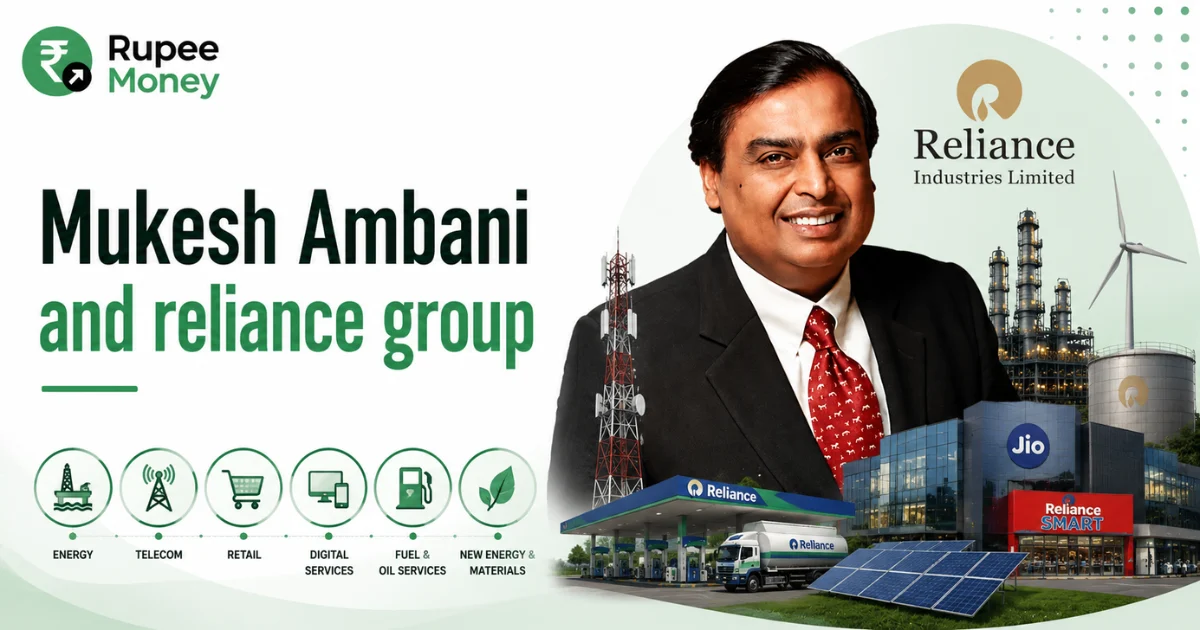
Mukesh Ambani runs a massive business empire today. His business goes far beyond the Reliance stock exchange name. The group covers energy, retail, digital services, and media.
But how many companies does Mukesh Ambani actually own? The answer depends entirely on what we count. Reliance Industries Limited acts as the flagship listed company. Jio Financial Services operates as another separately listed company.
However, the broader Reliance corporate structure contains many more entities. It features a huge network of subsidiaries and joint ventures. The official Reliance database lists hundreds of active subsidiaries today.
Welcome to RupeeMoney. We help you understand complex corporate structures easily. Saying Mukesh Ambani owns only two companies sounds misleading. Let us explore the complete Reliance business ecosystem today.
Who Is Mukesh Ambani?
Mukesh Ambani serves as Chairman of Reliance Industries Limited. He manages the entire Reliance corporate ecosystem actively. He transformed Reliance from a strict energy business globally.
The group now dominates retail and digital services completely. Reliance recently expanded aggressively into green energy and artificial intelligence. The FY2025-26 annual report describes an incredibly diversified enterprise. The group actively serves India’s growing energy and consumption needs.
Mukesh Ambani’s Role in Reliance
Mukesh Ambani leads Reliance Industries with absolute strategic vision. His leadership drove the massive expansion into telecom services. He also guided the rapid expansion of organized retail.
Recently, Reliance invested billions into new energy manufacturing projects. The company delivered stellar financial results recently. Reliance reported consolidated revenue of ₹11.76 lakh crore for FY2025-26. It generated consolidated EBITDA of ₹2.08 lakh crore. Mukesh Ambani ensures steady growth across all divisions continually.
How Mukesh Ambani Built Reliance
Dhirubhai Ambani originally started Reliance with textiles and trading. The company expanded into petrochemicals and crude oil refining. Mukesh Ambani subsequently pushed the group into consumer technology.
Jio quickly became India’s biggest telecom success story ever. Reliance Retail developed into India’s absolute largest retail network. The group plans another major transformation through new energy today. Solar panels and green hydrogen form the next massive frontier.
How Many Companies Are Under the Reliance Group?
No single simple number covers all Reliance companies accurately. The reason comes down directly to corporate legal structure. Reliance Industries manages subsidiaries, associates, and strategic joint ventures.
Some businesses operate through subsidiaries of other existing subsidiaries. Reliance provides a dedicated database for its major subsidiaries. Its FY2025-26 database contains a very large list of companies.
Therefore, you must understand the safest, most accurate answer. Reliance features two major separately listed companies today. The wider corporate structure contains hundreds of unlisted entities.
Major Listed Companies Under Reliance
You can buy shares in two primary Ambani companies. These companies trade publicly on Indian stock exchanges today.
- Reliance Industries Limited (RIL): The flagship conglomerate holding massive energy and retail assets.
- Jio Financial Services Limited (JFS): The financial arm operating as an independent entity now.
Jio Financial Services listed separately after a massive corporate demerger. This separated financial services from the core energy business. To understand the initial listing process completely, read what is an IPO.
You can estimate bulk investments in these stocks using our Lumpsum Calculator.
Why There Is No Simple Single Number
Readers often mix completely different types of corporate entities. You must understand these distinct legal categories clearly:
- Listed companies: Their shares trade publicly on major stock exchanges.
- Subsidiaries: Another larger company controls these specific businesses directly.
- Associates: Another company holds significant influence over their daily operations.
- Joint ventures: Multiple independent partners share ownership and management control.
- Brands: A brand does not always represent a separate company.
This distinction makes counting Ambani’s exact companies very difficult. Many investors trade unlisted shares of these private subsidiaries constantly.
Reliance Industries vs Reliance Group
These two terms do not mean exactly the same thing. Reliance Industries Limited represents the flagship listed company explicitly. The broader Reliance ecosystem includes all businesses connected through RIL.
This ecosystem includes Jio, Reliance Retail, and Reliance Brands. Jio Financial Services operates as a separately listed corporate company. The FY2025-26 annual report shows the Ambani family controlling both. This distinction helps investors evaluate asset ownership accurately.
Major Unlisted Businesses and Subsidiaries
The Reliance Group controls massive private subsidiaries globally. These entities dominate Indian consumer markets today.
Reliance Retail
Reliance Retail operates grocery, electronics, fashion, and lifestyle stores. It runs powerful digital commerce platforms like JioMart continuously. The retail business reached over 20,000 active stores recently. Reliance Retail generated immense gross revenue during FY2025-26.
Jio Platforms and Telecom
Jio Platforms serves as a massive digital services platform. Its businesses cover connectivity, cloud services, and digital commerce. Reliance Jio Infocomm operates the group’s massive telecom business directly. Jio reported millions of active digital subscribers in FY2025-26.
Jiostar Media
Jiostar represents Reliance’s massive media and entertainment platform today. Its portfolio covers television, sports broadcasting, and digital streaming. The business achieved record viewership across multiple digital entertainment platforms.
How Reliance Group Makes Money
Reliance does not depend on one single revenue source. Its diversified structure allows different businesses to generate profits.
Energy and Petrochemicals
Oil-to-Chemicals remains a massive Reliance business division today. Refining and petrochemicals generate substantial cash revenue for RIL. The business maximized profitability through higher operating rates recently.
Financial Services
Jio Financial Services operates across lending, payments, and insurance. The company provides technology-driven financial products to consumers directly.
Calculate your potential loan payments quickly using our EMI Calculator.
New Energy
New energy forms one of Reliance’s biggest future investments. The company builds a huge manufacturing ecosystem in Jamnagar. This includes solar PV manufacturing, advanced batteries, and electrolysers.
Mukesh Ambani’s Major Business Expansion
Reliance originally built its immense strength around energy materials. The launch of Jio changed the group’s growth strategy. Jio brought Reliance directly into India’s massive digital economy.
Reliance entered organized retail through the Reliance Fresh brand. The business later expanded into grocery and digital commerce rapidly. The group then separated its financial services into JFS. Reliance makes new energy its next major long-term investment.
Investors love analyzing these massive blue-chip corporate giants. You can explore large-cap mutual funds to diversify your market exposure.
Comparing Reliance Group with Adani Group
Both business groups expanded aggressively into several different sectors. However, their core business structures differ quite significantly today. Reliance maintains a massive presence in consumer businesses and telecom.
Adani concentrates heavily across infrastructure, ports, airports, and energy. Both dynamic groups continue investing billions into new energy. Smart investors compare company profitability margins before deploying capital.
Learn how to evaluate companies effectively using Return on Assets.
Conclusion
Mukesh Ambani’s business empire transcends simple listed company counts. Reliance Industries Limited remains the primary flagship listed company. Jio Financial Services operates as another separately listed Ambani entity.
Beyond them, Reliance controls hundreds of subsidiaries and joint ventures. The major businesses span energy, retail, telecom, and digital services. Reliance invests heavily in advanced batteries and green hydrogen today.
Consolidated revenue reached an astonishing ₹11.76 lakh crore recently. Investors must understand that Reliance Group means a massive ecosystem. Each company maintains its own distinct financial performance metrics.
If you want to grow wealth steadily, start early. Read our guide on building wealth in your 20s. You can build discipline through what is SIP investing strategies.
Estimate your future portfolio growth accurately using our SIP Calculator.
FAQs
How many companies does Mukesh Ambani own?
No single number accurately counts his personally owned companies. The broader Reliance ecosystem contains hundreds of subsidiaries and associates. Mukesh Ambani controls RIL and Jio Financial Services directly. Do not equate listed companies with total personal asset ownership.
What is Mukesh Ambani's main company?
Reliance Industries Limited acts as Mukesh Ambani's flagship company. RIL remains the central listed entity within the Reliance ecosystem. It houses major energy businesses and controls vital consumer subsidiaries.
Is Jio owned by Reliance?
Yes. Jio operates completely within the massive Reliance ecosystem today. Jio Platforms houses the group's digital telecom and internet businesses. Reliance Industries maintains absolute controlling ownership over Jio Platforms.
Is Jio Financial Services part of Reliance?
Yes. Jio Financial Services originated from Reliance's internal financial division. It now operates proudly as a separate listed corporate company. Its core businesses include lending, insurance broking, and payment solutions.
Is Reliance Industries the same as Reliance Group?
No. Reliance Industries Limited represents the flagship listed corporate company. The Reliance Group represents the wider network of connected businesses. That network includes hundreds of unlisted subsidiaries and joint ventures.
Reliance Industries Limited acts as Mukesh Ambani’s flagship company. RIL remains the central listed entity within the Reliance ecosystem. It houses major energy businesses and controls vital consumer subsidiaries.
Yes. Jio operates completely within the massive Reliance ecosystem today. Jio Platforms houses the group’s digital telecom and internet businesses. Reliance Industries maintains absolute controlling ownership over Jio Platforms.
Yes. Jio Financial Services originated from Reliance’s internal financial division. It now operates proudly as a separate listed corporate company. Its core businesses include lending, insurance broking, and payment solutions.
Disclaimer: This article provides general financial information for educational purposes only. The Reliance corporate structure changes frequently through acquisitions and mergers. Company names, ownership percentages, and subsidiary relationships evolve over time. Verify the latest official exchange filings before making investment decisions. This article does not constitute professional investment advice today. RupeeMoney does not recommend buying or selling any specific security.
ABOUT THE AUTHOR

