
What Is Intraday Trading? A Beginner’s Guide
Most people step into the stock market hoping to grow their money, but not everyone does it the same way. Some investors hold shares for months or years, while others complete an entire buy-and-sell cycle within a single trading session — an approach traders call Intraday Trading.
Intraday Trading draws traders in because it lets them profit from short-term price swings without waiting years for a return. But it also brings higher volatility, split-second decisions, and a real need for disciplined risk management. Jump in without the right knowledge, and you can lose money fast.
At RupeeMoney, we think every beginner should understand how Intraday Trading actually works before putting real money on the line. Getting comfortable with concepts like liquidity, trade volume, short selling, and different trading styles goes a long way toward smarter decisions.
This guide covers what Intraday Trading means, how it works, its defining features, popular trading strategies, and how it stacks up against Standard Trading and Swing Trading.
What Is Intraday Trading?
Intraday Trading means buying and selling shares within the same trading day. You open and close every position before the market shuts — never carrying one into the next session.
The goal isn’t long-term growth; it’s capturing profit from small price movements during market hours. Buy shares in the morning and sell them before the market closes that day, and that’s an intraday trade.
If you don’t close your position manually, your broker may square it off automatically before the close, depending on their policy.
How Does Intraday Trading Work?
Intraday Trading follows a fairly simple process, though executing it well takes careful planning and real market analysis.
- Pick a stock – traders usually look for stocks with strong liquidity, healthy trade volume, and regular price movement.
- Study the market – before placing any trade, you’d study charts, price trends, technical indicators, and relevant news to spot opportunities.
- Place the trade – you buy or sell shares through a registered broker’s online trading platform.
- Track the price – once you’re in the trade, you keep watching market conditions since prices can shift rapidly through the day.
- Exit before the close – every intraday position has to close before the session ends, completing the trade within the same day.
Key Features That Set Intraday Trading Apart
Intraday Trading looks quite different from long-term investing, and knowing its defining traits helps you decide if it fits your goals.
- Same-day trading: every buy and sell transaction happens within a single session.
- Short holding periods: you might hold a position for a few minutes or a few hours, but never overnight.
- Higher volatility: intraday trades rely on short-term price swings — more volatile stocks create more opportunities, but also more risk.
- High liquidity: liquid stocks let you enter and exit quickly without major price gaps.
- Frequent opportunities: since prices keep shifting through the session, you may spot several setups in a single day.
- Quick decision-making: you need to react fast to changing conditions and manage risk on the fly.
Intraday Trading vs Standard Trading vs Swing Trading
Beginners often mix up these three approaches. They all involve buying and selling shares, but each one differs in objective and holding period.
| Feature | Intraday Trading | Standard Trading (Delivery) | Swing Trading |
| Holding Period | Same day | Days, months, or years | A few days to a few weeks |
| Objective | Capture short-term price moves | Long-term investment growth | Ride short-term trends |
| Risk Level | High | Moderate | Moderate to high |
| Overnight Holding | No | Yes | Yes |
| Best Suited For | Active traders | Long-term investors | Trend-following traders |
Pick the approach that matches your financial goals, experience level, and risk appetite. If long-term, lower-effort investing appeals to you more than active trading, our guide on what SIP is and how it works covers a completely different, much steadier route into the markets.
Why Liquidity, Volatility, and Trade Volume Matter in Intraday Trading
Three factors decide how well an intraday trade plays out.
- Liquidity tells you how easily you can buy or sell a stock without causing a big price shift. Highly liquid stocks attract more buyers and sellers, which helps you execute orders quickly.
- Volatility measures how much a stock’s price moves during a session. Moderate volatility creates real opportunities, but excessive volatility raises your risk of losses too.
- Trade volume shows the total shares traded in a given period. Higher volume usually signals stronger market participation, and many intraday traders stick to high-volume stocks because they tend to offer better liquidity and smoother order execution.
Popular Intraday Trading Strategies
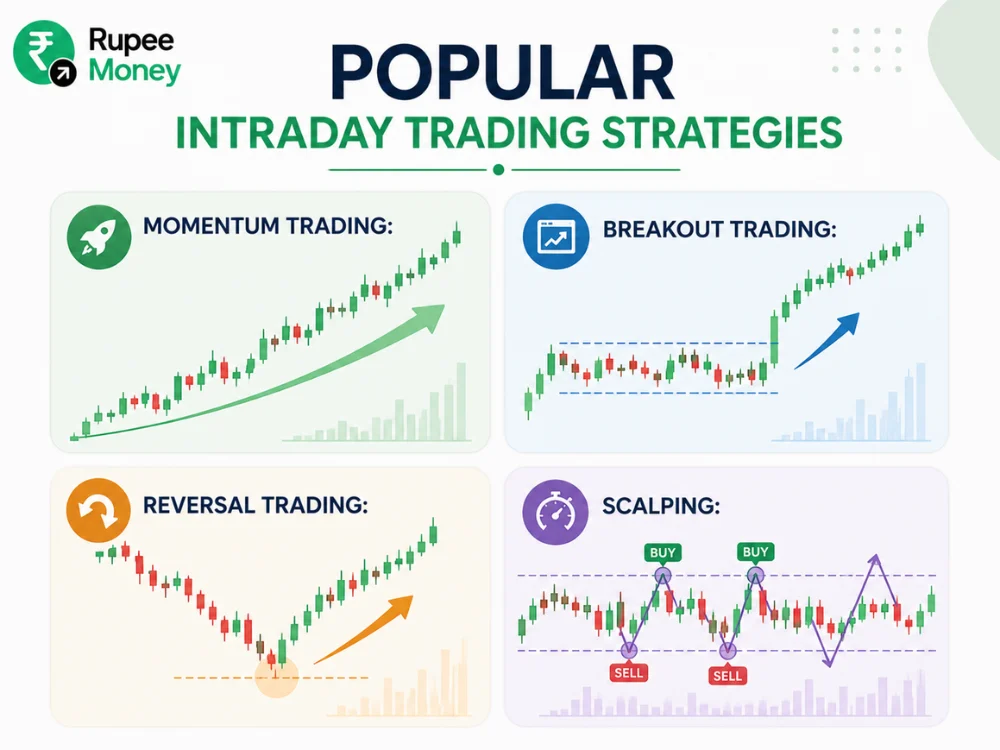
Different traders lean on different strategies depending on their experience, market conditions, and goals.
- Momentum trading: focuses on stocks showing strong upward or downward movement, entering trades while that trend stays active.
- Breakout trading: identifies key price levels and enters when a stock breaks above resistance or below support with strong volume.
- Reversal trading: looks for points where an existing trend might flip direction — this one demands experience, since false reversals happen often in volatile conditions.
- Scalping: involves firing off multiple small trades through the day to grab tiny price movements; professional traders favour this since it requires constant monitoring and fast execution.
What Is Short Selling in Intraday Trading?
Short selling lets you sell shares before you actually own them, and it works when you expect a share’s price to fall during the session.
The sequence: you sell first, the price drops, you buy back at that lower price, and the difference (minus applicable charges) becomes your profit. If the price rises instead, you take a loss. Short selling carries real risk since prices can move against your expectations quickly.
Benefits of Intraday Trading
Intraday Trading offers several real advantages for traders who understand market movement and manage risk carefully.
- Multiple opportunities: price swings through the day create several entry and exit points.
- No overnight market risk: closing positions before the close means you sidestep overnight news or global events affecting prices the next day.
- Better capital utilisation: many brokers offer intraday facilities that let you use available capital more efficiently, subject to applicable rules.
- Profit potential in both directions: short selling lets you try to benefit from rising and falling markets in the same session.
- Continuous learning: active participation builds your understanding of market behaviour and trading psychology over time.
Risks of Intraday Trading
Intraday Trading brings real opportunities, but it also carries genuine risk. Beginners should understand these before entering the market.
- High volatility: prices can shift within minutes, and sudden moves can trigger losses if you don’t react in time.
- Emotional decision-making: fear and greed often drive trading choices, leading to poor entries, delayed exits, and avoidable losses.
- Weak risk management: many beginners trade without a stop-loss or a set maximum acceptable loss, risking serious damage in volatile conditions.
- Brokerage and trading costs: frequent buying and selling rack up charges that eat into profitability, especially on small trades.
- Limited market knowledge: successful intraday trading requires a solid grasp of market trends, technical analysis, and discipline — trading without it increases your financial risk.
Do You Need a Demat Account for Intraday Trading?
One question beginners ask a lot: do you need a Demat Account for Intraday Trading?
For equity intraday trades, shares don’t actually sit in your account since you buy and sell within the same session, so settlement works differently from delivery-based investing. That said, most brokers in India bundle an integrated Trading Account and Demat Account when you open a new account, making it easy to switch between intraday trading and long-term investing whenever you want.
If you also plan to invest long-term — say, by applying for IPOs — a Demat Account becomes essential, since it stores your securities electronically.
How to Start Intraday Trading
Starting Intraday Trading takes real preparation, not just opening a trading account.
- Open a trading account – pick a SEBI-registered broker with a reliable platform and transparent brokerage charges.
- Complete your KYC – submit the required documents and finish verification before you start trading.
- Learn market basics – understand support, resistance, liquidity, volatility, trade volume, and risk management before your first trade.
- Build a trading plan – decide your entry price, target price, stop-loss, and maximum acceptable loss before you enter any position.
- Start small – new traders should avoid putting in large amounts early on; smaller capital lets you gain experience while keeping risk in check.
- Review every trade – keep a trading journal and analyze both your wins and losses, since this habit helps you spot mistakes and sharpen your decisions.
If you’d rather build wealth more gradually while you’re still learning the ropes, our guide on building wealth in your 20s lays out a steadier, long-term approach alongside any trading you take on.
Tax on Intraday Trading in India
Understanding taxation matters for every trader. Unlike delivery-based investing, income from Intraday Trading generally counts as business income under the Income-tax Act — it doesn’t qualify as Capital Gains since you never take delivery of the shares.
Your profits get taxed per applicable income tax rules based on your overall taxable income, and you may need to maintain proper records and meet filing requirements. Since tax laws can change, it’s worth consulting a qualified tax professional about your specific obligations.
Common Mistakes Beginners Make in Intraday Trading
Many traders lose money by repeating avoidable mistakes. Watch out for:
- Trading without learning market basics.
- Ignoring stop-loss orders.
- Following market rumours instead of research.
- Trading on emotion instead of a strategy.
- Investing more than you can afford to lose.
- Taking too many trades in a single day.
- Ignoring brokerage charges and taxes.
- Expecting quick, guaranteed profits.
- Skipping the review of past trades.
Avoiding these mistakes builds discipline and supports better long-term trading decisions. If you’d rather track a metric that helps you judge a company’s efficiency before trading its stock, our explainer on Return on Assets (ROA) is a good starting point.
Where Intraday Trading Is Headed in India
India’s stock market has seen strong retail participation over the past few years, helped by better digital trading platforms, faster internet access, and growing financial awareness.
At the same time, SEBI keeps introducing measures that strengthen investor protection, improve transparency, and encourage responsible trading. Brokers also now offer better risk tools, educational resources, and more advanced platforms to support informed decisions.
Even so, Intraday Trading remains a high-risk activity. Beginners should prioritize learning, disciplined execution, and proper risk management over chasing quick profits. If a lower-risk, professionally managed route appeals to you more, our guide to large-cap mutual funds is worth exploring, and you can estimate long-term growth using our Lumpsum Calculator or SIP Calculator.
Key Takeaways
- Intraday Trading means buying and selling shares within the same trading day.
- Traders aim to profit from short-term price movements.
- Liquidity, volatility, and trade volume all shape trade selection.
- Momentum trading and short selling rank among the most popular strategies.
- A disciplined trading plan and solid risk management are non-negotiable.
- Intraday Trading income generally falls under business income for tax purposes.
- Beginners should build knowledge before committing significant capital.
Conclusion
Intraday Trading can offer real opportunities to profit from short-term stock movements, but it demands discipline, knowledge, and effective risk management. Unlike long-term investing, intraday traders make decisions within a single session and need to respond quickly as conditions change.
Before you start, take the time to understand liquidity, volatility, trade volume, short selling, and the different trading strategies covered here. Learn the basics, practise with a clear trading plan, and never risk money you can’t afford to lose. Building experience gradually is what helps you make better trading decisions over time.
Frequently Asked Questions (FAQs)
What is Intraday Trading?
Intraday Trading means buying and selling shares within the same trading day. You close every position before the market shuts, so you never hold shares overnight. The goal is short-term profit rather than long-term growth, and it demands market knowledge, quick decisions, and disciplined risk management.
Is Intraday Trading suitable for beginners?
Beginners can learn it, but should approach it carefully since it carries more risk than long-term investing. Before trading with real money, get comfortable with technical analysis, risk management, liquidity, and volatility. Starting small and following a clear plan builds confidence while keeping risk in check.
What’s the difference between Intraday Trading and Swing Trading?
The holding period is the key difference. Intraday Trading requires closing every position the same day, while Swing Trading lets positions stay open for days or weeks. Intraday traders chase small daily moves; swing traders try to capture broader trends over a longer stretch.
Can I earn regular income through Intraday Trading?
Some experienced traders do, but there’s no guarantee of consistent profits. Market conditions shift daily, and losses are a normal part of trading. Success depends on knowledge, discipline, and continuous learning — beginners shouldn’t treat it as a guaranteed income source.
Which stocks work best for Intraday Trading?
Many traders favour stocks with high liquidity, strong trade volume, and moderate volatility, since these allow easier entry and exit during market hours. Large-cap companies often see higher volumes, but the right stock depends on market conditions, your strategy, and risk tolerance.
Disclaimer: This article is for educational and informational purposes only. Intraday Trading involves market risk, and profits are never guaranteed. Nothing here should be considered investment, legal, or tax advice. Trading rules, taxation, and SEBI regulations may change over time, so always do your own research or consult a qualified financial advisor before making trading decisions.
ABOUT THE AUTHOR

