
How Does Cochin Shipyard Make Money? Business Model & Revenue Sources
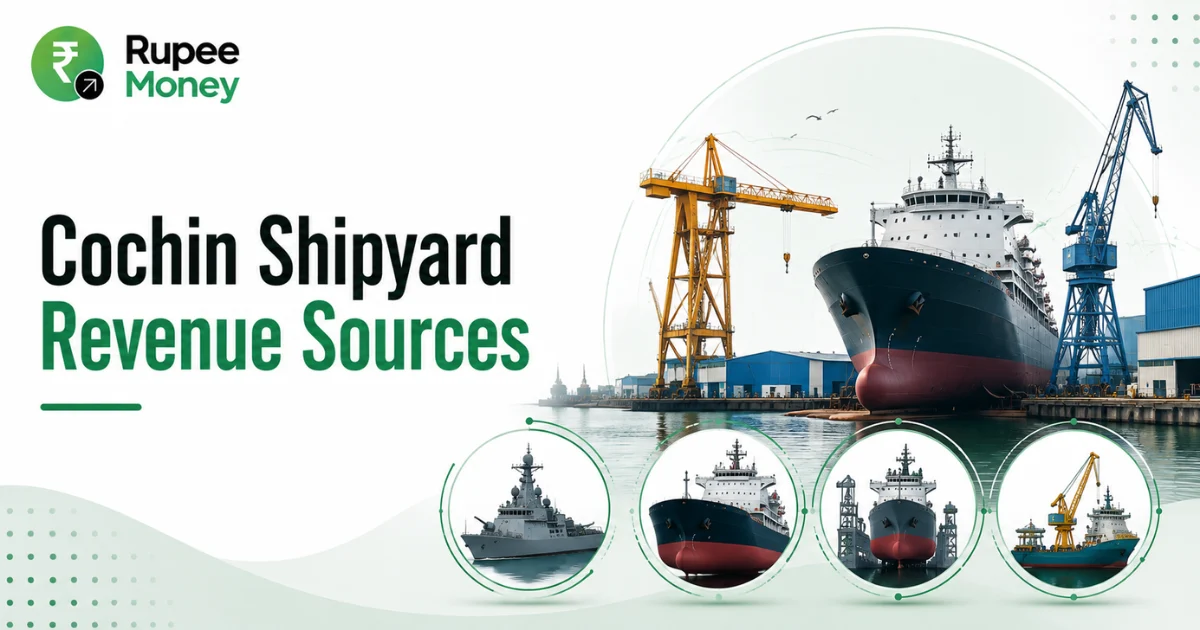
Cochin Shipyard does not make money by selling ships like consumer cars. It earns revenue through massive shipbuilding contracts, ship repairs, and critical defence projects. The company operates powerfully across the defence, commercial, and maritime engineering segments.
Its market position becomes extremely important as India pushes domestic shipbuilding aggressively. The government focuses heavily on rapid naval modernisation. In FY2025-26, Cochin Shipyard reported consolidated revenue of about ₹5,432 crore. Its profit after tax reached an impressive ₹717 crore.
Welcome to RupeeMoney. We break down complex financial business models for Indian retail investors. So, how does Cochin Shipyard actually generate this massive wealth? The answer lies inside two major business engines: shipbuilding and ship repair.
The Cochin Shipyard Business Model Explained
Cochin Shipyard follows a highly structured, project-based business model. The company receives massive orders from government organisations, defence forces, and commercial clients. It then designs, builds, and upgrades vessels according to strict contract requirements.
The basic revenue cycle works like this:
Customer Order → Ship Construction/Repair → Project Execution → Delivery → Revenue Recognition
Large shipbuilding projects can easily run for several years. Therefore, Cochin Shipyard does not generate the exact same revenue every quarter. Revenue depends heavily on achieving specific project milestones and execution schedules. This makes the company’s total order book a critical indicator of future revenue visibility.
To understand how government-backed enterprises list their shares publicly, read how companies go public.
How Cochin Shipyard Makes Money From Shipbuilding
Shipbuilding remains the absolute core business for Cochin Shipyard. The company builds various types of vessels for defence and commercial customers. Its immense capabilities cover lethal naval vessels, commercial ships, and highly specialised maritime vessels.
Cochin Shipyard can comfortably build ships with a capacity of up to 110,000 DWT. It can also repair massive vessels of up to 125,000 DWT. The company successfully builds world-class vessels for international customers too. It exported roughly 40 ships during the last decade to prestigious clients across Europe and the United States. This proven export capability reduces its complete dependence on India’s domestic market.
Defence Shipbuilding Generates Long-Term Revenue
Defence shipbuilding provides Cochin Shipyard with massive, long-duration contracts. The Indian Navy remains its most important and reliable customer. The company proudly built INS Vikrant, India’s first indigenously developed aircraft carrier. This legendary vessel represents India’s most significant indigenous shipbuilding project.
Cochin Shipyard is currently executing several additional defence programmes. Its active order pipeline includes Anti-Submarine Warfare Shallow Water Crafts and Next Generation Missile Vessels. Defence contracts provide incredibly strong revenue visibility because construction spans multiple financial years. However, an order does not become actual revenue immediately. The company must execute the project flawlessly.
Commercial Ships and Export Opportunities
Cochin Shipyard also builds commercial vessels consistently. These lucrative projects include ships for domestic port operators and international buyers. Commercial shipbuilding gives the company a reliable secondary source of revenue. It also strongly supports the company’s strategy of capturing the global maritime market.
Commercial orders fluctuate significantly depending on global shipping demand. Therefore, this commercial segment experiences more economic cycles than pure defence shipbuilding.
How Ship Repair Adds Recurring Revenue
Ship repair represents the second major business pillar for the company. Ships require regular, extensive maintenance throughout their operating lives. They require major mechanical repairs, technological upgrades, and life-extension work.
Cochin Shipyard earns substantial money by executing these critical services. Its elite repair capabilities cover naval fleets, commercial freighters, and offshore vessels. The company operates massive, modernized repair facilities in Kerala.
Ship repair provides recurring business because vessel owners need continuous maintenance. This happens even when brand new shipbuilding orders slow down completely. This stability makes repair an incredibly vital part of Cochin Shipyard’s business model.
Ship Repair Revenue Trends
Ship repair creates a completely different revenue pattern compared to shipbuilding. A major repair contract generates significant revenue within a much shorter timeframe. This dynamic can cause quarterly revenue figures to swing sharply.
In Q4 FY2026, consolidated ship repair revenue reached around ₹330 crore. That specific figure fell roughly 60.5% year-on-year. Meanwhile, shipbuilding revenue actually increased by 25.3% to approximately ₹1,154 crore during the same quarter. This stark difference shows why intelligent investors must evaluate both segments separately. A temporary fall in repair revenue never means the entire business has weakened.
Marine Engineering and Training Services
Cochin Shipyard also operates within the marine engineering space. The company lists Marine Engineering Training as a distinct and proud business area. It started this educational activity back in 1993.
This business supports the broader maritime ecosystem wonderfully. However, core shipbuilding and ship repair remain vastly more important to overall profits. Investors should treat marine engineering as a supportive business unit rather than the primary revenue driver.
Why the Cochin Shipyard Order Book Matters
The order book provides the most important clue regarding future revenue. Cochin Shipyard possessed a staggering order book of around ₹21,100 crore recently. That massive figure represents more than four times the company’s FY2025 revenue.
The heavy backlog includes massive defence programmes and lucrative commercial orders. A company holding a massive order book enjoys brilliant revenue visibility. However, you should never treat the entire order book as immediate cash.
The company still needs to execute these complex contracts over several years. The speed of construction and final delivery determines exactly when revenue hits the income statement.
How Cochin Shipyard Converts Orders Into Profit
Winning an order is merely the beginning of the journey. Cochin Shipyard must purchase heavy materials, employ skilled workers, and utilize its shipyards. Steel, heavy machinery, and advanced electronics form a massive part of project costs.
The company executes the project according to strict contractual milestones. As physical work progresses, it officially recognizes revenue under accounting rules. The remaining cash after clearing project costs contributes directly to profitability.
Therefore, investors should monitor much more than order-book growth. Track revenue growth, operating margins, raw material costs, and working capital. A large order book creates wealth only when the company executes contracts profitably. To understand asset efficiency, read our guide on Return on Assets (ROA).
Why Government Defence Spending Matters
Government spending directly influences Cochin Shipyard’s future opportunity pipeline. India aggressively increases its focus on naval modernisation and domestic defence production today. This massive push creates explosive demand for new warships and specialised naval vessels.
The company already boasts a legendary association with the Indian Navy. Its successful execution of INS Vikrant cemented its dominant position in India’s defence shipbuilding ecosystem. To understand how national budgets impact these companies, read how government spending influences PSU stocks.
However, investors must carefully separate government announcements from actual finalized orders. A higher national defence allocation does not become Cochin Shipyard revenue automatically. The company must win competitive contracts and execute them flawlessly.
Cochin Shipyard Update 2026: OFS and Financial Performance
Cochin Shipyard remained in the market spotlight heavily during 2026. The Centre launched a massive Offer for Sale (OFS) in July 2026. The government sold a 5.04% stake in Cochin Shipyard to investors.
The OFS floor price stood at ₹1,400 per equity share. Strong institutional demand encouraged the government to exercise the full green-shoe option. The government previously held 67.91% before initiating this strategic sale.
This OFS does not provide any fresh capital to Cochin Shipyard directly. It simply represents a sale of existing shares by the government promoter.
Financial Performance in FY2026
Cochin Shipyard’s FY2026 performance showed mixed but highly profitable movement. The company generated approximately ₹5,432 crore in total annual income. Its final profit after tax stood robustly at around ₹717 crore.
The fourth quarter showed another extremely important financial trend. Revenue from operations declined 15.5% year-on-year to around ₹1,484 crore. However, the core EBITDA increased beautifully by 22.5% to reach ₹310 crore.
The EBITDA margin improved dramatically to roughly 20.87% from 15.35% a year earlier. This brilliant margin expansion proves why investors must not judge the business by revenue drops alone. Superior project mix and execution efficiency affect net profitability heavily.
What Can Drive Future Growth?
Several critical factors will influence the company’s future stock performance heavily:
- Defence Shipbuilding: Higher naval procurement creates immediate opportunities for new contracts.
- Submarine Projects: Upcoming massive defence programmes provide multi-year revenue visibility.
- Commercial Exports: International shipbuilding diversifies the company’s revenue base beautifully.
- Ship Repair: A rapidly growing global fleet increases demand for maintenance services.
- Capacity Expansion: Modernized facilities allow the shipyard to handle massive international projects smoothly.
What Risks Can Affect Cochin Shipyard?
Cochin Shipyard also faces several unavoidable business risks daily. Severe project delays can postpone revenue recognition and destroy quarterly earnings. Cost inflation regarding raw steel can shrink project margins rapidly.
Government procurement delays slow down new order inflows heavily. Commercial shipping cycles affect lucrative private-sector orders constantly. Finally, excessive valuation risk can easily hurt retail shareholder returns.
The stock can trade at a dangerous premium when investors expect impossible growth. If earnings fail to grow at that expected pace, the valuation crashes instantly. Investors must separate excellent business quality from an overvalued stock price carefully.
To diversify your risk across many stable companies, explore large-cap mutual funds. If you want a consistent wealth-building strategy, look into SIP investing in India.
What Investors Should Track in Cochin Shipyard
Investors analyzing Cochin Shipyard must track several vital metrics together constantly.
- The order book shows all guaranteed future work.
- New order inflows indicate whether the pipeline keeps expanding safely.
- Revenue growth proves actual physical execution success.
- Operating margins indicate true project profitability.
- Cash flow proves whether accounting profits translate into real bank cash.
You must also track the exact split between defence, commercial, and repair segments. Building an early understanding of these metrics helps tremendously. Read our guide on building wealth in your 20s to master long-term investing.
Conclusion
Cochin Shipyard makes money primarily through massive shipbuilding and ship repair services. Its shipbuilding division covers lethal defence vessels, commercial ships, and highly specialised crafts. Its repair business provides vital maintenance, upgrades, and structural refit services.
The business model relies entirely on securing and executing massive, long-term contracts. Order wins, flawless project execution, and expanding margins remain the true drivers of financial performance. FY2026 revenue stood proudly at around ₹5,432 crore, with PAT reaching ₹717 crore.
The company carries a phenomenal order book providing excellent future visibility. The biggest opportunity comes from India’s aggressive focus on defence manufacturing and naval modernisation. But remember, the ultimate question remains execution. Can Cochin Shipyard convert its massive order pipeline into profitable, timely deliveries constantly? That execution ultimately dictates shareholder wealth creation.
FAQs
How does Cochin Shipyard make money?
Cochin Shipyard earns money by building and repairing massive marine vessels. The company constructs advanced defence vessels, commercial ships, and specialised vessels for global customers. It also repairs and upgrades both naval and commercial fleets.
What are Cochin Shipyard's main sources of revenue?
The company operates two highly profitable major segments. The first is shipbuilding, which includes both defence and commercial vessels. The second is ship repair, covering maintenance, structural refits, and critical upgrades.
Does Cochin Shipyard depend heavily on government orders?
Yes, government and defence orders play an absolutely massive role. The Indian Navy represents its most reliable and important customer. However, commercial and export projects give the company excellent revenue diversification today.
What is Cochin Shipyard's current order book?
Cochin Shipyard possessed an incredible order book of around ₹21,100 crore recently. This massive backlog included critical defence projects and major commercial orders. It provides fantastic future revenue visibility.
Why is Cochin Shipyard important to India's defence sector?
Cochin Shipyard holds decades of elite experience in naval shipbuilding. It constructed INS Vikrant, India's first indigenous aircraft carrier. Its elite capabilities aggressively support India's massive push for self-reliant domestic defence manufacturing.
Cochin Shipyard holds decades of elite experience in naval shipbuilding. It constructed INS Vikrant, India’s first indigenous aircraft carrier. Its elite capabilities aggressively support India’s massive push for self-reliant domestic defence manufacturing.
Disclaimer: This article provides general information for educational and informational purposes only. The financial figures and business information come from company filings and publicly available sources up to 2026. Future orders, revenue, profits, and project execution can change because of government procurement decisions and market conditions. Past performance does not guarantee future results. This article does not constitute investment advice or a recommendation to buy or sell Cochin Shipyard shares. Always consult a SEBI-registered financial advisor before investing.
ABOUT THE AUTHOR

