
What Makes the Stock Market Go Up or Down?
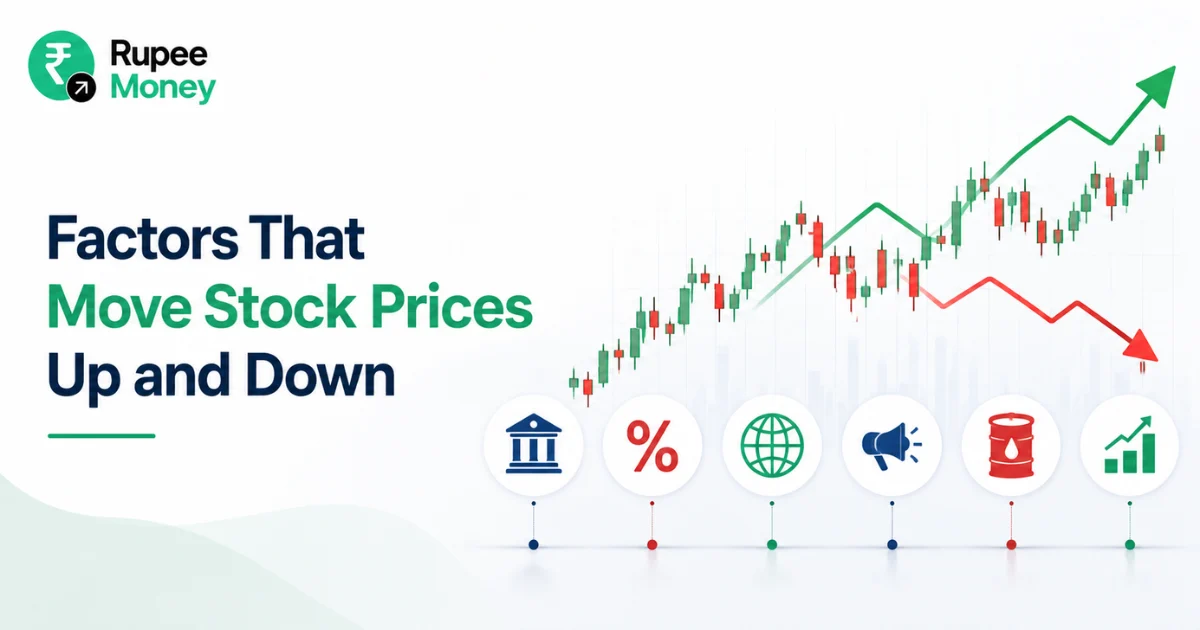
What makes the stock market go up or down is a question every new investor asks eventually. The market rarely moves without a reason, some days it rises sharply, other days it falls despite seemingly good news. The real answer is a mix of business performance, economic conditions, investor behaviour, and market expectations, all pulling in different directions at once.
If you’ve recently started learning about investing, RupeeMoney breaks down concepts like this in plain language so you can make decisions with genuine confidence, not guesswork. Understanding what actually drives the market helps you avoid emotional decisions and stick to a real long-term strategy.
This guide walks through the major factors that push the Indian stock market up or down, and how companies, governments, global events, and everyday investors all play a part.
Why Does the Stock Market Go Up or Down?
Every stock price moves because buyers and sellers are constantly placing orders. When more people want to buy than sell, demand rises and the price usually follows. When more want to sell than buy, prices generally fall.
Demand and supply don’t shift randomly though, they react to business performance, economic developments, interest rates, inflation, investor confidence, and global events. The market also reflects expectations, not just current reality. Investors buy shares expecting companies to perform better in future, and sell when they anticipate weaker earnings or economic uncertainty. That’s exactly why markets sometimes rally before good news becomes official, and fall even after strong results, the market had already priced in something even better.
Demand and Supply Drive Stock Market Prices
Demand and supply remain the single most fundamental force behind every price move. When investors believe a company has real growth potential, more buyers compete for its shares, pushing the price up. When confidence fades, selling pressure builds and prices fall. In simple terms: high demand with limited sellers pushes prices up; heavy selling pressure with fewer buyers pulls them down. Every transaction in the market follows this basic principle, even when the underlying reasons get complicated.
How Company Earnings Influence Stock Prices

Corporate Earnings
Corporate earnings genuinely shape whether investors buy or sell. Companies report quarterly and annual results covering revenue, expenses, profits, and future plans. Better-than-expected earnings usually build confidence and drive buying, while disappointing results often trigger selling. Strong earnings also signal a company can keep expanding and reward shareholders over time, if you’re evaluating earnings quality more deeply, our explainer on Return on Assets (ROA) is a useful companion metric.
Earnings Growth
Investors rarely fixate only on today’s profit number, they compare earnings growth across several quarters. Consistent growth attracts long-term investors because it signals management is genuinely improving the business over time. Even a company with positive profits can lose confidence if that growth visibly slows, markets reward companies that keep growing year after year, not just those posting one good quarter.
How Investor Sentiment Changes the Stock Market
Investor sentiment is the overall mood of market participants, and it can move prices well beyond what fundamentals alone would justify. Optimism sometimes pushes prices higher than underlying performance supports, while fear can drag prices down even when companies remain financially sound.
Positive sentiment tends to build from strong economic growth, rising corporate profits, stable policy, better employment data, and positive global markets. Negative sentiment usually stems from economic uncertainty, political instability, financial crises, natural disasters, global conflicts, or weak business performance. In the short term, investor psychology often moves markets more than fundamentals do, which is exactly why staying level-headed matters more than reacting to every headline.
How Interest Rates Affect the Stock Market
Interest rates directly shape borrowing costs for businesses and consumers. When rates stay low, companies borrow easily, invest in expansion, and consumer spending tends to rise, conditions that generally support market growth. Higher rates flip this: borrowing gets costlier, businesses may delay expansion, and consumers pull back spending, pressure that can eventually show up in earnings and stock prices.
Rates also shape where investors park money. When Repo Rate-linked deposits offer attractive returns, some investors shift money out of equities into safer instruments, worth understanding if you’re also weighing Fixed vs Floating Interest Rate options on your own borrowing.
How Inflation Influences Share Prices
Inflation measures how quickly prices rise across the economy. Moderate inflation usually supports healthy growth, but high inflation raises costs across raw materials, transport, electricity, and salaries. If companies can’t pass these costs to customers, profits shrink, and lower profits tend to dent confidence, pulling share prices down across affected sectors. Not every industry feels this equally, some perform better through inflationary periods while others face real pressure. Our guide on What Is Inflation and Why Does It Matter? covers the mechanics in depth.
How Economic Growth Supports the Stock Market
A growing economy creates genuinely better business conditions: higher consumer spending, stronger employment, rising industrial output, and growing profits. As companies grow faster, investors turn more optimistic, which typically supports higher prices. When growth slows, profits often follow, and investors turn cautious, usually meaning more volatility.
How Government Policies Influence the Share Market
Government decisions ripple through almost every sector. Changes in taxation, infrastructure spending, manufacturing policy, and industry regulation all shape company performance. Supportive policies encourage expansion and a positive investor response, while restrictive policies or higher taxes can dent profitability and sour sentiment. Markets often react fast to major policy announcements, but for long-term investors, the direction of policy matters far more than reacting to each individual headline.
How Global Events Affect the Indian Stock Market
The Indian stock market doesn’t operate in isolation. Global interest rate decisions, crude oil prices, currency swings, geopolitical tension, recessions, trade agreements, banking crises, and supply chain disruptions all shape investor confidence and capital flows here too. Foreign investors constantly weigh India against other markets, and major global developments can shift capital in or out of Indian equities even when domestic conditions stay stable, our piece on How Crude Oil Prices Influence Natural Gas Rates covers one such global-to-local ripple effect.
How FIIs and DIIs Move the Stock Market
Institutional investors genuinely move daily market direction, and both sides matter.
Foreign Institutional Investors (FIIs), technically now Foreign Portfolio Investors (FPIs), invest in Indian equities from overseas, spanning mutual funds, pension funds, insurers, and asset managers. Heavy FII buying tends to push the Sensex and Nifty higher; large withdrawals can trigger short-term declines, especially in large-cap stocks.
Domestic Institutional Investors (DIIs), Indian mutual funds, insurers, pension funds, and banks, often provide real stability during volatile stretches. This played out at real scale recently: in March 2026, FIIs pulled roughly ₹1.18 lakh crore out of Indian equities, while DIIs absorbed much of that shock with net purchases of about ₹1.16 lakh crore, resulting in far less market disruption than a similar exodus would have caused a decade ago. Much of this DII resilience now comes from steady retail SIP inflows, which have grown roughly 7x over the past decade, from ₹43,921 crore in FY 2016–17 to ₹3,17,502 crore in FY 2025–26, a genuinely structural shift toward a market less dependent on foreign flows. Retail investors should still avoid decisions purely based on FII/DII activity though, and focus on long-term business fundamentals instead.
How Corporate Actions Can Affect Share Prices
Companies regularly take decisions that shift investor confidence: dividend announcements, bonus shares, stock splits, rights issues, buybacks, and mergers or acquisitions. Positive corporate actions often lift sentiment since they signal financial strength, but it’s worth understanding why a company announced something rather than assuming every announcement is good news. Our guide on Bonus Shares explains exactly how they affect investors.
How Market Valuation Influences Buying Decisions
Investors don’t just look at profits, they compare stock prices against actual business performance. If a valuation looks reasonable, buying tends to continue; if prices have run well ahead of earnings, investors may view the stock as expensive and start booking profits. Common valuation measures include the Price-to-Earnings (P/E) Ratio, Price-to-Book (P/B) Ratio, Earnings Per Share (EPS), and Return on Equity (ROE), together, these help judge whether a stock looks fairly priced, undervalued, or overvalued.
Bull Market vs Bear Market
A bull market is a sustained period of rising prices, marked by strong confidence, rising profits, higher investment activity, and a positive outlook. Bull markets support long-term wealth creation, though prices rarely climb in a straight line.
A bear market is an extended decline, typically driven by weak growth, high inflation, global financial stress, poor earnings, or rising rates. Bear markets create real fear, but they’ve also historically given disciplined long-term investors a chance to accumulate quality companies at genuinely lower prices.
Common Reasons the Stock Market Goes Up or Down
Markets tend to rise when several positive factors align: strong earnings, healthy growth, lower interest rates, moderate inflation, supportive policy, rising confidence, strong FII/DII inflows, favourable global conditions, and robust consumer spending.
Markets tend to fall when the opposite builds up: weak earnings, an economic slowdown, high inflation, rising rates, global conflict, financial stress, political uncertainty, falling profits, heavy institutional selling, or retail panic. Market corrections are a natural part of investing, as every major market experiences periods of growth as well as decline.
What Should Investors Do During Market Ups and Downs?
Many beginners get nervous when markets fall sharply, but successful investing depends far more on discipline than prediction. Stay focused on long-term goals, avoid emotional buying and selling, keep investing regularly through SIPs rather than pausing during dips, diversify across sectors, review fundamentals before investing, keep an emergency fund entirely separate from investments, ignore market rumours, and invest according to your own risk tolerance. If you’re unsure how often to invest, our guide on Daily, Weekly or Monthly SIP breaks down the trade-offs, and the SIP Calculator can help you estimate how staying consistent through volatility pays off.
Conclusion
The stock market moves because millions of investors make buying and selling decisions every day, shaped by earnings, economic growth, interest rates, inflation, government policy, global events, and confidence, all at once. No single factor controls it; multiple forces interact constantly. Understanding these drivers helps you make informed decisions instead of reacting emotionally to daily swings. Rather than trying to predict every move, focus on investing in genuinely good businesses and holding a long-term perspective.
Frequently Asked Questions (FAQs)
Which Factor Influences Stock Market Prices the Most?
There’s no single controlling factor. Prices move due to demand and supply, but that demand shifts because of earnings, growth, inflation, interest rates, policy, global events, and sentiment, usually several together rather than one isolated event.
Why do stock prices change every day?
Buyers and sellers place orders constantly through the trading day. When demand outweighs supply, prices rise; when selling pressure dominates, prices fall. Company news, economic data, and global events shift these dynamics quickly.
Can good company results still lead to a fall in share prices?
Yes. Prices reflect expectations, not just performance. If investors expected exceptional results and the company delivered only moderate growth, the stock can still fall, sometimes because the good news was already priced in.
How do inflation and interest rates affect the stock market?
Higher inflation raises business costs and erodes purchasing power. Central banks often raise rates in response, increasing borrowing costs and slowing expansion and profits, pressuring stock prices. Moderate inflation and stable rates generally support healthier performance.
Should beginners worry about daily stock market movements?
Not particularly. Daily fluctuations are normal. Long-term investors focus on company quality and financial goals rather than short-term noise, frequent reactive trading tends to increase risk and reduce long-term returns.
Can global events affect the Indian stock market?
Yes. International rate decisions, crude oil prices, geopolitical tension, currency moves, and global recessions all influence sentiment and foreign investment flows into India, even when domestic conditions remain stable.
Disclaimer: This article is for educational and informational purposes only and doesn’t constitute investment, financial, legal, or tax advice. Stock market investments are subject to market risk, and share prices fluctuate due to a wide range of economic, business, and global factors. Conduct your own research and consult a qualified financial advisor before investing.
ABOUT THE AUTHOR

