
Pradhan Mantri Awas Yojana 2.0: Eligibility, Benefits, Apply Online & Housing Subsidy 2026
Purchasing or constructing an independent residential property in metropolitan areas has grown progressively out of reach for working-class households. Soaring land rates, inflationary building costs, and multi-decade mortgage payments make owning a home difficult without state assistance. To ease this burden, the Union Government launched Pradhan Mantri Awas Yojana Urban 2.0 (PMAY-U 2.0).
Also known as Pradhan Mantri Awas Yojana 2.0, this flagship scheme delivers central financial assistance to 1 crore low-income and middle-income urban households across a five-year mission timeline (September 1, 2024, to August 31, 2029). Administered by the Ministry of Housing and Urban Affairs (MoHUA) via State Governments, Union Territories, Urban Local Bodies (ULBs), and Primary Lending Institutions (PLIs), the mission ensures that families without a permanent roof can build, buy, or lease an all-weather home.
Beneficiaries can unlock financial assistance of up to ₹2.50 lakh through construction and partnership components, while the revamped Interest Subsidy Scheme (ISS) offers home loan interest relief of up to ₹1.80 lakh. If you plan to finance a property, evaluating things to know before taking a home loan in India helps set realistic expectations. You can also forecast your monthly repayments using the RupeeMoney Home Loan Calculator.
Below is an in-depth operational guide to PMAY 2.0 eligibility, key benefits, the digital application journey, subsidy math, and the four distinct programmatic verticals.
What Is Pradhan Mantri Awas Yojana 2.0?
Pradhan Mantri Awas Yojana Urban 2.0 is India’s premier public housing vehicle for urban areas, designed as a comprehensive expansion of the original PMAY-Urban mission. The core objective is ensuring every qualifying urban family gains access to an all-weather pucca dwelling featuring basic utilities such as electricity, running water, and private sanitation.
The mission addresses varying demographic needs through four housing interventions:
- Constructing an independent home on family-owned land.
- Purchasing an apartment constructed under public-private housing partnerships.
- Securing clean, rent-controlled urban housing for mobile workforces.
- Securing upfront interest subsidies on commercial mortgages.
PMAY-U 2.0 accounts for the economic realities of diverse urban populations. Rather than forcing all applicants into one standardized program, it lets families choose a vertical matching their property ownership status, income category, and long-term residency plans.
PMAY 2.0 Eligibility
Meeting the fundamental PMAY Urban 2.0 eligibility requirements is mandatory before initiating an application on the government portal.
The overarching rule is that the applicant or any member of the beneficiary family must not own a pucca (permanent) house anywhere in India. The family must also fall within designated annual household income brackets:
| Income Category | Annual Household Income | Primary Eligible Verticals |
| Economically Weaker Section (EWS) | Up to ₹3,00,000 | BLC, AHP, ARH, ISS |
| Low Income Group (LIG) | ₹3,00,001 to ₹6,00,000 | ISS, ARH (Select AHP rules apply) |
| Middle Income Group (MIG) | ₹6,00,001 to ₹9,00,000 | ISS (Interest Subsidy Scheme only) |
Key Eligibility Checkpoints
- Urban Jurisdiction: The family must reside within statutory towns as per the 2011 Census, notified planning areas, development authorities, or special industrial/urban development zones.
- Homeownership Bar: Neither the primary applicant nor their spouse, unmarried sons, or unmarried daughters may own a permanent brick-and-mortar home across the country.
- Prior Housing Grants: The household must not have availed of any central, state, or municipal housing assistance during the preceding 20 years.
- Identity Authentication: All adult family members must undergo digital verification via government identity platforms. For households updating their documentation, following the official guidelines on Baal Aadhaar card rules and updates ensures smooth processing for minors.
Definition of a Beneficiary Family
Under PMAY-U 2.0, a “beneficiary family” is strictly defined as:
Household = Husband + Wife + Unmarried Sons + Unmarried Daughters
Housing eligibility is assessed at the aggregate household level. A married son living in the same home with his own spouse forms an independent household, provided neither partner owns residential real estate. An unmarried working daughter living with her parents remains part of the primary parental family unit for income calculation.
PMAY 2.0 Benefits
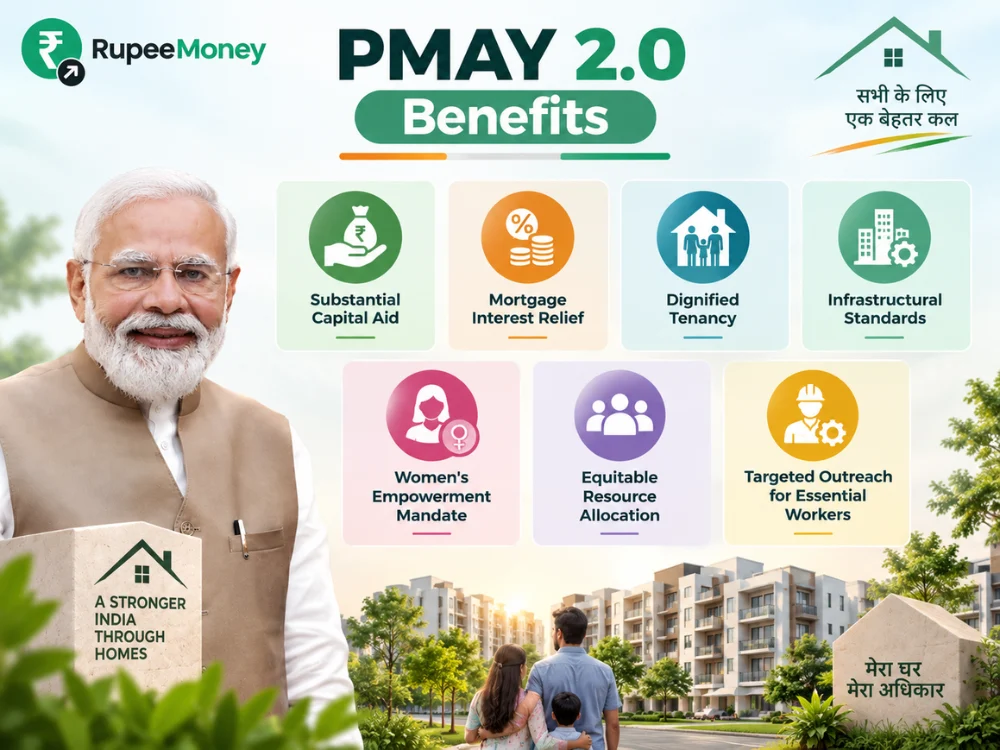
The PMAY 2.0 housing scheme delivers tangible socio-economic benefits tailored to distinct income brackets:
- Substantial Capital Aid: Direct financial transfers up to ₹2.50 lakh per dwelling unit under construction pathways (BLC/AHP).
- Mortgage Interest Relief: Up to ₹1.80 lakh credited directly against home loan principal balances, cutting the effective interest burden.
- Dignified Tenancy: High-quality, subsidized rental complexes for urban blue-collar workers through the ARH vertical.
- Infrastructural Standards: All supported dwellings include municipal water supply, electrical wiring, proper drainage, and internal toilets.
- Women’s Empowerment Mandate: Property titles under BLC and AHP must list the female head of the family either as sole owner or joint owner.
- Equitable Resource Allocation: Built-in priority for Scheduled Castes (SC), Scheduled Tribes (ST), religious minorities, single women, widows, differently-abled persons, and senior citizens.
- Targeted Outreach for Essential Workers: Dedicated provisions cover Safai Karmis, registered street vendors, Anganwadi workers, construction laborers, and craftspeople supported by government skill initiatives.
How Much Money Is Available Under PMAY 2.0?
The total financial package under PMAY 2.0 depends on the chosen operational vertical:
- Beneficiary Led Construction (BLC): Central assistance of up to ₹1.50 lakh per unit, with supplementary state contributions often bringing total public support to ₹2.50 lakh.
- Affordable Housing in Partnership (AHP): Up to ₹2.50 lakh in combined central and state support, applied directly as an upfront reduction to the purchase price of the housing unit.
- Interest Subsidy Scheme (ISS): A maximum subsidy of ₹1.80 lakh on qualified mortgages, disbursed over five annual installments.
When evaluating housing finance options alongside personal savings, compare alternatives like a personal loan vs home loan to pick the most cost-effective financing structure for ancillary expenses like interior finishing.
The Four Major Components of PMAY 2.0
1. Beneficiary Led Construction (BLC)
The BLC vertical serves EWS families who own a plot of land or an unlivable kuccha structure and wish to construct a modern pucca house.
- Income Limit: Annual household earnings cannot exceed ₹3 lakh.
- Dwelling Dimensions: Carpet area cannot exceed 45 square meters.
- Layout Mandates: The finished property must contain at least two livable rooms, an independent kitchen, and an attached toilet/bathroom connected to local municipal sewage or a septic tank.
- Fund Flow: Central assistance of up to ₹1.50 lakh (supplemented by state grants) is disbursed via Direct Benefit Transfer (DBT) in geo-tagged, milestone-based tranches linked to construction progress.
2. Affordable Housing in Partnership (AHP)
The AHP component supports EWS households who lack private residential plots. State agencies, municipal boards, and private developers construct mass housing complexes where designated units are reserved for low-income buyers.
- Income Limit: Up to ₹3 lakh annually.
- Carpet Area: Standardized between 30 and 45 square meters per flat.
- Subsidized Allotment: Central assistance of ₹1.50 lakh per flat is combined with state support to reduce the final purchase price payable by the buyer.
- Financing Options: Buyers can pay their balance share out of savings or through institutional home loans from scheduled commercial banks.
3. Affordable Rental Housing (ARH)
The ARH vertical provides affordable, formal rental housing for urban workforces who do not wish to purchase a home or take on a mortgage.
- Target Demographics: Industrial operators, hospitality workers, construction labor, delivery personnel, seasonal migrant workers, and students.
- Operational Model: Existing vacant public-funded housing stock is converted into operational rental complexes via Public-Private Partnerships (PPP), or new complexes are built by private/public entities on unutilized land.
- Carpet Area: Up to 30 square meters for single-bed dormitories and up to 60 square meters for two-room family rental apartments.
4. Interest Subsidy Scheme (ISS)
The Interest Subsidy Scheme helps middle- and lower-income families who require mortgage financing to purchase or construct a home.
- Eligibility Threshold: Household income up to ₹9 lakh per year (spanning EWS, LIG, and MIG brackets).
- Home Loan Cap: Maximum loan value of up to ₹25 lakh.
- Property Valuation Cap: Property value cannot exceed ₹35 lakh.
- Maximum Carpet Area: Spacious ceiling up to 120 square meters.
- Subsidy Structure: 4% interest rate relief calculated on the first ₹8 lakh of the principal loan amount, capped at an aggregate subsidy of ₹1.80 lakh.
- Tenure: The subsidy is calculated over a maximum 12-year window and credited to the loan balance in five equal annual tranches.
PMAY 2.0 Interest Subsidy: How Does It Work?
The PMAY 2.0 interest subsidy operates through an automated settlement mechanism between the central government and the primary lending bank. The state does not issue an unrestricted cash grant directly to the borrower.
Operational Mechanics
- Sanction: An eligible borrower secures an approved home loan (originated on or after September 1, 2024) from a participating bank or housing finance company.
- Claim Submission: The bank registers the borrower’s profile and property details on the MoHUA portal.
- Direct Principal Credit: Once cleared by the Central Nodal Agency, the subsidy is released in five yearly installments of roughly ₹36,000 each (up to ₹1.80 lakh total).
- Balance Adjustment: The lending bank credits each installment directly against the outstanding loan principal. This immediately reduces the interest-accruing balance, shortening the repayment schedule and cutting total borrowing costs.
Managing loan repayments requires consistent financial planning. If you are comparing financing options, analyzing a fixed vs floating interest rate clarifies how changing market conditions impact your long-term interest bill. Tracking monetary policy shifts such as reading what is the repo rate explained in simple words also helps you understand why your bank alters its lending terms over time.
House Size and Construction Specifications
All construction financed through the program must follow clear floor-space and infrastructure standards:
| Vertical | Permissible Carpet Area | Mandatory Minimum Infrastructure |
| BLC | Up to 45 sq. m. | 2 rooms, 1 kitchen, 1 dedicated toilet, water connection |
| AHP | 30 to 45 sq. m. | Living room, bedroom, kitchen, combined bath/toilet, shared elevator |
| ARH | 30 to 60 sq. m. | Community utilities, basic civic amenities, ventilation systems |
| ISS | Up to 120 sq. m. | Standard residential specifications meeting municipal building bylaws |
The construction of these residences must align with National Building Code guidelines, ensuring structural durability against regional hazards such as earthquakes and flooding.
Women Ownership Mandate Under PMAY 2.0
PMAY-U 2.0 places legal property ownership in the hands of women:
- Mandatory Title Registration: For houses built or bought under BLC and AHP, the legal registry deed must list the female head of the family as the sole owner or as the primary joint owner alongside her spouse.
- Exceptions: Sole male ownership is permitted only in genuine circumstances where there is no adult female member in the immediate family.
- Special Considerations: Widows, single mothers, deserted wives, and unmarried adult women are granted dedicated priority processing across all participating states.
PMAY 2.0 Apply Online: Step-by-Step Guide
The application workflow for PMAY 2.0 apply online is handled primarily through the official Unified PMAY-U 2.0 Web Portal, supported by local municipal administrative kiosks.
Visit Unified Portal ──► Check Eligibility ──► Choose Vertical (BLC/AHP/ARH/ISS) ──► Submit KYC & Land/Bank Data ──► Physical/Digital Audit ──►Track Application Status
- Access the Portal: Navigate to the official Unified PMAY-U 2.0 Web Portal (managed by MoHUA) and select the Citizen Assessment/Beneficiary Registration module.
- Authenticate Identity: Enter your baseline identity credentials. Complete two-factor authentication via the mobile number linked to your identity records.
- Select Your Vertical: Choose between BLC, AHP, ARH, or ISS based on your eligibility. Note: Once submitted, your chosen vertical cannot be altered on the portal.
- Input Household Demographics: Fill in the demographic details of all family members, including names, relationship ties, ages, and individual income statements.
- Enter Banking Details: Provide the applicant’s operational bank account details (Account Number, Bank Name, and IFSC). For construction grants (BLC), this account receives DBT funds directly.
- Upload Property Documentation: For BLC, upload digital land ownership records, mutation deeds, or municipal property tax receipts. For ISS, input the Loan Application Number and bank branch details.
- Submit Self-Declaration: Sign and submit the digital affidavit affirming that no member of your household owns a pucca home anywhere in India and that you have received no public housing grants in the past 20 years.
- Verification and Tracking: Municipal field officers or bank underwriters verify the application details. You can track real-time progress using your unique Application Reference Number on the portal’s status dashboard.
PMAY 2.0 Documents Required
Organizing the required paperwork in advance prevents delays during municipal verification:
Identity & Household Records
- Government photo identification for all declared household members.
- Proof of active mobile numbers linked to official records.
- Active Bank Account Passbook or cancelled cheque displaying clear account and IFSC details.
- Recent passport-size photographs of the primary applicant.
Income & Employment Proof
- Salary slips or employer salary certificates (for salaried workers).
- Income Certificate issued by the competent district authority (Tehsildar, Revenue Officer, or Municipal Commissioner) for informal and self-employed workers.
- Recent Income Tax Returns (ITR) or Form 16 (for MIG applicants filing under ISS).
Property & Technical Paperwork
- For BLC Applicants: Registered Sale Deed, Mutation Record (Patta/Khatiyan), Encumbrance Certificate, and municipal site approval plans.
- For ISS Applicants: Loan Sanction Letter issued by a scheduled bank, signed tripartite construction agreement, or registered Agreement to Sell with the builder.
- Legal Declaration: A self-attested affidavit confirming your family does not own a residential property in India.
For households managing long-term finances while planning a home purchase, maintaining an emergency reserve remains critical. Using an FD calculator or evaluating a recurring deposit (RD) can help you systematically build the margin money required for your home purchase.
Who Cannot Get PMAY 2.0 Benefits?
Applications are automatically rejected if an applicant fails any of the scheme’s statutory exclusions:
- Existing Property Ownership: Any member of the family owns a permanent residential structure anywhere in India.
- Income Ceiling Violations: Annual household income exceeds ₹9 lakh for ISS, or exceeds ₹3 lakh for BLC and AHP.
- Prior Public Housing Aid: The family received benefits under schemes like PMAY-Gramin, standard PMAY-U, VAMBAY, or state government housing grants within the past 20 years.
- Duplicate Submissions: The applicant’s identity records match an active beneficiary profile under PMAY-Gramin.
- Failed Field Verification: Site inspection reveals that the applicant already lives in a permanent pucca dwelling or does not possess clear legal title to the land parcel.
PMAY-U (Original) vs PMAY-U 2.0
| Feature | Original PMAY-U (2015–2024) | PMAY-U 2.0 (2024–2029) |
| Target Scale | 1.18 crore homes sanctioned | 1 crore additional urban households |
| Programmatic Verticals | ISS (CLSS), BLC, AHP, ISSR | BLC, AHP, ARH, ISS |
| Middle-Income Coverage | CLSS discontinued for MIG in 2021 | ISS reintroduced for MIG households up to ₹9L income |
| Rental Housing | Ad-hoc sub-scheme (ARHCs) | Fully integrated independent ARH vertical |
| Maximum Carpet Area (ISS) | Varied across complex tiers | Uniform ceiling up to 120 sq. meters |
| Administrative System | PMAY MIS Portal | Unified PMAY-U 2.0 Web Portal |
RupeeMoney View
Pradhan Mantri Awas Yojana 2.0 provides practical financial support for urban households navigating high real estate prices. Its modular structure addresses different living situations: EWS families with private land can turn to BLC for direct construction grants; urban buyers without property can consider state-backed AHP inventory; temporary workers can find shelter through ARH without long-term debt; and salaried middle-class families can use the Interest Subsidy Scheme to lower their ongoing mortgage burden.
While the scheme eases financing, success depends on planning your household balance sheet carefully. Borrowers should account for processing charges, property registration costs, and ancillary setup expenses alongside their regular EMIs.
FAQs
What is PMAY 2.0?
PMAY 2.0 is the Union Government's urban housing initiative operating from 2024 to 2029. It delivers financial aid, interest subsidies, and affordable rental housing to 1 crore low- and middle-income urban families.
Who is eligible for PMAY 2.0?
Urban Indian families belonging to the EWS (income up to ₹3L), LIG (income ₹3L–₹6L), or MIG (income ₹6L–₹9L) brackets who do not own a pucca house anywhere in India.
What is the maximum subsidy under PMAY 2.0?
Under the construction components (BLC/AHP), eligible EWS families can receive combined central and state assistance up to ₹2.50 lakh. Under the Interest Subsidy Scheme (ISS), qualifying mortgage borrowers receive up to ₹1.80 lakh credited against their home loan principal.
Can MIG families apply for PMAY 2.0?
Yes. Middle Income Group (MIG) households with an annual income between ₹6 lakh and ₹9 lakh can access the Interest Subsidy Scheme (ISS) for home loans up to ₹25 lakh, provided the property value is under ₹35 lakh.
How does the interest subsidy reach the borrower?
The subsidy is not transferred as lump-sum cash to a personal savings account. The Central Nodal Agency disburses the amount in five annual installments directly to the lending institution, which credits it against your home loan principal balance.
Can I apply for PMAY 2.0 if I already own a plot of land?
Yes. If you fall into the EWS category and own residential land with clear legal title, you can apply under the Beneficiary Led Construction (BLC) component to construct a new home.
Is women's ownership mandatory under PMAY 2.0?
Yes. For homes acquired or constructed under the BLC and AHP verticals, the house must be registered in the name of the female head of the family, either as the sole owner or as a joint owner with her spouse.
PMAY 2.0 is the Union Government’s urban housing initiative operating from 2024 to 2029. It delivers financial aid, interest subsidies, and affordable rental housing to 1 crore low- and middle-income urban families.
Urban Indian families belonging to the EWS (income up to ₹3L), LIG (income ₹3L–₹6L), or MIG (income ₹6L–₹9L) brackets who do not own a pucca house anywhere in India.
Disclaimer: This guide is prepared for informational and educational purposes only. PMAY-U 2.0 scheme parameters, income boundaries, interest subsidy limits, and operational portals are subject to administrative updates by the Ministry of Housing and Urban Affairs (MoHUA) and state housing authorities. Submitting an application does not guarantee allotment or subsidy sanction. Final approval remains subject to document verification, municipal field audits, and primary lending institution underwriting. Readers should confirm current guidelines on the official PMAY-U 2.0 portal before entering into binding property or financial contracts.
ABOUT THE AUTHOR

