
Home Loan in India: 10 Things to Know

Buying a home is one of the biggest financial decisions most people will ever make. For most families, it simply isn’t possible without a home loan, which is exactly why the loan itself deserves as much thought as the house you’re buying. But picking a home loan isn’t just about chasing the lowest advertised interest rate; a handful of other factors quietly shape your EMI, your total repayment cost, and even whether your application gets approved in the first place.
At RupeeMoney, we think seeing the full picture before you apply for a home loan can save you from expensive mistakes down the road. Whether you’re buying your first home or upgrading to a bigger one, understanding how banks actually evaluate your application makes the whole process far less stressful.
This article covers the 10 most important things to know before taking a home loan in India from your credit score and EMI to interest rates, loan eligibility, down payment, tenure, tax benefits, and the SARFAESI Act. These apply broadly across most major banks and housing finance companies in the country.
Why It Pays to Understand a Home Loan Before You Apply
A home loan is a long-term commitment typically stretching anywhere from 10 to 30 years. Over that time, your income, expenses, family responsibilities, and financial priorities are almost guaranteed to shift. Picking the wrong loan amount, tenure, or interest rate early on can quietly add up into a much bigger financial burden later. Spending a little time upfront understanding how home loans actually work can help you pick the right lender and dodge unnecessary costs.
1. Check Your Home Loan Eligibility Before Applying
Before you even start comparing lenders, it’s worth checking where you stand on loan eligibility. Banks typically weigh your monthly income, employment status, existing loans, age, credit history, property value, and overall repayment capacity before approving an application.
Generally, a higher income and lower existing debt work in your favour. Since eligibility criteria differ from bank to bank, it’s worth comparing a few lenders before applying. It can save you both time and a rejected application. For a deeper look at exactly what affects your loan eligibility, it’s worth reading up before you walk into a branch.
2. Maintain a Good Credit Score for Better Approval Odds
Your credit score is one of the heaviest factors banks weigh when processing a home loan application. It’s a three-digit number reflecting your repayment history, and in India, a score of 750 or above is generally seen as favourable by most lenders.
A healthy credit score can improve your approval chances, help you negotiate a better interest rate, speed up processing, and even unlock access to higher loan amounts. On the flip side, a low score might mean rejection outright, or approval only at a noticeably higher interest rate. Before applying, it’s worth pulling your credit report and clearing off any outstanding dues and if your score needs work, these 15 ways to improve your CIBIL score are a good place to start.
3. Compare Home Loan Interest Rates Across Banks
Your interest rate plays an outsized role in what you end up repaying over the life of the loan. Even a small difference can swing your total repayment by several lakhs over a long tenure. Rather than settling with the first bank you visit, it’s worth comparing offerings from major lenders like SBI, HDFC Bank, ICICI Bank, Axis Bank, Bank of Baroda, and PNB.
And don’t stop at the headline rate. Processing fees, foreclosure charges, prepayment flexibility, customer service quality, and the disbursement process all matter just as much. The right lender is the one offering the best overall package, not necessarily the one with the flashiest rate on paper.
4. Understand Your EMI Before Committing
EMI stands for Equated Monthly Instalment, the fixed amount you pay each month toward your home loan, split between principal and interest. Your EMI depends on three things: the loan amount, the interest rate, and the tenure. A bigger loan generally means a bigger EMI, and a longer tenure lowers your monthly payment while raising the total interest you’ll pay over time.
Before finalising anything, run the numbers through a home loan EMI calculator or a general EMI calculator to make sure the monthly outgo comfortably fits your budget. And if you’re also weighing a personal loan for other expenses alongside your home loan, it’s worth comparing personal loan vs home loan before taking on multiple EMIs at once.
5. Choose the Right Tenure for Your Situation
Tenure is simply the period over which you repay your loan; most banks in India offer anywhere from 10 to 30 years, depending on your age and eligibility. A shorter tenure means less total interest and faster repayment, but a higher monthly EMI. A longer tenure eases your monthly cash flow but costs you more in interest over time.
Rather than defaulting to the maximum tenure available, it’s worth picking one that balances an EMI you’re comfortable with against a total interest cost you’re okay paying.
6. Plan Your Down Payment in Advance
A lot of first-time buyers assume banks finance the entire property value in reality, most lenders only cover a percentage, and the rest has to come out of your own pocket as a down payment.
A bigger down payment brings real advantages: a smaller loan amount, a lighter EMI, less interest paid overall, and generally better odds of approval. If you know you’re a few years out from buying your first home, it’s worth starting a dedicated savings fund early whether that’s steady contributions toward building wealth in your 20s or simply parking savings in an FD to grow your down payment fund safely while you wait.
7. Know the Tax Benefits Before You Borrow
One genuine upside of a home loan is the tax relief available under the Income Tax Act, which can meaningfully reduce your overall tax liability if you meet the prescribed conditions. Homebuyers may be able to claim deductions on principal repayment under Section 80C, interest paid under Section 24(b), and potentially other provisions announced from time to time all subject to applicable limits and conditions.
Whether you actually qualify depends on things like whether the property is self-occupied or rented out, whether construction is complete, and which tax regime you’ve opted into. Since these rules get revised through the Union Budget fairly regularly, it’s worth checking the latest provisions or speaking with a tax professional before claiming anything.
8. Factor In Processing Fees and Other Charges
Plenty of borrowers compare only the interest rate and end up surprised by everything else layered on top. Beyond the headline rate, expect charges like the processing fee, legal verification and technical valuation charges, stamp duty and registration, documentation fees, MOD (Memorandum of Deposit of Title Deeds) charges where applicable, and insurance premiums if you opt in.
Fee structures differ meaningfully between banks, and some run festive-season offers with reduced or waived processing fees. Before you sign anything, ask your lender for the complete schedule of charges so nothing catches you off guard later.
9. Decide Between Fixed and Floating Interest Rates
One of the more consequential choices you’ll make is between a fixed or floating interest rate. A fixed rate stays the same for the agreed period, making your EMI predictable a good fit if you prefer stable monthly expenses or expect rates to rise. A floating rate, on the other hand, moves with benchmark lending rates and broader market conditions: if rates fall, your EMI or tenure could shrink, but if they rise, you’ll pay more one way or another.
Most home loans in India today are linked to external benchmark rates which is closely tied to how the repo rate moves making floating-rate loans the more common choice among borrowers. Before deciding, understand exactly how and how often your lender revises rates.
10. Understand the SARFAESI Act
The SARFAESI Act (Securitisation and Reconstruction of Financial Assets and Enforcement of Security Interest Act, 2002) is a law every home loan borrower should at least know exists. It gives banks and certain financial institutions the legal ability to recover dues from borrowers who repeatedly default, following the procedures prescribed under the Act.
If repayments stop despite repeated notices and the account gets classified as a Non-Performing Asset (NPA), the lender can take steps permitted under the Act to recover outstanding dues including, after due process, taking possession of the secured property. It’s a useful reminder that a home loan is a serious, long-term legal commitment, and staying current on EMIs really does matter.
Documents You’ll Typically Need
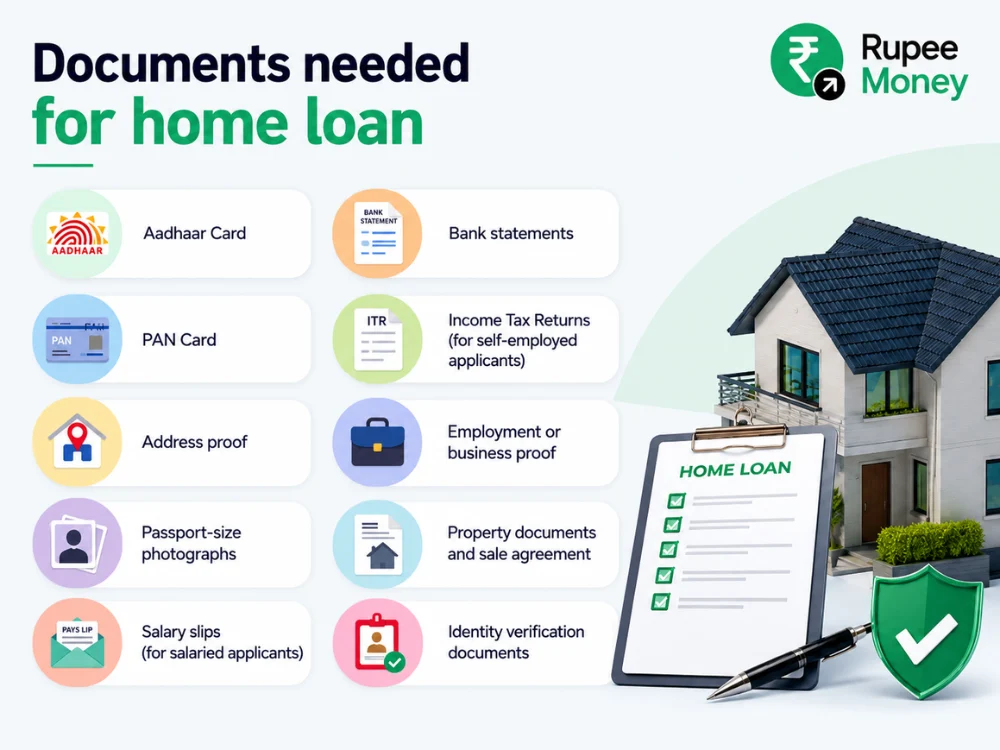
The exact list varies by lender, but most banks generally ask for:
- Aadhaar Card
- PAN Card
- Address proof
- Passport-size photographs
- Salary slips (for salaried applicants)
- Bank statements
- Income Tax Returns (for self-employed applicants)
- Employment or business proof
- Property documents and sale agreement
- Identity verification documents
Keeping these ready in advance can meaningfully speed up your approval timeline.
Common Mistakes Should Avoid
Some avoidable slip-ups that quietly push up the cost of borrowing:
- Choosing the first lender without comparing offers.
- Focusing only on EMI while ignoring the total loan cost.
- Taking a loan amount beyond your realistic repayment capacity.
- Skipping a credit score check before applying.
- Not saving enough for the down payment in advance.
- Overlooking processing fees and other hidden charges.
- Picking a longer tenure without calculating the total interest payable.
- Signing the loan agreement without reading it properly.Key Takeaways Before Taking a Home Loan
- Check your loan eligibility before you apply.
- Maintain a good credit score to improve your approval odds.
- Compare interest rates and processing charges across multiple banks.
- Calculate your EMI before deciding on the loan amount.
- Pick a tenure that balances an affordable EMI against total interest cost.
- Save toward a reasonable down payment in advance.
- Understand the tax benefits available to you.
- Read the full loan agreement carefully before signing.
- Compare customer service and repayment flexibility across lenders.
- Know your rights and responsibilities under the SARFAESI Act.
Frequently Asked Questions (FAQs)
What should I check before taking a home loan?
Before applying, evaluate your loan eligibility, credit score, monthly repayment capacity, interest rate, tenure, processing fees, down payment requirement, and available tax benefits. Comparing offers from multiple lenders helps you find a loan suited to your finances rather than one chosen purely on the lowest advertised rate.
What credit score is considered good for a home loan?
Most lenders prefer a credit score of 750 or above, though approval also depends on income, employment stability, existing obligations, and the lender’s own internal policies. A higher score generally improves your chances of a competitive rate and faster approval.
How Much Should You Pay as a Down Payment for a Home Loan?
Banks typically finance a percentage of the property’s value, with the remaining amount paid by you as a down payment. The exact percentage depends on the property value, lender policy, and applicable regulatory guidelines. Planning this early reduces both your loan amount and long-term interest burden.
Is a longer home loan tenure always better?
Not necessarily. A larger down payment reduces the amount you need to borrow, which can lower your monthly EMI and decrease the total interest payable over the loan tenure.. The better approach is choosing a tenure that keeps EMIs affordable while keeping overall borrowing costs in check.
What is the SARFAESI Act in the context of a home loan?
The SARFAESI Act, 2002 gives eligible banks and financial institutions a legal framework to recover outstanding dues from defaulting borrowers, following prescribed legal procedures. It’s a reminder of why timely EMI payments matter and why communicating with your lender during financial difficulty is important.
Can I prepay my home loan before the tenure ends?
Yes, most lenders allow part-prepayments or full closure before the tenure ends, though the exact terms, conditions, and charges depend on the lender and the type of interest rate you’ve chosen.
Disclaimer: The information shared in this article is for general awareness and educational purposes only. Home loan interest rates, eligibility requirements, processing charges, tax benefits, and lending terms may differ from one bank or housing finance company to another and can also vary based on an applicant’s financial profile. These policies are subject to change in line with RBI guidelines, government regulations, and the lender’s internal policies. Before applying for a home loan or making any financial decision, readers are advised to check the latest details with the respective lender or seek guidance from a qualified financial or tax professional. This article should not be treated as financial, legal, or tax advice.
ABOUT THE AUTHOR

