
Baal Aadhaar Card 2026: Eligibility, Documents Required, Biometric Update Rules and How Parents Can Apply
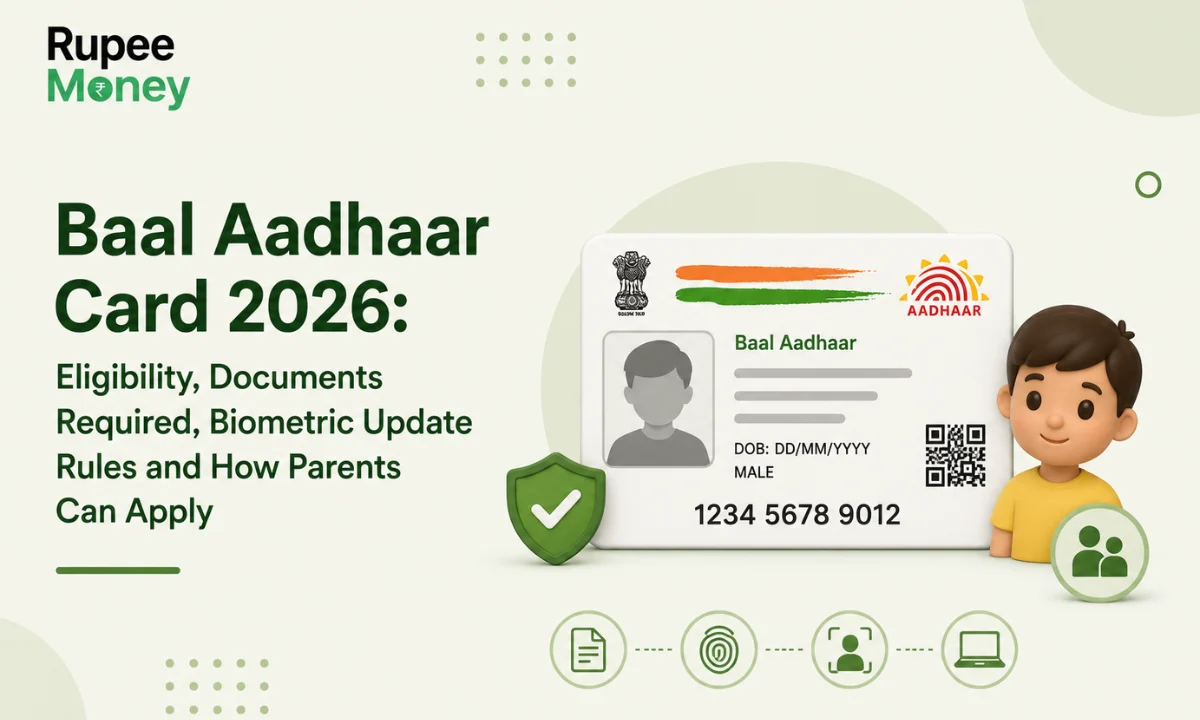
From school admissions and passport applications to government welfare schemes, Aadhaar has become just as essential for children as it is for adults. Alongside identity documents, opening a savings account for your child early is another smart step parents often overlook. To make this simpler, the Unique Identification Authority of India (UIDAI) issues a special card for children under five, called the Baal Aadhaar.
A lot of parents assume that once it’s issued, that’s the end of the process. It isn’t. UIDAI requires mandatory biometric updates at specific ages to keep the Aadhaar valid, and missing them can create real friction later. Here’s what you need to know if you’re applying for your child’s Aadhaar in 2026, from eligibility and documents to the biometric update rules and the application process.
What Is a Baal Aadhaar Card?
A Baal Aadhaar is issued to children below five years of age. Like a regular Aadhaar, it carries a unique, lifelong 12-digit number, but it’s easy to spot because it’s printed in blue rather than standard white.
Since a young child’s fingerprints and iris patterns are still forming, UIDAI doesn’t collect biometric data at this stage. Only the child’s photograph and demographic details are captured, with one parent or legal guardian authenticating the enrolment using their own Aadhaar.
Who Can Apply?
A child qualifies for a Baal Aadhaar if they’re under five, at least one parent or legal guardian has a valid Aadhaar, and that parent or guardian is present at enrolment to complete the authentication.
Documents You’ll Need in 2026
Carry original documents to the enrolment centre. You’ll typically need:
- The child’s birth certificate (mandatory for children born on or after 1 October 2023, under UIDAI’s updated document rules)
- The Aadhaar card of either parent or legal guardian
- Any additional documents requested for verification in specific cases
Having everything ready in original form helps avoid unnecessary delays at the centre.
How to Apply for a Baal Aadhaar
Step 1: Book an appointment. Use the UIDAI website to schedule a visit to your nearest Aadhaar Seva Kendra; many centres also accept walk-ins depending on availability.
Step 2: Visit the centre with your child. Bring all original documents. The enrolment form gets verified, your child’s photograph is taken, and you provide Aadhaar-based authentication and consent as the parent or guardian. No fingerprints or iris scans are collected at this stage.
Step 3: Collect your acknowledgement slip. This contains the enrolment ID, which you can use to track the Aadhaar’s status online.
Why the Biometric Update Is Mandatory
A Baal Aadhaar isn’t a one-and-done document. Since a child’s biometric features change dramatically as they grow, UIDAI requires two Mandatory Biometric Updates (MBUs).
First update, at age 5: Fingerprints, iris scans, and a fresh photograph are recorded for the first time. The Aadhaar number itself doesn’t change, this simply adds the biometric layer skipped at initial enrolment.
Second update, at age 15: This refreshes the biometric data again, since fingerprints and iris patterns shift through adolescence before stabilising into adulthood.
A useful, time-sensitive detail: UIDAI has waived the MBU fee for children aged 5–17 from 1 October 2025 through 30 September 2026. Outside this window, a late fee of around ₹100–125 typically applies, so it’s worth completing the update as soon as your child becomes eligible.
What Happens If You Miss It?
If the update isn’t completed once your child becomes eligible, their Aadhaar may not work reliably for authentication-based services, creating friction with school or college admissions, government scholarship schemes, passport applications, identity verification, and any service requiring biometric authentication. UIDAI’s advice is straightforward: complete the update as soon as your child crosses the relevant age milestone. Just as identity documents need to be kept current, so does your child’s financial protection — see why term insurance matters for every Indian family.
Where Can You Get It Done?
The mandatory biometric update can’t be completed online. Parents must visit an Aadhaar Seva Kendra or an authorised enrolment centre with the child present, since fresh fingerprints, iris scans, and a photograph all need to be captured in person.
Worth knowing: UIDAI has also partnered with schools to run on-campus MBU camps for children aged 5 to 15, covering roughly 83,000 schools and completing over one crore updates so far. If your child’s school is part of this drive, it can save you a separate trip to a centre entirely; otherwise, any Aadhaar Seva Kendra works just as well.
Can You Apply Entirely Online?
Not quite. You can book your appointment online through the UIDAI portal, but the actual enrolment requires an in-person visit, since the child’s photograph must be captured and the parent or guardian needs to complete authentication on-site.
Recent Rule Changes Worth Knowing
UIDAI updated its enrolment and document rules under the Aadhaar (Enrolment and Update) First Amendment Regulations, 2026, partly to prevent duplicate Baal Aadhaar enrolments. Keeping documents and processes updated is also relevant when applying for loans — see what affects your loan eligibility for a broader picture. Aadhaar numbers generated from birth certificates can now be shared with birth registrars, with parental consent, to stop multiple IDs being issued off the same certificate. The core requirements, birth certificates for enrolment and mandatory biometric updates at 5 and 15, remain unchanged. As with any government scheme, it’s worth checking UIDAI’s official site for the latest updates before your visit.
Key Points to Remember
Baal Aadhaar is for children under five and identifiable by its blue design. No fingerprints or iris scans are taken at first enrolment. A free biometric update is compulsory at age 5, and another at age 15 (with the fee currently waived through September 2026). One parent or guardian’s Aadhaar is required throughout, and the entire enrolment process is free of cost. While you’re setting up your child’s essential documents, it’s also worth reviewing your family’s health insurance coverage. For long-term child education or marriage goals, a Sukanya Samriddhi Yojana investment for daughters is worth exploring too .
FAQs
What’s the age limit for Baal Aadhaar?
It’s issued to children below five years of age.
Is fingerprint collection required at the time of applying?
No. Only the child’s photograph is captured initially; fingerprints and iris scans come later, during the mandatory biometric updates.
Is the biometric update free?
Yes, the updates at ages 5 and 15 are free, and UIDAI has extended a fee waiver for ages 5–17 through 30 September 2026.
Can I apply for Baal Aadhaar completely online?
No. You can book an appointment online, but you must visit a centre in person with your child to complete enrolment.
Is Baal Aadhaar useful for school admissions?
Yes, many schools, government schemes, passport services, and other official processes accept it as valid identity proof for children.
Conclusion
A Baal Aadhaar is more than a formality, it helps children access education, healthcare, government schemes, and a range of other services from an early age. Planning for these milestones financially is just as important — our guide on building wealth in your 20s is a good starting point for new parents mapping out long-term goals. A PPF investment is another reliable, long-term option many parents use for their child’s future. The application itself is straightforward, but don’t lose sight of the mandatory biometric updates at ages 5 and 15; they’re what keeps the Aadhaar accurate and functional as your child grows. Staying on top of these updates now means one less last-minute scramble later, whether it’s for school admissions, travel, or any government service down the road.
Disclaimer: This article is for informational purposes only. Aadhaar rules, fees, and documentation requirements are set by UIDAI and may change over time. Always verify the latest details on the official UIDAI website (uidai.gov.in) before visiting an enrolment centre.
ABOUT THE AUTHOR

