
Unveiling the Blinkit Business Model: How Quick Commerce Actually Works
Getting a packet of chips, a smartphone charger, or fresh vegetables delivered to your doorstep in just ten minutes feels like magic. However, behind this incredible convenience lies a highly sophisticated logistical and financial engine. At first glance, you might wonder how any company can afford to pay a delivery rider for a ₹150 grocery order without losing money.
The truth is, the Blinkit business model has evolved dramatically from its early days. Now operating under Eternal Limited (formerly Zomato Limited), the platform does much more than just ferry groceries. It operates an expansive retail network, an advertising channel, and a direct-sales powerhouse all rolled into one app. Understanding how this quick-commerce giant turns a profit requires the same strategic approach you would use for your own financial planning.
In this comprehensive guide, we will break down exactly how Blinkit makes money, the secret behind its lightning-fast delivery times, and why order density is the ultimate key to its success.
The Core Strategy: Decoding 10-Minute Delivery
To understand how Blinkit generates revenue, you must first understand its operational foundation. The company does not rely on massive, out-of-town warehouses. Instead, it utilizes a hyperlocal strategy driven by highly optimized micro-warehouses.
The Magic of Dark Stores
The secret weapon of the Blinkit business model is the “dark store.” These are compact, tightly organized fulfillment centers scattered strategically across densely populated urban neighborhoods. Unlike traditional supermarkets, dark stores strictly prohibit walk-in customers.
When you place an order on your phone, the Blinkit app instantly routes your request to the nearest dark store—usually located just two or three kilometers away. Inside, dedicated pickers use automated tracking software to locate your items and pack them in under three minutes. A delivery partner then picks up the bag and covers the short distance to your home in just a few minutes. By drastically reducing the travel distance, Blinkit cuts fuel costs, maximizes the number of deliveries a single rider can make, and ensures the 10-minute promise is physically possible.
Transitioning to an Inventory-Led Approach
Initially, Blinkit functioned merely as a digital middleman, connecting local grocery shops with buyers and charging a small commission. However, relying on third-party sellers limited their profit margins.
By mid-2025, Eternal guided Blinkit toward a robust inventory-led model. Today, the company directly purchases thousands of products at wholesale rates and stocks them inside its own dark stores. This massive operational shift gives Blinkit total control over product availability, quality, and pricing. Analyzing this strategic pivot is just as fascinating as studying corporate earnings to understand what makes the stock market go up or down.
How Does Blinkit Make Money?
Generating cash in the quick-commerce sector requires multiple income streams. Blinkit captures value at almost every stage of the consumer journey. Here is exactly how the platform drives its revenue.
1. Direct Sales and Product Margins
Since transitioning to an inventory-led operation, direct retail sales form the most significant chunk of Blinkit’s revenue. The company buys items in massive bulk from consumer goods manufacturers. When a customer purchases those items on the app at the standard maximum retail price (MRP), Blinkit pockets the difference as gross margin.
Furthermore, Blinkit aggressively pushes non-grocery items. While margins on milk and bread remain thin, the markup on beauty products, electronics, toys, apparel, and festive gifts can comfortably exceed 25%. Expanding this premium catalog directly boosts their bottom line.
2. The Power of Retail Media and Advertising
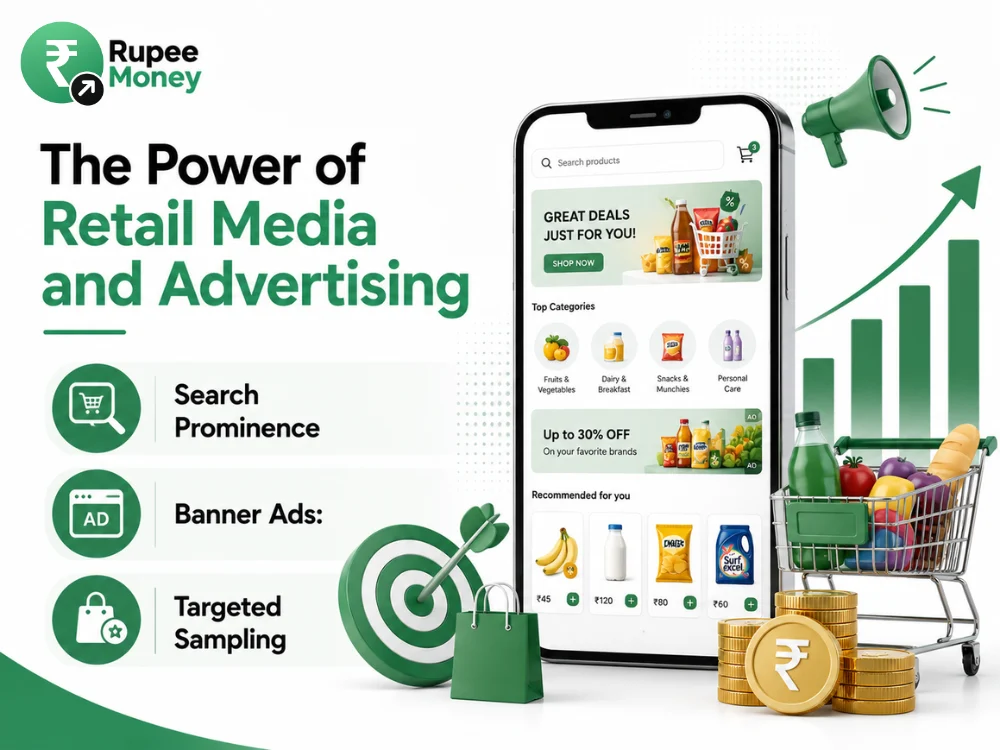
Advertising acts as a massive, high-margin cash cow for Blinkit. Because millions of users open the app with immediate buying intent, major brands view the platform as prime digital real estate.
Fast-moving consumer goods (FMCG) companies pay Blinkit premium rates for:
- Search Prominence: Ensuring their specific brand of shampoo appears first when a user types “hair care.”
- Banner Ads: Displaying large, colorful promotional campaigns on the app’s home screen.
- Targeted Sampling: Slipping free trial sachets of new products into the delivery bags of specific demographic groups.
Since displaying a digital banner incurs virtually zero logistical cost, advertising revenue translates almost entirely into pure profit.
3. Delivery Fees and Convenience Charges
To help offset the massive costs of paying last-mile delivery riders, Blinkit implements several user-facing fees. If you place a small order, you will likely incur a base delivery charge. Additionally, the platform utilizes dynamic pricing algorithms; if it rains or demand surges late at night, Blinkit applies a “surge fee.”
Moreover, the company charges a nominal handling or platform fee on every single transaction to support its backend technology infrastructure. Managing these small, recurring fees requires consumers to be mindful of their budgets, much like calculating fixed monthly outflows using an EMI calculator.
4. Seller Commissions and Logistics Services
Although Blinkit holds its own inventory, it still allows select third-party vendors and specialty brands to list products on the app. In exchange for access to millions of daily active users, Blinkit charges these sellers a variable commission rate based on the product category. Additionally, the company monetizes its supply chain by charging partner brands for cold-chain storage and warehousing space.
Mastering the Unit Economics of Quick Commerce
In the quick-commerce industry, survival depends entirely on efficiency. Running a network of over 2,400 dark stores requires immense capital. To turn a profit, Blinkit relies on two vital operational metrics.
Increasing Average Order Value (AOV)
A delivery rider expends the exact same amount of time and fuel delivering a ₹150 packet of biscuits as they do delivering a ₹1,200 electronic trimmer. Therefore, Blinkit constantly encourages you to buy more.
By offering a diverse catalog that includes stationary, premium cosmetics, and emergency electronics, Blinkit successfully increases its Average Order Value (AOV). A larger cart size absorbs the fixed cost of the delivery trip, transforming a potentially loss-making transaction into a highly profitable one.
Achieving High Order Density
A dark store carries fixed monthly expenses, including commercial rent, electricity, refrigeration, and staff salaries. If a dark store processes only 300 orders a day, those fixed costs destroy the profit margin. However, when a dark store processes 2,000 orders a day, the operational cost per order drops to almost nothing.
This concept of volume driving success mirrors the principles of compounding wealth. Just as small, consistent investments build a fortune over time—a concept you can track using a SIP calculator or by exploring what is SIP—Blinkit relies on millions of micro-transactions compounding into massive aggregate revenue.
Is the Blinkit Business Model Actually Profitable?
For years, critics argued that 10-minute delivery was merely a cash-burning gimmick designed to acquire users. However, Blinkit’s relentless focus on operational efficiency and high-margin advertising has silenced many skeptics.
According to financial disclosures from Eternal Limited, the quick-commerce division officially achieved adjusted EBITDA profitability in the third quarter of FY2026. By the June 2026 quarter, the company reported an adjusted EBITDA of ₹102 crore.
While the profit margins in hyperlocal logistics remain relatively slim (usually hovering around 1% to 2% at present), the sheer scale of operations generates tremendous absolute cash flow. For ambitious young professionals, observing how startups scale into profitable behemoths offers fantastic lessons on building wealth in your 20s. Furthermore, understanding how private capital fuels this initial growth is closely tied to how companies eventually go public; you can learn more about this by reading what is an IPO.
Conclusion
The Blinkit business model proves that quick commerce is much more than a logistical party trick. It is a highly calculated, data-driven retail ecosystem. By utilizing a dense network of dark stores, Blinkit turns physical proximity into speed, which in turn drives high customer purchasing frequency.
Instead of relying solely on delivery fees, the platform cleverly generates sustainable revenue through wholesale inventory margins, targeted digital advertising, and an ever-expanding product catalog. As consumers increasingly rely on quick commerce for daily essentials and premium goods alike, Blinkit’s unique blend of technology and local retail positions it as a dominant force in the future of Indian e-commerce.
For those looking to build their own financial safety nets, understanding diverse revenue streams is vital. Whether you are balancing an expanding portfolio or seeking safe, guaranteed returns, utilizing tools like an FD calculator can help you structure your personal wealth just as efficiently as Blinkit structures its dark stores.
FAQs
How is Blinkit able to deliver orders in 10 minutes?
Blinkit achieves lightning-fast delivery times by operating a vast network of "dark stores" positioned within a two-kilometer radius of residential hubs. Advanced software guides store workers to pick and pack items in under three minutes, allowing riders to cover the short physical distance to the customer's home almost instantly.
How does Blinkit actually make money?
The company generates revenue through multiple streams: pocketing the gross margin on direct inventory sales, charging brands for in-app advertising and sponsored search results, collecting delivery and convenience fees from users, and taking commissions from third-party sellers listed on the platform.
Do quick-commerce apps lose money on small grocery orders?
Yes, extremely small orders (e.g., under ₹100) often result in a net loss after factoring in packaging and rider payouts. To counter this, Blinkit applies small cart fees, surge pricing, and aggressively promotes high-margin items like electronics and cosmetics to increase the total basket size and achieve profitability.
What exactly is a dark store?
A dark store is a micro-fulfillment warehouse designed exclusively for online order processing. Unlike regular grocery stores, dark stores do not have glass storefronts, shopping carts, or cash registers. The aisles are optimized entirely for rapid navigation by dedicated warehouse staff.
Is Blinkit a profitable company today?
Yes, after years of refining its unit economics and expanding its product catalog, Blinkit's parent company, Eternal Limited, reported that the quick-commerce division achieved adjusted EBITDA profitability during the FY2026 financial year.
Blinkit achieves lightning-fast delivery times by operating a vast network of “dark stores” positioned within a two-kilometer radius of residential hubs. Advanced software guides store workers to pick and pack items in under three minutes, allowing riders to cover the short physical distance to the customer’s home almost instantly.
Yes, after years of refining its unit economics and expanding its product catalog, Blinkit’s parent company, Eternal Limited, reported that the quick-commerce division achieved adjusted EBITDA profitability during the FY2026 financial year.
Disclaimer: This article is intended strictly for educational, informational, and analytical purposes. The operational strategies, financial metrics, profitability reports, and revenue models discussed reflect publicly available data and corporate disclosures available up to 2026. Because corporate strategies and market dynamics evolve rapidly, readers should not treat this content as definitive financial or investment advice. Always consult a SEBI-registered financial advisor before making equity investments in publicly traded tech companies.
ABOUT THE AUTHOR

