
What Is a PPF Calculator? Calculate PPF Maturity Sum and Interest Online
Planning for long-term financial security gets much easier when you can accurately predict how your money grows over time. The Public Provident Fund (PPF) remains one of India’s most trusted savings schemes because it offers sovereign safety, high tax efficiency, and reliable long-term returns. However, many investors struggle to calculate their final maturity amount or understand how small changes in their annual contributions affect future wealth.
This is where an online tool comes in handy. You can easily estimate your total investment, interest earned, and final corpus within seconds. Instead of doing tedious math manually, using a dedicated financial tool helps you make smart money decisions with complete clarity.
At RupeeMoney, we believe that true wealth management starts with clear, accessible planning. Whether you keep your account with SBI, HDFC Bank, ICICI Bank, or India Post, every institution follows the exact same government-regulated rules and interest rates. If you want to compare different low-risk strategies before locking in your funds, try our FD Calculator alongside our primary PPF Calculator to see which fixed-income vehicle aligns best with your savings targets.
In this guide, you will discover how a Public Provident Fund calculator works, key factors influencing your returns, tax rules, and simple strategies to maximize your wealth accumulation.
What Is an Online PPF Calculator?
An online PPF calculator is a free financial tool that forecasts the future value of your Public Provident Fund investment. By entering your planned yearly contribution, the calculator computes your total deposits, total interest earned, and final maturity amount.
Rather than relying on complex spreadsheets, you receive an instant breakdown showing how your money compounds over the standard 15-year tenure. The tool also lets you project returns if you choose to extend your tenure in 5-year blocks.
While the calculator provides highly accurate estimates, keep in mind that the final payout depends on the quarterly interest rates declared by the Ministry of Finance.
What Is a Public Provident Fund (PPF) Account?
A Public Provident Fund account is a government-backed, long-term savings option designed to help individuals build a secure financial safety net. It offers a unique combination of capital safety, guaranteed returns, and unmatched tax benefits under Indian tax law.
Key operational features of a PPF account include:
- 15-Year Lock-in Period: The account matures after 15 full financial years. You can extend it indefinitely in blocks of 5 years.
- Investment Limits: You must deposit a minimum of ₹500 per financial year, with a maximum cap of ₹1,500,000 per year.
- Triple Tax Benefit (EEE Status): Your contributions qualify for deductions under Section 80C, the interest earned remains tax-free, and the final maturity amount carries zero tax liability.
- Sovereign Guarantee: Because the Central Government backs the scheme, your capital faces zero default risk.
Many smart investors use PPF as an anchor asset when building wealth in your 20s, using it as a risk-free baseline while taking calculated growth risks elsewhere.
How Does a PPF Calculation Engine Work?
A PPF calculator works by combining three basic inputs to project your long-term growth:
- Your total deposit amount every year.
- The prevailing annual PPF interest rate.
- The total duration of your investment (minimum 15 years).
What the Engine Outputs
- Total Principal Invested: The sum of all your yearly deposits.
- Total Interest Accrued: The compound interest generated over the tenure.
- Estimated Maturity Value: Your final total payout at the end of 15 years.
Interest on a PPF account compounds annually, but banks compute it monthly on the lowest balance recorded between the 5th and the last day of every month. Depositing your money before the 5th of every month ensures you earn interest for that entire month.
Key Benefits of Using an Online PPF Calculator
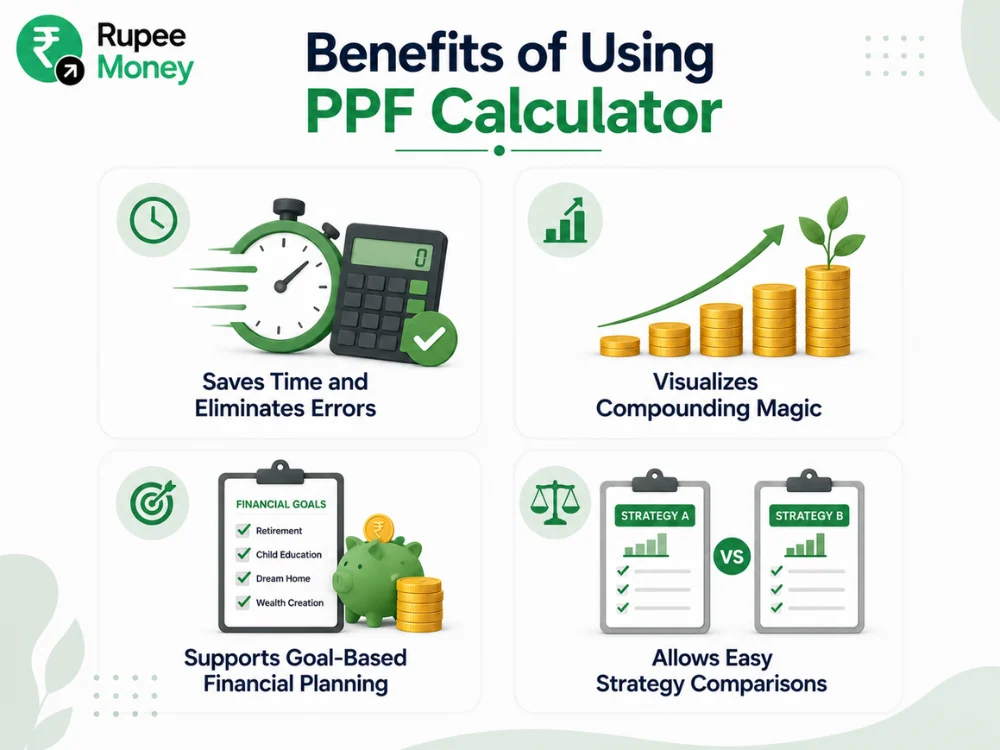
Using a digital calculator simplifies long-term wealth management and helps you build a disciplined saving habit:
- Saves Time and Eliminates Errors: You get instant, error-free results without doing manual math or managing complex spreadsheet formulas.
- Visualizes Compounding Magic: It clearly demonstrates how compound interest turns modest yearly contributions into a massive financial corpus over 15 to 20 years.
- Supports Goal-Based Financial Planning: You can easily adjust your annual inputs to match specific future goals like retirement, buying property, or funding higher education.
- Allows Easy Strategy Comparisons: You can compare conservative options like PPF against market-linked growth. For instance, comparing long-term PPF compounding with equity returns using a SIP Calculator helps you strike the perfect balance between risk and stability.
Factors That Impact Your PPF Maturity Corpus
Several practical factors directly influence how much wealth you accumulate at maturity:
- Deposit Timing: If you deposit your funds between the 1st and 5th of April each year, you earn interest on that full amount for all 12 months of the financial year.
- Quarterly Interest Rate Revisions: The Government of India reviews small savings interest rates every quarter based on market conditions and economic policies.
- Frequency and Regularity: Investing the maximum possible amount consistently every year maximizes compound interest growth.
- Tenure Extensions: Extending your account beyond 15 years (in 5-year blocks) allows compound interest to accelerate exponentially during the later years.
Where Can You Open a PPF Account in India?
You can open a PPF account at most major public and private sector banks, as well as designated India Post branches. Because the Central Government sets all rules, every institution offers identical interest rates, withdrawal policies, and safety levels.
Prominent institutions offering PPF accounts include:
- State Bank of India (SBI)
- HDFC Bank
- ICICI Bank
- Punjab National Bank (PNB)
- Canara Bank
- Bank of Baroda
- India Post (Post Office)
While interest rates stay uniform everywhere, choosing a bank with seamless net banking facilities makes managing your annual contributions much easier.
PPF vs. Mutual Fund SIP vs. Bank Fixed Deposits (FD)
Choosing the right investment vehicle depends on your risk tolerance, liquidity needs, and financial goals.
| Feature | Public Provident Fund (PPF) | Mutual Fund SIP | Bank Fixed Deposit (FD) |
| Asset Class | Sovereign Debt Scheme | Equity / Hybrid Funds | Bank Debt Deposit |
| Expected Returns | Government-declared (Fixed) | Market-linked (Variable) | Bank-declared (Fixed) |
| Risk Level | Zero Risk (Sovereign) | Moderate to High | Low (Insured up to ₹5 Lakh) |
| Lock-in Period | 15 Years | None (3 yrs for ELSS) | Flexible (7 days to 10 yrs) |
| Taxation Status | EEE (100% Tax-Free) | Capital Gains Tax applies | Taxable as per Income Slab |
| Best Suited For | Risk-averse wealth accumulation | Long-term inflation beating | Short-term capital safety |
If you want to understand how market volatility impacts long-term wealth, read our comprehensive guide on what is inflation and why does it matter to evaluate real inflation-adjusted returns.
Common Mistakes to Avoid When Using a PPF Calculator
Avoid these common missteps when calculating your projected savings:
- Assuming Interest Rates Remain Permanent: Small savings interest rates fluctuate quarterly. Treat calculator projections as strong estimations rather than fixed guarantees.
- Forgetting the Deposit Deadline: Depositing money after the 5th day of a month means you forfeit interest earned for that specific month.
- Miscalculating Extension Periods: If you plan to hold your account for 20 or 25 years, make sure to set the calculator duration to match your full planned tenure.
- Ignoring Tax Rules: Remember that the annual deduction limit under Section 80C stands capped at ₹1.5 Lakh per financial year across all eligible instruments.
For a broader perspective on low-risk options, check our breakdown comparing gold vs fixed deposit to balance your portfolio effectively.
Who Should Invest in a Public Provident Fund?
A PPF account suits a wide range of conservative and moderate investors, including:
- Salaried Employees: Individuals looking for reliable tax savings under Section 80C while building a safe retirement nest egg.
- Self-Employed Professionals: Business owners and freelancers needing a risk-free, government-backed wealth accumulator.
- Parents: Families building long-term financial security for their children’s future education or marriage goals.
- Young Professionals: Beginners starting their career who want to lock in a portion of their income in safe, tax-exempt debt assets.
Summary Key Takeaways
- An online PPF calculator provides instant projections for your principal, total interest, and final maturity sum.
- PPF offers absolute capital protection backed by the Government of India alongside 100% tax-exempt returns (EEE status).
- Depositing your yearly contribution before April 5th maximizes your annual interest payout.
- You can easily extend your PPF account in 5-year blocks after completing the initial 15-year tenure.
- Rates apply uniformly across all banks and post offices in India.
FAQs
What is an online PPF calculator?
An online PPF calculator is an automated financial planning tool that calculates your investment returns, compound interest, and final maturity value based on your annual contributions and current interest rates.
Can I deposit more than ₹1.5 Lakh in a PPF account per year?
No. The official maximum annual investment limit for a PPF account is ₹1,500,000 per financial year. Any excess amount deposited will not earn interest or qualify for tax benefits.
Is the maturity sum from a PPF account completely tax-free?
Yes. PPF falls under the Exempt-Exempt-Exempt (EEE) tax regime. This means your invested amount, accrued interest, and final maturity withdrawal remain entirely exempt from income tax.
Does a PPF account offer better security than bank deposits?
Yes. While bank deposits carry DICGC insurance coverage up to ₹5 Lakh per bank, a PPF account enjoys a direct sovereign guarantee from the Central Government of India, making it completely risk-free.
Conclusion
A PPF calculator serves as an essential tool for smart financial planning. By giving you immediate visibility into how your money grows over 15 years, it allows you to set realistic targets, optimize tax savings, and build a substantial, risk-free retirement corpus.
Start planning early, make regular contributions before the 5th of every month, and let annual compounding work for you.
Disclaimer: This article is only for educational purposes. PPF interest rates and rules are subject to periodic revisions by the Ministry of Finance, Government of India. Investors should check official government notifications before finalizing investment decisions.