
Large Mid or Small Cap? How Missing Best Market Days Costs Lakhs
Imagine investing ₹1 lakh in the stock market today. You leave that money untouched for 21 whole years. Your initial investment grows into a massive financial fortune. Now, remove just five of the strongest market days. Your final portfolio value drops by lakhs of rupees instantly.
Abakkus Mutual Fund published a brilliant analysis recently. Their study tracked Indian equity indices until July 2026. The results teach retail investors a highly valuable lesson. You might struggle to choose a large mid or small cap. However, staying invested matters much more than category selection.
Welcome to Rupeemoney. We simplify complex stock market returns for Indian investors. Today, we explore how market timing affects long term returns.
Large Cap vs Mid Cap vs Small Cap Returns Data
Abakkus Mutual Fund compared four major total return indices. They analyzed the Nifty 50 TRI and Nifty 100 TRI. They also studied the Nifty Midcap 150 TRI. Finally, they evaluated the Nifty Smallcap 250 TRI perfectly.
The researchers assumed a strict ₹1 lakh initial investment. They reviewed historical market data from April 2005. The study period ended precisely in July 2026.
They compared a fully invested portfolio against a timed portfolio. The timed portfolio missed the five best market days.
| Index Name | CAGR (Fully Invested) | Final Value | CAGR (Missed 5 Days) | Final Value | Total Wealth Gap |
| Nifty 50 TRI | 13.67% | ₹15.39 lakh | 11.31% | ₹9.83 lakh | ₹5.55 lakh |
| Nifty 100 TRI | 14.00% | ₹16.37 lakh | 11.68% | ₹10.56 lakh | ₹5.81 lakh |
| Nifty Midcap 150 TRI | 17.20% | ₹29.54 lakh | 15.12% | ₹20.16 lakh | ₹9.38 lakh |
| Nifty Smallcap 250 TRI | 15.80% | ₹22.86 lakh | 13.83% | ₹15.85 lakh | ₹7.01 lakh |
The mid-cap index delivered the absolute highest CAGR overall. Yet, it also suffered the most severe wealth destruction. Missing those five best days caused massive financial damage.
Why Missing Five Best Market Days Hurts You
Stock markets never move upward in a perfect straight line. Specific trading sessions deliver exceptionally massive financial returns suddenly. These explosive market days boost your long-term compounding significantly.
Scared investors often sell their holdings during market corrections. They try to protect their capital from further drops. Consequently, they miss the strongest market recovery rallies completely.
Re-entering the stock market creates a massive psychological hurdle. You must identify the perfect market bottom accurately. This impossible task causes immense anxiety during market volatility.
The Abakkus data demonstrates this exact danger very clearly. Missing five explosive sessions destroyed the CAGR across all indices. This proves why staying invested matters in stock market investing. You must stop trying to predict short-term market movements continuously.
Nifty 50 TRI: Large Cap Stocks Lose ₹5.55 Lakh
The Nifty 50 index represents fifty massive Indian companies. These large cap stocks provide relatively stable equity returns. The Nifty 50 TRI generated a solid 13.67% CAGR. A ₹1 lakh investment grew to exactly ₹15.39 lakh.
However, missing the five best days ruined this outcome. The adjusted CAGR plummeted to a mere 11.31%. That same ₹1 lakh reached only ₹9.83 lakh eventually.
Active market timing destroyed ₹5.55 lakh of potential wealth. You lost this money by missing five days across 21 years. You can read our guide on large cap mutual funds here.
Nifty 100 TRI: Broad Market Timing Fails
The Nifty 100 index offers broader large-cap market exposure. Patient investors earned a handsome 14.00% CAGR here. Their ₹1 lakh investment reached an impressive ₹16.37 lakh.
Missing the five best market days changed everything negatively. The revised CAGR dropped sharply to exactly 11.68%. The final portfolio value reached a disappointing ₹10.56 lakh.
This error created a massive wealth gap of ₹5.81 lakh. Large-cap investing never protects you from market timing mistakes. Blue-chip companies also experience extremely violent daily price swings.
Nifty Midcap 150 TRI: Highest Returns and Biggest Loss
Mid-cap stocks offer thrilling wealth creation opportunities for investors. The Nifty Midcap 150 TRI delivered a stunning 17.20% CAGR. A simple ₹1 lakh investment exploded to ₹29.54 lakh. This index generated the highest final value overall.
Unfortunately, missing five crucial days caused absolute devastation. The CAGR dropped significantly to exactly 15.12%. The investment value shrank rapidly to ₹20.16 lakh.
The resulting wealth gap reached a staggering ₹9.38 lakh. Mid-cap investments demand high tolerance for severe market volatility. You must endure terrifying drops to capture massive gains. Discover how these funds work in our mid cap mutual funds article.
Nifty Smallcap 250 TRI: High Risk Costs Dearly
Small-cap stocks attract aggressive investors seeking rapid portfolio growth. The Nifty Smallcap 250 TRI delivered an excellent 15.80% CAGR. The initial ₹1 lakh grew beautifully to ₹22.86 lakh.
Market timers who missed five days suffered harsh consequences. Their adjusted CAGR fell to a low 13.83%. Their final portfolio value reached only ₹15.85 lakh ultimately.
This active trading mistake wiped out ₹7.01 lakh entirely. Small-cap investors face brutal penalties when they miss market recoveries. Learn more about these risky options in our small cap mutual funds guide.
Should You Invest in Large Mid or Small Cap?
Every new investor struggles to pick the perfect segment. No single category matches every individual investor perfectly. Your personal risk appetite dictates your ideal portfolio diversification.
Why Choose Large Cap Stocks?
Large-cap companies boast massive market capitalisation and established businesses. They provide excellent stability during harsh economic downturns. Conservative investors prefer these giant corporations for steady growth. However, severe market crashes still affect their share prices heavily.
Why Choose Mid Cap Stocks?
Mid-cap companies sit perfectly between established giants and startups. They balance current operational stability with future expansion opportunities. The 21-year study highlighted their superior long-term wealth creation. You must accept higher daily volatility to hold them successfully.
Why Choose Small Cap Stocks?
Small-cap companies provide the highest possible growth potential globally. Their stock prices experience incredibly violent daily fluctuations. Poor market liquidity creates extra danger during market panics. Only aggressive investors with decade-long horizons should buy them.
Market Timing vs Staying Invested: What Wins?
Market timing sounds incredibly simple and logical in theory. You sell all stocks right before a market crash. You buy everything back right before the recovery starts.
Executing this strategy in reality remains functionally impossible. Markets usually rebound forcefully when general sentiment looks terrible. A fearful investor waits for positive news to re-enter. They buy back in only after prices have skyrocketed.
You avoid minor losses but miss the strongest recovery sessions. The Abakkus study illustrates the severe cost of this approach. Consistent market participation builds massive wealth over long periods.
Start your investing journey early to maximize these compound returns. Read our comprehensive guide on building wealth in your 20s today.
How Compounding Demands Continuous Market Participation
Financial compounding requires completely uninterrupted time to work properly. Your investment returns generate additional returns every single year. This mathematical snowball accelerates rapidly over long investment horizons.
Frequent buying and selling disrupts this beautiful process entirely. Every day spent outside the market carries severe financial risk. You risk missing the most profitable days of the decade. Time in the market always beats timing the market flawlessly.
Does This Mean You Must Never Sell Stocks?
You do not need to hold every stock forever. Smart investors sell assets when their financial goals change. You must rebalance your portfolio to manage asset risk properly.
You should sell a stock if company fundamentals deteriorate permanently. Selling makes perfect financial sense in these specific situations. The problem arises when investors trade based on daily emotions.
Short-term fear and greed destroy long-term wealth creation plans. You must learn the difference between rebalancing and panic selling.
How to Avoid Missing the Best Market Days
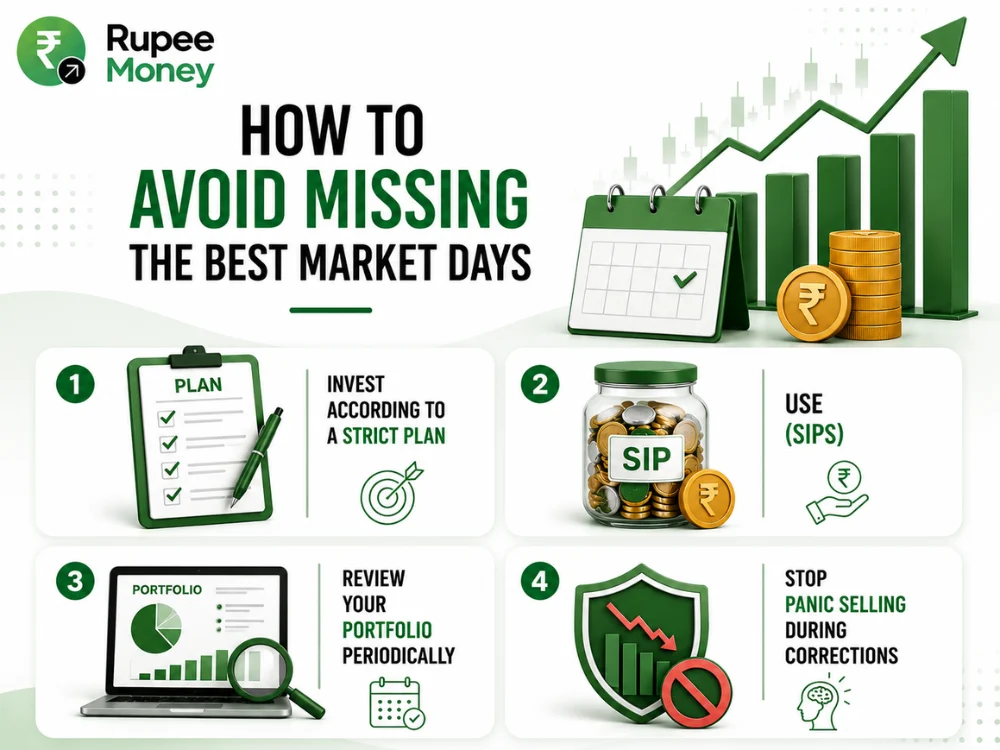
Nobody can predict the strongest market sessions beforehand accurately. This reality makes perfect market timing a fool’s errand. Instead, successful investors follow a highly disciplined investment process.
Invest According to a Strict Plan
Set a specific investment amount based on your monthly income. Define your long-term financial goals very clearly today. Avoid changing your entire strategy whenever the news sounds bad.
Use Systematic Investment Plans (SIPs)
A systematic investment plan automates your wealth creation journey completely. You invest a fixed rupee amount every single month reliably. This strategy eliminates the dangerous urge to time the market.
If you are new to systematic investing, learn the basics. Read our guide on what is SIP before starting your journey. You can estimate your future wealth using our accurate SIP Calculator.
Review Your Portfolio Periodically
Regular portfolio review does not mean checking stock prices daily. A periodic review helps you verify your target asset allocation. It ensures your current investments still match your future goals.
Stop Panic Selling During Corrections
Stock market corrections naturally create immense fear among retail investors. Selling your entire portfolio locks in your temporary losses permanently. It prevents you from participating in the inevitable market recovery. Make calm decisions based entirely on your original investment plan.
Can Missing Five Days Really Cost Lakhs?
Yes, the historical 21-year analysis proves this terrifying fact. Missing just five days reduced a ₹1 lakh investment severely. The wealth gaps ranged from ₹5.55 lakh to ₹9.38 lakh.
The Nifty Midcap 150 index suffered the absolute largest gap. The Nifty 50 index recorded the smallest wealth destruction gap. However, these exact figures represent one specific historical period.
You will not lose these exact rupee amounts in reality. Your actual outcome depends on your chosen index and timing. This example simply demonstrates how powerful daily compounding truly is.
What Should Investors Learn From This Data?
The biggest lesson ignores the large mid or small cap debate. The study highlights the brutal cost of missing market recoveries. All four major indices produced significantly lower CAGRs for timers.
The mid-cap index showed the most extreme wealth difference. The large-cap indices also showed deeply painful financial gaps. The small-cap index showed a ₹7.01 lakh difference strictly.
Therefore, you must adopt a strategy you can actually follow. Stop trying to predict every market high and low daily. A disciplined approach helps you reach your financial goals safely.
Conclusion
The 21-year market comparison delivers a powerful message for Indians. Your ₹1 lakh investment grows massively across all market caps. You just need to stay invested patiently for two decades.
Missing just five of the strongest market days destroys wealth. The Nifty Midcap 150 showed a terrifying ₹9.38 lakh gap. The Nifty Smallcap 250 followed closely with ₹7.01 lakh.
This data does not declare mid-caps better than large-caps. It proves you must look beyond short-term market price movements. Choose your market cap based entirely on your risk profile.
Give your chosen investments enough time to compound properly. Finally, accept that you cannot predict the market’s best days.
FAQs
What happens if you miss the best market days?
Missing the strongest market sessions reduces your long-term returns severely. These explosive days contribute massively to your overall portfolio compounding. The Abakkus study proved that missing five days destroys wealth. It reduced the CAGR across all major Indian equity indices.
Which market cap category gave the highest CAGR?
The Nifty Midcap 150 TRI delivered the absolute highest CAGR. It generated a stunning 17.20% CAGR over 21 years. A hypothetical ₹1 lakh investment grew to roughly ₹29.54 lakh. However, historical returns never guarantee future stock market performance.
Which index suffered the biggest wealth loss?
The Nifty Midcap 150 TRI recorded the largest wealth gap. The fully invested portfolio grew to approximately ₹29.54 lakh. Missing five days reduced this final value to ₹20.16 lakh. Active market timing cost these investors exactly ₹9.38 lakh.
Are large cap stocks safer than small cap stocks?
Large-cap stocks offer relatively greater stability during market crashes. They represent established corporate giants with massive market capitalisation. However, they still carry significant equity market risks constantly. You must match your asset allocation to your personal risk tolerance.
Is staying invested better than timing the market?
Staying invested remains far superior to active market timing. It prevents you from missing sudden and powerful market recoveries. However, you must still review your portfolio periodically for rebalancing. You must simply avoid emotional trading based on daily news.
Disclaimer: This article provides general information for educational and informational purposes only. The historical figures, CAGR calculations, and wealth gap examples discussed above are based on an independent analysis of Indian equity indices (Nifty 50, Nifty 100, Nifty Midcap 150, and Nifty Smallcap 250) spanning from April 2005 to July 2026, as reported by Mint. Past performance is never a reliable indicator or guarantee of future returns.
ABOUT THE AUTHOR

