
Why Do Companies Buy Back Their Own Shares? Meaning, Benefits and Impact on Investors
Have you ever seen a company announce a share buyback and wondered why? At first glance, the decision seems backwards. Companies usually issue shares to raise money, after all. So why would they spend cash buying those same shares back?
The answer sits in business strategy. A buyback can improve financial ratios, reward shareholders, and put excess cash to better use. It doesn’t always signal strong performance, though. Sometimes companies buy back shares for genuinely strategic reasons. Other times, they simply lack better places to deploy surplus cash.
At RupeeMoney, we believe understanding corporate actions like buybacks helps you invest with real clarity. This guide covers how buybacks work, why companies announce them, and what the major 2026 regulatory changes mean for you as an investor.
What Is a Share Buyback?
A share buyback, also called a share repurchase, happens when a company buys back its own shares from existing shareholders. The company usually cancels these shares after purchase. That reduces the total outstanding share count in the market.
Since fewer shares remain, each existing shareholder owns a slightly larger slice of the company, without buying anything more. Companies generally fund buybacks from accumulated cash reserves. Unlike issuing new shares, a buyback shrinks share capital, rather than expanding it.
Why Do Companies Buy Back Their Own Shares?
Companies announce buybacks for several genuinely distinct business and financial reasons. Each company’s objective usually depends on its own financial position and future plans.
Return Excess Cash to Shareholders
Many mature companies generate more cash than they currently need for expansion. Rather than letting unused cash sit idle, they return it through a buyback instead. This lets investors capture value without locking in a higher regular dividend commitment.
Improve Earnings Per Share
One of the biggest reasons behind buybacks is boosting Earnings Per Share, or EPS. EPS measures how much profit belongs to each outstanding share. When a company reduces its share count, that same total profit gets divided among fewer shares. EPS rises, even if overall profit stays flat. Higher EPS often draws investor attention, since it signals stronger per-share earnings.
Increase Shareholder Value
A buyback raises the ownership percentage held by remaining shareholders. With fewer shares in circulation, existing investors indirectly own a larger slice of the business. This can genuinely improve long-term shareholder value, if the company keeps growing afterward. Metrics like Return on Assets help you judge whether that growth is actually real.
Show Confidence in the Business
Sometimes management believes the market has undervalued the company’s shares. Rather than investing elsewhere, they buy their own shares, treating it as an attractive investment. Such announcements often signal real confidence in future prospects. This positive signal can improve sentiment, but you should still evaluate the company’s actual financial performance before deciding anything.
Support the Share Price
During weak markets, companies sometimes buy back shares to boost demand. Higher demand can ease selling pressure and support the price temporarily. Buybacks can’t permanently prevent declines, though, if the underlying business fundamentals genuinely weaken.
Improve Financial Ratios
Reducing outstanding shares can lift several financial ratios at once. Earnings Per Share, Return on Equity, and Book Value Per Share all typically improve. The Price-to-Earnings Ratio can shift too, depending on the situation. Improved ratios can make a company look more attractive on paper. You should still ask whether actual business performance improved, or just the ratios did.
How Does a Share Buyback Work?
The buyback process follows a fairly structured path.
Step 1: Board approval. The company’s Board of Directors approves the buyback proposal, specifying the share count, price, and method.
Step 2: Regulatory compliance. The company follows SEBI regulations and legal requirements before proceeding, disclosing key information to stock exchanges.
Step 3: Buyback announcement. The company publicly announces the buyback size, price, eligibility, method, and timeline for investors to review.
Step 4: Shareholders participate. Eligible shareholders decide whether to tender their shares or keep holding them. Participation always stays entirely voluntary.
Step 5: Shares get bought back. The company purchases shares per the announced terms, then typically extinguishes them, shrinking the outstanding share count.
Types of Share Buyback in India: What’s New in 2026
Indian companies generally use two buyback methods, though the landscape shifted significantly this year.
Tender Offer Buyback
In a tender offer, the company offers to purchase shares from eligible shareholders at a fixed price, usually set above the prevailing market price. Participation stays voluntary. If offered shares exceed the buyback size, the company accepts them proportionately across applicants.
Open Market Buyback
In an open market buyback, the company purchases shares directly through stock exchanges over a set period, at prices that shift with market conditions.
Here’s where things genuinely changed. SEBI phased out this route entirely between 2022 and 2025, citing unequal shareholder treatment and tax distortions, before fully banning it from April 1, 2025. After the government aligned buyback taxation with standard capital gains treatment, SEBI reintroduced open market buybacks effective August 1, 2026, under a stricter new framework. Companies can now repurchase up to 15% of paid-up capital and free reserves through this route, with the offer opening within four working days of announcement and closing within 66 working days, considerably tighter than the earlier six-month window.
How Does a Share Buyback Affect Share Prices?
A buyback can shape a company’s share price in several ways, though the actual impact depends heavily on market conditions and business fundamentals.
Reduced share supply, improved investor confidence, and higher EPS all tend to support prices. Positive sentiment and stronger demand during the buyback window add further support too. Buybacks often help share prices in the short run, but they never guarantee long-term appreciation. Future business performance remains the single most important driver of stock prices, regardless of any buyback.
Advantages of Share Buybacks
Buybacks can genuinely benefit both companies and shareholders together. They improve EPS, raise shareholder ownership percentage, and return excess cash efficiently. Share buybacks demonstrate management confidence and improve financial ratios broadly. They can support valuation during weak markets too, offering more flexibility than committing to regular dividends. Remember, though, that a buyback only becomes meaningful alongside genuinely strong business fundamentals and sustainable growth.
Disadvantages and Risks of Share Buybacks
Buybacks often create positive sentiment, but they’re not automatically beneficial. Understand the real drawbacks before assuming every buyback signals good news.
Reduced cash reserves. A buyback uses up available cash directly. Spend too much here, and the company may have less left for expansion, research, or acquisitions.
Temporary ratio improvement. EPS rises through a smaller share count, not necessarily stronger performance. If profits stay flat while EPS climbs purely from fewer shares, dig into the company’s overall financial health more carefully.
Limited long-term impact. A buyback can’t fix weak fundamentals. If revenue growth slows or debt rises, a buyback alone won’t sustain the share price for long.
Opportunity cost. Money spent on buybacks can’t fund anything else. Sometimes new factories, technology, or acquisitions would generate stronger long-term returns than repurchasing shares instead.
How Do Share Buybacks Benefit Investors?
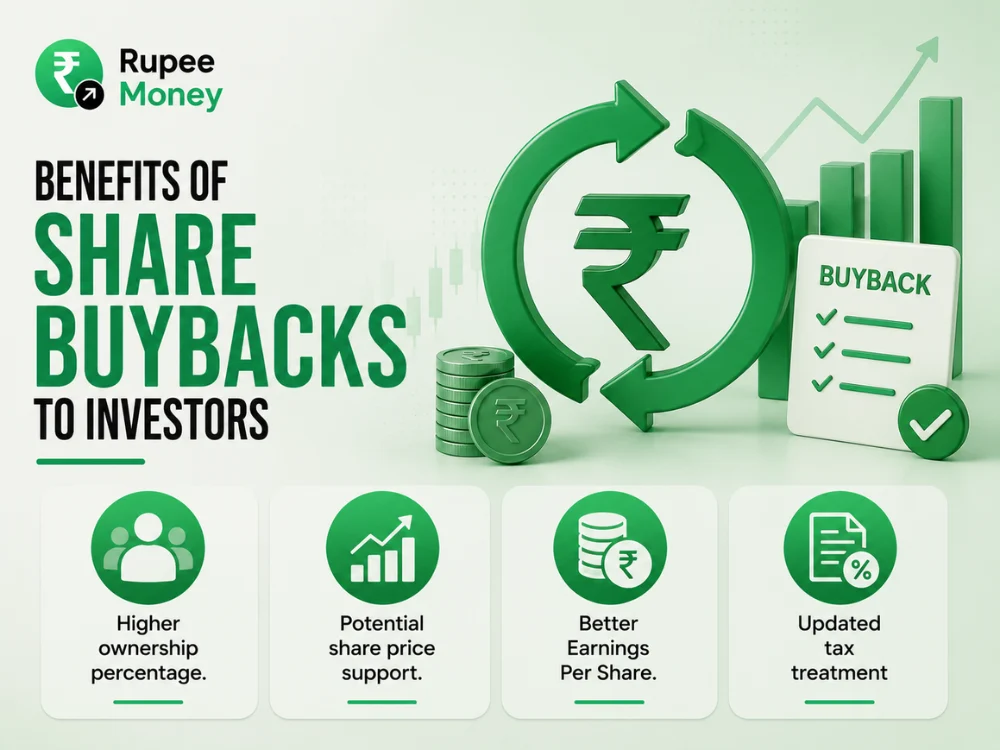
A successful buyback can genuinely create value, though the real benefit depends on the company’s financial strength and future performance.
Higher ownership percentage. Fewer outstanding shares mean each remaining shareholder owns a slightly bigger slice, without buying anything extra.
Potential share price support. Buyback announcements often lift investor confidence, and the added demand can support prices during the buyback window.
Better Earnings Per Share. With fewer shares splitting the same profit, EPS often improves, making per-share performance look stronger.
Updated tax treatment for 2026. This changed significantly this year, and it’s worth understanding clearly. From October 1, 2024, buyback proceeds became taxable as deemed dividends in shareholders’ hands, taxed at your regular income slab rate. From April 1, 2026, that shifted again: buyback proceeds now attract capital gains tax instead, calculated on your actual gain. Long-term holdings get taxed at 12.5%, while short-term holdings attract 20%. This brings buyback taxation in line with regular market sales, removing the earlier tax distortion that partly triggered the 2025 ban on open market buybacks in the first place.
Share Buyback vs Dividend vs Bonus Shares
All three corporate actions benefit shareholders, but they work quite differently.
| Feature | Share Buyback | Dividend | Bonus Shares |
| Purpose | Reduce outstanding shares | Distribute profits | Increase share count |
| Cash Received | Only participating shareholders | All eligible shareholders | No cash received |
| Share Count | Decreases | Unchanged | Increases |
| EPS Impact | Usually increases | No direct impact | Usually decreases initially |
| Ownership Percentage | Increases for remaining shareholders | Unchanged | Almost unchanged |
Understanding these differences helps you interpret corporate announcements far more accurately. If you’re weighing all three together, it’s also worth reading Bonus Shares Explained for the full picture.
Should Investors Buy Shares Before a Buyback?
Not necessarily, no. A buyback announcement alone should never become your sole reason for investing. Before buying any stock, weigh revenue growth, profit margins, and debt levels together. Cash flow, Return on Equity, and the underlying business model matter just as much. Industry outlook, future expansion plans, and promoter quality round out a genuinely complete picture. Company valuation deserves real scrutiny too, rather than getting overshadowed by buyback headlines.
A buyback should support an already strong business, not compensate for weak performance. Long-term wealth creation depends on fundamentals, not corporate actions alone. If you’re new to how companies raise money in the first place, What Is an IPO? covers the opposite side of this story. If you’d rather build wealth through disciplined, regular investing instead of reacting to corporate news, What Is SIP? is worth reading.
Conclusion
A share buyback ranks among the most important corporate actions in the stock market. Companies buy back shares to return excess cash, improve EPS, increase shareholder value, and signal confidence in future growth.
Investors, though, should never assume every buyback is automatically good news. A meaningful buyback comes from financially strong companies with healthy cash flows and sustainable models. With India’s buyback rules shifting significantly through 2025 and 2026, including the return of open market buybacks and new capital gains tax treatment, staying current on these mechanics genuinely matters more than ever. Before investing, always weigh financial performance, growth prospects, and valuation alongside any buyback announcement. If you’re building your broader investing foundation, Building Wealth in Your 20s pairs well with concepts like this. Try the SIP Calculator to plan disciplined, long-term investing instead of reacting to corporate actions, or the Lumpsum Calculator if you’re planning a one-time investment in quality companies.
Frequently Asked Questions:
Why do companies buy back their own shares?
To return excess cash to shareholders, improve EPS, increase ownership percentage, and signal confidence in future growth. A buyback may also support the share price during weak markets. Its effectiveness, though, depends on the company’s financial strength, not the announcement alone.
Is a share buyback good for investors?
It can be, if the company has strong fundamentals and deploys surplus cash wisely. It may improve EPS and ownership percentage. Don’t treat every buyback as automatically positive, though, since even weaker companies sometimes announce them too.
How does a share buyback affect the share price?
It often reduces outstanding shares, which can improve demand and sentiment. Higher EPS and management confidence can support prices further. Long-term price movement, though, still depends mainly on earnings growth and future business performance.
What is the difference between a share buyback and a dividend?
A dividend distributes profits to all eligible shareholders as cash. A buyback purchases shares from willing shareholders, shrinking the outstanding count. Dividends give immediate income; buybacks can raise shareholder value through better ownership percentage and ratios.
How are buyback proceeds taxed in 2026?
As capital gains, calculated on your actual profit. This rule took effect April 1, 2026, replacing the earlier deemed-dividend treatment used since October 2024. Long-term holdings attract 12.5% tax, and short-term holdings attract 20%.
Should beginners invest in a company only because it announces a buyback?
No, definitely not. Study revenue growth, profitability, debt, valuation, and management quality first. A buyback only becomes meaningful when it’s backed by genuinely strong business fundamentals underneath.
Disclaimer: This article is intended for educational and informational purposes only. A share buyback is one of several corporate actions that may influence investor sentiment and financial ratios, but it should not be the sole basis for an investment decision. Tax rules and SEBI regulations mentioned here reflect the position as of August 2026 and may change further. Investors should evaluate a company’s financial performance, valuation, cash flow, and growth prospects before investing, and consult a qualified tax or financial advisor for personalised guidance.
ABOUT THE AUTHOR

