
How Does Independence Day Affect the Indian Stock Market?
Every August 15, India celebrates its Independence Day with massive pride. For stock market investors, this date raises a completely different question entirely. Does Independence Day actually affect the Indian stock market?
The real answer requires proper context. Independence Day itself does not magically force the Sensex or Nifty to rise. The real market impact comes from trading holidays, government announcements, and shifting investor sentiment.
In 2026, August 15 falls on a Saturday. The National Stock Exchange (NSE) and Bombay Stock Exchange (BSE) will remain completely closed. India proudly celebrates its 80th Independence Day this year.
Welcome to RupeeMoney. We help you understand exactly how national events influence your stock portfolio. Let us explore what happens to Indian markets around Independence Day.
Is the Indian Stock Market Open on Independence Day?
No, the Indian stock market remains strictly closed on Independence Day. The NSE and BSE suspend all regular equity trading activities completely.
In 2026, August 15 falls exactly on a Saturday. This means the national holiday simply merges with the normal weekend market closure. Investors cannot buy or sell equity shares on this specific day.
However, market-moving news does not stop simply because Indian exchanges remain closed. Global stock markets continue operating normally during India’s national holiday. Geopolitical developments, global interest rates, and crude oil movements continue altering global sentiment.
These massive global factors heavily influence Indian stocks when local trading finally resumes. Read how global markets affect the Indian stock market to understand this dynamic perfectly.
Why Independence Day Influences Stock Market Sentiment
Independence Day carries incredibly strong national sentiment. Millions of Indians focus fiercely on the country’s rapid economic progress. Discussions regarding infrastructure, modern manufacturing, and defence capabilities dominate national headlines.
Crucial government announcements around this occasion easily attract massive investor attention. The Prime Minister’s Independence Day address usually outlines major national economic priorities. He focuses heavily on infrastructure execution, manufacturing boosts, and employment generation.
Smart investors hunt for specific announcements affecting particular corporate industries. A new policy supporting domestic manufacturing directly benefits listed capital goods companies. A major defence-related announcement immediately attracts massive attention toward defence stocks.
However, investors must distinguish temporary sentiment from actual corporate financial impact. A political speech alone does not instantly increase a company’s quarterly earnings.
Can Independence Day Announcements Move Stock Prices?
Yes, they potentially can. The stock market reacts aggressively to information altering future corporate earnings expectations.
Suppose the government announces a massive multi-billion dollar infrastructure programme. Investors immediately expect higher future order inflows for listed construction companies. This pure expectation influences stock prices rapidly before companies report any additional revenue.
This exact logic applies heavily to defence, renewable energy, and railway sectors. However, no Independence Day announcement guarantees a massive, sustained market rally. Investors will react terribly negatively if an announcement severely disappoints their high expectations.
How Independence Day Affects Indian Defence Stocks
Defence companies always receive massive additional attention around Independence Day. This connection makes absolute intuitive sense. National security forms a critically important part of India’s long-term strategic agenda.
Government spending on military modernisation creates lucrative opportunities for domestic defence manufacturers. Companies building aircraft, missiles, radar systems, and naval vessels benefit greatly. You can read our detailed guide on why defence stocks gain attention around Independence Day for deeper insights.
However, retail investors should never buy defence stocks simply because August approaches.
You must strictly evaluate these critical business factors first:
- Massive defence budget allocations
- New official procurement programmes
- Actual signed contract announcements
- Total corporate order-book size
- Physical production capabilities
- Overseas export opportunities
- Current stock market valuation
India’s defence production reached a staggering ₹1.78 lakh crore recently in FY2025-26. Defence exports also reached a record ₹38,424 crore. Long-term earnings still depend entirely on actual orders and successful execution.
Does Independence Day Affect Infrastructure Stocks?
Infrastructure stocks attract incredibly heavy investor attention during this period. Independence Day speeches constantly discuss India’s massive future development ambitions.
Huge infrastructure projects create massive business opportunities across several different industries. These heavily affected sectors include highways, railways, airports, cement, and specialized engineering.
When the government announces new spending targets, investors instantly reassess exposed companies. However, the stock market usually prices these expectations long before actual revenue appears.
Investors must meticulously verify whether a promised project actually received official government funding. A catchy news headline never automatically generates massive earnings for any listed company.
If you are a young investor, read about building wealth in your 20s.
How Independence Day Affects Broad Investor Sentiment
Stock markets respond fiercely to future expectations constantly. Investor sentiment improves massively when people expect stronger future economic growth.
Independence Day perfectly reinforces ongoing conversations around India’s massive growth story. Discussions naturally highlight digital infrastructure, soaring exports, and booming domestic consumption.
Positive national sentiment definitely supports short-term buying interest. However, patriotic sentiment alone cannot control the stock market permanently. Global interest rates, currency movements, and geopolitical risks easily overpower festive sentiment completely.
This brutal reality matters immensely in 2026. Indian markets currently deal with extreme global geopolitical uncertainty continually. Elevated crude oil prices put immense pressure on Sensex and Nifty indices heavily. Therefore, never assume Independence Day creates a magical, risk-free positive market environment.
What Happens to Stocks After the Independence Day Holiday?
The very first trading session after a holiday reacts to accumulated global information. Imagine the Indian stock market closes completely before Independence Day.
While Indian exchanges sleep, massive international markets continue trading aggressively. Crude oil prices swing wildly based on global supply dynamics. The US stock markets might crash or rally sharply overnight.
When Indian markets finally reopen, investors respond to all these developments simultaneously. This sudden reaction creates a massive gap-up or gap-down market opening immediately.
A gap-up occurs when stocks open significantly higher than their previous closing price. A gap-down occurs when stocks open brutally below their previous close. Traders must monitor global cues tightly before the next Indian trading session begins.
For steady long-term growth, explore SIP investing in India.
Can Independence Day Create a Massive Market Rally?
It contributes to positive sentiment, but it absolutely cannot guarantee a rally. Some financial researchers study the “holiday effect” in international markets. Historical data shows US markets sometimes perform better around their major holidays.
However, investors must never directly apply this specific theory to India. Indian markets possess vastly different trading calendars and unique retail investor behavior. Independence Day should never become your sole standalone trading strategy.
Why Market Timing Around Holidays Remains Highly Risky
Holiday-based trading strategies look incredibly attractive because the pattern seems deceptively simple. You buy everything before the holiday and sell everything afterward.
Unfortunately, financial markets rarely follow such beautifully straightforward patterns consistently. Unexpected global events completely destroy these simple market direction predictions instantly.
Geopolitical news influences crude oil prices overnight without any warning whatsoever. US interest-rate expectations change foreign institutional investor (FII) flows aggressively. Domestic economic data suddenly changes investor expectations drastically.
This makes short-term holiday trading strategies incredibly risky. Recent market research highlights the terrifying cost of trying to time the market. Missing the best market days destroys your portfolio returns completely.
If you prefer guaranteed security over market risks, compare SIP vs FD.
Independence Day and Long-Term Stock Investors
Long-term investors never change their entire investment strategy because of Independence Day. If you follow a decade-long financial goal, one single holiday holds zero importance.
Regular, disciplined investing heavily reduces the dangerous temptation to predict short-term movements. Consistency remains the absolute most important factor for massive wealth creation.
Investors planning regular investments can use our SIP Calculator to estimate potential future value.
If you want to invest in giant, stable companies, explore large-cap mutual funds.
What Should Traders Watch Before Independence Day?
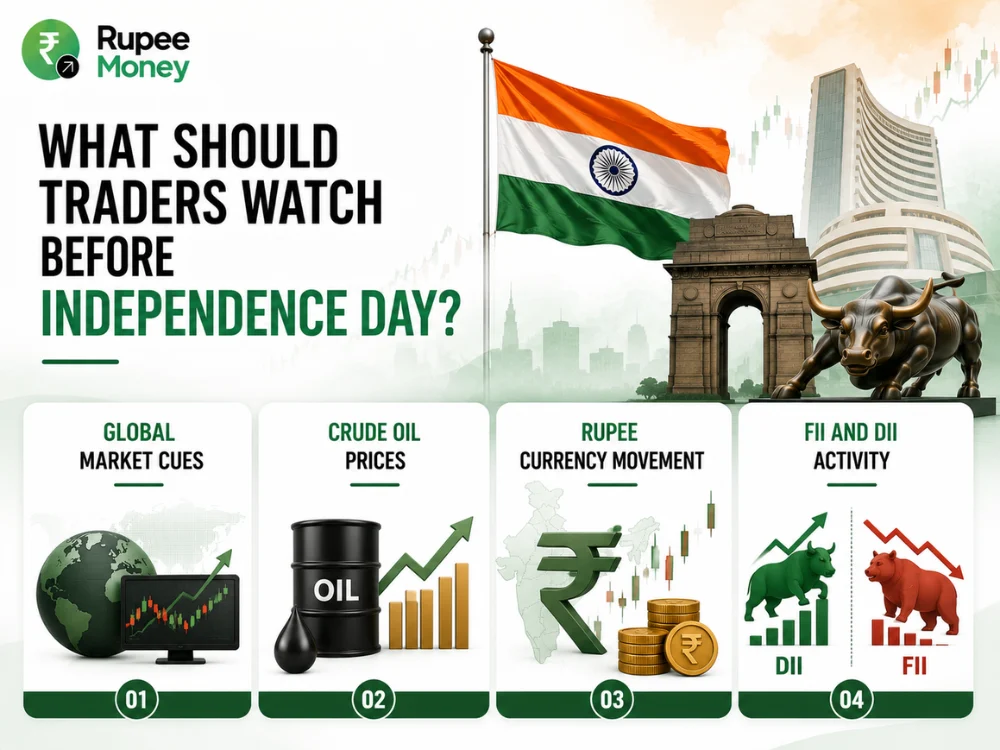
Short-term traders must focus strictly on actual market indicators constantly. Ignore patriotic sentiment and watch the brutal factors influencing prices directly.
Global Market Cues
US market performance directly dictates the next Indian trading session’s opening mood. Asian markets provide excellent early signals regarding global risk appetite.
Crude Oil Prices
India imports a massive portion of its daily crude oil requirements constantly. Higher crude prices dramatically increase concerns regarding national inflation and trade deficits.
Rupee Currency Movement
Currency fluctuations affect completely different business sectors in totally different ways. IT companies earning overseas revenue benefit massively from a much weaker rupee. Conversely, import-heavy businesses face brutally higher operating costs instantly.
FII and DII Activity
Foreign and domestic institutional cash flows control massive market liquidity. Aggressive institutional buying or selling activity controls major market indices effortlessly.
Investors considering a one-time investment can use our Lumpsum Calculator to estimate potential returns.
Conclusion
Independence Day never has a fixed, guaranteed impact on the Indian stock market. The stock market remains completely closed on August 15. The true impact appears through shifting investor expectations and massive news flows.
Government announcements influence highly specific corporate sectors directly. Global markets dictate the mood of the next Indian trading session heavily. Crude oil prices and institutional flows matter infinitely more than festive holiday sentiment.
Long-term investors must never let one holiday destroy a carefully planned strategy. Traders must actively avoid assuming Independence Day guarantees a massive market rally.
Watch the policy announcements, follow the hard data, and avoid trading purely on emotion.
FAQs
Is the Indian stock market closed on Independence Day?
Yes. Both the NSE and BSE remain completely closed on Independence Day. In 2026, August 15 falls on a Saturday, merging directly with the weekend holiday. Investors cannot execute regular equity trades on this specific day.
Does Independence Day make the stock market go up?
No fixed rule guarantees the stock market will rise around Independence Day. Positive government economic announcements certainly improve overall market sentiment heavily. However, global markets, crude oil prices, and corporate earnings exert much stronger effects.
Can Independence Day announcements affect defence stocks?
Yes. Massive government announcements regarding defence procurement directly influence investor expectations. Companies receiving massive new orders benefit from vastly stronger future revenue visibility. However, you must wait for actual signed contracts before judging the financial impact.
What happens to Indian stocks when the market reopens?
Stocks open significantly higher or lower depending on accumulated global information. Global markets and crude oil prices move wildly while Indian markets sleep. This easily creates a massive gap-up or gap-down opening during the very next session.
Should investors buy stocks before Independence Day?
Investors should never buy stocks simply because Independence Day approaches rapidly. Short-term holiday effects remain highly unpredictable and dangerous. Your stock purchase must depend entirely on the company's financial performance and business valuation.
Investors should never buy stocks simply because Independence Day approaches rapidly. Short-term holiday effects remain highly unpredictable and dangerous. Your stock purchase must depend entirely on the company’s financial performance and business valuation.
Disclaimer: This article provides general information for educational purposes only. Market movements around Independence Day vary significantly every single year. Historical market patterns never guarantee future stock market returns. Investors must consider company fundamentals, current market conditions, and personal financial goals before investing. RupeeMoney does not constitute investment advice or a recommendation to buy or sell any financial product. Always consult a SEBI-registered financial advisor before making any major investment decisions.
ABOUT THE AUTHOR

