
How Should You Evaluate a Solar Company IPO Before Investing?

A solar company IPO can look incredibly attractive when renewable energy is growing rapidly across the country. Strong Grey Market Premium (GMP), high subscription numbers, and expected listing gains often create a frenzy among retail investors. However, these surface-level indicators do not tell you whether the company truly deserves its IPO valuation. Welcome to RupeeMoney, your trusted financial platform. In this guide, we will explore exactly how to evaluate a solar IPO before you risk your hard-earned capital.
A solar company can operate in a fast-growing industry and still deliver weak shareholder returns if it has poor fundamentals. Investors must look beyond the hype. India’s cumulative solar capacity reached an impressive 164.59 GW by July 2026. This growth has triggered a wave of public issues. But before you hit the “apply” button, you need a solid evaluation framework.
What Is a Solar Company IPO?
An Initial Public Offering (IPO) allows a solar or renewable-energy company to raise money from public investors by offering shares on the stock market. If you are new to primary markets, understanding exactly what an IPO is is your first step. After the IPO, these shares are listed and traded on exchanges like the NSE and BSE. An IPO typically consists of two distinct components that investors must scrutinize.
Fresh Issue
A fresh issue involves the creation of brand new shares. The company directly receives the money raised through this portion of the IPO. For a solar company, this capital is vital. It is typically used for capacity expansion, building new manufacturing facilities, retiring expensive debt, or funding large-scale solar parks.
Offer for Sale
An Offer for Sale (OFS) involves existing shareholders, such as promoters or early private equity investors, selling their existing shares to the public. The company itself does not receive this money. When evaluating an IPO, understanding the fresh issue vs offer for sale mix is critical. A large OFS might indicate that insiders are cashing out at peak valuations.
How to Evaluate a Solar IPO Before Investing
The best way to evaluate a solar IPO is to follow a disciplined, step-by-step framework. Do not begin your research with the GMP. Instead, start with the company’s actual business operations, move towards its financial health and debt, analyze its valuation, and only then consider subscription demand and listing expectations.
Check the Solar Company’s Business Model
How does the company actually make money? The solar industry is vast, and different companies occupy different parts of the value chain.
Solar Manufacturing Business
Manufacturers earn their revenue by producing and selling solar cells or modules. Their financial performance depends heavily on production capacity, factory utilization rates, and the selling prices of panels. They are highly sensitive to raw material costs and global supply chain disruptions.
Solar EPC Business
Engineering, Procurement, and Construction (EPC) companies design and build solar projects for other developers. They earn revenue through massive project contracts. Their profitability is determined by execution efficiency, logistics management, and keeping project costs under budget.
Renewable Power Generation
Power producers develop, own, and operate massive solar farms. They generate electricity and sell it to utilities or commercial buyers, often through long-term Power Purchase Agreements (PPAs) lasting up to 25 years. This provides stable revenue but requires enormous upfront capital.
Check the Company’s Solar Capacity and Expansion Plans
Capacity gives you a clear idea about the company’s operating scale. For a manufacturer, you want to see a high installed gigawatt (GW) production capacity. For a power developer, look at their operational versus under-construction megawatts. A company with aggressive expansion plans outlined in its prospectus shows growth potential, but you must ask if they can fund this expansion without drowning in debt.
Analyse Solar IPO Financial Performance
Financial statements provide a clearer picture than glossy IPO marketing brochures. Look at the company’s revenue, EBITDA (operating profit), and Profit After Tax (PAT). You should also evaluate their Return on Assets (ROA) and Return on Equity (ROE) to see how efficiently management is using capital to generate profits.
Check Revenue and Profit Growth
Revenue growth indicates increasing market demand, but revenue alone is not enough. A company can grow its top line rapidly while its profit margins shrink due to fierce price competition. Always compare revenue growth alongside profit growth. If revenue is rising sharply but profits remain flat, the company might be sacrificing margins to capture market share just before the IPO.
Check Debt Before Investing in a Solar IPO
Debt deserves special attention in the renewable-energy sector. Solar projects and massive manufacturing facilities require significant capital. While debt can fuel expansion, excessive borrowing increases financial risk. Check the company’s net debt, interest coverage ratio, and debt-to-equity ratio. High interest expenses can wipe out profits, especially in a high-rate environment.
Understand Why the Company Is Launching the IPO
Why does this company need your money? Read the “Objects of the Issue” section in the Red Herring Prospectus (RHP). If the funds are earmarked for building a new solar cell factory or repaying high-interest debt, that is a positive sign. If the majority of the IPO is just an OFS for promoters to exit, or designated for vague “general corporate purposes,” approach with caution.
Check the Solar IPO Valuation
A fundamentally strong solar company can still be a terrible investment if the IPO valuation is too expensive. Look beyond the nominal share price. Assess the company’s overall market capitalization relative to its earnings. Check the Price-to-Earnings (P/E) ratio, Price-to-Book (P/B) ratio, and EV/EBITDA multiples.
Compare the Solar IPO With Listed Peers
Peer comparison reveals whether the IPO price is reasonable. If a new solar manufacturing IPO demands a P/E ratio of 60, while an established, listed competitor trades at a P/E of 30, the new company must justify that massive premium. Compare companies only with similar business models—do not compare a solar module manufacturer with an independent power producer.
What Is Solar IPO GMP?
GMP stands for Grey Market Premium. It represents the unofficial premium at which IPO shares trade in the unlisted market before their official listing date. If an IPO price is ₹100 and the GMP is ₹30, the grey market expects a listing around ₹130.
Why Solar IPO GMP Can Be Misleading
GMP operates outside the official stock exchange mechanism and is highly susceptible to manipulation and sudden shifts in broader market sentiment. A high GMP does not guarantee a profitable listing, nor does it mean the company is a good long-term investment.
How Should You Read Solar IPO Subscription Numbers?
Subscription data shows the real-time demand for the shares during the IPO bidding period. Knowing why some IPOs get oversubscribed helps you gauge market sentiment. Bids are divided among Qualified Institutional Buyers (QIBs), Non-Institutional Investors (NIIs), and Retail Investors.
What Does a High Solar IPO Subscription Mean?
While heavy oversubscription indicates strong market interest, it does not automatically validate the company’s fundamentals. Many investors bid purely to capture short-term listing gains rather than holding for long-term wealth creation. Always prioritize the company’s balance sheet over the hype of subscription multiples.
How Should You Evaluate Solar IPO Listing Expectations?
The expected listing price often dominates social media discussions. However, an investor must separate the “Listing Gain Decision” from the “Long-Term Investment Decision.” A stock can list at a 40% premium and subsequently crash over the next year. Conversely, a stock might list flat but deliver multi-bagger returns over a five-year horizon as its solar projects come online.
Check the Solar Company’s Order Book
For EPC and manufacturing companies, the order book provides visibility into future earnings. A strong, unexecuted order book means guaranteed revenue for the next few quarters. However, scrutinize the quality of these orders. Check the execution timelines and ensure they are high-margin contracts, not just low-bid projects won purely to inflate the order book before the IPO.
Check Customer Concentration
Solar companies often rely heavily on a few massive clients, such as state electricity boards or large corporate developers. This creates concentration risk. If one major customer delays their project or defaults on payments, the solar company’s revenue can plummet overnight. Read the RHP to see what percentage of revenue comes from their top five clients.
Check Government Policies and Solar Demand
The Indian solar industry is heavily bolstered by policy support, subsidies, and domestic manufacturing mandates. However, changes in import duties on solar glass or cells can drastically alter profit margins. Furthermore, grid infrastructure challenges—where power transmission networks cannot keep up with new solar capacity—can lead to power curtailment, hurting developer revenues.
Check Solar IPO Risks Before Investing
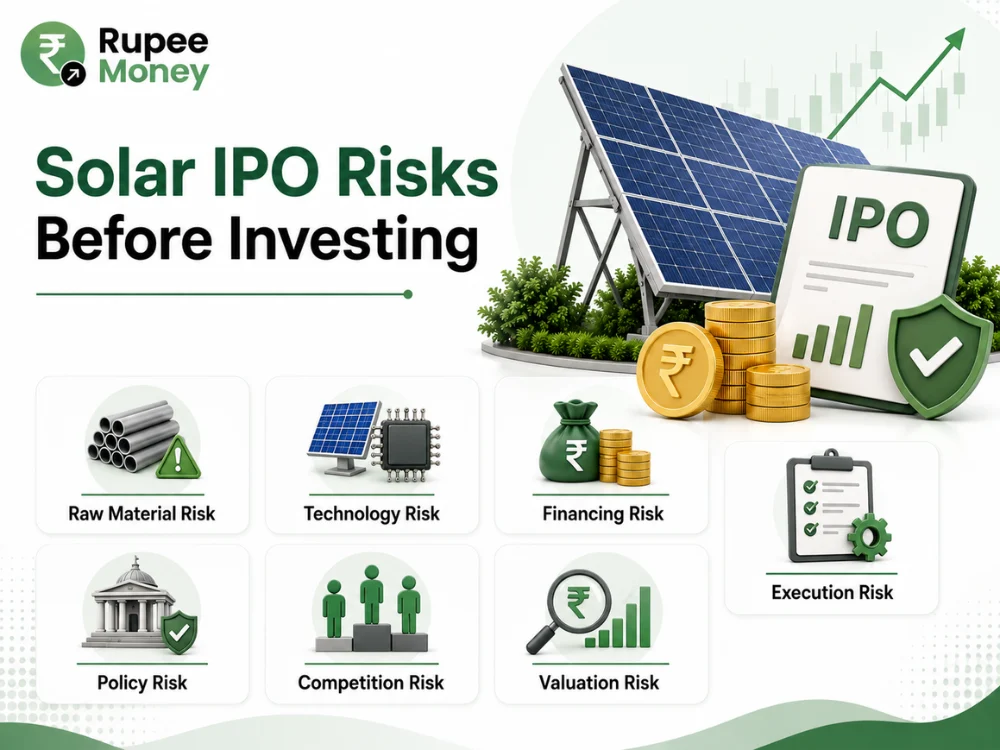
Every equity investment carries risk. When dealing with solar IPOs, pay close attention to the “Risk Factors” section in the prospectus.
Raw Material Risk
Manufacturers are heavily dependent on global supply chains for silver, polysilicon, and aluminum. Price volatility hurts margins.
Technology Risk
Solar technology evolves rapidly. Companies that fail to upgrade to newer, more efficient cell technologies will lose market share.
Financing Risk
Higher interest rates compress the returns of debt-heavy solar power producers.
Execution Risk
Bureaucratic delays in land acquisition or grid connectivity can postpone project commissioning and delay revenue generation.
Policy Risk
Sudden removals of subsidies or changes in state net-metering laws can weaken consumer demand.
Competition Risk
As the sector booms, massive new manufacturing capacity is coming online, which could lead to an oversupply and crash module prices.
Valuation Risk
Paying an exorbitant IPO price leaves no margin of safety for the investor if the company’s growth slows down.
Solar IPO Checklist Before Investing
Before applying, tick off these boxes:
- Do I understand their core business model?
- Is the revenue and PAT growing consistently?
- Is the debt level manageable?
- Is the fresh issue larger than the OFS?
- Is the valuation (P/E) comparable to listed peers?
- Are the risk factors acceptable?
Should You Invest in a Solar IPO for Listing Gains?
Chasing listing gains is a popular, albeit risky, strategy. While a strong GMP and massive QIB subscription can hint at a pop on listing day, broader market volatility can erase those gains instantly. Furthermore, you must understand what happens if you don’t get IPO allotment—your funds are simply unblocked, but the opportunity cost of holding that cash remains.
Should You Hold a Solar IPO for the Long Term?
If the fundamentals are robust, holding a solar stock long-term allows you to ride India’s multi-decade energy transition. Long-term investors should monitor IPO lock-in periods to anticipate when pre-IPO investors might sell their shares, potentially causing temporary price drops.
Solar IPO vs Existing Solar Stocks
Sometimes, the best solar investment isn’t a new IPO at all. Existing listed solar stocks provide years of historical market data, transparent quarterly earnings, and proven management execution. A new IPO may offer an exciting narrative, but established players often offer a safer, more predictable risk-to-reward ratio.
Where Do Alpex Solar and ACME Solar Fit?
Recent names like Alpex Solar and ACME Solar highlight the sheer diversity of IPOs hitting the market—ranging from module manufacturing to power generation. However, relying on outdated GMP or subscription news for these companies is a mistake. Always base your post-listing investment decisions on their most recent quarterly earnings rather than their historical IPO hype.
Solar IPO GMP vs Fundamentals: Which Matters More?
For a quick flip on listing day, GMP holds weight. But for serious wealth creation, fundamentals rule supreme. GMP tells you what speculators expect today; financial statements tell you what the business has actually achieved. Always anchor your investment decisions in cash flows, debt reduction, and sustainable profit margins.
FAQs
What should I check before investing in a solar IPO?
Always check the business model, revenue growth, debt-to-equity ratio, the purpose of the IPO (Fresh Issue vs. OFS), and how the valuation compares to existing listed peers.
Is Solar IPO GMP reliable?
No, GMP is an unofficial, unregulated metric driven by short-term market sentiment. It is not a guarantee of listing price or long-term business success.
What does IPO subscription tell investors?
It indicates the level of market demand. Heavy institutional subscription (QIB) often suggests that large funds find the valuation reasonable, but it should not replace your own fundamental research.
Should I invest in a solar IPO because of high GMP?
Never invest solely based on GMP. If the company has high debt, weak margins, and an expensive valuation, a high GMP is just a speculative bubble waiting to burst.
How do I evaluate a solar company's valuation?
Compare the IPO's implied P/E ratio, Market Capitalization, and EV/EBITDA against currently listed solar companies operating in the exact same business segment.
Is subscription more important than financial performance?
Absolutely not. Subscription shows temporary hype, whereas financial performance (cash flow, EBITDA, PAT) dictates long-term shareholder returns and corporate survival.
Compare the IPO’s implied P/E ratio, Market Capitalization, and EV/EBITDA against currently listed solar companies operating in the exact same business segment.
Conclusion
Evaluating a solar company IPO requires much more than glancing at grey market premiums and subscription multiples. The renewable energy sector in India is expanding at a historic pace, but a rising tide does not lift fundamentally broken boats. By systematically checking the business model, dissecting the financial statements, assessing the debt load, and ensuring the valuation is fair, you can protect your capital from overpriced issues. Take the time to read the prospectus, understand where the IPO funds are going, and align your strategy with your long-term financial goals. Let RupeeMoney be your guide as you navigate the exciting, yet volatile, world of solar investments.
Disclaimer: This article is intended for educational and informational purposes only. Loan interest rates, eligibility criteria, subsidy rules, processing charges, and repayment conditions are subject to change. Always verify the latest terms with the official government portal and your chosen lender before taking a solar loan. This article does not constitute direct financial advice.
ABOUT THE AUTHOR

