
How Does a Solar Loan Work and How Is Solar EMI Calculated?
Installing a rooftop solar system can drastically reduce your monthly electricity bills, but the upfront cost can feel overwhelming. Welcome to RupeeMoney, your trusted guide for smart financial decisions. A solar loan helps spread the massive installation cost across manageable monthly payments. Instead of depleting your savings, you borrow the required amount and repay the lender through regular EMIs. The Indian government also supports this transition through the PM-Surya Ghar: Muft Bijli Yojana, offering subsidies up to ₹78,000 for residential systems of 3 kW or higher. Let us explore how solar financing works, how EMIs are calculated, and whether taking a loan is the right financial choice for your household.
What Is a Solar Loan?
A solar loan is specialized financing designed to pay for a solar energy system. Homeowners use it to cover eligible rooftop solar installations without breaking their savings. The exact expenses covered will depend on the lender, but a typical rooftop solar project usually includes photovoltaic panels, a solar inverter, mounting structures, wiring, electrical equipment, and professional installation costs.
Instead of paying the complete amount upfront, you borrow the necessary funds and repay them over time. Every EMI contains two parts: one portion reduces the outstanding principal amount, while the other covers the interest charged by the lender. Over time, the interest portion decreases while the principal repayment portion increases.
How Does a Solar Loan Work?
The process begins when you receive a cost estimate for your rooftop solar installation. For example, if your system costs ₹2.50 lakh, you might pay ₹50,000 as a down payment and seek a loan for the remaining ₹2 lakh.
The lender evaluates your application, checking your income, repayment capacity, and credit history. Maintaining a good credit profile is essential, and you can learn how to improve your CIBIL score to secure better interest rates. Once approved, the lender disburses the funds. You then repay the outstanding loan through monthly instalments. Your final EMI will depend on the loan amount, the interest rate, and the chosen tenure.
How Is Solar EMI Calculated?
A solar loan EMI uses the standard mathematical formula utilized by banks globally. If you understand how a Home Loan EMI works, calculating a solar EMI is virtually identical.
The standard formula is: EMI = P × R × (1 + R)ⁿ ÷ [(1 + R)ⁿ − 1]
Here, ‘P’ represents the principal loan amount, ‘R’ is the monthly interest rate (annual rate divided by 12), and ‘N’ is the total number of monthly instalments (tenure in months). For instance, a 10% annual interest rate converts to roughly 0.833% per month. RBI guidelines also mandate using this standard reducing-balance method for consumer loans.
Solar Loan EMI Example
To simplify the math, let’s look at a practical example. Imagine you borrow ₹2,00,000 at an annual interest rate of 10% for a tenure of 5 years (60 months).
Plugging these numbers into the formula, your approximate monthly EMI would be around ₹4,250. Over the entire 5-year period, your total repayment to the bank would be around ₹2.55 lakh. Consequently, the interest component paid to the bank is approximately ₹55,000. These figures are illustrative; actual EMIs vary based on your lender’s processing fees, final interest rates, and specific repayment structures.
Solar EMI Calculator: Calculate Your Monthly Payment
While knowing the manual formula is useful, a digital calculator is much faster and error-free. By entering your loan amount, interest rate, and tenure, the tool instantly generates your monthly payment.
A good calculator also breaks down your payments into an amortization schedule, showing exactly how much interest you will pay over time. We highly recommend using RupeeMoney’s official EMI Calculator to accurately estimate your monthly financial commitments. Adjusting the tenure slider will quickly show you how a longer repayment period reduces your monthly EMI but increases the total interest burden.
How Much EMI Do You Pay for Solar Panels?
There is no fixed EMI that applies universally. The amount you pay depends entirely on the system size and the loan terms offered by your bank.
For example, assuming a 10% interest rate over 5 years: a ₹1 lakh loan results in an EMI of ₹2,125; a ₹2 lakh loan creates an EMI of ₹4,250; and a ₹3 lakh loan pushes the EMI to roughly ₹6,374. Always review your final sanction letter carefully, as processing fees, documentation charges, and other hidden fees can alter the final effective monthly payout.
What Affects Your Solar Loan EMI?
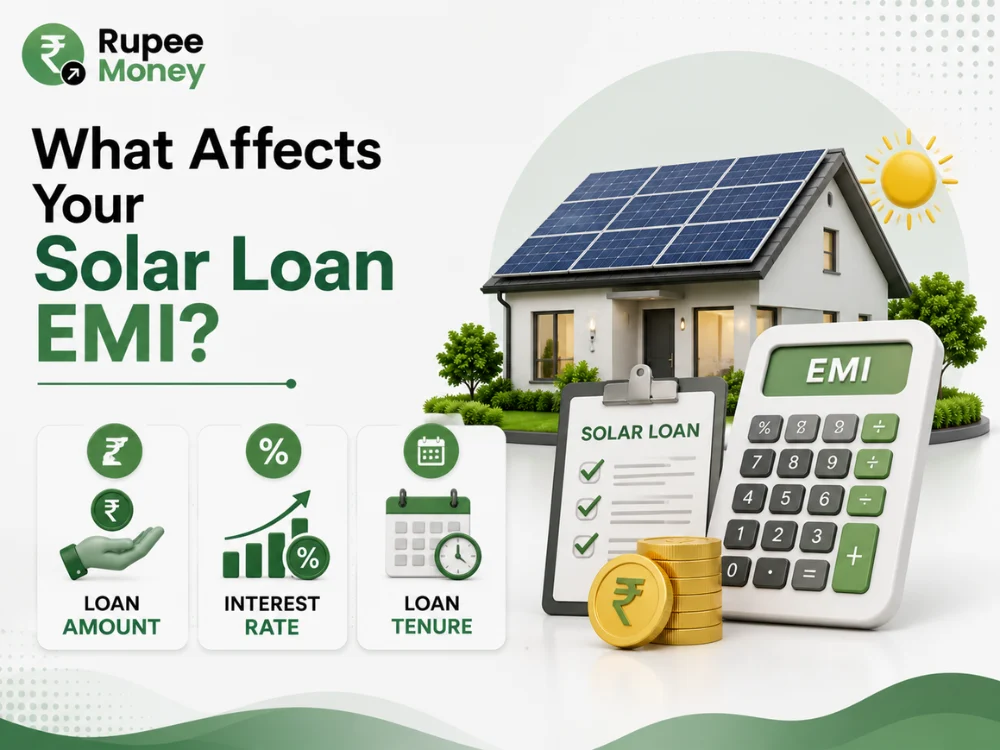
Three primary factors manipulate your monthly EMI, which are critical to understand for solid financial planning.
First is the loan amount: borrowing ₹3 lakh will naturally result in a higher EMI than borrowing ₹1 lakh. Making a larger down payment minimizes this burden.
Second is the interest rate: a higher rate increases the overall cost of borrowing.
Third is the loan tenure: compressing repayment into a short 3-year window creates a higher monthly EMI but saves you money on total interest. Conversely, a 10-year tenure lowers the monthly payment but maximizes the total interest paid to the bank over a decade.
What Is the Solar Loan Interest Rate in India?
Solar loan interest rates in India vary widely among public banks, private banks, and NBFCs. The final rate you receive depends on your credit profile, income, and the specific loan product.
Currently, the PM-Surya Ghar scheme facilitates access to highly attractive, collateral-free loans from public sector banks like SBI, with rates starting around 7.15% to 7.25% in 2026 for eligible residential systems. Private banks typically charge slightly higher rates. The RBI’s priority-sector lending framework also encourages banks to finance renewable energy projects up to ₹10 lakh for individuals. Always verify the latest rates before signing any agreement.
How Does PM-Surya Ghar Affect Solar Loan Costs?
The PM-Surya Ghar: Muft Bijli Yojana is a landmark scheme designed to make rooftop solar affordable for millions of Indian households. The scheme provides robust Central Financial Assistance (subsidy) which directly reduces your upfront installation cost.
For eligible residential installations in 2026, the subsidy provides ₹30,000 for a 1 kW system, ₹60,000 for a 2 kW system, and a maximum of ₹78,000 for systems of 3 kW or higher. Because this subsidy significantly lowers the net cost of the solar system, you need to borrow a much smaller loan amount. However, the loan and the subsidy are separate processes; you must officially apply for the subsidy through the national portal.
Who Can Get a Solar Loan?
Loan eligibility is determined by a lender’s internal risk assessment. When evaluating what affects your loan eligibility, banks look for stable income, manageable existing debts, and a strong credit history.
Common documentation required for a solar loan includes identity proof (PAN card, Passport), address proof, income documents like salary slips or ITRs, and bank statements. Lenders will also require an official quotation from a DISCOM-empanelled solar vendor and proof of property ownership. Some government bank loans strictly require the applicant to have a valid electricity connection in their name to approve the financing.
How to Calculate Solar Loan Repayment
Calculating the EMI alone does not reveal the true cost of borrowing. To understand your financial commitment, multiply your EMI by the total number of months in your tenure.
If your EMI is ₹4,250 for 60 months, your total repayment equals ₹2.55 lakh. The ₹55,000 difference is your interest cost. When you factor in processing fees and GST, you get the actual total cost of financing your solar installation.
Can Solar Savings Cover Your EMI?
A well-designed rooftop solar system significantly reduces the electricity you draw from the grid. A 3 kW system can generate roughly 300 to 360 units of electricity per month, translating to substantial monthly savings depending on your state’s electricity tariff.
However, you should not assume that your solar savings will perfectly cover your EMI every single month. Solar generation fluctuates with monsoons, winter fog, and shading. A safer financial approach is to compare your expected annual electricity savings against your total annual loan repayment to ensure the investment remains cash-flow positive over the long term.
Solar Loan vs Paying Cash
You essentially have two ways to fund your green energy transition: taking a loan or paying entirely in cash.
Paying cash is mathematically the cheapest route because you pay absolutely zero interest. However, doing so drains your liquid savings immediately. A solar loan preserves your cash reserves for medical emergencies but creates a monthly debt obligation and adds interest costs to the system. Your choice depends on your overall liquidity. You should never deplete your emergency fund just to avoid taking a manageable solar loan.
How to Reduce Your Solar Loan EMI
If you decide to finance your system, there are smart ways to minimize the monthly burden.
First, make a larger down payment; reducing the principal borrowed instantly lowers your EMI. Second, shop around and compare effective interest rates across multiple lenders, paying close attention to whether the loan offers a fixed vs floating interest rate. Third, opt for a slightly longer repayment tenure if you need a smaller monthly payment, though this increases total interest paid. Finally, only borrow the exact shortfall required after factoring in your PM-Surya Ghar subsidy.
Is a Solar Loan Worth It?
Yes, a solar loan is highly worthwhile if the long-term electricity savings outpace the cost of financing. It allows households to adopt renewable energy immediately without waiting years to save up the capital.
The benefits include a lower upfront financial burden, immediate reduction in utility bills, and preserved liquidity. However, you must weigh these against the risks of interest expenses, processing charges, and the strict obligation of monthly EMIs. The loan makes financial sense when it fits comfortably within your household budget.
Solar Loan EMI and Solar Return on Investment
Beyond the EMI, calculating your solar Return on Investment (ROI) is crucial. Start with the gross project cost, subtract the PM-Surya Ghar subsidy, and add the total interest you will pay to the bank.
Next, estimate your annual electricity savings. Divide your total net cost by your annual savings to find your breakeven period. With rising grid electricity tariffs, most residential solar systems break even within 4 to 6 years. Once the loan is paid off and the system breaks even, the electricity generated by the panels is essentially free for the next two decades.
What Should You Check Before Taking a Solar Loan?
Never choose a loan blindly based on a small EMI figure. Like reviewing the terms of standard Home Loans, you must read the fine print.
Check the interest rate type to see if it is linked to the RBI repo rate, meaning your EMI could fluctuate. Scrutinize processing charges, valuation fees, and GST, as these can make a seemingly cheap loan expensive. Verify the prepayment rules; many government-backed solar loans allow penalty-free foreclosure if you use your subsidy to pay down the principal. Finally, conservatively estimate your solar savings so you aren’t caught off guard by seasonal generation dips.
Conclusion
Taking a solar loan is a highly effective way to make the transition to green energy affordable. Instead of paying the entire installation cost out of pocket, you can comfortably repay the financed amount through manageable monthly EMIs. Understanding how your loan amount, interest rate, and tenure affect your EMI allows you to choose a repayment plan that fits seamlessly into your household budget.
Furthermore, the massive government support under the PM-Surya Ghar scheme drastically reduces your initial financial burden. However, subsidies do not eliminate the need for disciplined financial planning. Compare the total interest cost, check for hidden processing charges, and conservatively estimate your actual electricity savings. By doing your due diligence, you can ensure that financing your rooftop solar system is a profitable, long-term victory.
FAQs
How does a solar loan work?
A solar loan finances part or all of the eligible cost of a rooftop solar installation. The borrower receives funds from a bank and repays the outstanding amount through scheduled monthly EMIs over an agreed tenure, covering both principal and interest.
How is solar EMI calculated?
Solar EMI follows the standard formula used for all instalment-based loans: EMI = P × R × (1 + R)ⁿ ÷ [(1 + R)ⁿ − 1]. The calculation considers the principal amount, the monthly interest rate, and the total number of instalments.
What is a solar EMI calculator?
It is a digital financial tool that estimates your monthly payment. By entering your loan amount, interest rate, and repayment tenure, the calculator provides an instant EMI estimate and a detailed amortization schedule.
Can solar savings pay the EMI?
Solar savings can significantly offset the EMI, and in many cases, completely cover it. However, actual savings depend on household electricity consumption, local tariff rates, system size, and seasonal weather conditions.
Does PM-Surya Ghar provide a solar loan?
The PM-Surya Ghar scheme directly provides a subsidy up to ₹78,000 and facilitates access to low-interest, collateral-free financing products (around 7.15% in 2026) from partner banks like SBI and Canara Bank.
Disclaimer: This article is intended for educational and informational purposes only. Loan interest rates, eligibility criteria, subsidy rules, processing charges, and repayment conditions are subject to change. Always verify the latest terms with the official government portal and your chosen lender before taking a solar loan. This article does not constitute direct financial advice.
ABOUT THE AUTHOR

