
Credit Card Minimum Payment: How Debt Can Keep Growing Every Month
Your monthly credit card bill always shows two completely different numbers. One large number looks extremely scary. The other smaller number looks surprisingly affordable.
The smaller number says ‘Minimum Amount Due’ clearly. Paying this tiny amount prevents a missed-payment penalty immediately. However, it absolutely does not make your actual credit card debt disappear.
In fact, carrying the remaining balance triggers massive interest charges. Those finance charges make your next monthly bill much harder to repay. Recent financial reporting highlighted how thousands of users fall into this exact trap.
Some card users paid only the minimum amount without understanding the brutal consequences. One shocking case involved monthly finance charges exploding from ₹12,000 to over ₹25,000.
Welcome to RupeeMoney. We help you understand complex banking traps simply. The biggest lesson here remains very simple. Minimum payment keeps your account active, but it keeps your massive debt alive forever. Let us explore how to escape this credit card debt trap.
What Exactly Is a Credit Card Minimum Payment?
The Minimum Amount Due (MAD) represents the absolute smallest payment your bank accepts. The exact amount varies according to your specific card issuer and billing cycle.
It usually represents a tiny percentage of your total outstanding debt. Recent market reporting indicates the minimum amount typically hovers around 5% to 10% of the total bill.
For example, imagine your total credit card bill reaches exactly ₹60,000. Your minimum payment might look like a manageable ₹3,000. Paying that small amount helps you avoid a strict missed payment penalty.
However, the remaining ₹57,000 balance definitely does not disappear. It moves forward directly into your next billing cycle. High interest then increases the total amount you eventually need to repay.
Minimum Amount Due vs Total Amount Due: The Big Difference
These two figures serve completely different financial purposes. The Total Amount Due represents the complete debt you need to repay today. Paying this full amount by the due date helps you retain your interest-free grace period.
The Minimum Amount Due represents only the smallest legally required payment. It helps you avoid treating the card account as a defaulted asset. However, it leaves a massive unpaid balance behind.
Reserve Bank of India (RBI) rules strictly require card issuers to communicate these consequences clearly. The RBI clearly states that partial payment causes the immediate loss of the interest-free credit period.
That crucial difference matters much more than many first-time card users ever realize. Learn how to choose the right payment method to avoid unnecessary debt.
Why Credit Card Minimum Payment Creates a Massive Debt Trap
Credit cards work very differently from ordinary debit card spending. When you use a debit card, your own money leaves your bank account immediately. A credit card gives you an expensive short-term borrowing facility instead.
You must repay that specific borrowing through your monthly billing statement. Pay the full bill exactly on time, and you enjoy the interest-free period perfectly. Pay only the minimum, and the remaining heavy balance continues forward.
High interest then radically increases the total cost of carrying that balance. The next monthly bill therefore becomes much larger automatically. If you continue spending normally, the debt problem becomes completely unmanageable. This creates the classic, terrifying credit card debt trap.
How Credit Card Interest Brutally Increases Your Bill
Credit card interest rates remain incredibly high compared with traditional personal loans. Market reports showed annual interest rates ranging between 20% to 40% recently.
Some premium cards charge different penalty rates based on customer default profiles. Therefore, always check your card’s Most Important Terms and Conditions carefully.
When you carry an unpaid balance, your beloved interest-free benefit disappears instantly. Massive interest then applies directly to the entire outstanding balance. Even your new daily purchases lose the normal grace-period benefit completely.
This creates a highly dangerous financial cycle. You spend money, carry the balance, pay heavy interest, and then face a much larger bill next month. To understand how interest rates work globally, read what the repo rate is.
A Real Credit Card Minimum Payment Calculation Example
Let us consider a very simple numerical example. Suppose you spend exactly ₹65,000 using your new credit card. Your monthly statement arrives showing ₹65,000 as the total amount due.
Your calculated minimum payment comes to just ₹6,500. You decide to pay only ₹6,500 this month. The remaining massive ₹58,500 stays completely unpaid.
Now the brutal interest calculation changes your entire situation. You no longer enjoy the same free interest treatment on new purchases. You also continue carrying the heavy unpaid balance into the next billing cycle.
If you make fresh purchases today, your new spending increases the outstanding amount further immediately. The next bill might easily reach ₹93,350 after adding new purchases and heavy interest penalties. The actual charges depend entirely on the specific card issuer agreement.
If you struggle with calculating interest, use our EMI Calculator to plan your repayments better.
Why the Interest-Free Grace Period Matters So Much
The interest-free period acts as the absolute biggest benefit of responsible credit card usage. You can spend freely during the billing cycle and repay the entire bill later without cost.
This brilliant arrangement works perfectly when you pay the full amount by the due date. However, making a partial repayment destroys this calculation immediately.
The RBI states that failing to clear the total amount destroys the interest-free credit period. This means the minimum payment does not act like a free time extension. It simply keeps the account from becoming officially overdue and reported to CIBIL. The massive unpaid amount still costs you heavy daily interest.
Does Minimum Payment Affect Your Credit Score Badly?
Paying the minimum amount exactly on time helps you avoid a missed-payment record on CIBIL. However, that does not mean minimum payments protect your credit profile perfectly.
A consistently high outstanding balance increases your total credit utilisation ratio rapidly. Credit utilisation measures exactly how much of your available credit limit you currently use.
For example, suppose your card has a strict ₹2 lakh limit. If your outstanding balance reaches ₹1 lakh, your utilisation hits a dangerous 50%. High utilisation destroys your credit profile over a few months.
Carrying high balances for months increases utilisation and gradually drops credit scores severely. If you want to understand proper credit behaviour, read our guide on how to improve your CIBIL score.
Does Paying Minimum Due Avoid Late Payment Fees?
Paying the exact minimum amount by the due date helps you avoid a missed-payment penalty. However, it absolutely does not eliminate heavy daily interest charges.
You also need to check the specific penalty terms of your particular card. Late-payment charges apply heavily when you fail to make even the required minimum payment.
The RBI requires all card issuers to disclose late-payment charges clearly to customers. Therefore, you must think of the minimum payment as a desperate last-resort safety net. Do not ever treat it as your regular monthly repayment strategy.
How Minimum Payments Keep Your Debt Growing Faster
The debt problem becomes extremely serious when the billing cycle repeats itself. Imagine you pay only the small minimum amount every single month. Your original principal loan amount reduces incredibly slowly.
Heavy interest continues adding to the total bill every single day. Then you use the credit card again for daily shopping. Your total outstanding balance rises once more immediately. The next minimum payment requirement also increases proportionally.
This creates a vicious cycle where your current income keeps servicing very old spending. You eventually find yourself paying huge amounts without making any real progress. That terrifying situation becomes almost impossible to escape eventually.
Start building smart money habits today. Read our guide on building wealth in your 20s.
What Happens When You Keep Paying Only the Minimum Due?
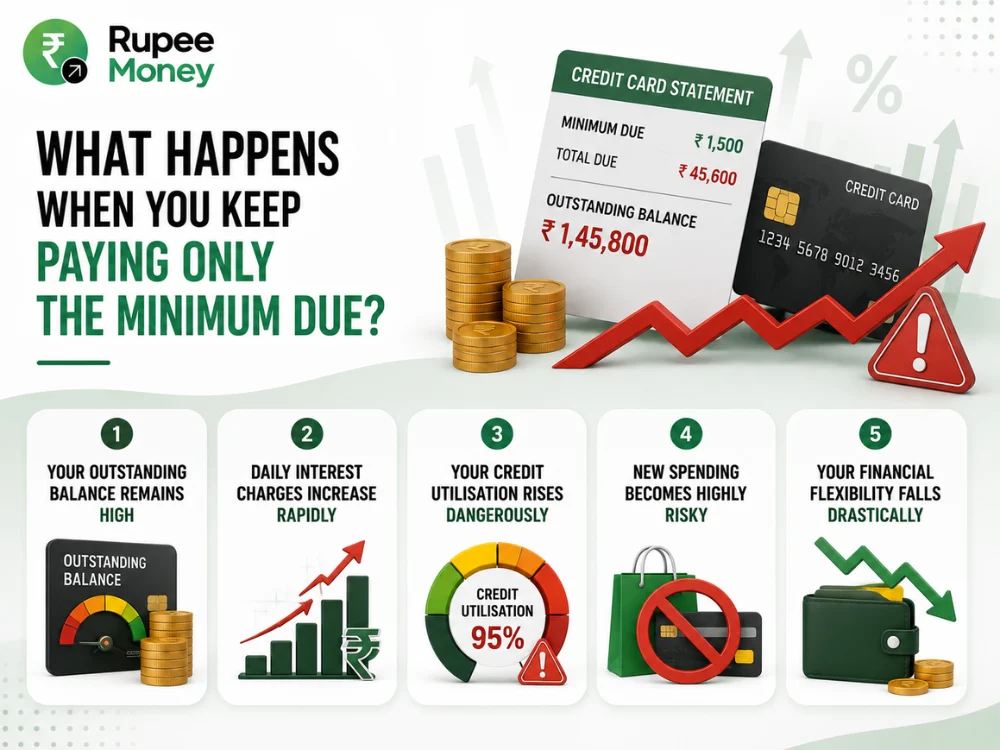
Several dangerous financial events happen over a long time.
Your Outstanding Balance Remains High
The massive unpaid portion moves directly into the very next billing cycle. You continue carrying the heavy debt until you repay it completely.
Daily Interest Charges Increase Rapidly
The outstanding balance attracts high interest according to your card’s penalty rate. Annual rates exceeding 30% make full repayment incredibly expensive.
Your Credit Utilisation Rises Dangerously
A large balance against your assigned credit limit pushes your utilisation higher. This destroys your credit profile and stops future loan approvals.
New Spending Becomes Highly Risky
New purchases add directly to your existing heavy balance. You lose your interest-free grace period completely on these new purchases.
Your Financial Flexibility Falls Drastically
A massive portion of your future monthly income goes toward servicing old credit card debt. That leaves much less money for vital savings and investments.
Learn how to plan long-term savings correctly using our SIP Calculator.
How to Avoid the Terrifying Credit Card Debt Trap
The best financial approach always starts with one very simple habit. Use your credit card only when you can afford the full repayment today.
Do not ever treat the assigned credit limit as your additional monthly income. A ₹2 lakh credit limit does not mean you have ₹2 lakh cash available to spend. It simply represents your maximum allowed borrowing capacity.
Pay the Full Bill Always
Try to pay the total amount due strictly before the due date. This helps you avoid massive interest on all eligible purchases perfectly. It also stops heavy balances from accumulating month after month.
Stop New Spending During Debt Repayment
If you already carry a massive card balance, stop new card spending immediately. Otherwise, you keep adding fresh fuel to the exact same debt fire.
Check Your Autopay Settings Monthly
Do not blindly assume your bank payment instruction remains unchanged forever. Review your banking app before every single billing cycle starts. Recent reports highlighted cases where customers discovered shocking changes in autopay settings suddenly.
Can You Use an EMI to Manage Credit Card Debt Better?
Some smart card issuers allow customers to convert eligible large purchases into EMIs. This facility can make your monthly repayment much more predictable and manageable.
However, an EMI conversion also comes with heavy interest and processing charges. Therefore, compare the total repayment cost carefully before choosing this easy option.
Do not convert every single purchase into an EMI simply because the monthly amount looks smaller. A smaller monthly payment often means a much larger total interest cost over time.
Before making a decision, you must compare personal loan vs home loan options for debt consolidation.
What Should You Do If Credit Card Debt Has Become Huge?
Start by stopping all unnecessary credit card spending immediately today. Next, write down every outstanding balance and its applicable annual interest rate. Then aggressively prioritize the specific debt carrying the highest interest cost.
Contact your card issuer directly if full repayment has become truly impossible. Ask them about available hardship repayment options before the account defaults. Avoid taking multiple new expensive personal loans without understanding their total cost first.
Most importantly, never ignore the growing debt problem hoping it disappears. Credit card debt always becomes much harder to manage when borrowers delay taking action. Read about how high interest rates impact your budget by understanding what is inflation and why does it matter.
Conclusion
The safest financial routine involves paying the full statement amount strictly by the due date. The minimum payment option helps only during a severe, temporary cash-flow crisis. It must never become your permanent monthly financial repayment plan.
The difference between minimum and total due looks very small initially. However, the long-term financial cost becomes incredibly massive and destructive. A ₹5,000 minimum payment feels much easier to pay than a ₹50,000 total bill. But the remaining ₹45,000 absolutely does not disappear.
It continues working aggressively against your finances through daily interest and future repayment obligations. Use credit cards strictly for payment convenience, never as a dangerous substitute for actual income.
FAQs
Is paying the minimum amount due on a credit card bad?
Paying the exact minimum amount on time prevents the account from becoming officially overdue. However, it leaves a massive part of your bill completely unpaid. The remaining balance attracts heavy daily interest immediately. You also lose the interest-free period entirely. Therefore, minimum payment helps only during a very temporary cash shortage.
What happens if I pay only the minimum amount?
The massive unpaid balance carries forward directly into the very next billing cycle. Heavy interest applies to that balance according to your card's penalty terms. You lose the interest-free period completely. Fresh purchases then add more expensive debt to your account instantly.
Does paying the minimum due avoid credit card interest?
No. Paying the minimum amount simply helps you avoid a strict missed-payment penalty. It absolutely does not give you the same interest-free benefit as paying the full total amount. RBI specifically warns that partial payment causes the immediate loss of the interest-free period.
Does minimum payment affect CIBIL score?
Paying the minimum amount on time helps you avoid a default record. However, repeatedly carrying a massive balance increases your overall credit utilisation dangerously. High utilisation destroys your credit profile completely over time.
Can credit card interest compound daily?
Yes, credit card debt grows aggressively through repeated interest charges on all unpaid balances. The exact compounding calculation depends on the specific card issuer terms. New daily purchases also increase the total outstanding amount quickly.
What is the difference between minimum due and total due?
The total amount due represents the absolute complete bill for the billing cycle. The minimum amount due represents only the smallest legally required payment. Paying only the minimum leaves the remaining massive amount completely unpaid and attracting heavy interest.
The massive unpaid balance carries forward directly into the very next billing cycle. Heavy interest applies to that balance according to your card’s penalty terms. You lose the interest-free period completely. Fresh purchases then add more expensive debt to your account instantly.
Disclaimer: This article provides general financial information for educational purposes only. Credit card interest rates, penalties, and charges vary significantly between different banks and card products. Always check your specific card agreement and latest statement before making repayment decisions. Reserve Bank of India (RBI) rules and regulations may also change over time. RupeeMoney does not provide personalised financial or debt counseling advice through this article. Consider consulting a SEBI-registered qualified financial professional for advice based on your exact circumstances.
ABOUT THE AUTHOR

