
Bonus Shares vs Stock Split: Key Differences Explained
A company announces a bonus issue or a stock split, and suddenly investors see more shares in their demat accounts. At first glance, both corporate actions look almost identical: your total number of shares increases, while the share price usually falls proportionately.
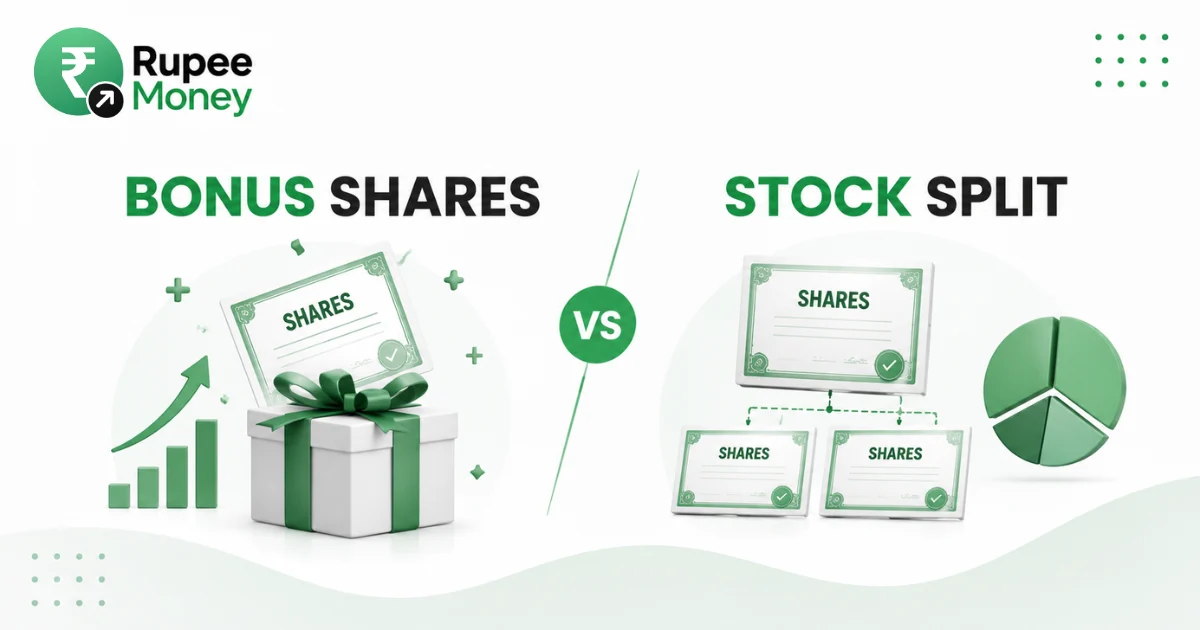
However, bonus shares and stock splits work very differently at the corporate level. A bonus issue gives existing shareholders additional shares from the company’s eligible cash reserves. A stock split simply divides existing shares into smaller units and reduces the face value of each share.
Understanding this difference matters deeply because the accounting treatment, face value changes, and the strategic reasons behind each corporate action are fundamentally different. If you are new to how share capital works, you might first want to read our guide on what is an IPO and how companies go public.
What Are Bonus Shares?
A bonus issue means a company gives additional shares to its existing shareholders without charging them any extra money. The company’s board decides a specific “bonus ratio” to determine how many additional shares each investor receives.
For example, suppose a company announces a 2:1 bonus issue. This means an investor receives 2 additional shares for every 1 share already held.
If you own 100 shares before the bonus issue:
- Existing shares: 100
- Bonus shares: 200
- Total shares after bonus: 300
You do not pay a single rupee for these extra bonus shares. Companies generally issue bonus shares by capitalising their eligible financial reserves and transferring that corresponding amount directly into paid-up share capital.
Why Do Companies Issue Bonus Shares?
Companies consider bonus shares when they have accumulated massive cash reserves and want to increase their official share capital. A bonus issue also drastically increases the number of shares available for trading in the open market. This improves stock liquidity and makes the stock more accessible to a wider group of retail investors.
However, receiving bonus shares does not automatically mean you have become richer overnight. The stock market normally adjusts the share price downward to reflect the newly increased number of shares.
What Is a Stock Split?
A stock split simply divides an existing single share into multiple smaller shares. The company does not give investors additional value for free; instead, it changes the basic denomination of each existing share.
For example, assume a company announces a 1:2 stock split. One existing share becomes two shares.
If you previously owned 100 shares:
- Existing shares: 100
- Shares after split: 200
- Total number of shares: Doubles
Most importantly, the face value also reduces in the exact same proportion. If the face value was ₹10 before a 1:2 split, it immediately becomes ₹5 after the split.
Why Do Companies Split Their Shares?
Companies use stock splits primarily to reduce a very high market price per share and improve daily trading liquidity. A lower per-share price makes the stock appear much more affordable to small retail investors. For instance, you can read our analysis on why MRF stock is so expensive to understand why some companies avoid splits altogether.
However, the split itself does not create any additional economic value or underlying wealth for existing shareholders.
Bonus Shares vs Stock Split: Key Differences
The easiest way to understand the difference is to compare what actually happens to the share count, corporate reserves, and face value.
| Factor | Bonus Shares | Stock Split |
| Core Meaning | Company issues additional shares from reserves. | Existing shares are divided into smaller units. |
| Investor Payment | No additional payment. | No additional payment. |
| Share Count | Increases. | Increases. |
| Face Value | Remains unchanged. | Reduces proportionately. |
| Corporate Reserves | Eligible reserves are capitalised (reduced). | No reserves are touched or transferred. |
| Market Share Price | Adjusts downward proportionately. | Adjusts downward proportionately. |
| Primary Purpose | Capitalise reserves and increase share capital. | Reduce per-share price and boost retail liquidity. |
Bonus Issue vs Stock Split: A Practical Example
Let’s use a simple mathematical example to see the practical difference. Suppose a company has a market price of ₹1,000 per share, and you own exactly 100 shares.
- Your total investment: 100 × ₹1,000 = ₹1,00,000
Scenario A: 1:1 Bonus Issue
You receive one additional share for every share held.
- Total shares: 200 (100 existing + 100 bonus)
- Theoretical adjusted price: ₹1,00,000 ÷ 200 = ₹500 per share
- Total holding value: 200 × ₹500 = ₹1,00,000
Scenario B: 1:2 Stock Split
Your 100 shares are physically divided into 200 shares.
- Total shares: 200
- Theoretical adjusted price: ₹500 per share
- Total holding value: 200 × ₹500 = ₹1,00,000
In both scenarios, your total holding value does not magically double. The major difference lies strictly in how the company creates the additional share count on its official balance sheet.
What Happens to Face Value?
This is the most critical structural difference to remember. In a bonus issue, the face value remains completely unchanged. In a stock split, the face value decreases directly according to the split ratio.
- Bonus issue: ₹10 face value → Remains ₹10 face value
- Stock split (1:2): ₹10 face value → Drops to ₹5 face value
What Happens to Company Reserves?
A bonus issue actively affects the company’s reserves because the company uses eligible cash reserves to create permanent additional share capital. A stock split does not require this reserve transfer; it simply divides the existing shares like cutting a pizza into smaller slices.
Do These Actions Make You Richer?
Not immediately. Because both corporate actions aggressively increase the number of outstanding shares, the open market adjusts the share price downward proportionately.
If a company doubles its total share count, the theoretical market price halves. The company has not suddenly become worth twice as much; you simply own more units at a proportionately lower price. Your investment will only increase later if the company’s underlying business grows, profits surge, and the market price rises organically.
Which Is Better?
There is no universal answer. Both actions successfully increase the number of shares you hold without requiring additional capital, but they communicate entirely different things about the company’s financial structure.
Smart investors should never decide whether a stock is a “buy” simply based on an upcoming corporate action. Instead, evaluate the company’s actual financial performance:
- Revenue and profit growth trends
- Earnings per share (EPS) expansion
- Corporate debt and free cash flow
- Return on capital and Return on Assets (ROA)
If you prefer avoiding the stress of analyzing individual corporate actions, you can easily build wealth by investing in diversified large-cap mutual funds.
What Investors Should Check Before Trading

When a company announces either a bonus or a stock split, always look out for these three critical metrics:
- Record Date: This specific date determines exactly which shareholders qualify for the corporate action. You must hold the shares in your demat account on this day.
- Ex-Date: This marks the day when the stock begins trading without the entitlement to the bonus or split. The price adjusts downward on this exact morning.
- Ratio: Always check the exact mathematical ratio (e.g., a 1:1 bonus differs significantly from a 1:5 split) to understand precisely how your share count and portfolio value will change.
Conclusion
Bonus shares and stock splits look identical on the surface because both increase your total share count and reduce the daily share price. However, their underlying financial mechanics are vastly different. A bonus issue uses eligible corporate reserves to issue brand-new shares, while a stock split simply divides existing shares into smaller units.
The biggest difference lies strictly in the treatment of face value and cash reserves. Neither action automatically makes an investor richer. For long-term investors, the more important question remains whether the company’s core business, earnings, and valuation can support future growth. If you want to build steady wealth over time regardless of corporate actions, read our beginner’s guide on Systematic Investment Plans (SIPs).
FAQs
What is the difference between bonus shares and a stock split?
A bonus issue gives existing shareholders additional shares in a predetermined ratio without any extra cost by capitalizing the company's eligible reserves. A stock split divides existing shares into smaller units and reduces the face value of each share.
Are bonus shares completely free?
Yes. Existing shareholders do not pay separately for bonus shares. However, the stock market adjusts the share price downward in proportion to the new shares issued, meaning the total monetary value of your investment does not double immediately.
Does a stock split increase the value of my investment?
No. A stock split increases the total number of shares while reducing the price per share proportionately. The total market value of your holding remains broadly unchanged immediately after the split. Future returns depend entirely on the company's financial performance.
Which is better, bonus shares or a stock split?
Neither is automatically superior. A bonus issue and a stock split serve different corporate purposes and follow different accounting treatments. Investors should focus on earnings growth, valuation, debt levels, and business prospects rather than picking a stock merely for an announced corporate action.
Does a bonus issue reduce the share price?
Yes. The market adjusts the stock price downward in proportion to the additional shares issued. For instance, in a 1:1 bonus issue, the theoretical share price halves so the overall market capitalization stays identical.
Does a stock split reduce the face value?
Yes. A stock split reduces the face value in the exact proportion of the split. For example, a 1:2 split reduces a ₹10 face value share to ₹5. In contrast, a bonus issue leaves the face value completely unchanged.
Can a company announce both bonus shares and a stock split?
Yes. Companies can undertake different corporate actions at different times, subject to board and regulatory approvals. Each action has its own distinct ratio, record date, ex-date, and accounting treatment.
Do bonus shares increase a company's market capitalisation?
Not automatically. A bonus issue increases the number of outstanding shares, but the market price adjusts downward proportionately. Market capitalization only increases if the stock appreciates later due to market demand and business growth.
Why do companies announce stock splits?
Companies split their shares to lower the per-share market price, making the stock highly accessible to small retail investors and drastically improving daily trading liquidity on stock exchanges.
Why do companies issue bonus shares?
Companies issue bonus shares when they have accumulated large eligible cash reserves and wish to convert them into permanent paid-up share capital. This rewards long-term shareholders while increasing the total floating shares.
A bonus issue gives existing shareholders additional shares in a predetermined ratio without any extra cost by capitalizing the company’s eligible reserves. A stock split divides existing shares into smaller units and reduces the face value of each share.
No. A stock split increases the total number of shares while reducing the price per share proportionately. The total market value of your holding remains broadly unchanged immediately after the split. Future returns depend entirely on the company’s financial performance.
Disclaimer: The content provided on RupeeMoney is strictly for educational and informational purposes only. We are NOT a SEBI-registered Research Analyst or Investment Adviser and do not provide buy/sell recommendations, stock tips, or trading advice. Investments in the securities market are subject to market risks; read all related documents carefully before investing. Past performance and corporate actions (like bonus issues or stock splits) do not guarantee future returns. Please conduct your own independent research or consult a SEBI-registered financial advisor before making any investment decisions.
ABOUT THE AUTHOR

