
How Does Government Defence Spending Affect Defence Companies?

Investors quickly analyze defence stocks when the government increases military spending. However, larger budgets do not guarantee immediate profits for every manufacturer.
The actual financial impact depends entirely on capital allocation and execution speed. India’s defence sector currently experiences a massive structural growth phase.
Defence production hit a record ₹1.78 lakh crore in FY2025-26. This figure jumped 15.6% from ₹1.54 lakh crore in the previous year. Defence exports also achieved a record ₹38,424 crore during FY2025-26.
These massive numbers explain why government spending excites stock market investors today. Welcome to RupeeMoney. We simplify complex stock market dynamics for retail investors.
Let us understand how government defence budgets transform into corporate profits.
How Government Defence Spending Reaches Companies
Government defence spending never enters a company’s bank account directly. The money moves strictly through official procurement programmes and formal contracts.
The basic financial cycle looks exactly like this:
Defence Budget → Procurement → Contract → Order Book → Production → Revenue → Profit
The government allocates money to the Ministry of Defence first. The Ministry identifies critical military equipment and capability requirements quickly. Companies compete aggressively for eligible contracts through strict bidding processes.
The company’s order book increases immediately after winning a contract. The manufacturer then builds and delivers the required military equipment. Revenue arrives only after successful execution over the agreed timeline.
This process takes significant time. A massive defence budget never creates immediate quarterly corporate revenue.
Why the Defence Budget Matters for Defence Stocks
Government spending creates the core demand environment for defence manufacturers. India buys massive military equipment because armed forces need continuous modernisation.
The government buys aircraft, helicopters, missiles, and naval vessels actively. They also procure radar systems, electronic warfare tools, and modern drones. Rising procurement gives manufacturers much larger official order opportunities.
This predictable demand improves future revenue visibility for listed companies. Investors track defence spending to gauge this potential market demand.
However, smart investors look far beyond the headline budget number. Capital allocation for equipment procurement matters much more than total budgets.
Defence Capital Spending Creates New Orders
Capital expenditure funds the purchase of brand new strategic military assets. This specific spending creates direct opportunities for defence product manufacturers.
For example, an aircraft procurement programme benefits multiple business sectors simultaneously. It helps aircraft manufacturers, engine suppliers, and specialized electronics companies grow. A missile programme creates massive demand for specialized component suppliers instantly.
A naval expansion programme benefits major shipbuilders and their supplier networks. Therefore, one government procurement programme generates lucrative business across several companies. This dynamic creates a massive multiplier effect within the defence ecosystem.
How Defence Orders Increase Company Revenue
Defence companies rarely recognize the entire contract value as immediate revenue. Large military contracts usually run across several active production years.
Suppose a company receives a massive ₹10,000 crore defence order. The company will manufacture and deliver the equipment over multiple years. It recognizes revenue only after completing specific contractual delivery obligations.
This structured process creates excellent visibility for future corporate revenue. That exact visibility becomes incredibly valuable for stock market investors. A growing order book proves the company has future business waiting.
However, a massive order book never guarantees strong net profits automatically. Understand how these enterprises list their shares by learning how companies go public.
Why the Order Book Matters Massively
The order book represents official contracts awaiting future corporate execution. Defence investors monitor this number closely due to long project timelines.
A strong order book provides vastly superior revenue visibility. This easily beats depending heavily on winning new orders every quarter. However, investors must always examine the underlying quality of those orders.
Ask yourself these vital financial questions:
- When will the company actually execute these orders?
- What operating margins will these specific contracts generate?
- Does the company possess enough active production capacity?
- Are the required raw materials readily available today?
- Could project delays destroy expected corporate revenue?
These specific questions reveal much more than the headline order value.
Government Spending Improves Defence Production
India’s growing defence spending perfectly matches its rising domestic production. India produced defence equipment worth a staggering ₹1.78 lakh crore recently.
This FY2025-26 figure increased 110% from ₹84,643 crore in FY2020-21. The domestic industry now successfully meets India’s strict military requirements. Defence PSUs contributed roughly 76% of total production in FY2025-26.
The private sector contributed the remaining 24% successfully. Private sector production reached an all-time high of approximately ₹42,000 crore. This proves how government procurement rapidly expands the domestic manufacturing ecosystem.
Make in India Changes the Defence Spending Impact
Government spending affects companies differently based on active procurement policies. India focuses aggressively on domestic manufacturing to reduce expensive imports.
The government uses Positive Indigenisation Lists to support domestic businesses heavily. The Ministry states nearly 65% of defence equipment gets produced domestically now. This massive shift creates incredible opportunities for Indian defence manufacturers.
It also creates highly lucrative business for smaller tier-two suppliers. MSMEs, startups, and component makers participate in massive defence programmes easily. Manage your market volatility better by understanding SIP investing.
How Defence Spending Benefits Private Companies
Government defence spending no longer benefits public-sector companies exclusively. Private companies play a massive role in India’s defence manufacturing ecosystem today.
The private sector drove 24% of defence production in FY2025-26. Its total production value reached a massive ₹42,000 crore recently.
Private companies participate actively in these lucrative specialized areas:
- Defence electronics and sensors
- Military drones and UAVs
- Precision aerospace components
- Advanced radar systems
- Tactical guided missiles
- Secure communication systems
This growing participation gives retail investors a much broader stock universe. However, private companies carry higher business and market valuation risks.
Defence Exports Create a Second Revenue Opportunity
Government spending helps companies develop advanced products and production capabilities initially. Those newly acquired capabilities support lucrative international exports later.
India’s defence exports hit a record ₹38,424 crore in FY2025-26. This jumped 62.66% from ₹23,622 crore during FY2024-25. The private sector exported goods worth exactly ₹17,353 crore. Defence PSUs contributed the remaining ₹21,071 crore successfully.
This matters because companies diversify completely beyond India’s domestic defence budget. Selling proven military products overseas expands their addressable market significantly.
Government Spending Improves Production Capacity
Defence companies require factories, skilled workers, and research capabilities continuously. Higher and more predictable demand encourages companies to invest heavily.
Companies expand their physical manufacturing facilities to handle larger orders. They also invest millions into dedicated research and development programs. Many companies develop new technologies using direct government support.
This strengthens their global competitive position over a long timeframe. The government continuously highlights the importance of expanding industrial capacity today.
Defence Spending Does Not Guarantee Higher Profits
This remains the most critically important point for retail investors. A bigger defence budget never automatically guarantees bigger corporate profits.
A company must execute its contracts efficiently to make money. Higher raw-material costs easily destroy expected operating profit margins. Project delays postpone revenue recognition and anger stock market investors.
Fixed-price contracts create immense financial pressure when production costs increase suddenly. Companies also face massive working-capital requirements while waiting for customer payments.
Therefore, you must examine profit margins and cash flows constantly. Compare your investment risk options carefully by exploring SIP vs FD.
How Defence Spending Affects Defence Stock Prices
The stock market always reacts long before companies report higher revenue. Smart investors try to estimate future business opportunities very early.
Suppose the government announces a massive new naval procurement programme. Investors immediately identify and buy shares of companies that benefit directly. Their share prices explode upward before the companies sign actual contracts.
Stock prices respond aggressively to future expectations. Corporate revenue responds strictly to actual, physical project execution. If investors already expect an order, the stock might not rise later.
Investors considering a one-time investment can use our Lumpsum Calculator to estimate potential outcomes.
What Happens When Defence Spending Falls?
The exact opposite financial reaction occurs when military procurement slows down. Companies suddenly face fewer new orders and shrinking order books.
Revenue growth halts completely after existing defence contracts finish entirely. Companies then compete ruthlessly and aggressively for any new contracts. Lower spending crushes companies that depend entirely on government orders.
However, India’s defence requirements remain tightly linked to long-term modernisation. A temporary slowdown rarely signals a permanent decline in military demand.
Defence Spending and Company Valuation
Never buy defence stocks solely because government spending keeps increasing. Current market valuation matters deeply.
A company might boast excellent prospects but trade at absurd valuations. If the market expects impossible growth, even strong results disappoint investors. To understand asset efficiency, read our guide on Return on Assets (ROA).
Investors must always compare these critical financial metrics:
- Annual revenue growth
- Net profit growth
- Total order book size
- Operating profit margins
- Free cash flow generation
- Total corporate debt
Which Defence Companies Actually Benefit?
The exact financial impact depends entirely on the specific spending category. Discover how massive corporations operate by exploring large-cap mutual funds.
Hindustan Aeronautics (HAL)
Aircraft and helicopter procurement creates massive opportunities for HAL. They dominate military aviation, engine manufacturing, and aircraft maintenance entirely.
Bharat Electronics (BEL)
Higher spending on advanced defence electronics benefits BEL directly. Their core business covers radar systems and electronic warfare tools perfectly.
Bharat Dynamics (BDL)
Missile and guided-weapon procurement helps Bharat Dynamics grow rapidly. Their entire business connects directly with India’s missile defence requirements.
Defence Shipbuilders
Rising naval spending benefits companies handling massive warship construction. These builders receive highly lucrative multi-year project execution contracts.
What Investors Should Track in Defence Companies
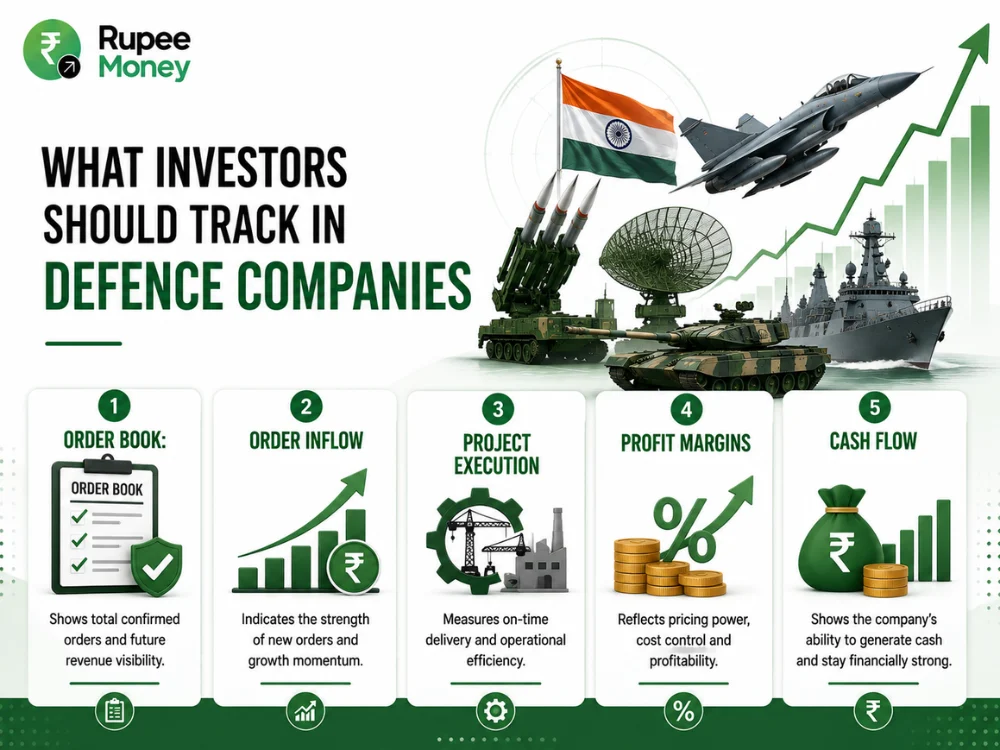
Government spending simply provides the starting point for investment research. Actual company fundamentals determine the final financial impact on your portfolio.
Track these five critically important areas constantly:
- Order Book: It provides excellent future revenue visibility.
- Order Inflow: It proves the company still wins new business.
- Project Execution: Companies must convert orders into physical deliveries efficiently.
- Profit Margins: Revenue growth must create actual profit growth simultaneously.
- Cash Flow: It proves that reported profits create real spendable cash.
Government Defence Spending: The Bigger Picture
India’s defence spending grew exponentially over the past ten years. The budget jumped from ₹2.53 lakh crore in FY2013-14 massively. It reached a staggering ₹7.85 lakh crore in FY2026-27 recently.
Domestic defence production increased sharply alongside this massive budget expansion. Military exports expanded perfectly alongside domestic production capabilities. The government aims to push production above ₹3 lakh crore soon. They target pushing defence exports aggressively toward ₹50,000 crore.
Young investors can start planning early by reading building wealth in your 20s. Investors planning regular investments can use our SIP Calculator to estimate potential long-term returns.
Conclusion
Government defence spending affects listed companies through several distinct channels. It creates highly lucrative new military procurement opportunities. Also, it increases total order books and improves revenue visibility massively.
It encourages physical capacity expansion and supports domestic Indian manufacturing. It also helps local companies build advanced products for global exports. India’s record ₹1.78 lakh crore production highlights this rapid ecosystem expansion perfectly.
However, you must remember one absolutely critical investing rule always. A bigger national budget never guarantees bigger individual shareholder returns automatically. True value emerges only when companies win and execute orders profitably.
FAQs
How does government defence spending affect defence companies?
Government defence spending creates massive demand for military equipment. Companies participate in procurement programmes by supplying advanced defence products. Successful contract wins increase their total order books immediately. Companies execute these contracts and recognize revenue over several years eventually.
Does a higher defence budget mean defence stocks will rise?
Not necessarily. Smart investors usually expect higher spending before budget announcements happen. Stock prices often reflect those high expectations extremely early. A stock falls heavily if the actual announcement disappoints greedy investors.
How do defence orders affect company revenue?
Defence orders create highly visible future business for listed companies. Companies execute these large military contracts over multiple years smoothly. They recognize revenue based strictly on actual deliveries and contractual milestones.
Which defence companies benefit from government spending?
Beneficiaries depend entirely on the exact military procurement category chosen. Aircraft programmes benefit aerospace companies like HAL massively. Naval modernisation budgets benefit established shipbuilders directly. Private manufacturers also benefit heavily from domestic procurement policies.
Does government defence spending benefit private defence companies?
Yes. Private companies play a massive role in defence production today. The private sector contributed ₹42,000 crore to production in FY2025-26. Domestic procurement policies create highly lucrative opportunities for private manufacturers continually.
Disclaimer: This article provides general information for educational purposes only. Government budgets and defence procurement policies change over time frequently. Defence contracts face delays, severe cancellations, cost changes, and execution risks. Stock prices depend heavily on company fundamentals, valuations, and investor expectations. Past performance never guarantees future stock market returns. This article does not constitute investment advice or stock recommendations. Conduct independent research before making any financial investment decisions.
ABOUT THE AUTHOR

