
What Happens After a Company Gets Listed on the Stock Exchange?

An Initial Public Offering (IPO) does not end a company’s journey. It actually starts a completely new phase. Before listing, retail investors buy shares directly through the IPO process. After listing, investors buy and sell shares in the secondary market. The share price changes continuously throughout the daily trading session.
Market demand, company performance, and financial news drive these price changes. But what exactly happens to the company itself after listing? Does the business receive cash every time someone trades its shares? Does the management team face new legal responsibilities?
Welcome to Rupeemoney. We help Indian investors understand financial markets clearly. Today, we explore what happens after a company gets listed on the stock exchange. You can also read our basic guide on what is an IPO to understand the primary market.
What Happens on the Listing Day?
The listing day marks the official debut of company shares. The National Stock Exchange (NSE) conducts a special pre-open session. This session happens before normal market trading begins. The original issue price serves as the base price here. Investors place eligible buy and sell orders during this window.
The stock exchange then discovers a fair equilibrium price. This newly discovered price becomes the official opening price. Strong buyer demand pushes the opening price above the IPO price. Weak demand pushes the opening price below the issue price. This explains why stocks list at a premium or discount.
What Happens to IPO Shares After Listing?
Shares immediately move from the primary market to the secondary market. The primary market allows investors to buy shares from the company. The secondary market allows investors to trade shares among themselves. This specific distinction matters greatly for all new investors.
Suppose you buy one listed share for ₹500 today. The company does not receive your ₹500 payment. The seller receives the money through the market settlement system. The company already raised its capital during the IPO process. The stock market now simply provides liquidity for these shares.
How Does a Listed Share Price Change?
Investors constantly place buy and sell orders every trading day. Heavy buying pressure pushes the share price higher rapidly. Heavy selling pressure forces the share price to drop quickly. Company performance directly influences these critical investor expectations. To understand these price swings, read what makes the stock market go up or down.
Higher quarterly profits improve overall market sentiment instantly. Weak earnings reduce investor demand and drop stock prices. Other external factors also move the stock price daily. These include interest rates, inflation trends, and global market movements. The market constantly discovers new prices through active trading.
Does the Company Get Money After Listing?
The company does not receive money from daily secondary-market trades. This concept confuses many beginner stock market investors. Suppose an IPO investor buys shares at ₹100 initially. That investor later sells those exact shares at ₹140.
The investor keeps the ₹40 profit as a capital gain. The company receives absolutely nothing from this secondary transaction. The company only received funds during the actual IPO. Investors must always check the IPO structure carefully. A fresh issue brings new capital directly to the company. An offer for sale only pays the existing selling shareholders.
What Changes for the Company After Listing?
Listing brings massive new legal and financial responsibilities. A listed company must follow strict stock exchange rules immediately. It must obey Securities and Exchange Board of India rules. Management must provide investors with timely and accurate information constantly.
Executives must disclose important events that influence investment decisions. They must follow continuous listing requirements without any fail. This creates much greater transparency compared to private unlisted companies.
What Financial Results Must a Listed Company Share?
Listed companies must disclose financial information regularly to the public. Investors use these disclosures to track actual business performance. These reports include revenue, expenses, net profit, and debt levels. NSE provides a strict compliance calendar for all financial filings.
Companies must file quarterly financial results within 45 days. Annual financial results follow slightly different regulatory timelines. This transparency gives investors regular access to crucial company performance. Shareholders easily compare current results with previous financial quarters. Learn more about how company results affect share prices to invest smartly.
What Corporate Events Must a Listed Company Disclose?
A listed company cannot keep important business developments private. Management must disclose material events to the stock exchanges quickly. These rapid disclosures help retail investors make informed financial decisions. Examples include major business acquisitions and sudden management changes.
SEBI requires listed entities to disclose specified material events promptly. This strict framework focuses on timely and highly accurate transparency. These mandatory requirements often influence share prices very quickly. A major new contract improves investor sentiment and raises prices. A regulatory investigation creates fear and increases heavy selling pressure.
What Happens to Promoters After Listing?
Company promoters continue to own shares after the listing day. However, they cannot sell all their shares immediately. Strict lock-in rules restrict promoter holdings for specified time periods. This prevents key shareholders from exiting immediately after raising public money.
You can read our detailed guide on the IPO lock-in period for more details. Promoter shareholding details remain visible to all public investors. This transparency allows investors to track major ownership changes easily. A sharp fall in promoter ownership often attracts investor concern.
What Happens to Public Shareholding After Listing?
Listing creates a much broader shareholder base for the business. Retail investors and mutual funds can own the company shares. Foreign institutional investors also buy shares from the open market. Listed companies must comply with minimum public shareholding requirements strictly.
Regulators require listed companies to maintain 25% public shareholding generally. This important requirement supports wider ownership and better market liquidity. It prevents excessive concentration of shares among controlling promoters.
Can the Company Raise More Money After Listing?
Yes, a listed company can definitely raise more capital later. Listing does not stop the company from seeking future funds. Management can use different methods to raise additional growth capital. They can launch follow-on public offers or rights issues easily.
They can also use qualified institutional placements for quick funding. A rights issue allows companies to offer shares to existing shareholders. Investors choose whether to participate based on their personal strategy. An IPO simply represents the first step toward public capital.
What Happens to the Company Valuation After Listing?
Before listing, investors use the IPO price to assess valuation. After listing, the stock market continuously reassesses that specific valuation. Find out exactly how is market capitalization calculated to track company growth.
The math remains very simple for all investors. Market Capitalisation equals Share Price multiplied by Total Outstanding Shares. Suppose a company has exactly 10 crore outstanding shares. If the share price hits ₹200, the market capitalisation becomes ₹2,000 crore.
If the price drops to ₹150, the valuation falls to ₹1,500 crore. The actual business operations may not change overnight at all. However, market valuation changes significantly because investor expectations constantly shift.
What Happens When the Stock Gains or Loses Value?
A changing share price does not change the company bank balance. Suppose a company stock rises from ₹100 to ₹150 quickly. The total market capitalisation increases for the entire business. However, the company does not receive ₹50 per share directly.
The higher price mainly benefits the current shareholders. A falling share price also works in the exact same way. A decline reduces market capitalisation without draining company bank accounts. However, a falling stock price affects the company indirectly over time. It reduces investor confidence and makes future fundraising very expensive.
What Happens to Investors After Listing?
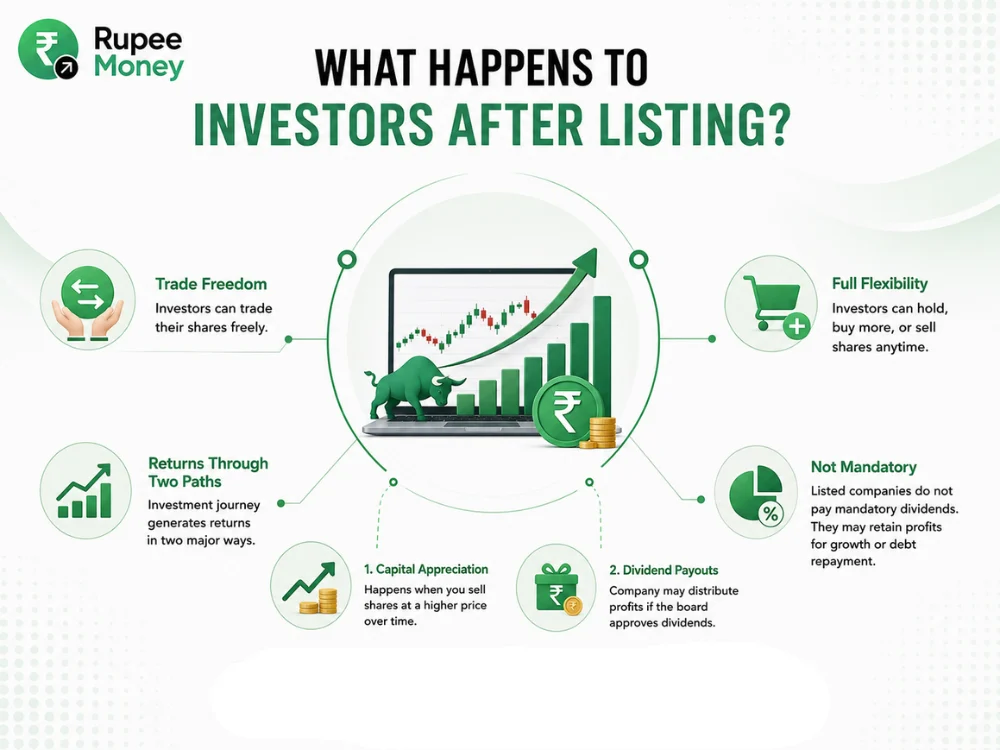
Investors gain the ultimate ability to trade their shares freely. They can hold, buy more, or sell shares anytime. This investment journey generates returns through two major paths. The first path involves simple capital appreciation over time.
This happens when you sell shares at a higher price. You can calculate potential lump sum returns using a Lumpsum Calculator. The second path involves earning regular dividend payouts.
A company may distribute profits if the board approves dividends. However, listed companies do not pay mandatory dividends. They can retain profits for business expansion or debt repayment. If you prefer steady investing, use a SIP Calculator to plan your finances.
Why Does Liquidity Matter After Listing?
Liquidity refers to how easily investors buy or sell shares. A highly liquid stock always has many active buyers and sellers. This high volume makes market transactions incredibly fast and easy. Poorly traded stocks feature wide differences between buying and selling prices.
Liquidity helps the stock market discover fair prices efficiently. Listing gives eligible investors access to an organised trading platform. However, mere listing does not guarantee high liquidity for any stock. Investor interest, company size, and trading activity influence overall liquidity.
What Happens to the Company Public Image?
A stock exchange listing dramatically increases corporate visibility. Investors, media organisations, and large institutions follow the company closely. The company receives massive attention during quarterly financial result announcements. This newfound visibility creates great business opportunities.
Customers and potential business partners view listed companies with trust. However, greater visibility also brings much greater public scrutiny. Poor results or governance issues quickly attract negative market attention.
What Happens During the First Few Months?
The period right after listing brings highly active trading. Many IPO investors sell their allotted shares to book quick profits. Other retail investors buy shares expecting massive future business growth. Institutional investors also adjust their large portfolio positions heavily.
The stock price experiences massive volatility during these initial months. Investors should avoid judging a company by its first trading week. A strong listing gain never guarantees long-term business success. A weak listing does not mean the company will fail completely.
What Should Investors Check After a Company Gets Listed?
Investors must shift focus from IPO hype to actual business metrics. Revenue and profit growth deserve your immediate attention. Check whether the company grows its revenue consistently every quarter. Look for logical reasons behind changes in financial performance.
Track the operating cash flow to understand actual earnings quality. High debt increases financial pressure during difficult economic conditions always. Compare company valuation against industry peers and future earnings growth. Also, monitor promoter ownership changes and strict corporate governance disclosures carefully.
Examine the operating profit margins closely every quarter. Analyze the total market share of the listed company. Review the quarterly earnings call transcripts for management commentary. Check if the company pays regular taxes to the government.
What Happens If a Listed Company Performs Poorly?
Listing definitely does not protect any company from business failure. A listed company can easily suffer from falling sales and losses. Debt problems and governance issues destroy share prices very quickly. Regulatory bodies take strict action against severe corporate violations.
A failing company eventually faces delisting under strict exchange rules. Becoming listed gives a business access to vital public capital. However, it never guarantees permanent business success or survival.
Conclusion
The real corporate journey begins after the IPO listing completes. The stock market discovers the share price through constant trading. The company raises capital through the IPO but not secondary trades. Listing brings massive disclosure and strict compliance responsibilities for management.
Executives must regularly share financial information and vital business events. Retail investors gain excellent visibility into ownership and financial performance. Do not judge a newly listed company by its listing day gain. Study the actual business, valuation, cash flows, and future growth potential.
FAQs
Does a company get money every time its shares are traded?
No. The company raises capital only during the IPO process. Normal secondary market trades happen strictly between investors. The sale proceeds go directly to the selling investor.
What happens to IPO shares after listing?
IPO shares become available for active trading on the stock exchange. Investors buy or sell these shares through registered stock brokers. The market determines the daily trading price through demand and supply.
Can I sell IPO shares on the listing day?
Yes, retail investors can sell shares on the listing day itself. Freely tradable shares carry no restrictions for normal retail investors. Always check your demat account holdings before placing any sell order.
Why can a stock list above its IPO price?
A stock lists higher when market demand exceeds available share supply. Positive investor sentiment and strong industry conditions influence this listing price. NSE uses a special pre-open mechanism to discover this opening price.
Does listing increase a company market capitalisation?
Listing establishes a publicly traded market price for the shares. Market capitalisation changes whenever the daily share price moves. This simply represents a change in the assigned market value.
What happens if a listed company goes bankrupt?
A bankrupt company faces strict legal action and liquidation processes. The stock exchange suspends trading for the specific company shares. Shareholders often lose their entire invested capital during bankruptcy. Investors must avoid companies with heavy debt and falling profits.
Do promoters buy shares after listing?
Yes, promoters can buy more shares from the open market. This process demonstrates strong management confidence in the business future. SEBI regulates these insider purchases through strict reporting guidelines constantly.
Disclaimer: This article is strictly for educational and informational purposes only and should not be construed as financial, investment, or legal advice. Stock market investments are subject to market risks. The information provided is based on publicly available data and market conditions as of 2026, which are subject to change. RupeeMoney does not provide buy or sell recommendations. Always conduct your own research or consult a SEBI-registered financial advisor before making any investment decisions.
ABOUT THE AUTHOR

