
How Does Inflation Affect the Stock Market in India?

Every investor wants to know why markets rise one month and fall the next. Many factors shape share prices, but inflation remains one of the biggest. Inflation touches household spending, business profits, interest rates, and investor confidence all at once. Each of these factors eventually feeds into how the stock market performs.
If you follow financial news on RupeeMoney, you’ve probably noticed something. Market experts always watch inflation data closely before making investment calls. Whether you invest through stocks, mutual funds, or SIPs, understanding inflation helps you make better choices. It stops you from reacting emotionally to every market swing too.
This guide explains how inflation affects the Indian stock market. It also covers why some sectors benefit while others struggle, and what you should actually do when inflation rises.
What Is Inflation and Why Does It Matter to the Stock Market?
Inflation means prices for goods and services rise gradually over time. As prices climb, the purchasing power of your money drops. The same rupee amount simply buys fewer products than before.
Here’s a simple example. Say your grocery bill rises from ₹5,000 to ₹5,500 every month, with no income increase. Inflation has just reduced your real purchasing power directly.
Inflation matters to the stock market because companies face higher costs too. Businesses spend more on raw materials, transport, salaries, electricity, and borrowing. If companies can’t pass these costs to customers, their profits shrink. Lower profits often drag share prices down with them.
Inflation also shapes interest rates, consumer spending, and overall economic growth at the same time. These combined effects make inflation one of the biggest drivers of market performance. Read What Is Inflation and Why Does It Matter? for the full breakdown of how it’s measured.
How Inflation Affects the Stock Market
Inflation doesn’t hit every company the same way. Some businesses manage rising costs well, while others struggle to protect their margins.
Higher Inflation Increases Business Costs
Companies need raw materials, fuel, electricity, salaries, and logistics to run. When inflation rises, all these expenses climb too. Businesses with weak pricing power can’t raise product prices right away. Their profit margins shrink as a direct result.
Lower profits usually dent investor confidence and pressure stock prices downward. Automobile manufacturers, airlines, and consumer electronics firms often feel this first. Textile companies and real estate developers face similar squeeze effects too.
Inflation Reduces Consumer Spending
Higher prices leave families with less money to spend elsewhere. People start postponing purchases like cars, electronics, and furniture. Luxury goods and travel bookings often get pushed back too.
Lower consumer demand directly hits company sales figures. If firms report slower revenue growth during earnings season, investors often sell. This selling pressure can trigger genuine market corrections.
RBI May Raise Interest Rates
Controlling inflation ranks among the RBI’s core responsibilities. When inflation stays high, the RBI may raise the Repo Rate in response. As of mid-2026, the Repo Rate sits at 5.25%, with retail inflation running around 4.38% in June.
Higher interest rates make loans costlier for businesses, home buyers, and car buyers alike. Consumers across the board feel this pinch too. Higher borrowing costs then reduce investment and spending economy-wide.
Many listed companies also pay more interest on their existing loans. This directly cuts into their profitability. The combined effect often creates negative sentiment in the stock market.
Corporate Earnings May Decline
Corporate earnings represent the profit companies keep after paying all expenses. Inflation pushes operating costs higher across most industries. If revenue doesn’t grow at the same pace, earnings fall.
During quarterly results season, weak earnings often trigger falling share prices. Investors watch revenue growth, profit margins, and operating expenses closely. Net profit and future guidance matter just as much here. Poor earnings paired with high inflation can spark real market volatility.
How Moderate Inflation Helps the Stock Market
Not every inflation level actually hurts the economy. Moderate inflation usually signals healthy, steady economic growth instead.
When inflation stays under control, businesses expand their operations confidently. Consumers keep spending, and employment generally improves alongside it. Corporate earnings grow, and investors tend to stay optimistic. A growing economy often supports higher stock prices over the long run. This is exactly why economists view moderate inflation as healthier than extremes.
Which Sectors Perform Better During Inflation?
Some sectors handle inflation far better than others. Companies that raise prices without losing customers keep generating healthy profits.
Banking often benefits when lending rates rise. Higher rates can boost interest income, depending on credit demand. Large private and public banks often perform relatively well here.
Energy and oil companies often see higher revenues when commodity prices climb. Oil, gas, and power firms may gain if pricing improves earnings. Government policy and regulation still shape actual profitability, though.
FMCG companies usually hold strong pricing power in tough times. Consumers keep buying daily essentials, even as prices creep up. Established brands can raise prices gradually without losing much demand.
Commodity producers in steel, mining, cement, and metals sometimes gain too. Higher selling prices can lift revenue, provided production costs stay manageable.
Which Sectors Face More Pressure During Inflation?
Some industries struggle badly, since consumers cut discretionary spending first. Automobile, aviation, and consumer durables companies fall into this group. Real estate developers and hospitality businesses face similar pressure too.
These companies depend heavily on discretionary spending from households. When budgets tighten, customers delay purchases, and company earnings suffer directly.
Inflation and Investor Sentiment
Inflation affects far more than just company profits. It also reshapes how investors actually behave day to day.
When inflation rises sharply, uncertainty spreads through the market quickly. Some investors shift money toward safer investment options instead. Others simply reduce their equity exposure until conditions stabilise. This shift often increases daily volatility across the board.
Short-term market moves can turn genuinely unpredictable during these phases. This holds true even when the long-term economic outlook stays positive.
Inflation vs Deflation: Different Impacts on the Stock Market
Both inflation and deflation affect the stock market, but in opposite ways.
Inflation means prices rise steadily over time. Moderate inflation usually supports growth, since businesses earn more and consumers keep spending. Very high inflation, though, raises business costs and cuts purchasing power. This combination pressures corporate earnings and stock prices together.
Deflation means prices keep falling instead. Lower prices might look appealing at first glance. Prolonged deflation, though, usually signals genuinely weak demand in the economy. Consumers delay purchases, expecting prices to drop even further. Businesses then earn less, cut production, and sometimes reduce jobs. These effects can hurt company profits and stock prices badly.
Healthy economies generally do better when inflation stays within a manageable band. Extremes in either direction tend to cause real economic strain.
What Should Investors Do When Inflation Is High?
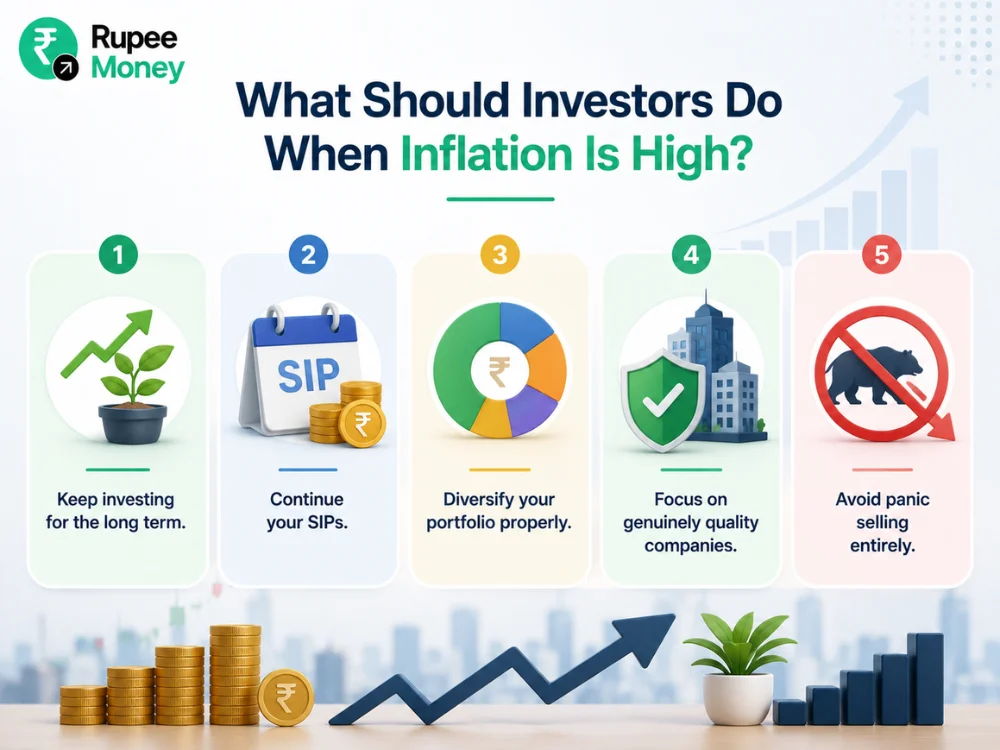
Market volatility often rises during inflationary periods. Instead of reacting emotionally, follow a disciplined investment approach instead.
Keep investing for the long term. Many investors stop investing when markets turn volatile. Long-term investors, though, usually benefit by staying invested across different cycles. Consistent investing helps smooth out short-term fluctuations over time.
Continue your SIPs. Many investors pause their SIP during market declines, but this rarely helps. Regular SIP investments buy more units when markets fall. They buy fewer units when markets rise instead. This process averages out your investment cost over time. Wondering how SIP frequency plays into this? It matters far less than simply staying consistent. Try the SIP Calculator to see how staying invested through inflation actually plays out.
Diversify your portfolio properly. Avoid putting all your money into a single sector. A diversified portfolio spreads risk across different asset classes instead. Consider equity mutual funds, large-cap stocks, and gold together. Debt investments and government securities round out a balanced mix well. Check the PPF Calculator too, since PPF holds up reliably regardless of inflation swings. If you’re weighing gold specifically, How to Start Investing in Gold and Silver is worth reading first. Diversification cushions the blow if one category underperforms.
Focus on genuinely quality companies. Businesses with strong financials usually manage inflation better than weaker peers. Look for consistent profits, low debt, and strong cash flows. Good management and stable business models matter here too. These companies tend to perform better through economic uncertainty.
Avoid panic selling entirely. Many investors sell right after negative market headlines appear. Emotional decisions like this often lead to real losses. Review a company’s fundamentals before making any investment decision instead. Long-term wealth creation genuinely requires patience and real discipline.
Common Mistakes Investors Make During Inflation
Inflation creates real uncertainty, and beginners often make avoidable mistakes.
Some sell investments after every single market correction. Others stop their SIPs the moment volatility appears. Many chase stocks based purely on social media tips instead. Ignoring company fundamentals and skipping diversification both cause real damage too. Trying to time the market perfectly rarely works out either. Avoiding these mistakes genuinely improves your long-term investment outcomes.
Key Takeaways About Inflation and the Stock Market
- Inflation remains one of the biggest economic factors shaping financial markets.
- It touches company profits, consumer demand, borrowing costs, and investor confidence together.
- Moderate inflation generally supports healthy economic growth.
- High inflation raises market volatility and squeezes corporate profitability.
- Smart investors don’t react to every single inflation announcement.
- They focus on long-term investing, diversification, and genuinely quality businesses instead.
Understanding how inflation moves through different sectors helps you make sharper financial decisions.
Frequently Asked Questions (FAQs)
Does inflation always reduce stock market returns?
No, not always. Moderate inflation often reflects a growing economy where businesses expand steadily. Employment improves, and consumer spending stays genuinely healthy in these conditions. Such conditions can actually support higher corporate earnings and stock prices. Very high inflation, though, raises business expenses and cuts purchasing power. This combination can hurt profits and trigger real volatility. Evaluate the actual inflation level rather than assuming every rise hurts markets.
Which sectors perform better during inflation?
Some sectors manage inflation well because they can pass costs to customers. Banking, FMCG, energy, utilities, and commodity-based firms often perform relatively well. These businesses usually maintain stable demand or gain from higher commodity prices. Actual performance still depends on broader economic conditions and company-specific factors.
Why does the RBI raise the Repo Rate during inflation?
The RBI uses the Repo Rate specifically to control rising inflation. When inflation climbs significantly, the RBI may raise this rate in response. Higher borrowing costs reduce excessive spending and demand across the economy. This process helps bring inflation back under control over time. Higher rates, though, can briefly dent stock market sentiment, since companies and consumers face steeper financing costs.
Is it smart to continue SIPs during inflation?
Yes, generally speaking. Continuing your SIP through inflation and market corrections usually benefits long-term investors. Market declines let you buy more mutual fund units at lower prices. Over time, this averages out your overall investment cost nicely. Stopping SIPs during temporary volatility often costs you long-term wealth creation instead.
Can inflation actually create investment opportunities?
Yes, it genuinely can. Market corrections caused by inflation sometimes let you buy strong companies cheaply. Investors focused on long-term goals, rather than short-term noise, often benefit later. Proper research and real diversification still matter before you invest, though.
How can beginners protect their investments during inflation?
Beginners should avoid emotional decisions during inflationary periods above all else. Stay diversified across asset classes, and keep investing regularly regardless of headlines. Choose quality companies, and review your financial goals periodically too. Stay informed about economic developments, and avoid decisions based on rumours or short-term price swings.
Conclusion
Inflation touches nearly every part of the economy, from businesses to consumers to financial markets. It reshapes company costs, changes spending habits, and drives monetary policy decisions. Eventually, these factors feed straight into stock prices and investor sentiment.
High inflation can create real short-term uncertainty, but it shouldn’t scare you off long-term investing. Investors who understand market cycles, stay disciplined, and focus on quality often navigate inflation well. If you’re still building your broader financial foundation, Building Wealth in Your 20s is worth reading alongside this guide.
Learning how inflation moves through the stock market helps you read financial news with real confidence. Instead of reacting to headlines, you can make decisions grounded in research, goals, and long-term thinking.
Disclaimer: This article is intended for educational and informational purposes only. It should not be considered investment, financial, legal, or tax advice. Stock market investments involve market risks, and values may rise or fall due to economic conditions, inflation, interest rates, and other factors. Always conduct your own research or consult a qualified financial advisor before making any investment decisions.
ABOUT THE AUTHOR

