
Best Gold Investment Option in India :Gold Jewellery, Gold Coins or Gold Bars
For most Indian families, gold is more than just a metal — it’s an emotion. It shows up at weddings, gets bought during Dhanteras and Akshaya Tritiya, and often ends up as a gift passed down through generations. But once the festive excitement settles, a practical question usually pops up: is it smarter to buy gold jewellery, gold coins, or gold bars?
Each of these serves a slightly different purpose. Jewellery gives you something you can wear and enjoy while it holds value. Coins are compact, easy to gift, and simple to store. Bars, on the other hand, are built purely for people who want to grow their wealth without worrying about design or craftsmanship.
At RupeeMoney, we’ve noticed that a lot of buyers pick a gold format simply out of habit, without really checking things like purity, making charges, or how easily it can be resold later. This guide breaks down gold jewellery, gold coins, and gold bars side by side, so you can pick the one that actually fits your goals — not just tradition. If you’re new to precious metal investing altogether, our guide on how to start investing in gold and silver is a good place to begin before diving deeper here.
Gold Jewellery, Coins, and Bars: How Are They Actually Different?
All three are made of gold, yet they’re built for different jobs.
- Gold jewellery is bought mostly for wearing at weddings, festivals, and family functions. It holds real gold value, but you also pay for the design and labour that went into making it.
- Gold coins are bought more for saving or gifting. They come in fixed weights and are usually purer than jewellery.
- Gold bars exist almost entirely for investors. With little to no craftsmanship involved, they tend to be the cheapest way to hold physical gold per gram.
Once you know this distinction, the decision becomes less about tradition and more about what you’re actually trying to achieve with your money.
Buying Gold Jewellery as an Investment: What Works and What Doesn’t
Jewellery remains the most bought form of gold in India, and it’s easy to see why — it doubles up as an adornment and a store of value at the same time.
Why People Still Love Gold Jewellery
- You get to wear it, not just store it away.
- It works as a backup asset during emergencies.
- It can be pledged for a gold loan if you ever need quick funds.
- It’s accepted almost everywhere across the country.
- You’ll find designs to match nearly any budget.
For many households, the sentimental value alone justifies the extra cost — and that’s a completely fair reason to buy it.
Where Jewellery Falls Short as an Investment
- Making charges push up the buying price significantly.
- You rarely get that making-charge money back when you sell.
- Resale value is usually lower than what you originally paid.
- Purity isn’t consistent — it could be 22K, 18K, or something else entirely.
- Old or worn-out designs can pull down resale offers even further.
If wealth building is your main goal rather than wearing the gold, jewellery probably isn’t your most efficient route.
Are Gold Coins a Smarter Buy Than Jewellery?
Gold coins have picked up serious popularity among Indian buyers because they strike a nice middle ground — decent returns with real flexibility. People buy them during festive months, hand them out as gifts, and hold onto them as long-term savings.
Compared to jewellery, coins usually come with much smaller making charges and standardised weights, which makes pricing far easier to compare across sellers.
What Makes Gold Coins Worth Considering
- Often sold in 24K purity, which is about as pure as gold gets.
- Making charges are noticeably lower than jewellery.
- Compact and simple to store or carry.
- Work equally well as gifts and as investments.
- Available in small sizes, so you can build your holdings gradually.
If you’re just starting to invest in physical gold and don’t want the extra cost of jewellery-making, coins are a fairly safe entry point.
Points to Check Before You Buy Gold Coins
- Stick to trusted jewellers, banks, or certified dealers.
- Look for BIS Hallmark certification wherever it applies.
- Compare buyback terms before you commit to a purchase.
- Note that some banks sell coins but won’t buy them back later.
- Premiums charged over the market gold rate can differ a lot between sellers.
A little research on pricing and buyback terms upfront can save you from overpaying later.
Why Serious Investors Often Choose Gold Bars
If your only goal is investment — not wearing the gold — bars are usually the most efficient physical option available.
Gold bars come in a range of sizes, from small starter bars to heavier ones meant for bigger purchases. Since there’s barely any craftsmanship involved, the additional cost over the actual gold price stays minimal.
The Case for Gold Bars
- Typically sold in 24K purity.
- Making charges are lower than what jewellery attracts.
- Better value per rupee when you’re investing large sums.
- Higher gold content than most jewellery pieces of the same weight.
- Easier to compare prices since there’s no design premium involved.
For someone focused on long-term wealth preservation, bars often beat decorative gold on pure returns.
What to Watch Out For
- You’ll need a secure place to store them.
- They’re not something you can wear.
- Bigger bars mean a bigger upfront cost.
- How easily you can sell one depends on the seller and purity proof.
- Insurance and storage can add to the cost if you’re holding a large quantity.
These aren’t dealbreakers, but they’re worth planning for before you buy in bulk.
Understanding Gold Purity: Why 24K, 22K, and Hallmarking Matter
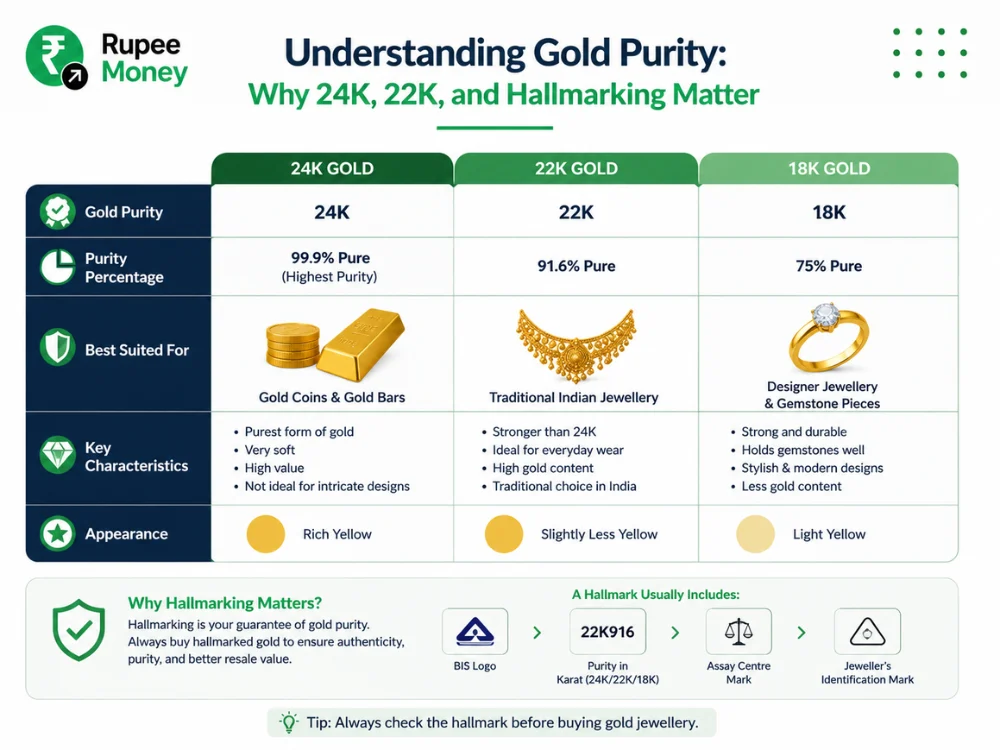
Purity is the single biggest factor that decides both the value of your gold and what it’s suited for.
- 24K gold (99.9% pure): The purest form available, typically used for coins and bars. It’s too soft to hold up well in detailed jewellery designs.
- 22K gold (91.6% pure): The standard for Indian jewellery, since it’s tougher and better suited for everyday wear while still carrying a high gold content.
- 18K gold (75% pure): Common in designer pieces, especially those set with diamonds or stones, because the added strength helps hold gemstones securely.
Always check for BIS Hallmark certification before buying. It confirms purity and authenticity, and it also tends to make resale a lot smoother down the line.
Which One Resells Better: Jewellery, Coins, or Bars?
Resale value is where many buyers get caught off guard. All three forms can be sold, but what you actually receive depends on purity, certification, making charges, and the prevailing market rate.
Gold bars resell the most efficiently since they carry minimal making charges and are usually 24K. Coins aren’t far behind, especially hallmarked ones from reliable sellers. Jewellery tends to lose the most value because making charges, wastage, and design costs are rarely refunded.
Comparing Gold Jewellery, Coins, and Bars at a Glance
| Feature | Gold Jewellery | Gold Coins | Gold Bars |
| Primary Purpose | Personal use + investment | Investment + gifting | Pure investment |
| Purity | Usually 22K | Mostly 24K | Mostly 24K |
| Making Charges | High | Low | Lowest |
| Resale Value | Moderate | Good | Very Good |
| Storage | Moderate effort | Easy | Easy |
| Daily Wear | Yes | No | No |
| Investment Value | Moderate | High | Highest |
| Best Suited For | Weddings, festivals | First-time investors, gifting | Long-term wealth building |
Each format holds value in its own way — the right pick depends entirely on why you’re buying gold in the first place.
Which Gold Investment Should You Actually Buy?
There’s no universal “best” option here — it comes down to your budget, purpose, and how long you plan to hold onto it. Before deciding, it also helps to see how gold stacks up against other options, such as in our comparison of gold versus fixed deposits, or by working out potential returns using our Lumpsum Calculator if you’re comparing gold with mutual fund investments.
Go for Gold Jewellery If…
- You need it for a wedding, festival, or family occasion.
- Emotional value matters to you as much as financial returns.
- Wearing the gold is part of the point, not just owning it.
- You don’t mind paying extra for the craftsmanship.
Go for Gold Coins If…
- You’re just getting started with gold investing.
- You’d rather invest smaller amounts at a time.
- You want something that works as both a gift and an investment.
- High purity matters more to you than design.
Go for Gold Bars If…
- Your only goal is long-term wealth building.
- You want the most gold for your money, with minimal extra cost.
- You’re planning a sizable investment.
- You have a safe way to store it.
A Quick Checklist Before You Buy Any Gold
Regardless of which format you choose, a few basic checks can protect your money:
- Confirm the BIS Hallmark certification.
- Verify the purity — 24K, 22K, or 18K.
- Compare making charges across different jewellers.
- Ask about the seller’s buyback and exchange terms.
- Insist on a proper tax invoice with full purchase details.
- Buy only from trusted jewellers, banks, or authorised dealers.
- Check the day’s gold rate before finalising your purchase.
These small steps go a long way in making sure you’re getting genuine gold and a fair resale value later.
Where Gold Investing in India Is Headed
Physical gold is no longer the only way Indians invest in the metal. Alongside jewellery, more buyers are now exploring Digital Gold, Gold ETFs, and government-backed instruments too. If you’d like to explore these routes, see our comparison of Digital Gold vs Gold ETFs and NSE Electronic Gold Receipts (EGR) vs Gold ETFs.
Growing awareness of making charges, purity, and resale value is pushing buyers to compare options rather than default to jewellery out of habit. With inflation and market swings still a concern for many households, gold continues to be seen as a dependable way to protect long-term wealth. You can also try our SIP Calculator to see how a diversified plan, including gold, could grow over time.
Key Takeaways
- Gold jewellery, coins, and bars each serve a different purpose — personal use, gifting, or pure investment.
- Jewellery carries emotional and practical value but usually comes with higher making charges.
- Coins balance affordability, purity, and ease of resale, making them ideal for beginners.
- Bars typically deliver the highest investment value thanks to lower charges and higher purity.
- Always check for BIS Hallmark certification before any gold purchase.
- Weigh purity, resale value, making charges, and your own goals before choosing a format.
Frequently Asked Questions (FAQs)
Is gold jewellery a good investment in India?
Jewellery can be a genuinely valuable asset, particularly for families planning to wear it at weddings or festivals. But from a pure investment standpoint, it’s often less efficient because of the making charges and design costs layered on top of the gold price — costs you typically don’t recover when selling. If wealth creation is your priority, gold coins or bars usually work out better, while jewellery remains a solid choice for those who want both utility and financial security.
Which resells better — jewellery, coins, or bars?
Gold bars usually offer the best resale value because of their high purity and minimal making charges. Coins come close, especially hallmarked ones from trusted sellers. Jewellery tends to lose value on resale due to making charges, wastage, and design deductions. The final amount you get also depends on purity, current gold rates, and the jeweller’s buyback policy.
Should I buy 24K gold coins or 22K gold jewellery?
It depends on your purpose. For pure investment, 24K coins usually make more sense because of their higher purity and lower making charges. For everyday wear, 22K jewellery is the better pick since it’s more durable. Many buyers use coins for saving and reserve jewellery purchases for occasions when they actually plan to wear it.
How do making charges affect gold investment returns?
Making charges cover the labour and craftsmanship that goes into designing jewellery, and they vary based on design complexity and the jeweller’s own pricing. Since these charges are rarely refunded on resale, they add to your upfront cost while lowering your effective returns. Coins and bars carry much smaller making charges, which is why investors often prefer them.
What should I verify before buying physical gold?
Check the BIS Hallmark certification, confirm the purity grade, compare making charges across sellers, understand the buyback policy, and collect a proper invoice. Buying from a reputed jeweller or authorised dealer helps ensure authenticity and makes future resale smoother. It also helps to check the day’s market gold rate so you’re paying a fair price.
Conclusion
Gold remains one of the most trusted assets for Indian households, but the format you choose matters just as much as the decision to invest. Jewellery blends financial value with sentiment and tradition, coins offer flexibility along with high purity, and bars remain the most cost-efficient route for investors focused purely on long-term growth.
Before your next purchase, think through your financial goals, storage capacity, and expected resale value instead of buying purely out of habit. And if long-term wealth planning is on your mind beyond gold as well, our guide on building wealth in your 20s is worth a read. Paying attention to purity, making charges, hallmark certification, and buyback terms will help you get real value out of every gram you invest in.
Disclaimer: This article is meant for informational and educational purposes only and should not be treated as financial or investment advice. Gold prices, making charges, taxes, and buyback policies differ across jewellers and can change over time. Always verify purity, hallmark certification, and current market rates before buying gold, and consider consulting a qualified financial advisor to see what fits your personal financial goals.
ABOUT THE AUTHOR

