
Raksan Transformers IPO 2026: Business Model & Full IPO Review
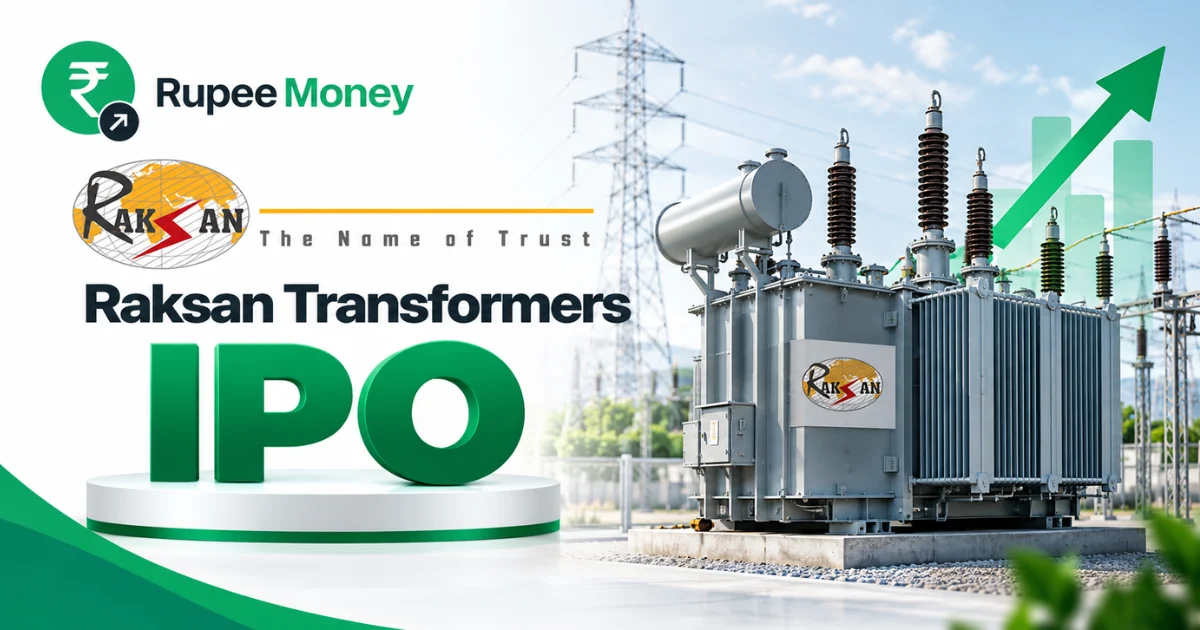
India’s rapid expansion of renewable power generation, transmission corridor upgrades, and industrial electrification creates unprecedented demand for heavy electrical equipment. Power utilities and green energy developers require specialized, high-efficiency transformers to prevent transmission loss and manage variable grid loads. Seizing on this multi-year infrastructure boom, Haryana-based Raksan Transformers Limited enters the primary capital market to launch its initial public offering (IPO) on the BSE SME platform to raise ₹150.50 crore. The enterprise plans to deploy the fresh capital to build an advanced manufacturing facility in Liwaspur and fund expanding working capital requirements.
Evaluating a heavy electrical engineering manufacturer requires the exact analytical discipline you apply to your personal financial planning. Because transformer manufacturing demands significant capital outlays, volatile copper and specialized steel inputs, and long tender collection cycles, prudent investors look far beyond headline sales expansion. You must scrutinize the firm’s confirmed order pipeline, analyze operating cash flows, and evaluate how management deploys fresh equity capital. If you are exploring primary market offerings for the first time, our foundational guide covering what is an IPO provides essential principles for analyzing corporate share offerings.
This comprehensive review examines the Raksan Transformers IPO, dissecting its engineering operations, key issue timelines, valuation multiples, balance sheet growth, and primary investment risks.
Raksan Transformers IPO: Core Issue Architecture
Raksan Transformers raises growth capital through a book-built public offering. The transaction combines a fresh issue of shares to fund operational expansion with an Offer for Sale (OFS) from the founding promoter group.
| Issue Parameter | Official Offer Specification |
| Company Name | Raksan Transformers Limited |
| Market Segment | SME IPO |
| Listing Exchange | BSE SME |
| Issue Mechanism | Book-Built Public Issue |
| Price Band | ₹258 to ₹273 per equity share |
| Face Value | ₹10 per share |
| Total Shares Offered | 55,12,800 equity shares |
| Total Issue Size | Approximately ₹150.50 crore |
| Fresh Issue Component | 44,12,800 shares (~₹120.47 crore) |
| Offer for Sale (OFS) | 11,00,000 shares (~₹30.03 crore) |
| Market Maker Reservation | 2,76,000 shares |
| Minimum Bid Lot | 400 shares |
| Minimum Retail Application | 2 Lots (800 shares) |
| Minimum Retail Outlay | ₹2,18,400 (at upper band) |
| Registrar to the Issue | Bigshare Services Pvt. Ltd. |
| Lead Merchant Banker | Hem Securities Ltd. |
(Note: Official allotment timelines and listing dates remain subject to final stock exchange notifications.)
Subscription Schedule and Important Dates
Bidders should monitor the official schedule outlined below to approve their UPI mandates on time:
| IPO Milestone | Scheduled Calendar Date |
| Anchor Investor Allocation | September 9, 2026 |
| IPO Bidding Opens | September 10, 2026 |
| IPO Bidding Closes | September 15, 2026 |
| Finalization of Allotment | September 16, 2026 |
| Initiation of Bank Refunds | September 17, 2026 |
| Credit of Shares to Demat Accounts | September 17, 2026 |
| Official Exchange Debut | September 18, 2026 |
If your application fails to secure an allocation during the allotment lottery, review our guide on what happens if you don’t get IPO allotment to understand the automated bank lien removal process.
Pricing Mechanics and Minimum Capital Requirements
The merchant bankers established the pricing corridor at ₹258 to ₹273 per equity share. To understand how book-running lead managers determine these valuation boundaries, read our explainer on how IPO share prices are decided in India.
Because Raksan Transformers lists on the BSE SME platform, stock exchange regulations mandate larger bid sizes to discourage speculative micro-trading. While a single base lot contains 400 shares, individual retail participants must bid for a minimum of two lots (800 shares).
Calculating the baseline retail financial outlay at the upper price band yields:
800 shares ✕ ₹273 = ₹2,18,400
Small High Net-Worth Individuals (sHNI) must apply for a minimum of three lots (1,200 shares), locking in an upfront capital commitment of ₹3,27,600. Big High Net-Worth Individuals (bHNI) must bid for at least 10 lots (4,000 shares), pushing their capital threshold to ₹10,92,000. Allocating such large cash reserves requires structured personal budgeting, much like evaluating long-term portfolio compounding using a lumpsum calculator or estimating monthly liabilities with an EMI calculator.
Grey Market Premium (GMP) Overview
As of early September 2026, unlisted tracking portals record the Grey Market Premium (GMP) for Raksan Transformers at ₹0 per share.
A flat GMP indicates that unofficial market participants anticipate listing parity with the upper issue price of ₹273. Unlisted brokers typically withhold active trading quotes on large SME issues until anchor investors commit capital and retail subscription figures reveal true demand. Investors must remember that grey market premiums reflect unregulated, speculative sentiment and never guarantee listing gains. Verified manufacturing assets, order execution speed, and balance sheet strength should drive your bidding choices rather than informal premium rumors.
Operating Model and Engineering Infrastructure
Incorporated in July 1995, Raksan Transformers brings roughly three decades of industrial experience to the electrical equipment sector. The company originally operated as a specialized service provider repairing industrial transformers before initiating in-house manufacturing in 2005-06. Today, the enterprise functions strictly on a Business-to-Business (B2B) framework, engineering customized transformers for state electricity distribution companies (DISCOMs), public sector undertakings (PSUs), infrastructure developers, and solar power plants.
Specialized Transformer Portfolio
The company designs and fabricates electrical transformers tailored to client-specific voltage ratings, sound tolerances, and climatic conditions. Its product catalogue spans four primary verticals:
- Distribution Transformers: Step down electrical grid voltages for domestic and commercial consumption.
- Power Transformers: Manage high-voltage bulk electricity transmission across substations.
- Solar Inverter Duty Transformers: Step up solar inverter output to interface directly with regional transmission grids.
- Special-Purpose Transformers: Provide customized electrical isolation and step-down capabilities for heavy industrial arc furnaces and manufacturing plants.
Manufacturing Scale and Backward Integration
The enterprise operates two manufacturing units located at Rai industrial area in Sonepat, Haryana. These plants maintain an aggregate annual installed capacity of 15,00,000 KVA for distribution transformers and 1,350 MVA for high-capacity power transformers. Raksan controls every major step of the manufacturing lifecycle internally – including core slitting, coil winding, wire drawing, vacuum drying, and oil filtration. Furthermore, its group entity, SHR Powers Private Limited, manufactures transformer tanks and steel enclosures, granting Raksan critical supply-chain independence and protecting gross margins.
Confirmed Order Book Pipeline
Demonstrating strong institutional demand, the company held an active order book of approximately ₹329.68 crore across 83 individual orders as of June 30, 2026. This contracted pipeline represents nearly 90% of its total FY2026 annual revenue, providing exceptional near-term business visibility.
Planned Deployment of IPO Proceeds
The company will utilize the fresh capital to execute a major operational expansion:
- Constructing a Mega-Plant at Liwaspur (₹62.14 Cr): Management will allocate ₹62.14 crore to construct and equip an advanced manufacturing plant in Liwaspur, Haryana. This modern facility will expand production capacity for higher-MVA power transformers to target larger central transmission tenders.
- Working Capital Requirements (₹35.00 Cr): Transformer manufacturing demands heavy upfront capital to procure copper coils and Cold-Rolled Grain-Oriented (CRGO) electrical steel. Channeling ₹35 crore into working capital prevents liquidity pinches during long government payment cycles.
- Debt Repayment (₹7.28 Cr): The company directs ₹7.28 crore to extinguish outstanding bank borrowings, lowering interest liabilities.
- General Corporate Purposes: The remaining balance funds public issue expenses and operational contingencies.
Financial Track Record and Profitability Acceleration
Raksan Transformers displays exceptional top-line revenue expansion and rapid bottom-line profit growth over the past three fiscal cycles.
| Financial Metric | FY2024 | FY2025 | FY2026 |
| Total Income | ₹162.52 Cr | ₹324.78 Cr | ₹363.63 Cr |
| Operating EBITDA | ₹10.19 Cr | ₹29.51 Cr | ₹46.72 Cr |
| Profit After Tax (PAT) | ₹7.59 Cr | ₹20.38 Cr | ₹33.60 Cr |
| Total Net Worth | ₹23.70 Cr | ₹44.07 Cr | ₹77.42 Cr |
| Total Borrowings | ₹9.81 Cr | ₹23.51 Cr | ₹20.74 Cr |
| Total Assets | ₹67.02 Cr | ₹117.90 Cr | ₹155.59 Cr |
| EBITDA Margin (%) | 6.27% | 9.09% | 12.87% |
| PAT Margin (%) | 4.67% | 6.28% | 9.25% |
Operational execution drove rapid top-line growth. Total income more than doubled between FY2024 and FY2026, climbing from ₹162.52 crore to ₹363.63 crore. Concurrently, operating efficiency surged, with EBITDA margins widening from 6.27% to 12.87%. Profit After Tax skyrocketed from ₹7.59 crore in FY2024 to ₹33.60 crore in FY2026, confirming powerful operating leverage as unit volumes scaled.
Total borrowings stood at ₹20.74 crore in FY2026 against a net worth of ₹77.42 crore. This gives the company an exceptionally clean Debt-to-Equity ratio of 0.27x, providing immense balance sheet stability ahead of its public debut.
Valuation Multiples and Capital Productivity
At the upper price band of ₹273 per equity share, the Raksan Transformers IPO commands an attractive valuation based on its FY2026 financial metrics:
- Pre-IPO P/E Ratio: ~13.39x (calculated on basic EPS of ₹20.39)
- Post-IPO P/E Ratio: ~16.98x (calculated on diluted post-issue EPS of ₹16.08)
- Return on Capital Employed (ROCE): 46.72%
- Return on Net Worth (RoNW): 43.41%
- Net Asset Value (NAV) per Share: ₹14.38
- Debt-to-Equity Ratio: 0.27x (prior to IPO debt reduction)
Comparing Raksan to listed electrical equipment peers reveals strong relative value:
- Supreme Power Equipment: Trades at ~29.19x P/E with an RoNW of 20.11%
- Shilchar Technologies: Trades at ~23.78x P/E with an RoNW of 42.32%
- Marsons: Trades at a speculative ~108.72x P/E with an RoNW of 22.78%
At an implied post-issue P/E of roughly 17x, Raksan Transformers leaves reasonable upside on the table for public market investors. The company validates this pricing by delivering a superior 46.72% ROCE and a 43.41% RoNW. Benchmarking disciplined wealth accumulation using a SIP calculator helps investors evaluate whether these corporate returns outpace equity mutual fund averages.
Core Competitive Strengths
- Three Decades of Technical Heritage: Operating since 1995 provides the enterprise with deep engineering expertise and entrenched vendor approvals across more than 20 state electricity boards and PSUs.
- Massive Order Book Visibility: Managing a confirmed order book of ₹329.68 crore provides strong forward revenue backing against its annual manufacturing run rate.
- Superior Capital Efficiency: Delivering an ROCE of 46.72% while maintaining a low 0.27x Debt-to-Equity ratio proves management allocates capital exceptionally well.
- Backward-Integrated Manufacturing: Producing transformer tanks and drawing copper conductors in-house protects operating margins from third-party vendor markups.
- Modern Plant Expansion: Investing ₹62.14 crore into a new manufacturing hub in Liwaspur unlocks the physical capacity needed to bid for larger, high-voltage power transmission contracts.
Primary Investment Risks
- Client Base Concentration: The top three clients contributed 32.27% of total operational revenue in FY2026. Any delayed order placements or vendor disputes with these key buyers could hurt earnings.
- Raw Material Price Volatility: CRGO electrical steel and copper constitute the primary manufacturing raw materials. Global commodity spikes compress operating margins if fixed-price utility contracts prevent prompt cost pass-throughs.
- Government Tender Exposure: Relying on state DISCOMs exposes the business to bureaucratic tender negotiations, rigid quality inspections, and extended receivable payment cycles.
- Geographic Manufacturing Concentration: Both active plants sit within the Rai industrial zone in Sonepat, Haryana. Any localized labor disputes or regional power outages directly impact production schedules.
- Steep Retail Capital Barrier: A mandatory two-lot minimum application requires retail investors to commit ₹2,18,400, locking up significant capital and limiting secondary market liquidity on the BSE SME platform.
Raksan Transformers: Promoters & Ownership
Raksan Transformers Limited is promoted by Sanjeev Kanda, Dievam Singh Kanda and Renu Kanda. Sanjeev Kanda is the Chairman and Managing Director, while Dievam Singh Kanda serves as Whole-Time Director. The promoters held 100% of the company before the IPO, with their stake expected to reduce to around 73.61% after the issue.
The company manufactures power and distribution transformers used across electricity transmission, distribution and industrial applications. It is also expanding its manufacturing capacity to support growing demand from the power and renewable energy sectors.
Final Review and Application Strategy
The Raksan Transformers IPO presents an exceptionally compelling electrical equipment manufacturing thesis. The company has carved out an indispensable role in India’s power grid expansion and solar transition by engineering reliable distribution and power transformers. Financially, the enterprise displays blistering growth, scaling revenues to ₹363.63 crore and surging net profits to ₹33.60 crore in FY2026, alongside an extraordinary 46.72% ROCE.
Management’s strategic plan to deploy ₹62.14 crore into an advanced manufacturing facility at Liwaspur directly addresses the company’s long-term capacity constraints, positioning it to capture multi-megawatt solar and grid tenders.
Priced at an implied post-issue P/E of roughly 17x – well below listed peers like Supreme Power Equipment (29x) and Shilchar Technologies (24x) – the offering provides excellent structural value. While investors must account for government payment cycles and the steep ₹2.18 lakh retail ticket size, the company’s massive ₹329.68 crore order book and lean balance sheet provide durable long-term advantages. Investors seeking exposure to India’s electrical infrastructure boom should evaluate this issue for allocation. To grasp secondary market mechanics once bidding wraps up, read our comprehensive guide analyzing what happens to IPO shares after listing.
FAQs
What is the official price band and minimum retail investment for the Raksan Transformers IPO?
The merchant bankers established the pricing corridor between ₹258 and ₹273 per equity share with a face value of ₹10 each. Under BSE SME exchange rules, retail participants must bid for a minimum of two lots comprising 800 equity shares. Applying at the upper cut-off price of ₹273 requires an upfront capital commitment of ₹2,18,400.
When does the Raksan Transformers IPO open and close for subscription?
The public bidding window opens on September 10, 2026, and officially closes on September 15, 2026, following anchor investor allocation on September 9. The registrar will finalize the basis of share allotment on September 16, 2026.
What core electrical products does Raksan Transformers manufacture?
Raksan Transformers Limited manufactures power transformers, distribution transformers, specialized solar inverter duty transformers, and custom industrial transformers. These units step voltage up or down for electricity generation plants, regional substations, renewable energy farms, and heavy industrial facilities.
How large is the company's current confirmed order book?
As of June 30, 2026, Raksan Transformers maintained an active, confirmed order book of approximately ₹329.68 crore spread across 83 commercial orders. This pipeline provides strong revenue visibility against its FY2026 top line of ₹363.63 crore.
How does the company plan to deploy the fresh IPO capital?
Management will allocate approximately ₹62.14 crore of the fresh issue proceeds to construct and equip an advanced manufacturing facility at Liwaspur in Haryana, channel ₹35.00 crore into operational working capital, deploy ₹7.28 crore to repay bank borrowings, and use the remaining funds for general corporate purposes.
Where will the shares list, and who manages the public issue?
The equity shares will list on the BSE SME platform on September 18, 2026. Hem Securities Ltd. serves as the lead merchant banker, while Bigshare Services Pvt. Ltd. acts as the official registrar to the issue.
Disclaimer: Equities, derivatives, and initial public offerings (IPOs) carry inherent market risks, including the potential loss of capital. The insights, operational data, valuations, and grey market premium (GMP) indicators shared on this platform are compiled strictly for informational and educational awareness. We are not registered with the Securities and Exchange Board of India (SEBI) as Investment Advisers or Research Analysts. Nothing published here should be construed as formal investment, tax, or legal counsel. Bidders must independently evaluate the official Red Herring Prospectus (RHP) and consult a certified financial planner prior to submitting bids.
ABOUT THE AUTHOR

