
ESOP vs RSU: Key Differences, Valuation, and Taxation
Employee equity compensation now forms a critical pillar of modern remuneration. Startups, massive technology companies, and global multinationals use equity to attract and retain top talent. They primarily use two distinct instruments: Employee Stock Ownership Plans (ESOPs) and Restricted Stock Units (RSUs).
While both options allow you to build wealth alongside the company’s growth, they function very differently. The core difference between ESOP and RSU revolves around how you receive the shares, whether you must pay an exercise price, and exactly when you trigger a tax liability.
Understanding ESOP valuation, the ESOP pool, and ESOP taxation is vital. Similarly, understanding RSU taxation India prevents sudden cash-flow shocks. A ₹20 lakh equity component in your offer letter does not mean you instantly hold ₹20 lakh in your bank account. Taxes, vesting schedules, and stock market volatility dictate your final take-home value. Welcome to RupeeMoney, your trusted financial guide. Let us break down how these equity instruments actually work.
What Are ESOPs and RSUs?
Both ESOPs and RSUs reward employees with company equity. However, they represent fundamentally different legal arrangements.
An ESOP gives you the right (an option) to purchase company shares at a locked-in, predetermined price after you fulfill specific vesting conditions.
An RSU acts as a promise. The company commits to delivering actual shares to your demat or brokerage account once you meet the specified vesting conditions.
How Does an ESOP Work?
An ESOP lifecycle generally follows this path:
Grant → Vesting → Exercise → Shares Allotted → Sale
Suppose your employer grants you an option to purchase 1,000 shares at a strike price of ₹100 per share. After waiting two years (the vesting period), you decide to exercise your options. You must physically pay the company ₹1,00,000 (1,000 × ₹100). The company then allots the shares to you.
How Does an RSU Work?
The RSU lifecycle looks slightly different:
Grant → Vesting/Settlement → Shares Delivered → Sale
When RSUs vest, the company simply drops the shares into your account. You do not pay any exercise price to acquire them. This fundamental operational difference remains the biggest distinction in the ESOP vs RSU debate.
Difference Between ESOP and RSU:
The primary distinction is simple. An ESOP is an option to buy. An RSU is an outright grant of shares.
| Feature | ESOP | RSU |
| Basic Structure | Option to purchase shares | Promise to deliver actual shares |
| Exercise Price | Yes, you must pay to buy the shares | No, you pay nothing for the shares |
| Vesting | Usually time-based or performance-based | Usually time-based |
| Employee Cash Need | Must pay the strike price to exercise | Zero purchase cost |
| Tax Trigger 1 | When you exercise the options | When the shares vest |
| Common Use | Startups and early-stage companies | Listed MNCs and mature tech firms |
Always read your specific grant letter. Terms vary wildly between different employers.
Reasons Company Offer ESOPs and RSUs
Companies use equity to align your financial success directly with the company’s financial success.
How Do ESOPs Help Companies?
Startups heavily rely on ESOPs. Early-stage companies often lack the cash flow to pay massive base salaries. They offer ESOPs to bridge that gap. If the startup becomes the next unicorn, those options generate life-changing wealth for the early employees. It guarantees that employees work hard to grow the company’s overall valuation.
Why Are RSUs Popular?
Mature, publicly listed companies prefer RSUs. Because listed shares already carry a high market value, charging an exercise price would make the options unaffordable for most employees. RSUs provide immediate, guaranteed value to the employee on the vesting date, provided the stock does not crash to zero.
What Is an ESOP Pool?
An ESOP pool represents a specific chunk of a company’s total equity reserved strictly for employee stock grants.
Imagine a startup has 10 lakh total shares. The founders create an ESOP pool equivalent to 10% of the company’s equity. They lock away 1 lakh shares. The founders then distribute these 1 lakh shares to incoming employees over the next few years.
Importance of ESOP Pool:
The size of the pool dictates how generous a company can be with new hires. However, a large pool also dilutes the ownership percentage of the founders and early investors. Venture capital investors pay incredibly close attention to the ESOP pool size during funding rounds.
How Does an ESOP Pool Affect Employees?
Receiving 5,000 options sounds impressive. But you must ask: “What is the total number of fully diluted shares?” Owning 5,000 shares out of 1 lakh total shares gives you 5% ownership. Owning 5,000 shares out of 10 crore total shares makes your ownership mathematically insignificant.
ESOP Valuation:
ESOP valuation determines the real-world financial worth of your stock options. Employees always ask, “How much are my ESOPs actually worth?” The answer requires a bit of math.
How Is ESOP Value Estimated?
Suppose you hold 5,000 options with a strike price of ₹50. The company recently raised funds at a valuation of ₹150 per share.
Your theoretical profit spread is ₹100 per share (₹150 − ₹50).
Total theoretical value: ₹100 × 5,000 = ₹5,00,000.
This remains a paper profit. You cannot access this ₹5 lakh until a liquidity event occurs.
ESOP Valuation Startups: Key Challenges
Private startups do not trade on the stock market. You cannot log into a brokerage account to check the daily price. The company relies on independent merchant bankers to determine the Fair Market Value (FMV) during funding rounds. This makes private ESOP valuation highly subjective and illiquid.
What Is ESOP Taxation in India?
ESOP taxation strikes in two distinct, mandatory phases. You must plan for both to avoid severe cash-flow problems.
ESOPs as a Taxable Perquisite: Key Tax Rules
When you exercise your options and the company allots the shares to you, the government taxes the “discount” you received. The Income Tax Department treats this difference as a salary perquisite.
- FMV on Exercise Date: ₹500
- Your Strike Price: ₹100
- Number of Shares: 1,000
The taxable perquisite value equals ₹4,00,000. Your employer adds this ₹4 lakh to your regular salary and deducts TDS at your highest income tax slab rate.
ESOP Shares After Sale: Tax Treatment & Key Details
When you finally sell those allotted shares, you trigger Stage 2: Capital Gains Tax. The FMV from the exercise date becomes your official cost of acquisition. If you sell the shares for ₹800, you pay capital gains tax only on the ₹300 profit per share.
What Is RSU Taxation in India?
RSU taxation India follows a slightly different sequence because you do not pay a strike price.
How Does Taxation of RSU in India Work?
The moment your RSUs vest and the shares hit your account, you trigger Stage 1 taxation. The entire market value of those shares becomes a taxable salary perquisite.
- Shares Vested: 100
- Market Value on Vesting Date: ₹2,000
- Amount You Paid: ₹0
The total perquisite value is ₹2,00,000. Because you received ₹2 lakh worth of shares without receiving actual cash, your employer will usually sell a portion of your vested shares immediately to cover the 30% TDS requirement.
What Is the Tax on RSUs When Shares Are Sold?
When you eventually sell those shares on the open market, you trigger Stage 2 taxation.
If the shares appreciate from ₹2,000 at vesting to ₹2,500 at sale, you generate a capital gain of ₹500 per share. Depending on your holding period and whether the shares belong to an Indian or foreign company, you will pay either Short-Term or Long-Term Capital Gains tax on this specific ₹500 profit.
Foreign RSUs in India: Tax Rules & Treatment
Thousands of Indian tech workers receive RSUs from US-based parent companies like Google or Microsoft. This complicates the taxation of RSU in India.
The initial vesting stage still triggers salary perquisite tax in India. However, because these are foreign shares, they are treated as unlisted equities for capital gains purposes. Furthermore, you must declare these foreign assets in “Schedule FA” of your Income Tax Return. Failing to disclose foreign RSU income tax details carries severe penalties under the Black Money Act.
Vesting Affect ESOPs and RSUs
Vesting schedules lock you into the company. A common industry standard is a four-year vesting schedule with a “one-year cliff.”
This means if you resign before completing exactly one year of service, you get absolutely zero shares. After the cliff, your shares usually vest monthly or quarterly.
What Happens If You Leave Before Vesting?
You instantly forfeit all unvested ESOPs and RSUs when you resign. For ESOPs that have already vested, companies usually give you a tiny 30-day to 90-day window to exercise them. If you do not have the cash to pay the strike price and the resulting perquisite tax within that tight window, you lose your vested options forever.
ESOP vs RSU: Key Differences at a Glance
| Factor | ESOP | RSU |
| What is it? | Option to buy shares | Promise of actual shares |
| Exercise Price | Yes | No |
| Main Value Driver | Market value minus exercise price | Total market value |
| Liquidity | Highly illiquid in private startups | Highly liquid if company is publicly listed |
| Tax Stage 1 | Perquisite tax applied on exercise date | Perquisite tax applied on vesting date |
| Tax Stage 2 | Capital gains tax applied on sale | Capital gains tax applied on sale |
What Should Employees Check Before Accepting Equity Offers?
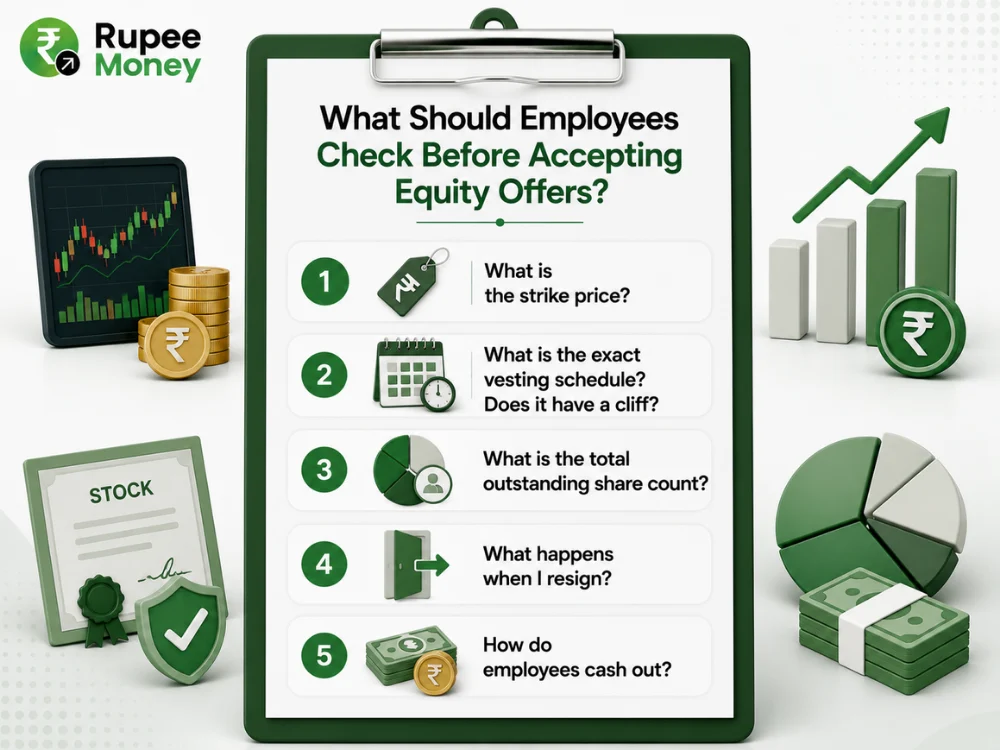
Never accept an equity offer blindly. Treat it like a serious investment. Ask your HR department these specific questions:
- What is the strike price? (Crucial for ESOPs)
- What is the exact vesting schedule? Does it have a cliff?
- What is the total outstanding share count? Calculate your actual percentage.
- What happens when I resign? Check the post-termination exercise window.
- How do employees cash out? Has the startup ever done a buyback?
You must evaluate equity alongside your fixed cash salary. A high equity component cannot pay your immediate home loan repayment. Keep your personal financial planning balanced.
Conclusion
The difference between ESOP and RSU dictates your financial strategy. Do not view equity simply as bonus money. View it as a complex financial asset that requires active management.
If you hold options, understanding ESOP valuation and the size of the ESOP pool tells you how much of the company you actually own. Understanding ESOP taxation ensures you do not face a massive, unpayable tax bill on the day you decide to exercise.
If you work for a multinational, understanding RSU taxation India prepares you for the sudden TDS deductions that hit your payslip on vesting day. The taxation of RSU in India heavily impacts your monthly cash flow, so plan accordingly. Never treat a ₹20 lakh equity grant as ₹20 lakh in cash. Calculate the taxes, assess the liquidity, and integrate the equity smartly into your long-term wealth-building journey.
FAQs
What is the difference between ESOP and RSU?
An ESOP gives you the option to buy shares at a fixed price. An RSU directly grants you the shares with zero purchase cost once you meet the vesting conditions.
What is ESOP valuation?
ESOP valuation calculates the theoretical worth of your options. You find it by subtracting your exercise price from the company's current Fair Market Value (FMV).
What is an ESOP pool?
An ESOP pool is a dedicated percentage of a company's total equity locked away specifically to grant options to future employees.
What is ESOP taxation in India?
ESOP taxation occurs in two phases. First, you pay salary perquisite tax when you exercise the options. Second, you pay capital gains tax when you eventually sell the allotted shares.
What is RSU taxation India?
RSU taxation India taxes the total market value of your shares on the vesting date as salary income. Any subsequent profit made when you sell the shares faces capital gains tax.
Is tax on RSUs charged twice?
No, you are not double-taxed. You pay salary tax on the value at vesting. You only pay capital gains tax on the additional profit generated after the vesting date.
Which is better, ESOP or RSU?
Neither is universally better. RSUs offer guaranteed value (assuming the stock does not hit zero) and zero exercise cost, making them safer. ESOPs in a hyper-growth startup offer much higher potential upside but carry massive liquidity risk.
Can ESOPs become worthless?
Yes. If the startup's valuation drops below your original exercise price, your options go "underwater." It makes zero financial sense to exercise them.
ESOP valuation calculates the theoretical worth of your options. You find it by subtracting your exercise price from the company’s current Fair Market Value (FMV).
An ESOP pool is a dedicated percentage of a company’s total equity locked away specifically to grant options to future employees.
ESOP taxation occurs in two phases. First, you pay salary perquisite tax when you exercise the options. Second, you pay capital gains tax when you eventually sell the allotted shares.
RSU taxation India taxes the total market value of your shares on the vesting date as salary income. Any subsequent profit made when you sell the shares faces capital gains tax.
No, you are not double-taxed. You pay salary tax on the value at vesting. You only pay capital gains tax on the additional profit generated after the vesting date.
Yes. If the startup’s valuation drops below your original exercise price, your options go “underwater.” It makes zero financial sense to exercise them.
Disclaimer: This article is strictly for educational and informational purposes and does not constitute tax, legal, or financial advice. ESOP and RSU taxation can vary drastically based on your company’s structure, the type of shares, and your residential status. Always review your specific grant documents and consult a qualified Chartered Accountant to evaluate your personal tax liability.
ABOUT THE AUTHOR

