
Will Consumers Have to Pay More on UPI Transactions? Finance Minister Clarifies
For millions of Indians, UPI has become as normal as carrying a wallet. You scan a QR code, enter the amount, and the payment reaches the merchant within seconds. So news about possible UPI charges naturally created real confusion this week.
Will your next UPI payment cost extra? Will you pay a fee for sending money to friends? Could shops start charging more for digital payments? At RupeeMoney, we track exactly these kinds of policy developments so you don’t have to sort fact from rumour yourself.
Parliament actually passed the Taxation and Other Laws (Amendment) Bill, 2026 on August 10, and the government’s clarification answers the biggest concern directly. Consumers will not face a direct UPI transaction fee under this change. Person-to-person payments stay completely free. The government may still introduce a limited Merchant Discount Rate for certain merchant transactions, but it hasn’t announced any universal UPI charge for consumers. Here’s what the latest update actually means for Indian users.
What Is the Latest UPI Charges Update?
The confusion started when the Lok Sabha passed the Taxation and Other Laws (Amendment) Bill, 2026. The Rajya Sabha then cleared it too, on August 10, 2026, via voice vote, sending it back to the Lok Sabha under standard Money Bill procedure. The bill amends Section 10A of the Payment and Settlement Systems Act, changing the legal framework around charges on certain digital payments.
Many users read this change as the end of free UPI payments entirely. Finance Minister Nirmala Sitharaman clarified directly in the Rajya Sabha that ordinary users won’t pay UPI charges, and that all person-to-person UPI transactions stay free. She specifically stated the enabling provision itself imposes no tax or transaction charge on users. Notably, she added that no MDR framework has actually been finalised yet — that decision now sits with the NPCI’s UPI and Services Steering Committee, which will separately consider whether to introduce any charge at all.
This means the law creates an enabling framework only. It doesn’t mean every UPI payment suddenly attracts a fee.
Will UPI Users Pay Transaction Charges?
No, ordinary UPI users won’t start paying a direct transaction charge. The Finance Ministry has stated clearly that users won’t face a fee for making UPI payments, and person-to-person transactions stay entirely free.
Sending ₹500 to your friend won’t suddenly attract a UPI fee. Sending money to your parents through UPI stays free too, and the same holds for normal transfers between individuals generally. The proposed change mainly concerns merchant-side charges instead, since a merchant payment and a personal transfer work quite differently under the framework. The government wants to protect everyday digital payments while still building a sustainable payment ecosystem long-term.
What Is MDR on UPI Payments?
MDR means Merchant Discount Rate, a fee tied to processing a digital payment. The merchant or business generally bears this cost, and the payment ecosystem can then distribute that amount among participating banks and payment providers.
Credit and debit card transactions already carry similar merchant charges today. UPI, though, has followed a zero-MDR model for most transactions since January 2020, when the government removed MDR on UPI and RuPay debit card transactions specifically to encourage digital adoption. It also introduced incentives supporting banks and payment ecosystem participants, helping maintain UPI services without charging users directly for years.
Why Is the Government Considering UPI MDR?
UPI has grown at a genuinely enormous pace across India. The system now handles billions of transactions monthly, having launched back in 2016. In July 2026, UPI processed around 2,366 crore transactions, worth a combined ₹29.9 lakh crore. UPI also had nearly 55.49 crore onboarded users by June 2026.
A system this large needs continuous investment. Banks and payment companies need funding for technology, infrastructure, cybersecurity, and fraud prevention together. The government wants UPI to stay reliable as volumes keep climbing, while also making the ecosystem more genuinely sustainable financially. It has said subsidies alone may not support the next phase of UPI’s growth going forward.
Who Could Pay UPI MDR?
The government hasn’t announced a final MDR rate for users or merchants, and as Sitharaman confirmed on August 10, no framework has actually been finalized. Reports, though, have discussed a possible charge for selected high-value merchant payments specifically.
Recent reports mention transactions above ₹2,000 as a possible threshold, applying only to merchants with annual turnover above ₹1 crore to ₹1.5 crore. A possible MDR range of 0.05% to 0.07% has circulated in recent reporting, notably lower than an earlier reported range of 0.25% to 0.4% from prior discussions. These figures remain reported possibilities, not confirmed rates, so treat them accordingly.
The government has said any future MDR would apply only to a limited merchant category, staying nominal and significantly below existing card-based MDR rates. Don’t assume every ₹2,000 UPI payment will attract a fee based on these reports.
Will Small Shops Charge More for UPI?
The government expects most merchant transactions to remain free, an approach specifically designed to protect small merchants and everyday digital payments. Sitharaman was direct on this point too, telling the House that small merchants remain central to UPI’s inclusive growth and that the government won’t impose MDR on them.
Think about your local grocery shop. You pay ₹300 for groceries through a UPI QR code, and the proposed framework doesn’t mean the shopkeeper must immediately start paying MDR. Officials have specifically stated that over 90% of transactions, including everyday purchases of milk, vegetables, and groceries, won’t attract any MDR charge under the discussed framework. The government wants future charges to stay threshold-based, protecting low-value transactions specifically. The final rules will still determine exactly which merchants and transactions qualify, so avoid treating reported thresholds as final until officially notified.
Will UPI Payments Above ₹2,000 Become Chargeable?
Not automatically, no. The ₹2,000 figure has appeared repeatedly in reports discussing possible future MDR rules, but it doesn’t mean the government has announced a blanket fee above that amount. The government has consistently described the possible framework as limited and threshold-based, with final implementation still depending on the NPCI committee’s future decisions. Paying ₹5,000 through UPI doesn’t currently mean you owe an additional UPI fee. Wait for an official notification before assuming any transaction has become chargeable.
Will Person-to-Person UPI Payments Remain Free?
Yes, definitively. The government has specifically clarified that P2P transactions stay free. P2P means person-to-person payments: you send ₹2,000 to a friend, transfer ₹10,000 to your sibling, or send money to your parents through your UPI app. These all fall under person-to-person payments, and the government says users won’t face charges for any of these transfers. This clarification genuinely removes the biggest concern the recent bill created.
Can Merchants Pass UPI Charges to Customers?
This question needs a separate distinction. MDR would technically apply to merchants, not consumers directly. Businesses, though, could still factor payment costs into their overall pricing decisions, creating an indirect concern for consumers regardless.
Say a large merchant eventually pays an MDR. That merchant could absorb the cost from its margin, or factor some business costs into pricing generally. That doesn’t mean the merchant can automatically add a specific UPI fee to your bill, though. The final rules and consumer protection framework will determine how businesses actually handle such charges. Distinguish clearly between a formal UPI fee and a merchant’s own pricing decision.
Is GST Charged on UPI Payments?
No GST applies simply because you use UPI. The government previously rejected claims about GST applying to UPI payments above ₹2,000 specifically. GST can apply to eligible charges like MDR itself, but the government removed MDR from UPI transactions under the existing framework, so users don’t pay GST merely for choosing UPI. The current discussion concerns possible future merchant charges only, not a new GST on every UPI payment.
Why Did UPI Remain Free for So Long?
The government wanted UPI to become a genuine mass-market digital payment system from the start. Zero MDR helped merchants accept digital payments without extra costs, encouraging small businesses to adopt QR-based payments and helping consumers move away from cash entirely.
The government backed this through incentive schemes too. Between FY2021-22 and FY2024-25, it provided roughly ₹8,730 crore in incentives, supporting banks and other ecosystem participants directly. This model helped UPI expand rapidly across both urban and rural India over that period.
What Changes After the 2026 UPI Bill?
The biggest change involves the legal framework itself. Earlier rules restricted banks and system providers from imposing certain charges outright. The new amendment creates an enabling framework for future charges instead, though the amendment alone doesn’t mean consumers start paying immediately.
The government, through the NPCI’s steering committee, still needs to determine how any future MDR would actually work. The proposed approach focuses on selected merchant transactions specifically, with P2P payments staying entirely outside this discussion. That distinction makes the latest UPI update genuinely easier to understand.
What Does the UPI Change Mean for Consumers?
For most people, daily UPI usage should continue completely normally. You can keep sending money to friends, receiving money from family, and making ordinary QR payments without any change. You don’t need to stop using UPI because of this announcement.
Do watch future government and NPCI notifications, though, since final MDR rules could affect selected merchant transactions and how some businesses handle payment costs. For now, there’s no reason to assume every UPI payment will become chargeable.
What Should UPI Users Do Now?
There’s no need to change your normal payment habits. Keep using UPI for routine transactions, and don’t pay any additional amount simply because someone claims UPI has become chargeable. Check your bank or payment app directly before accepting any new fee, and distinguish clearly between a merchant’s own service charge and an official UPI fee.
Watch official government and NPCI announcements specifically, rather than relying on social media posts about upcoming UPI charges. The final rules matter far more than speculation does. If you’re building broader financial awareness alongside staying alert to policy news like this, AI-Powered Financial Fraud Is Rising is worth reading too, since confusion around genuine policy changes like this one is exactly what scammers exploit.
UPI Charges: What You Need to Remember
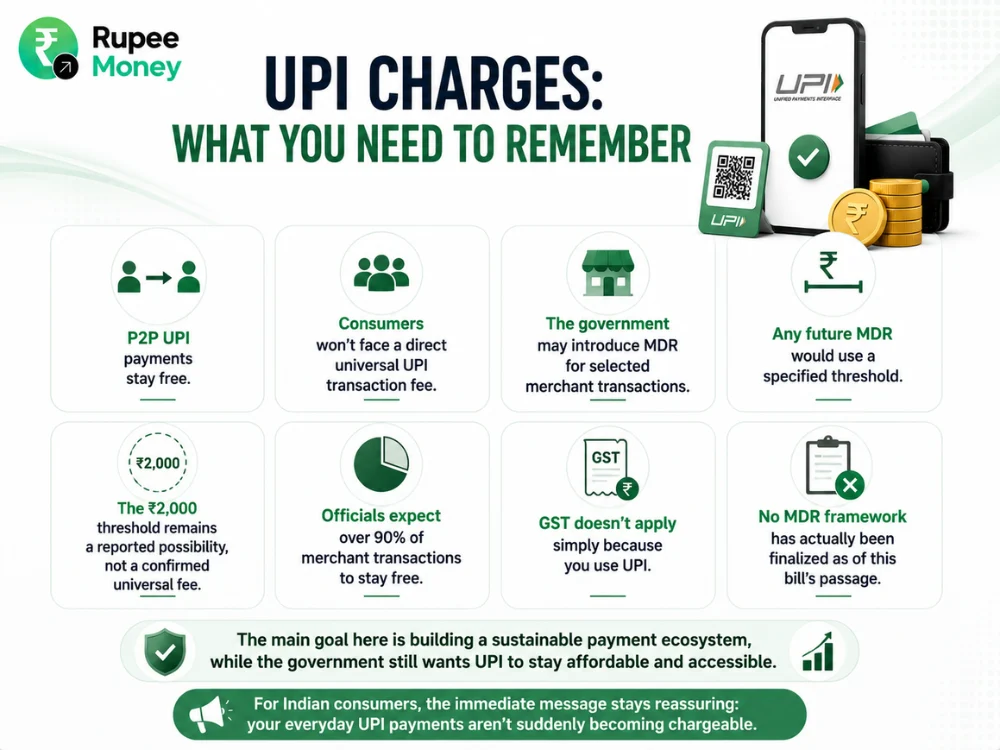
P2P UPI payments stay free. Consumers won’t face a direct universal UPI transaction fee. The government may introduce MDR for selected merchant transactions. Any future MDR would use a specified threshold. The ₹2,000 threshold remains a reported possibility, not a confirmed universal fee. Officials expect over 90% of merchant transactions to stay free. GST doesn’t apply simply because you use UPI. No MDR framework has actually been finalized as of this bill’s passage.
The main goal here is building a sustainable payment ecosystem, while the government still wants UPI to stay affordable and accessible. For Indian consumers, the immediate message stays reassuring: your everyday UPI payments aren’t suddenly becoming chargeable.
Conclusion
The latest UPI news sounds alarming at first glance, but the actual position stays much simpler. Consumers won’t suddenly pay a universal fee for using UPI, and person-to-person payments stay entirely free. Most merchant transactions should also remain free under the government’s stated approach, with the policy discussion mainly concerning a possible MDR for selected merchant transactions above a threshold.
The final rules, still pending NPCI committee review, will determine the affected merchants and thresholds. For now, Indian consumers can keep using UPI completely normally. The bigger story here concerns how India funds and protects its digital payment infrastructure long-term, having grown UPI into genuinely essential financial infrastructure since 2016. The real challenge now is keeping it affordable while making the ecosystem financially sustainable for the years ahead. If you’re weighing UPI against other everyday payment methods, UPI or Credit Card? is worth reading too.
FAQs
Will consumers have to pay more for UPI transactions?
No direct universal charge applies to consumers under this clarification. The Finance Ministry has specifically said users won't pay a transaction fee, and P2P payments stay free. Future MDR rules could affect a limited category of merchant payments, potentially creating an indirect effect if businesses adjust pricing, though that differs from a direct UPI fee. Will UPI remain free for sending money to friends? Yes. The government has clearly stated P2P UPI transactions stay free, including transfers between friends and family. Sending ₹1,000 to a friend won't attract a UPI transaction fee, and the current policy discussion focuses on merchant transactions specifically, not personal transfers. What is the possible UPI charge above ₹2,000? No confirmed universal charge exists. Recent reports discuss a possible MDR between 0.05% and 0.07% for merchant transactions above ₹2,000, applying only to businesses with turnover above ₹1–1.5 crore. These figures remain reported possibilities, since no framework has been finalized yet. Will small merchants pay UPI charges? The government expects most merchant transactions to stay free, protecting small businesses specifically. Officials say over 90% of transactions, including everyday grocery purchases, won't attract MDR. The Finance Minister explicitly stated small merchants won't face any MDR under the discussed approach. Can a shop charge customers extra for UPI? MDR and a customer surcharge are separate issues. MDR applies to merchants, not consumers directly, though a business could factor costs into overall pricing. If a business adds a specific UPI surcharge, ask for clarity and check applicable rules before accepting it. Is GST charged on UPI payments above ₹2,000? No. The government previously rejected claims about new GST on UPI payments above ₹2,000. GST can apply to eligible charges like MDR, but not automatically to the UPI payment amount itself. When will UPI charges actually start? There's currently no universal consumer UPI charge. The August 2026 legal change creates an enabling framework only, with the NPCI's steering committee still needing to decide on any actual MDR framework. Wait for official implementation details rather than relying on speculation.
No direct universal charge applies to consumers under this clarification. The Finance Ministry has specifically said users won’t pay a transaction fee, and P2P payments stay free. Future MDR rules could affect a limited category of merchant payments, potentially creating an indirect effect if businesses adjust pricing, though that differs from a direct UPI fee.
Will UPI remain free for sending money to friends?
Yes. The government has clearly stated P2P UPI transactions stay free, including transfers between friends and family. Sending ₹1,000 to a friend won’t attract a UPI transaction fee, and the current policy discussion focuses on merchant transactions specifically, not personal transfers.
What is the possible UPI charge above ₹2,000?
No confirmed universal charge exists. Recent reports discuss a possible MDR between 0.05% and 0.07% for merchant transactions above ₹2,000, applying only to businesses with turnover above ₹1–1.5 crore. These figures remain reported possibilities, since no framework has been finalized yet.
Will small merchants pay UPI charges?
The government expects most merchant transactions to stay free, protecting small businesses specifically. Officials say over 90% of transactions, including everyday grocery purchases, won’t attract MDR. The Finance Minister explicitly stated small merchants won’t face any MDR under the discussed approach.
Can a shop charge customers extra for UPI?
MDR and a customer surcharge are separate issues. MDR applies to merchants, not consumers directly, though a business could factor costs into overall pricing. If a business adds a specific UPI surcharge, ask for clarity and check applicable rules before accepting it.
Is GST charged on UPI payments above ₹2,000?
No. The government previously rejected claims about new GST on UPI payments above ₹2,000. GST can apply to eligible charges like MDR, but not automatically to the UPI payment amount itself.
When will UPI charges actually start?
There’s currently no universal consumer UPI charge. The August 2026 legal change creates an enabling framework only, with the NPCI’s steering committee still needing to decide on any actual MDR framework. Wait for official implementation details rather than relying on speculation.
Disclaimer: This article provides general information about UPI charges and recent policy developments. It does not constitute financial, legal, tax, or investment advice. UPI rules, MDR rates, and government policies can change after official notifications. Readers should verify the latest information from government, RBI, and NPCI sources directly. RupeeMoney does not guarantee the accuracy of future policy outcomes. Always check official notifications before making decisions based on payment charges.
ABOUT THE AUTHOR

