
Why Does the Dow Jones Affect Sensex and Nifty?

Every trading morning, long before the Indian stock market officially opens at 9:15 AM, seasoned investors engage in a very familiar financial ritual: they check how the United States markets closed the previous night. Among the various global indices flashing on their screens, the Dow Jones Industrial Average consistently steals the spotlight.
When Wall Street falls sharply during the US trading session, Indian retail investors frequently wake up to a weak, gap-down opening for the Nifty 50 and the BSE Sensex. But why exactly does a financial market located thousands of kilometres away dictate the morning mood of Dalal Street?
The straightforward answer lies in the deeply interconnected architecture of modern global finance. The Dow Jones does not directly control the Sensex or the Nifty. Instead, its overnight movements trigger a massive chain reaction that affects Indian markets through shifts in global investor sentiment, foreign capital flows, US economic expectations, currency fluctuations, and sector-specific performance.
Recent market dynamics highlight exactly why these global cues matter so much. On August 20, 2026, the Nifty 50 rose 0.50% and the Sensex gained 0.66% specifically as Asian markets strengthened and global bond-market sentiment improved following positive overnight cues from Wall Street.
Welcome to RupeeMoney. In this comprehensive guide, we will break down exactly how the Dow Jones impacts the Indian stock market, why certain sectors react more aggressively than others, and how you can successfully navigate this global volatility to protect your portfolio.
What Is the Dow Jones Industrial Average?
The Dow Jones Industrial Average (DJIA), commonly referred to simply as “the Dow,” is one of the oldest, most prestigious, and most widely followed stock market indices in the United States. Created by financial pioneers Charles Dow and Edward Jones in 1896, it tracks 30 prominent, large-cap, publicly traded US companies across various major industries, excluding transportation and utilities.
Unlike many modern global indices, the Dow utilizes a unique price-weighted methodology. This mathematical structure means that companies with higher nominal share prices exert a significantly greater influence on the index’s daily movement than companies with lower share prices, regardless of their actual overall market capitalization. Despite this quirk, the world views the Dow as a primary barometer for American corporate health and broader economic stability.
What Are the Sensex and Nifty 50?
To accurately understand this global connection, we must also define India’s primary domestic benchmarks:
- BSE Sensex: Tracks the 30 largest, most actively traded blue-chip companies listed on the Bombay Stock Exchange (BSE).
- Nifty 50: Tracks the 50 largest and most highly liquid companies listed on the National Stock Exchange (NSE).
Both of these Indian indices use a free-float market-capitalization-weighted methodology. While the Dow serves as a barometer for the US corporate landscape, the Sensex and Nifty represent the broader direction of the Indian economy. Because these indices track entirely different sets of companies operating in fundamentally different economies, a rise in the Dow does not mechanically guarantee an identical rise in the Nifty.
The Transmission Mechanism: How the Dow Affects Indian Stocks
The Dow Jones influences Indian equities through several highly interconnected economic and psychological channels. The basic global chain reaction usually looks like this:
US Market Movement → Global Investor Sentiment Shifts → Asian Markets React → Foreign Institutional Investors Adjust Portfolios → Indian Market Reacts
Let us explore the core factors driving this complex relationship in detail.
1. Global Investor Sentiment and Risk Appetite
The Dow is a primary indicator of global market psychology. A robust, sustained rally in the Dow signals strong economic confidence and improving global risk appetite. When international asset managers feel confident about the US economy, they become far more willing to invest in higher-growth, higher-risk emerging markets like India.
Conversely, a sharp plunge in the Dow triggers immediate global fear. When international investors worry about a potential US recession or systemic financial risk, they rapidly reduce their exposure to riskier assets. They flee toward traditional safe havens like US Treasury bonds, the US Dollar, or physical gold. This overnight shift in global sentiment almost always leads to immediate selling pressure on the Nifty 50 at the morning open.
2. Foreign Institutional Investor (FII) Flows
Foreign Portfolio Investors (FPIs) and FIIs are massive, influential participants in the Indian equity market. These colossal global funds allocate trillions of dollars across dozens of developing and developed countries.
When a major US market sell-off occurs, FIIs often face sudden redemption pressures from their own clients or seek to systematically lower their overall portfolio risk. To raise liquid cash quickly, they sell their highly liquid emerging-market holdings, which heavily include Indian blue-chip stocks.
When foreign investors aggressively reduce their exposure to Indian equities, they redirect that capital toward safer developed-market bonds. To build a resilient portfolio that can withstand FII selling pressure, explore investment strategies utilizing large-cap mutual funds.
3. US Interest Rates and the Federal Reserve
The US Federal Reserve holds unparalleled sway over global financial liquidity. While the Dow constantly reacts to Fed policy, the Fed’s decisions also directly impact India’s financial system.
When investors anticipate that US interest rates will remain high, American government bonds become highly attractive. High US yields siphon investment capital away from emerging markets like India. Therefore, the connection is rarely just about the Dow falling; it is critically about why the Dow fell. If the Dow drops specifically because of rising US interest rates, you can expect heavy, sustained capital outflows from Indian markets. To understand the mechanics of central bank lending and domestic interest rates, read our guide on what is the repo rate.
4. US Economic Growth and Corporate Earnings
The United States remains a massive, indispensable consumer of Indian goods and services. A strong US economy supports expectations for robust global demand. If the Dow is rising due to stellar US economic data—such as strong retail sales or high employment—it signals that American corporations are healthy and ready to spend. This is excellent news for Indian exporters and manufacturing firms that rely heavily on North American clients.
Sector-Specific Impacts: Which Indian Stocks React Most?
A global market crash or a massive Wall Street rally does not impact every single Indian stock equally. Certain domestic sectors are hyper-sensitive to US market movements, while others remain relatively insulated.
How Does the Dow Affect Indian IT Stocks?
The Indian Information Technology (IT) sector is deeply and inextricably tethered to the health of the US economy. Corporate giants like TCS, Infosys, HCLTech, and Wipro generate the absolute lion’s share of their revenue from North American enterprise clients.
When the Dow plummets because investors foresee a US economic slowdown, Wall Street assumes that American corporations will immediately slash their technology, cloud computing, and software consulting budgets. This causes Indian IT stocks to face intense, immediate selling pressure. However, if the Dow falls strictly due to an oil price shock rather than a technology slowdown, Indian IT stocks may remain surprisingly resilient.
How Does the Dow Affect Indian Banking Stocks?
Banking stocks react to the Dow indirectly through the lens of global liquidity, bond yields, and interest rates. A major Wall Street sell-off breeds extreme global risk aversion, prompting FIIs to dump highly liquid Indian financial stocks to raise cash. However, over the long run, Indian banks are driven entirely by domestic fundamentals: robust credit growth, secure asset quality, and RBI monetary policy.
How Does the Dow Affect the Indian Rupee?
When global fear spikes and the Dow crashes, international investors hoard US Dollars. This massive surge in dollar demand puts immense depreciation pressure on the Indian Rupee (USD/INR).
Currency fluctuations create divergent effects across Dalal Street:
- Exporters Win: A weaker Rupee generally benefits export-heavy sectors like IT and Pharmaceuticals, as their dollar earnings translate into much higher rupee profits.
- Importers Lose: A weaker Rupee severely hurts companies that rely on imported raw materials. Since India imports massive quantities of crude oil (priced strictly in dollars), currency weakness stokes domestic inflation. To understand this specific chain reaction, learn what is inflation and why does it matter.
Dow Jones vs Sensex vs Nifty 50: A Quick Comparison
To fully grasp the dynamic, it helps to view the structural differences between these benchmark indices side-by-side:
| Feature | Dow Jones (DJIA) | BSE Sensex | Nifty 50 |
| Country | United States | India | India |
| Number of Companies | 30 | 30 | 50 |
| Stock Exchange | NYSE & Nasdaq | Bombay Stock Exchange (BSE) | National Stock Exchange (NSE) |
| Weighting Methodology | Price-weighted | Free-float market-cap weighted | Free-float market-cap weighted |
| Trading Hours | US market hours | Indian market hours | Indian market hours |
| Global Influence | Extremely High | High (Emerging Market proxy) | High (Emerging Market proxy) |
Can the Sensex and Nifty Rise When the Dow Falls?
Yes. The phenomenon where the Indian market moves independently of US markets is known as decoupling.
The Dow provides an important global signal, but it absolutely cannot predict the Nifty’s closing price with certainty. Indian equities can easily outperform their American counterparts when domestic macroeconomic factors remain highly favourable.
Factors that help Indian markets defy a falling Dow include:
- Exceptional domestic corporate earnings growth.
- Massive, sustained retail liquidity pouring in through mutual fund SIPs.
- Strong domestic GDP growth and aggressive government infrastructure spending.
- Favourable RBI monetary policies and strictly contained domestic inflation.
What Should Investors Check Along With the Dow?
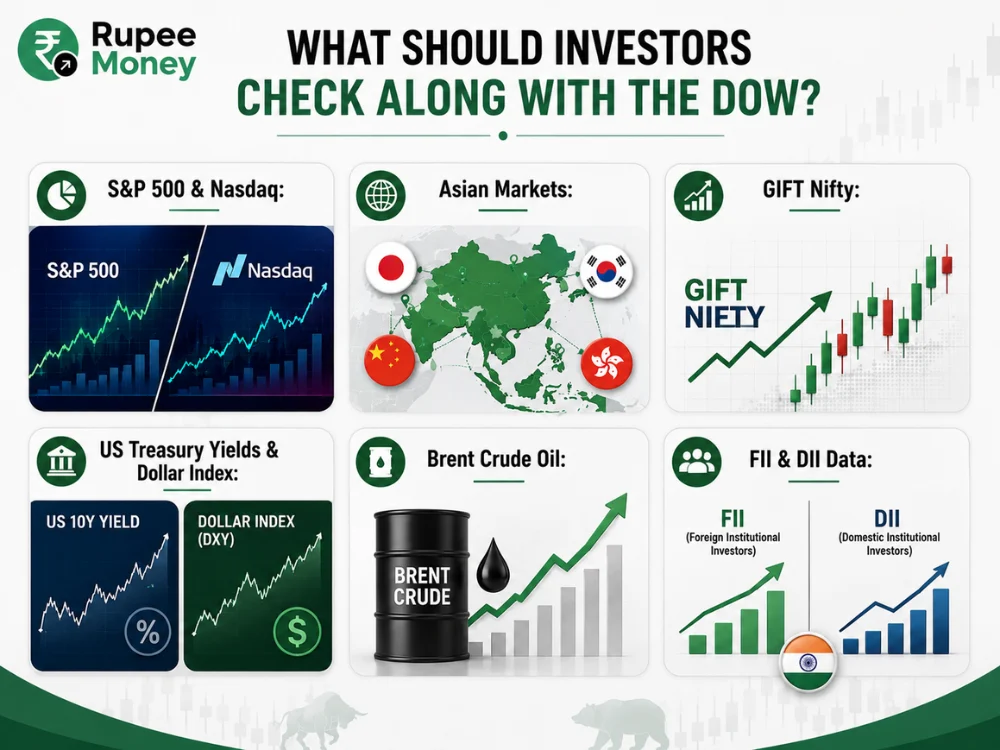
Relying solely on the Dow’s closing number is a highly flawed trading strategy. Savvy Indian investors use a comprehensive morning checklist to accurately gauge market sentiment before 9:15 AM:
- S&P 500 & Nasdaq: The S&P 500 offers a much broader, more accurate view of the US economy than the Dow, while the Nasdaq provides critical sentiment cues for global technology stocks.
- Asian Markets: Check the Japanese Nikkei, Hong Kong’s Hang Seng, and the South Korean KOSPI. If Asia is bleeding heavily, India rarely escapes unscathed.
- GIFT Nifty: This offshore futures contract trades before the Indian cash market opens and acts as an incredibly accurate directional indicator for the Nifty’s morning gap-up or gap-down.
- US Treasury Yields & Dollar Index: Spiking US bond yields usually forecast heavy, sustained FII selling in the Indian equity markets.
- Brent Crude Oil: Because India is a massive oil importer, surging overnight crude prices directly translate to domestic inflation fears.
- FII & DII Data: Check if domestic institutional investors (DIIs) are buying enough equities to absorb any ongoing foreign (FII) selling.
FAQs
Why does the Dow Jones affect the Sensex and Nifty?
The Dow Jones influences Indian markets primarily by shaping overnight global investor sentiment, driving foreign capital flows, and reflecting US economic expectations. Because the US market closes just a few hours before the Indian market opens, Dalal Street naturally reacts to the psychological tone set by Wall Street.
Does the Dow Jones directly control the Indian stock market?
No. The Dow acts merely as a powerful psychological and liquidity indicator. The Indian stock market is ultimately controlled by domestic corporate earnings, immense retail liquidity, RBI policies, and India's internal economic growth trajectory.
Which is more important for India: the Dow Jones or the Nasdaq?
It depends entirely on the specific market context. The Dow provides a broad signal regarding traditional US corporate health, while the Nasdaq is heavily tech-weighted. For Indian IT stocks (like TCS and Infosys), a crash in the Nasdaq is a far more relevant and dangerous signal than a drop in the Dow.
Can the Nifty rise when the Dow falls?
Absolutely. Indian markets routinely shrug off a weak Dow if domestic factors—such as stellar quarterly corporate earnings, strong GST collections, or massive domestic mutual fund buying—completely override the negative global sentiment.
How does the Dow affect Indian IT stocks?
Indian IT companies rely heavily on North American clients. When the Dow falls due to a looming US recession, investors assume American businesses will cut their IT and software budgets. This causes Indian IT stock prices to drop rapidly in anticipation of lower future revenues.
Should investors sell Indian stocks when the Dow falls?
No. Panic-selling based on a single-day decline in the Dow is an incredibly poor strategy. Investors must look at the underlying economic reason for the US market's fall. To build long-term wealth securely, you should focus on your personal financial goals rather than daily global volatility. You can easily project disciplined wealth accumulation using our SIP Calculator.
No. The Dow acts merely as a powerful psychological and liquidity indicator. The Indian stock market is ultimately controlled by domestic corporate earnings, immense retail liquidity, RBI policies, and India’s internal economic growth trajectory.
No. Panic-selling based on a single-day decline in the Dow is an incredibly poor strategy. Investors must look at the underlying economic reason for the US market’s fall. To build long-term wealth securely, you should focus on your personal financial goals rather than daily global volatility. You can easily project disciplined wealth accumulation using our SIP Calculator.
Conclusion
The Dow Jones casts a long, undeniable shadow over the Sensex and Nifty, acting as the primary transmitter of global investor sentiment, foreign capital allocation, and US economic health. Its influence becomes incredibly pronounced during major macroeconomic events, shifts in global interest rates, or geopolitical shocks.
However, the Dow absolutely does not dictate the ultimate, long-term destiny of the Indian stock market. India possesses a formidable, self-sustaining economic engine powered by resilient corporate earnings, aggressive government infrastructure spending, and a rapidly maturing base of domestic retail investors.
For the modern Indian investor, the most intelligent approach is to treat the Dow Jones as valuable context for understanding morning volatility, while basing your long-term investment decisions on the unshakeable fundamentals of the domestic economy. In simple terms: The Dow dictates the morning mood, but India’s fundamentals decide the final destination.
Disclaimer:
The content provided on RupeeMoney is strictly for educational and informational purposes only. We are NOT a SEBI-registered Research Analyst or Investment Adviser and do not provide buy/sell recommendations, stock tips, or trading calls. Investments in the securities market are subject to market risks; read all related documents carefully before investing. Past performance and global market correlations do not guarantee future returns. Please conduct your own independent research or consult a SEBI-registered financial advisor before making any investment decisions.
ABOUT THE AUTHOR

