
Demat Account vs Trading Account
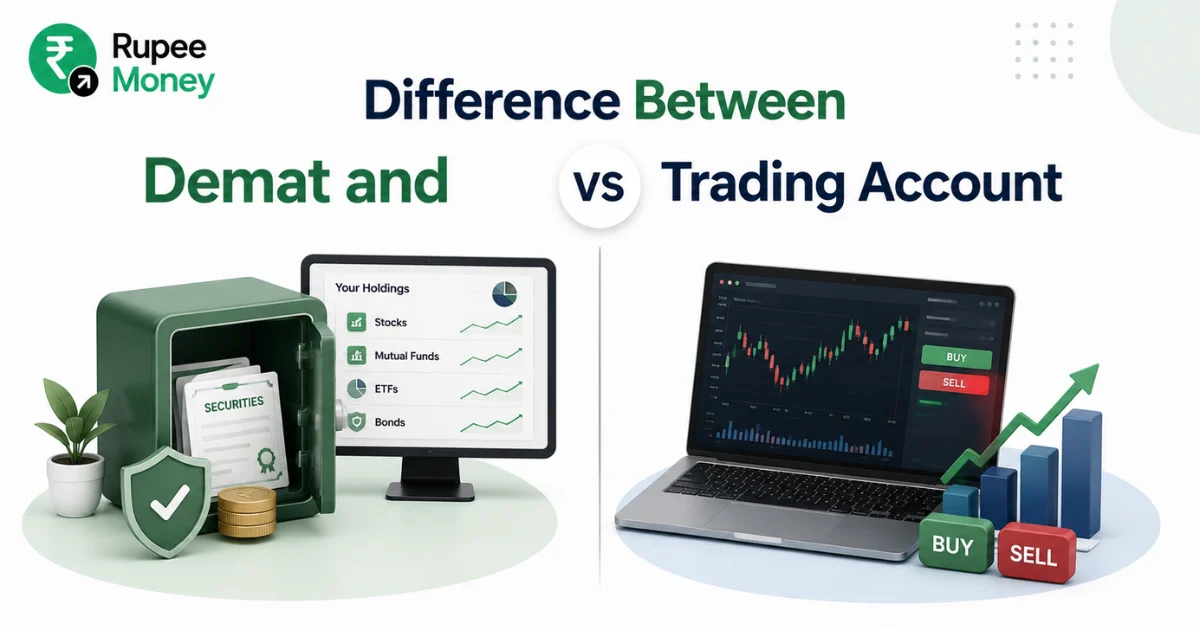
If you’re getting ready to invest in the stock market, you’ve probably run into two terms that sound similar but aren’t — Demat Account and Trading Account. A lot of beginners lump them together, mostly because brokers open both at the same time. But each one does a completely different job, and knowing that difference upfront will save you a lot of confusion later.
Think of it this way: your Demat Account holds your shares and other securities in electronic form, while your Trading Account lets you actually buy and sell those securities on the stock exchanges. You need both if you want to trade equities on the National Stock Exchange (NSE) or the Bombay Stock Exchange (BSE). And if you trade commodities, your Trading Account also links you to exchanges like the Multi Commodity Exchange (MCX) and the National Commodity and Derivatives Exchange (NCDEX).
At RupeeMoney, we think every investor should get these basics right before putting money into the market. This guide walks you through what a Demat Account and a Trading Account actually do, how they work together, and which one (or both) you need to start your investing journey in India.
What Does a Demat Account Actually Do?
A Demat Account — short for Dematerialisation Account — holds your financial securities digitally instead of as paper certificates, through a depository system. When you buy shares, they land in your Demat Account once settlement wraps up; when you sell, the system debits them automatically.
Your Demat Account can hold several types of investments, including:
- Equity shares
- Exchange Traded Funds (ETFs)
- Government securities
- Bonds and debentures
- Mutual funds held in Demat form
- Sovereign Gold Bonds
- REITs and InvITs
Picture your Demat Account as a digital locker — it keeps your securities safe until you decide to sell or transfer them.
What Does a Trading Account Actually Do?
Your Trading Account lets you buy and sell securities in the financial markets, linking your bank account to the stock exchanges through a registered stockbroker. Every buy or sell order you place goes straight to the exchange, and once it completes, your Demat Account either receives or releases the securities involved.
You can use your Trading Account to trade:
- Equity shares
- Exchange Traded Funds (ETFs)
- Futures and Options (subject to eligibility)
- Commodity derivatives on MCX and NCDEX
- Other exchange-traded products your broker offers
Without a Trading Account, you simply can’t place an order on the stock exchange — even if you already have shares sitting in a Demat Account.
Demat Account vs Trading Account: The Real Difference
Brokers usually bundle both accounts together at sign-up, but they exist for different reasons:
| Feature | Demat Account | Trading Account |
| Primary Purpose | Stores securities electronically | Buys and sells securities |
| Holds Shares | Yes | No |
| Places Market Orders | No | Yes |
| Required For | Holding investments | Executing trades |
| Connected With | Depository (NSDL/CDSL) | Stockbroker and stock exchanges |
| Receives Shares | Yes | No |
| Handles Sale Transfers | Yes | Initiates the transaction |
| Works For Long-Term Investing | Yes | Yes |
| Works For Active Trading | Supports settlement | Primary account |
Here’s a simple way to remember it: your Trading Account acts like a payment gateway that completes each transaction, while your Demat Account works like a locker that stores your investments safely once you’ve bought them.
How Your Demat and Trading Accounts Work Together
Even though they handle different jobs, both accounts work in tandem every time you make a trade. Here’s how the sequence typically plays out:
- You add money — you transfer funds from your bank account into your Trading Account.
- You place a buy order — using your broker’s platform, you place an order to buy shares listed on the NSE or BSE.
- The exchange executes the trade — the stock exchange matches your order with a seller, and once the trade goes through, settlement begins.
- Shares land in your Demat Account — after settlement, the shares you bought move into your Demat Account electronically.
- You sell your shares — when you decide to sell, your Trading Account places the sell order. Once it executes, your Demat Account releases the shares, and the sale amount reaches your linked bank account after settlement.
This back-and-forth between your bank account, Trading Account, and Demat Account is what lets you buy and sell securities smoothly without any manual paperwork.
How SEBI Oversees Demat and Trading Accounts
The Securities and Exchange Board of India (SEBI) regulates India’s securities market and protects investor interests. It sets the rules that brokers, depositories, listed companies, and other intermediaries must follow, and it actively monitors trading practices to keep the market fair and transparent.
Always pick a broker registered with SEBI before opening either account — it gives you a much stronger layer of protection and ensures your broker follows proper regulatory standards.
NSE, BSE, MCX, and NCDEX: Who Does What
Different exchanges let you trade different kinds of financial products:
- National Stock Exchange (NSE): India’s largest exchange by trading volume, where you buy and sell listed shares, ETFs, and other securities.
- Bombay Stock Exchange (BSE): One of Asia’s oldest exchanges, offering equities, mutual fund platforms, and various financial instruments.
- Multi Commodity Exchange (MCX): A platform for trading commodity derivatives like gold, silver, crude oil, and base metals.
- National Commodity and Derivatives Exchange (NCDEX): Focused mainly on agricultural commodity derivatives, letting participants trade products tied to farm produce.
Your Trading Account connects you to whichever of these exchanges your broker activates for your account.
Why You Should Have Both a Demat Account and a Trading Account
Opening both accounts gives you a complete setup for investing and trading:
- Easy investing — both accounts work together, so buying and selling securities stays simple.
- Safe storage — your Demat Account keeps shares in electronic form, so you never risk losing physical certificates.
- Faster transactions — electronic settlement lets you finish trades quickly, with almost no paperwork.
- Better portfolio management — you track every eligible security from one place and review your portfolio anytime.
- Convenient online access — most brokers offer apps and web platforms so you can trade and download statements whenever you want.
- Smoother corporate benefits — your broker processes bonus shares, stock splits, dividends, and rights issues more efficiently when you hold everything in a Demat Account.
- Transparent record keeping — the system logs every purchase, sale, and transfer electronically, which makes tracking easier and cuts down disputes.
Demat Account vs Trading Account: Which One Do You Need?
The right choice depends on what you want to do in the market. A Demat Account alone works if you only want to hold securities electronically, but you’ll need a Trading Account too if you plan to buy or sell shares on the NSE or BSE.
Most retail investors just open both together — many brokers now bundle an integrated account linking your bank account, Trading Account, and Demat Account, so transactions run without friction.
- Open a Demat Account if you just want to hold shares and other securities electronically.
- Open a Trading Account if you want to buy or sell securities on the exchanges.
- Open both if you plan to invest regularly in listed shares, ETFs, or IPOs.
Having both ready removes unnecessary delays and gives you a seamless investing experience from day one. If you plan to apply for IPOs, it also helps to understand the IPO lock-in period and the restrictions that apply after allotment.
KYC and PAN Card Requirements for Both Accounts
Before you open either account, you need to complete Know Your Customer (KYC) verification, which lets brokers confirm your identity and stay compliant with SEBI’s rules. Most brokers now finish this entirely online through Aadhaar-based verification and video authentication, making it quick and hassle-free.
You’ll typically need to submit:
- PAN Card
- Aadhaar Card
- Passport-size photograph
- Address proof
- Bank account proof
- Signature
- Mobile number
- Email ID
Submitting accurate documents the first time helps you avoid delays in getting your account activated.
Brokerage Charges and Other Costs You Should Know
Before you pick a broker, take time to understand what each account actually costs you. Different brokers follow different pricing models, so comparing charges upfront can save you real money over time.
- Account opening charges: Many brokers offer free account opening these days, though some may charge a nominal fee depending on the services they bundle in.
- Annual Maintenance Charges (AMC): Most Demat Accounts carry annual maintenance charges. If you qualify for a Basic Services Demat Account (BSDA), you may get reduced or waived charges within the prescribed holding limits.
- Brokerage charges: Your broker charges a fee for executing your buy and sell orders through the Trading Account, and this varies by broker, trading segment, and pricing plan.
- Other charges: You may also pay transaction charges, GST, stamp duty, Securities Transaction Tax (STT), and other statutory charges depending on the type of trade.
Understanding the full fee structure before you open an account helps you dodge unexpected costs down the line.
How to Open a Demat Account and Trading Account
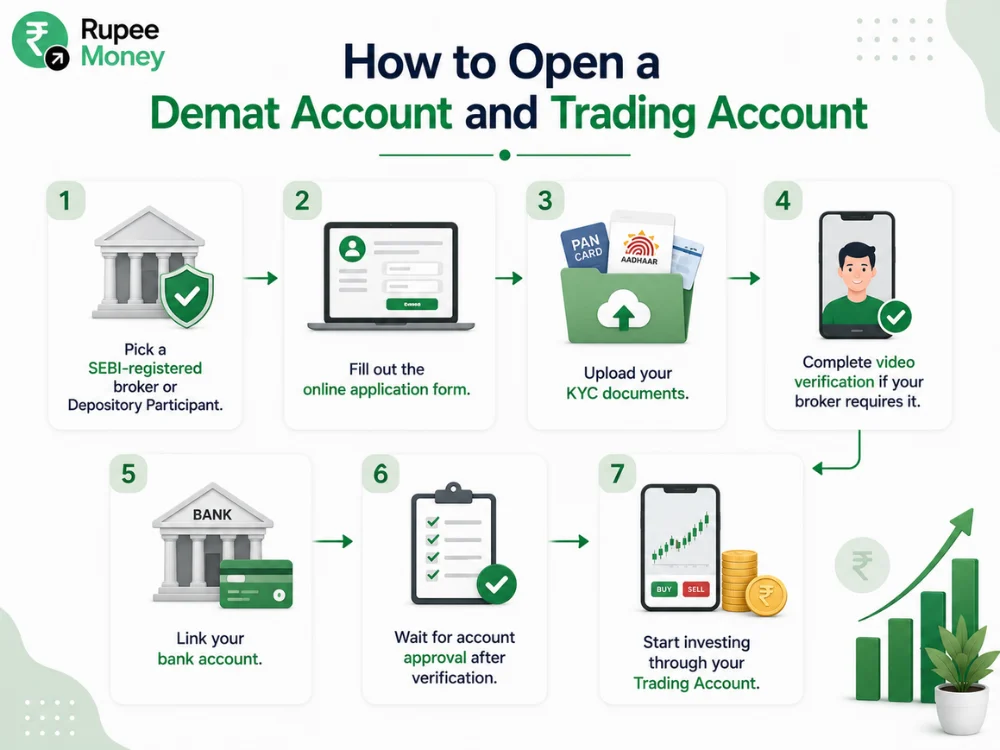
Opening both accounts has become far simpler now that most brokers offer a fully online application process. Follow these steps:
- Pick a SEBI-registered broker or Depository Participant.
- Fill out the online application form.
- Upload your KYC documents.
- Complete video verification if your broker requires it.
- Link your bank account.
- Wait for account approval after verification.
- Start investing through your Trading Account.
Most brokers finish this process within a short window, as long as you submit accurate documents.
Common Mistakes Beginners Should Avoid
First-time investors often make avoidable mistakes with their Demat and Trading Accounts. Watch out for these:
- Opening an account without comparing brokerage charges first.
- Picking a broker without checking their SEBI registration.
- Ignoring annual maintenance charges.
- Confusing the roles of a Demat Account and a Trading Account.
- Sharing login credentials with anyone else.
- Jumping into investing without learning basic stock market concepts.
- Choosing a broker purely on low brokerage instead of overall service quality.
Steering clear of these mistakes makes your investing experience smoother and cuts down unnecessary risk.
Where Demat and Trading Accounts Are Headed in India
India keeps seeing strong growth in retail participation across capital markets, as digital account opening, paperless KYC, and user-friendly platforms push more people to start investing in equities.
Younger investors increasingly open Demat and Trading Accounts to buy into listed companies, ETFs, and IPOs, helped along by better financial education and easier access to investment platforms. If you’re weighing direct stock investing against mutual funds, our guide on what SIP is and how it works can help you compare the two, and you can run the numbers using our SIP Calculator.
Regulators, meanwhile, keep strengthening investor protection and encouraging responsible investing through regular market reforms.
Key Takeaways
- Your Demat Account stores securities electronically.
- Your Trading Account lets you buy and sell securities.
- Most investors need both accounts to trade in the stock market.
- SEBI regulates brokers, exchanges, and other market participants.
- Complete your KYC with a valid PAN Card before opening any account.
- Compare brokerage charges and AMC across brokers before you commit.
- Understanding both accounts helps you avoid confusion and make smarter financial decisions.
Frequently Asked Questions (FAQs)
Can I open a Demat Account without a Trading Account?
Yes. It lets you hold securities electronically, but it won’t let you buy or sell them on an exchange. If you decide to trade later, you’ll need a Trading Account linked to it. Most investors open both together since it simplifies things and gives instant market access.
Can I trade in the stock market without a Demat Account?
For most equity investments in India, you need both accounts. Your Trading Account executes buy and sell orders, while your Demat Account stores the shares once the trade settles. Without a Demat Account, you can’t hold most listed shares electronically.
What’s the main difference between a Demat Account and a Trading Account?
It comes down to purpose. Your Demat Account stores your shares and other eligible securities electronically, while your Trading Account lets you place buy and sell orders on recognised exchanges. One handles the transaction; the other safely holds what you own afterward.
Do I need to complete KYC before opening these accounts?
Yes, every investor must complete KYC first. Your broker verifies your identity using your PAN Card, Aadhaar Card, and bank details. Most brokers now handle this fully online, which speeds up account opening while keeping things compliant with SEBI’s rules.
Which account should a beginner open first?
Most beginners should open both together. Since each handles a different function, linking them from day one gives you a smoother experience — you can buy shares, receive them electronically, and track your whole portfolio through a single platform right away.
Conclusion
Understanding the difference between a Demat Account and a Trading Account marks one of your first real steps toward investing successfully in the Indian stock market. Your Demat Account keeps your shares and other securities safely stored in electronic form, while your Trading Account lets you buy and sell them through recognised exchanges like the NSE and BSE.
Instead of treating these accounts as alternatives, think of them as two halves of the same system. Picking a reliable, SEBI-registered broker, completing your KYC properly, and comparing brokerage charges will set you up with a strong foundation. If you’re just starting out financially, our guide on building wealth in your 20s pairs well with this one, and if you’d like to explore other electronically-held instruments beyond equities, check out our breakdown of government securities in India.
Disclaimer: This article is meant for informational and educational purposes only and shouldn’t be treated as financial or investment advice. Account features, brokerage charges, KYC requirements, and regulatory guidelines vary across brokers and can change over time. Always verify the latest rules issued by SEBI and review your chosen broker’s terms before opening a Demat or Trading Account, and consider consulting a qualified financial advisor for personalised guidance.
ABOUT THE AUTHOR

