
What Is Intraday Trading Margin and How Does It Work?

What Is Intraday Trading Margin and How Does It Work?
Imagine you have exactly ₹20,000 in your demat account. You open your trading app, select a top-tier Indian company, and suddenly realize your broker is allowing you to buy shares worth ₹1,00,000. If you are new to the stock market, this might look like a system glitch or “free money.”
It is neither. This financial mechanism is called intraday trading margin.
Margin allows you to take a market position that is significantly larger than the actual cash balance in your account. While it is a powerful tool that enhances your buying power, it is essentially a short-term credit facility provided by your broker for a few hours. It acts as a double-edged sword: it can multiply your profits when the market moves in your favour, but it can wipe out your capital just as quickly when prices drop.
For Indian traders in 2026, understanding how margin works is more critical than ever. The Securities and Exchange Board of India (SEBI) has implemented strict “Peak Margin” rules that cap the amount of leverage brokers can offer.
Welcome to RupeeMoney. In this guide, we will explain in simple language how intraday margin works, how leverage is calculated, what SEBI’s current rules are, and how you can protect your capital.
What Is Intraday Trading Margin?
Intraday trading margin is the minimum amount of cash you must have in your trading account to place a “day trade.”
Intraday trading means you buy and sell a stock within the exact same market session (between 9:15 AM and 3:30 PM). Because you promise not to hold the shares overnight, the broker faces a much lower risk. As a result, the broker only asks you to pay a fraction of the total trade value upfront.
A Simple Example
Let’s say Reliance Industries is trading at ₹3,000 per share, and you want to buy 50 shares.
- Total Trade Value: 50 shares × ₹3,000 = ₹1,50,000
- Applicable Margin Requirement: 20%
- Required Margin (Your Cash): ₹1,50,000 × 20% = ₹30,000
In this scenario, you only need ₹30,000 to execute a ₹1.5 lakh trade. The remaining ₹1,20,000 is the extra exposure facilitated by your broker.
Margin vs. Leverage: What is the Difference?
Beginners often confuse the words “margin” and “leverage,” but they are two sides of the same coin:
- Margin is the money you deposit (e.g., 20%).
- Leverage is the exposure you control (e.g., 5x).
The formula is simple:
Leverage = 100% ÷ Margin Percentage
If a stock requires a 20% margin, your leverage is 5x (100 ÷ 20). This means every ₹1 of your capital controls ₹5 in the open market.
How Does Intraday Margin Work in Practice?
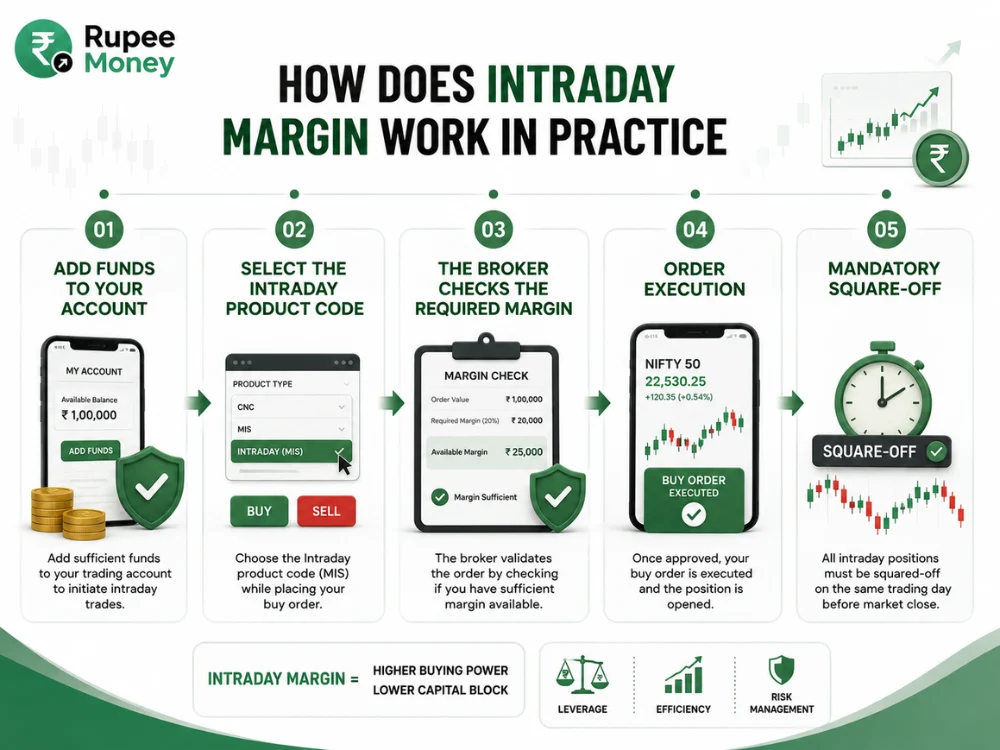
When you decide to place a leveraged day trade in India, the process generally follows these steps:
1. Add Funds to Your Account
You transfer money into your trading account, which acts as your cash margin limit.
2. Select the Intraday Product Code
When placing the order, you must explicitly tell the broker that this is an intraday trade. Most discount brokers (like Zerodha, Groww, or Upstox) use the code MIS (Margin Intraday Square-off) or CO (Cover Order). If you select CNC (Cash and Carry), it becomes a delivery trade, and you will get zero leverage.
3. The Broker Checks the Required Margin
Your broker’s system instantly calculates if you have enough money. For equity shares, the margin is calculated based on SEBI’s risk metrics, primarily VaR (Value at Risk) + ELM (Extreme Loss Margin). Highly volatile stocks require a larger margin, while stable large-cap stocks require a lower margin.
4. Order Execution
If you have sufficient margin, the trade is executed. You now hold a market position much larger than your bank balance.
5. Mandatory Square-Off
You must close the trade before the market shuts. If you forget to sell your shares, the broker’s system will automatically square off (close) your position around 3:15 PM to 3:25 PM. Brokers usually charge an extra penalty fee (e.g., ₹50 + GST) for auto-squaring off your trades.
The Double-Edged Sword: Amplifying Profits and Losses
To understand why intraday trading is risky, let’s look at the math behind leverage.
Assume you use ₹20,000 as a 20% margin to control ₹1,00,000 worth of shares (5x leverage).
Scenario A: You are Right (+2% Market Move)
- The stock price goes up by 2%.
- 2% of ₹1,00,000 = ₹2,000 Profit.
- You just made a 10% return on your actual ₹20,000 capital in a single day!
Scenario B: You are Wrong (-2% Market Move)
- The stock price drops by 2%.
- 2% of ₹1,00,000 = ₹2,000 Loss.
- You just lost 10% of your total capital in minutes.
A common beginner mistake is thinking, “I only invested ₹20,000, so my risk is small.” This is fatally wrong. You are exposed to the full ₹1,00,000 trade value. A sudden 10% crash in the stock price would result in a ₹10,000 loss, wiping out exactly half of your hard-earned capital.
SEBI’s Peak Margin Rules: Why Leverage is Capped Today
A few years ago, unregulated brokers in India lured traders by offering 20x, 40x, or even 50x intraday leverage. This reckless practice led to massive defaults when the stock market crashed.
To protect retail investors, SEBI fully implemented the Peak Margin Framework.
Here is how the rules work today:
- Maximum 5x Leverage for Equity Cash: For top-tier, highly liquid stocks (like Reliance or TCS), the minimum upfront margin required is 20% (VaR + ELM). This means the maximum intraday leverage any broker can legally provide in the cash market is 5x.
- No Extra Intraday Leverage for F&O: If you trade Futures and Options (F&O), SEBI mandates that brokers collect 100% of the normal overnight margin (SPAN + Exposure margin). This means you get 1x leverage for F&O intraday trades. The days of buying bank Nifty futures with just ₹5,000 are permanently over.
- Random Intraday Snapshots: The clearing corporations take four random snapshots of your account during the day. If your available cash falls below the required margin at any given second, a peak margin penalty is levied.
Intraday Margin vs. Delivery vs. MTF
It is easy to get confused by the different ways to buy stocks. Here is a simple comparison:
| Feature | Intraday (MIS) | Delivery (CNC) | Margin Trading Facility (MTF) |
| Holding Period | Same day only | Forever (Days/Years) | Up to several months |
| Margin Required | ~20% (Up to 5x leverage) | 100% (No leverage) | 25% to 50% (2x to 4x leverage) |
| Interest Charged | None | None | Yes (Daily interest applies) |
| Auto Square-Off | Yes (At ~3:15 PM) | No | No (unless margin falls too low) |
| Overnight Risk | None | Yes | Yes |
What Happens if There is a Margin Shortfall?
Stock market volatility can change rapidly. If a stock suddenly becomes highly volatile in the middle of the day, the stock exchange might dynamically increase the VaR margin requirement for that specific stock.
If the required margin goes up, and you do not have extra cash in your account, a margin shortfall occurs.
- Your broker will send you an urgent alert (Margin Call) asking you to deposit more funds.
- If you don’t add funds quickly, the broker’s risk management system will automatically sell your shares at the current market price to protect themselves from bad debt.
5 Golden Rules for Beginners Using Margin
If you decide to step into the fast-paced world of intraday trading, follow these strict rules to protect your capital:
- Always Use a Stop-Loss: Never execute a leveraged trade without a system-placed stop-loss order. A sudden flash crash can wipe out your account before you can manually click “sell.”
- Do Not Max Out Your Leverage: Just because your broker gives you 5x leverage doesn’t mean you should use all of it. Trading with 2x or 3x leverage gives you breathing room if the market swings wildly.
- Watch the Clock: Set an alarm for 3:00 PM. Always close your own intraday positions to avoid auto-square-off penalty charges from your broker.
- Factor in Brokerage and Taxes: Leveraged trading generates high turnover. Even if your trade breaks even, Securities Transaction Tax (STT) and brokerage fees will result in a net loss.
- Never Use Borrowed Money: Never fund your trading account using personal loans, credit cards, or emergency savings.
Conclusion
Intraday trading margin is an incredible tool that allows Indian traders to achieve high capital efficiency without locking up large sums of money. It lets you capture short-term daily trends and close your laptop at 3:30 PM with zero overnight risk.
However, margin is not free money—it is multiplied risk. SEBI’s strict peak margin rules have successfully capped equity cash leverage at 5x, protecting the system from systemic crashes. For beginners, the most crucial lesson is to focus heavily on risk management and position sizing. Understand that when you use margin, your profits are exciting, but your losses can be devastating.
FAQs
What is intraday trading margin?
Intraday trading margin is the fraction of money (e.g., 20%) you need to deposit in your demat account to place a day trade. It allows you to buy or short-sell shares worth more than your actual cash balance, provided you close the trade before the market shuts.
What is the maximum intraday leverage allowed in India?
Under SEBI's Peak Margin rules, the maximum leverage a broker can offer for highly liquid equity cash stocks is 5x (which requires a 20% upfront margin). For Futures & Options (F&O), intraday leverage is effectively 1x (100% margin required).
Can I lose more than my deposited margin?
Yes. Because your market exposure is much larger than your deposited margin, a sudden, violent stock market crash can cause losses that exceed your available cash. If this happens, your account goes into negative balance, and you will owe the broker money.
Does every stock provide 5x intraday leverage?
No. Brokers only provide maximum leverage on highly liquid, large-cap stocks (like Nifty 50 companies). Highly volatile mid-cap or small-cap stocks require a much higher margin, meaning you get lower leverage. Some risky stocks offer zero intraday leverage.
What happens if I forget to sell my intraday shares by 3:30 PM?
You don't have until 3:30 PM. Your broker's risk management system will automatically square off (sell) your open intraday positions between 3:15 PM and 3:25 PM. The broker will also charge you an auto-square-off penalty fee.
Under SEBI’s Peak Margin rules, the maximum leverage a broker can offer for highly liquid equity cash stocks is 5x (which requires a 20% upfront margin). For Futures & Options (F&O), intraday leverage is effectively 1x (100% margin required).
You don’t have until 3:30 PM. Your broker’s risk management system will automatically square off (sell) your open intraday positions between 3:15 PM and 3:25 PM. The broker will also charge you an auto-square-off penalty fee.
Disclaimer:
Disclaimer: The content provided on RupeeMoney is strictly for educational and informational purposes only. We are NOT a SEBI-registered Research Analyst or Investment Adviser and do not provide buy/sell recommendations, stock tips, or intraday trading calls. Investments and trading in the securities market are subject to market risks; read all related documents carefully before investing or trading. Past performance and leverage tools do not guarantee future returns. Intraday trading with margin carries substantial risk of capital loss. Please conduct your own independent research or consult a SEBI-registered financial advisor before making any financial decisions.
ABOUT THE AUTHOR

