
RBI Approves ₹10 and ₹20 Plastic Notes: Impact on India’s Currency System
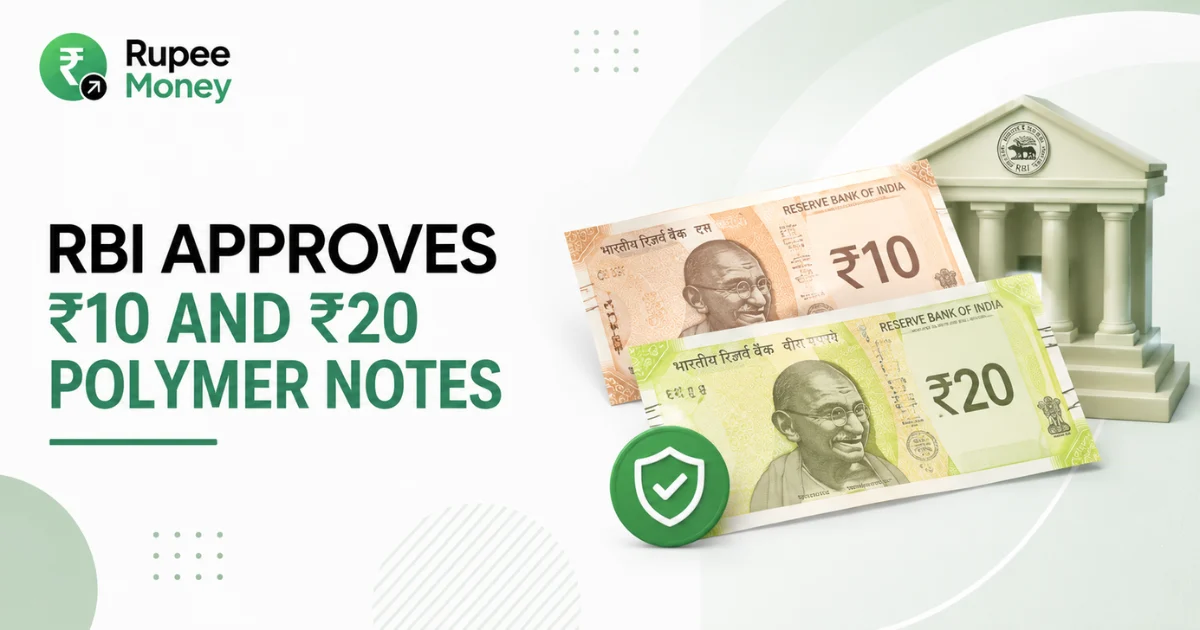
India might soon witness a new type of physical currency. The Reserve Bank of India (RBI) recently received vital government approval. The central government allowed the RBI to test polymer ₹10 and ₹20 notes.
This move does not eliminate traditional paper currency. Instead, the central bank will test plastic notes alongside existing paper notes.
Welcome to RupeeMoney. We help you understand major financial updates simply.
The government approved 100 crore pieces of each denomination for trials. The trial covers 200 crore polymer notes worth ₹3,000 crore. RBI Governor Sanjay Malhotra recently shared important timeline details. He indicated that polymer notes could enter circulation around FY2027-28. The final launch depends entirely on the field trial results.
Let us explore what polymer notes mean for ordinary Indian citizens.
What Did the Government Approve for RBI Polymer Notes?
The central government approved the RBI proposal recently. The RBI wants to conduct field trials for new polymer banknotes. The central bank plans to test one billion ₹10 polymer notes. It also plans to test one billion ₹20 polymer notes.
The RBI submitted this proposal under Section 25 of the RBI Act. The currency management arm of the RBI recently floated a printing tender. They asked manufacturers to supply special polymer substrate sheets.
The central bank will assess these notes through real-world circulation. Officials will observe durability, security, and daily handling factors. The RBI will issue these notes regularly if trials succeed.
India has not announced a complete shift to plastic currency. Existing paper notes will continue circulating during this transition phase.
When Will the RBI Launch ₹10 and ₹20 Polymer Notes?
The central government already approved the initial field trials. The RBI has started sourcing the required polymer material actively.
RBI Governor Sanjay Malhotra recently shared a target timeline. He stated polymer notes could enter circulation around early FY2027-28. This points to the start of April 2027.
However, you should not treat this as a guaranteed launch date. The RBI must complete the extensive field-trial process first. The central bank needs practical results before starting regular issuance. Consumers should wait for an official RBI announcement.
Why Did the RBI Choose ₹10 and ₹20 Denominations?
The RBI chose these specific notes for a highly practical reason. These lower denominations see incredibly heavy use daily. Small shopkeepers, vendors, and ordinary citizens exchange them constantly.
This frequent circulation creates massive wear and tear quickly. These two denominations make up nearly one-fourth of all Indian banknotes. However, they represent only a tiny fraction of the total currency value.
This makes them perfect for testing physical durability. The central bank wants to observe their performance under harsh conditions. Small vendors form the backbone of the cash economy. Read how small businesses help India’s economy grow faster.
Paper Notes vs. Polymer Notes in India
Polymer notes use a plastic-like substrate instead of cotton-based paper. They offer much better resistance against water and physical damage. Manufacturers can also embed advanced security features inside them. Counterfeiters find it extremely difficult to forge these features.
However, paper notes currently remain familiar to everyone. Paper currency works perfectly with India’s existing cash-handling infrastructure. The RBI wants to compare real-world performance carefully.
| Feature | Paper Notes | Polymer Notes |
| Material Base | Cotton-based paper substrate | Plastic polymer substrate |
| Durability | Lower durability under heavy use | Higher durability and tear resistance |
| Water Resistance | Very limited | Excellent moisture resistance |
| Expected Lifespan | Shorter lifespan | 3 to 4 times longer lifespan |
| Security Features | Standard existing features | Advanced transparent window features |
| Current Status | Regular everyday circulation | Government-approved field trial |
Do Polymer Notes Provide Better Counterfeit Protection?
Security remains a massive reason behind exploring polymer currency. Polymer substrates easily support transparent windows and complex holograms. Authorities can also include specialized visual and machine-readable features.
These features help ordinary people identify genuine notes instantly. They also create huge barriers for criminal counterfeiters.
However, polymer material does not stop counterfeiting completely. Criminals constantly improve their illegal techniques over time. The RBI will thoroughly assess security performance during these trials.
Will Existing ₹10 and ₹20 Paper Notes Become Invalid?
No. The central government clearly ruled out any demonetization step. Officials have no proposal to replace paper currency entirely.
The RBI plans to circulate polymer notes alongside paper-based banknotes. Your existing ₹10 and ₹20 paper notes will remain completely valid. You do not need to exchange your old notes. The new polymer notes will act as an additional currency form.
Will Polymer Notes Affect UPI Payments and Charges?
Many people worry about UPI payments and new potential charges. Polymer notes will never replace the UPI digital framework.
Parliament recently passed the Taxation and Other Laws (Amendment) Bill, 2026. Finance Minister Nirmala Sitharaman quickly clarified the new UPI rules. She stated that consumers will never pay any UPI transaction charge.
The government might introduce a Merchant Discount Rate (MDR) later. However, this MDR will only affect merchants above a specific turnover threshold. Consumers will continue using UPI absolutely free of cost.
If you use cards frequently, read our guide on choosing between UPI or credit cards for everyday spending.
Does India Still Need Cash Alongside UPI?
India continues to witness explosive digital payment growth daily. UPI now dominates everyday consumer transactions everywhere.
However, physical cash still remains incredibly important across India. Millions of small businesses strongly prefer accepting cash payments. Cash works perfectly without internet connectivity or a smartphone. This makes physical currency vital for absolute financial inclusion.
The RBI expertly manages both cash and digital payment systems simultaneously. India can expand digital payments while upgrading its physical currency. To learn how inflation impacts your cash savings, read what is inflation and why does it matter.
What Are the Major Benefits of Polymer Notes?
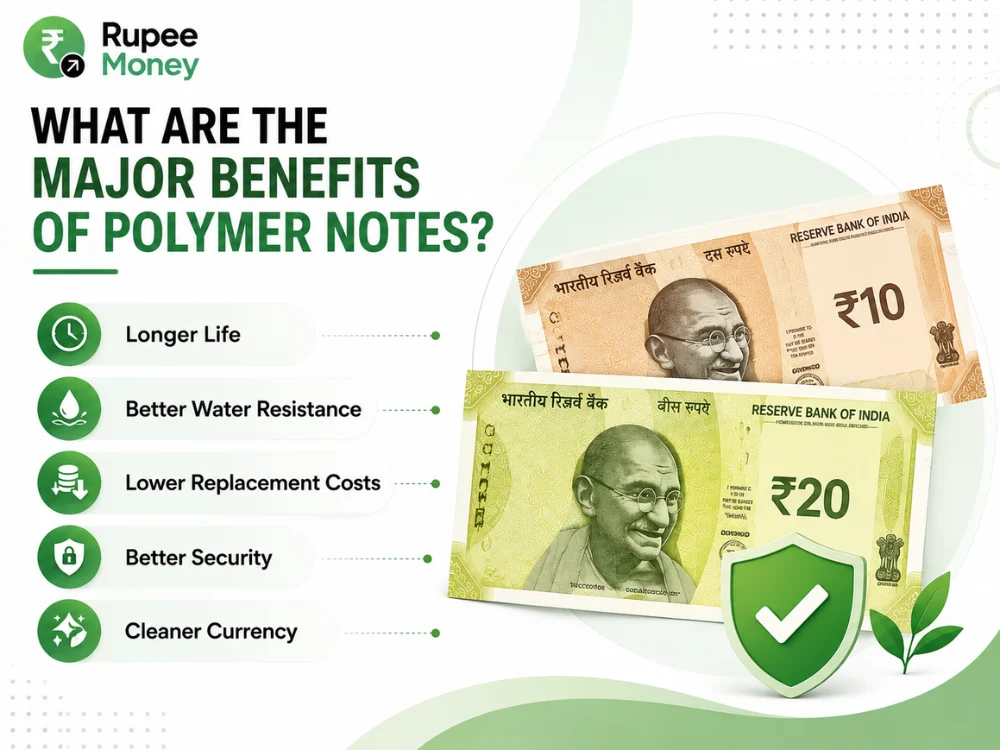
Polymer currency offers several brilliant advantages for the economy.
- Longer Life: Polymer notes last much longer than traditional paper notes. Experts expect them to last 3 to 4 times longer.
- Better Water Resistance: Polymer material handles moisture and rain exceptionally well.
- Lower Replacement Costs: The RBI replaces worn-out notes less frequently. This improves long-term currency management efficiency.
- Better Security: Polymer supports advanced anti-counterfeiting security features easily.
- Cleaner Currency: Plastic notes remain significantly cleaner under normal handling.
Many developed countries already use polymer banknotes successfully today. Australia, Canada, Singapore, and the UK prefer polymer currency.
What Challenges Does Polymer Currency Face?
Polymer notes present a few unique operational challenges. Manufacturers face higher initial production costs compared to paper. The RBI must adapt its entire currency-handling infrastructure quickly.
Commercial banks need to upgrade their ATMs and cash-processing machines. Public familiarity and acceptance can also take some time.
India previously explored polymer currency back in 2012. That initiative failed because of technological challenges at that time. The current trial allows the RBI to test improved modern technology.
What Will Happen During the Polymer Note Trial?
The RBI will release the new notes into public circulation. The central bank will actively observe how citizens handle them. Officials will assess how commercial banks manage these new notes.
The RBI will meticulously monitor durability and overall operational performance. Analysts will also study public acceptance and security reliability. These precise results will help determine the final regular issuance.
A successful trial will lead to wider nationwide circulation eventually.
What Does the ₹3,000 Crore Trial Value Mean?
The proposed trial includes 100 crore ₹10 notes. It also includes 100 crore ₹20 notes. Together, these test notes hold a face value of ₹3,000 crore.
This massive scale generates highly meaningful real-world data quickly. However, this figure only represents the face value. It does not represent the actual physical production cost. The central bank will determine procurement and manufacturing costs separately.
Will the RBI Introduce Polymer Notes in Other Denominations?
The government has not approved a complete currency switch. The current approval exclusively focuses on ₹10 and ₹20 notes.
The RBI must evaluate the results of these initial trials. The central bank might consider upgrading higher denominations later. Any new decision requires separate government approvals and formal announcements.
Consumers should not expect ₹50 or ₹500 polymer notes immediately. To understand how central banks operate globally, learn what is the repo rate.
What Should Indian Consumers Do Now?
Ordinary consumers do not need to change their habits immediately. You can continue using your existing paper currency freely. And you can spend your ₹10 and ₹20 paper notes normally.
You should also continue utilizing UPI and digital payment methods. The new polymer notes simply form an experimental field trial. The RBI will release further details as the trial progresses.
To build excellent financial habits early, read our guide on building wealth in your 20s.
You can plan your regular investments easily using our SIP Calculator. Evaluate your monthly loan costs accurately using our EMI Calculator. Try our Lumpsum Calculator for planning one-time major investments safely.
Why the RBI Polymer Notes Update Matters
This move proves that India’s currency system evolves constantly. India refuses to choose between cash and digital payments exclusively. The government rapidly develops both systems at the exact same time.
UPI facilitates incredibly fast and secure digital payments daily. Cash serves millions of people who lack digital internet access. Polymer notes will make this cash system highly durable.
The current trial marks a massive step forward. But the final decision depends on how the field trials perform. For now, simply remember one key takeaway. The RBI will test ₹10 and ₹20 polymer notes without replacing paper currency.
Conclusion
The RBI field trial of ₹10 and ₹20 polymer notes marks a massive step forward. India continuously upgrades its cash-handling infrastructure alongside booming digital payments. Polymer notes offer incredible durability and excellent resistance against water damage. They also support highly advanced anti-counterfeiting security features natively.
However, the central government will never replace existing paper currency completely. You can continue using your paper notes and UPI apps seamlessly. The RBI targets launching these plastic notes formally around early FY2027-28.
Keep an eye on official government announcements as the trial progresses successfully. Building strong financial knowledge helps you navigate these national economic changes confidently. Start your smart financial journey today by reading our guide on building wealth in your 20s.
FAQs
When will ₹10 and ₹20 polymer notes arrive?
RBI Governor Sanjay Malhotra targets the beginning of FY2027-28. This means the notes could launch around April 2027. However, the RBI must complete the field trials first successfully.
Will ₹10 and ₹20 paper notes stop working?
No. The government will not replace paper currency entirely. Polymer notes will circulate alongside existing paper notes seamlessly. You do not need to exchange your old currency.
Why is the RBI introducing polymer notes?
The RBI wants to improve the durability of lower denominations. These specific notes change hands quickly and wear out rapidly. Polymer notes resist water and tearing much better than paper.
Will polymer notes replace UPI payments?
No. Polymer notes and UPI serve completely different consumer needs. The government clarified that consumers will never pay UPI charges. Consumers will continue using free UPI payments daily alongside cash.
Are polymer notes better than paper notes?
Polymer notes offer greater durability and excellent water resistance. They support advanced security features easily. However, they carry higher initial production costs for the government.
Disclaimer: This article provides general information for educational purposes only. It does not constitute financial, investment, legal, or tax advice. The Reserve Bank of India and the Government of India may change implementation timelines. Readers should verify official RBI announcements before making financial decisions. RupeeMoney does not provide any recommendation to buy or sell financial products.
ABOUT THE AUTHOR

