
Home Loan Repayment: EMI, Interest and Repayment Options Explained

Buying a house remains a major financial milestone for most people. Taking a home loan makes this dream property more affordable. It allows you to spread the massive upfront cost over several years.
However, you must look closely at the math. The total amount you repay the bank is often significantly higher than the amount you originally borrowed. This gap exists because of the interest the bank charges you over a long tenure.
Understanding home loan repayment dynamics is critical before you choose your loan amount, set your tenure, or decide on a repayment strategy. Your monthly home loan EMI depends entirely on the principal amount, the interest rate, and the loan tenure. While a longer tenure reduces your monthly EMI, it drastically increases the total interest you pay over the life of the loan.
A home loan repayment calculator helps you estimate your EMI, track your total interest, and visualize the overall repayment amount before you sign the loan agreement. Understanding these numbers helps you compare different loan options and plan your finances securely. Welcome to RupeeMoney, your trusted guide for navigating major financial decisions.
What Is Home Loan Repayment?
Home loan repayment is the structured process of paying back the money you borrowed from a bank or lender. You repay this money along with the applicable interest and processing charges over an agreed schedule.
When you take a home loan, the actual money you borrow is called the principal. The lender charges a fee for giving you this money. We call this fee interest.
Your regular monthly EMI contains two specific components:
- Principal repayment
- Interest payment
When you start your loan, a huge portion of your EMI goes toward paying the interest. Very little goes toward reducing the principal. As the outstanding principal slowly decreases over the years, the interest component falls. Eventually, a larger portion of your EMI starts reducing the principal.
What Does a Home Loan Repayment Include?
The total cost of your home loan includes several factors:
- The original principal amount.
- The total interest accumulated over the tenure.
- Applicable processing fees or administrative charges.
- Applicable taxes and statutory charges.
The exact charges depend on your chosen lender. Therefore, smart borrowers look far beyond just the monthly EMI when comparing home loans.
How Is Home Loan EMI Calculated?
Home loan EMI stands for Equated Monthly Instalment. It is the fixed amount you pay to the bank every single month to clear your debt.
Banks calculate this EMI using a standard mathematical formula:
EMI = P × R × (1 + R)ⁿ ÷ [(1 + R)ⁿ − 1]
Where:
- P = Principal loan amount.
- R = Monthly interest rate (annual rate divided by 12).
- N = Total number of monthly instalments (tenure in months).
Let us look at a practical example. Suppose you borrow ₹50 lakh at an annual interest rate of 8.5% for 20 years. Your approximate monthly EMI would be ₹43,391.
Over 20 years, your total repayment to the bank would reach approximately ₹1.04 crore. Out of this total, around ₹54.1 lakh represents the interest you paid to the bank.
Why Does Loan Tenure Affect Your EMI?
Loan tenure directly impacts your monthly EMI and your total cost. If you choose a long 30-year tenure, the bank spreads the principal across many more monthly instalments. This naturally reduces your monthly EMI.
However, you remain in debt for a longer period. Because you hold the bank’s money longer, you pay significantly more interest overall.
Look at this quick comparison for a ₹50 lakh loan at 8.5%:
- 10 years: EMI = ₹61,993
- 20 years: EMI = ₹43,391
- 30 years: EMI = ₹38,446
While the 30-year option looks cheaper monthly, the total interest paid will be massive.
What Is Home Loan Interest?
Home loan interest is simply the cost a lender charges you for providing the funds. The interest rate heavily influences the total amount you repay by the end of the loan. Even a tiny 0.5% difference in interest rates becomes a massive financial burden over a 20-year tenure.
How Does Home Loan Interest Work?
Banks calculate your interest on the outstanding principal balance. As you pay your EMIs every month, your outstanding principal gradually reduces. As the principal drops, the interest calculated on that balance also drops.
This mechanism explains why making additional principal payments (prepayments) early in your loan cycle can dramatically reduce the total interest you owe.
Why Is the Home Loan Interest Rate Important?
The interest rate is the most critical factor affecting your home loan repayment.
Consider two hypothetical ₹50 lakh loans taken for 20 years:
- Loan A: 8% interest rate.
- Loan B: 9% interest rate.
Loan B will saddle you with a higher monthly EMI and a much higher total repayment. You must always compare the effective cost of different loan offers. Never choose a lender just because their initial EMI looks slightly more affordable.
What Can Affect Your Home Loan Interest Rate?
The interest rate a bank offers you depends on several personal and market factors:
- Your credit score and profile. (Learn how to improve your CIBIL score).
- Your monthly income and employment stability.
- The total loan amount and loan-to-value ratio.
- The property details and location.
- Whether you choose a fixed or floating rate.
- Prevailing RBI repo rates and market conditions.
What Is a Home Loan Repayment Calculator?
A home loan repayment calculator is a powerful digital tool. It estimates your monthly EMI and your total loan repayment based on three simple inputs: the loan amount, the interest rate, and the loan tenure.
It helps you instantly understand how changing any of these variables affects your total borrowing cost. You can easily access a Home Loan Calculator on RupeeMoney to crunch your numbers.
How Does a Home Loan Repayment Calculator Help?
Suppose you cannot decide between a 15-year and a 20-year loan. You can enter both scenarios into the calculator. The tool will instantly show you the monthly EMI, total interest, and total repayment for both options.
This comparison helps you understand the trade-off. You can clearly see the cost of choosing a lower monthly payment versus the savings of a shorter loan term.
How Can You Use a Home Loan Repayment Calculator?
Using the calculator is very straightforward:
- Enter the Loan Amount: Input the exact amount you plan to borrow (e.g., ₹50,00,000).
- Enter the Interest Rate: Input the annual interest rate offered by the bank (e.g., 8.5%).
- Enter the Tenure: Select your preferred loan duration (e.g., 20 years).
- Compare the Results: The calculator instantly displays your monthly EMI and total interest.
What Are the Main Home Loan Repayment Options?
Borrowers can structure their repayment strategy based on the rules set by their lender.
What Is Regular EMI Repayment?
This is the standard, conventional method. You pay a fixed, scheduled amount every month. If you have a floating-rate loan, your EMI or your tenure might change when the bank revises its interest rates.
What Is Part-Prepayment?
A borrower can make an extra lump-sum payment toward the outstanding principal at any time. A part-prepayment directly reduces the outstanding principal. This instantly lowers the total interest payable over the remaining loan term.
After making a part-prepayment, you can usually choose to either reduce your monthly EMI or reduce your overall loan tenure.
What Is Full Prepayment?
Full prepayment means you clear the entire outstanding loan balance before the scheduled maturity date. Banks do not charge prepayment penalties on floating-rate home loans for individuals. However, always check your specific loan agreement before making a massive final payment.
Why Can Part-Prepayment Reduce Home Loan Interest?
Interest calculations depend strictly on the outstanding principal balance.
Suppose you have a massive outstanding balance. You receive a bonus at work and make a ₹2 lakh part-prepayment toward the principal. Your outstanding balance immediately drops by ₹2 lakh.
The bank now calculates your future interest on this new, smaller principal amount. By doing this early in your loan cycle, you save hundreds of thousands of rupees in interest over the remaining tenure.
How Should You Decide Between EMI Reduction and Tenure Reduction?
When you make a part-prepayment, the bank will ask you a question. Do you want to reduce your EMI, or do you want to reduce your tenure?
- Reducing EMI: Your monthly financial burden drops. You have more cash in hand every month.
- Reducing Tenure: You keep paying the same EMI amount, but your loan finishes years earlier.
If your goal is to save the maximum amount of interest, always choose to reduce the tenure. However, if your monthly budget feels too tight, reducing the EMI provides welcome relief.
How Does Loan Tenure Affect Home Loan Repayment?
Choosing your loan tenure is one of your most important financial decisions. You must find the right balance between affordability and the total cost of borrowing.
What Happens With a Shorter Tenure?
A shorter tenure means:
- Your monthly EMI will be higher.
- Your total interest paid will be much lower.
- You will become debt-free much faster.
What Happens With a Longer Tenure?
A longer tenure means:
- Your monthly EMI becomes lower and easier to pay.
- Your total interest paid to the bank skyrockets.
- You remain in debt for a much longer period.
What Is the Difference Between Fixed and Floating Home Loan Interest?
The interest rate structure drastically affects how you plan your repayment. You must understand fixed vs floating interest rate mechanisms.
What Is a Fixed Interest Rate?
A fixed rate stays the same for a specified period or the entire loan tenure. Your EMI remains totally predictable. However, fixed-rate loans usually start at a higher interest rate than floating loans.
What Is a Floating Interest Rate?
A floating rate moves up or down based on external benchmarks set by the RBI. If the RBI raises rates, your home loan interest rate rises. Your bank will usually increase your loan tenure to absorb this hike, keeping your EMI the same. If rates fall, your borrowing cost decreases.
How Can You Reduce Your Home Loan Repayment Cost?
You do not have to accept the maximum interest burden. You can actively manage and reduce your overall costs.
How Can a Higher Down Payment Help?
If you make a massive down payment, you borrow less money from the bank. A smaller principal naturally results in lower interest costs over the tenure. However, never drain your emergency savings just to make a larger down payment.
Why Should You Compare Interest Rates?
A 0.5% difference in interest rates can save you lakhs of rupees over 20 years. Always compare offers from multiple banks. Negotiate the rate based on your strong credit score.
How Can Prepayments Help?
Make it a habit to prepay a small amount of principal every year. Even paying one extra EMI per year can shave years off your loan tenure and save you massive interest costs.
Why Should You Avoid an Unnecessarily Long Tenure?
A 30-year loan might look tempting because of the tiny EMI. However, you will end up paying more in interest than the actual cost of the house. Choose the shortest tenure you can comfortably afford.
Where Does Home Loan Repayment Fit Into Financial Planning?
Your home loan EMI is a massive commitment. It must fit neatly alongside your other financial goals. Before signing the loan papers, calculate how much of your monthly income goes toward:
- The new home loan EMI.
- Daily household expenses.
- Life and health insurance premiums.
- Existing personal loan vs home loan obligations.
- Investments and emergency savings.
Do not choose an EMI that chokes your monthly cash flow. Your goal is to find a repayment structure that is both affordable and financially sustainable.
When Should You Use a Home Loan Repayment Calculator?
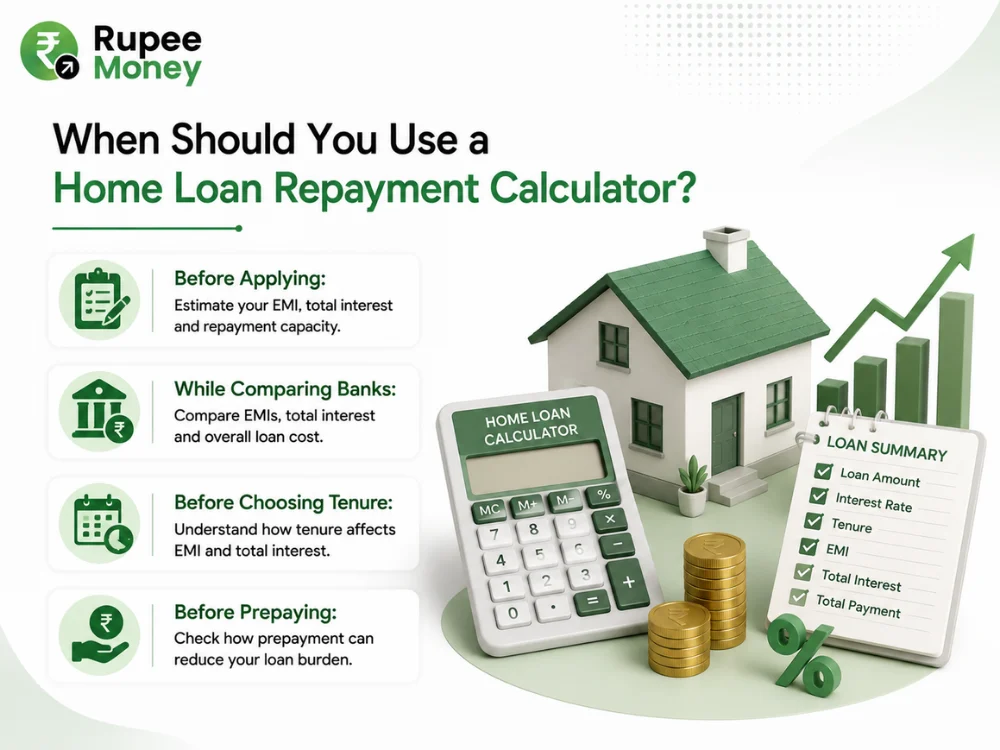
A home loan repayment calculator proves highly useful at multiple stages of your property journey.
- Before Applying: Estimate how much you can comfortably borrow based on your salary.
- While Comparing Banks: Compare different interest rate offers to find the cheapest loan.
- Before Choosing Tenure: See exactly how extending the tenure inflates your total interest.
- Before Prepaying: Calculate exactly how many months you will save if you make a ₹1 lakh prepayment today.
What Mistakes Should Borrowers Avoid?
- Choosing a Loan Only Based on EMI: A tiny EMI usually hides a 30-year tenure loaded with interest. Look at the total repayment amount instead.
- Ignoring Rate Changes: Floating rates will change. Ensure you have a buffer in your budget to handle future rate hikes.
- Taking the Maximum Loan Available: Just because a bank offers you ₹80 lakh does not mean you can afford to repay ₹80 lakh. Stick to your budget.
- Draining All Savings: Keep an emergency fund intact. Do not use every last rupee for the down payment.
Conclusion:
Home loan repayment requires careful planning. It is much more than just paying a monthly EMI. Your interest rate, loan tenure, and prepayment strategy dictate exactly how much the loan ultimately costs you.
Your home loan EMI determines your monthly budget, while the home loan interest determines the bank’s profit. While a 30-year tenure makes the EMI highly affordable, it destroys your long-term wealth by generating massive interest costs.
Always use an EMI Calculator to compare different loan amounts, interest rates, and tenures before making your final decision. The most affordable home loan is not the one with the lowest EMI. It is the loan structured to fit your monthly budget while keeping the total borrowing cost as low as possible.
FAQs
How is home loan EMI calculated?
The bank calculates your EMI using your principal amount, the interest rate, and the loan tenure. The standard mathematical formula uses your monthly interest rate and the total number of monthly instalments.
What does a home loan repayment calculator show?
A home loan repayment calculator estimates your monthly EMI, the total interest payable over the tenure, and the final total repayment amount based on your specific inputs.
What is home loan interest?
Home loan interest is the fee the lender charges you for providing the loan. The bank calculates this fee on your outstanding principal balance.
Does a longer tenure reduce home loan EMI?
Yes. A longer tenure spreads the repayment across more months, which reduces your monthly EMI. However, it significantly increases the total interest you will pay to the bank.
Can prepayment reduce home loan interest?
Yes. Any additional payment made toward the principal directly reduces your outstanding loan balance. This permanently reduces your future interest calculations.
Is it better to reduce EMI or tenure after prepayment?
If your goal is to save money on interest, reducing the tenure is the best choice. If your goal is to free up monthly cash flow, reducing the EMI is the better option.
Is fixed or floating home loan interest better?
Fixed rates offer complete payment predictability. Floating rates move with market conditions and are usually cheaper upfront. The right choice depends on your financial stability and the current economic environment.
How can I reduce my home loan repayment cost?
You can reduce the overall cost by making a larger down payment, negotiating a lower interest rate, choosing a shorter tenure, and making regular principal prepayments.
What is home loan repayment?
It is the structured process of returning the borrowed principal to the bank, along with all applicable interest and charges, through scheduled monthly payments.
A home loan repayment calculator estimates your monthly EMI, the total interest payable over the tenure, and the final total repayment amount based on your specific inputs.
Home loan interest is the fee the lender charges you for providing the loan. The bank calculates this fee on your outstanding principal balance.
Disclaimer: This article is strictly for educational and informational purposes and should not be considered financial advice. Home loan interest rates, processing fees, and repayment conditions vary significantly between lenders and change frequently. Always verify the latest terms and conditions with your chosen lender before signing a loan agreement.
ABOUT THE AUTHOR

