
Best Car Loans in India 2026: Compare Interest Rates, Processing Fees and EMI
Buying a new vehicle remains an exciting milestone for many Indian families. However, financing that dream car with the wrong credit facility can quickly turn a joyous occasion into a long-term financial burden. Even a fractional difference of 1% in the interest rate or an overpriced processing fee can drain thousands of extra rupees from your bank account over a five-year tenure. Therefore, identifying the Best Car Loans 2026 requires much more than simply glancing at a bank’s flashy promotional banner.
Before signing any financing agreement, prospective buyers must evaluate the actual interest rate, processing charges, foreclosure penalties, and the total lifetime cost of the EMI. Understanding what affects your loan eligibility early in the process ensures that you negotiate from a position of strength. In this comprehensive guide, we compare the top automotive financing options available in 2026 across major Indian banks like SBI, ICICI, HDFC, and Axis Bank.
Top Banks Offering the Best Car Loans 2026
Here is a quick comparison of selected major lenders for new car loans.
| Bank | Interest Rate | Processing Fee | Key Point |
| SBI | 8.95% to 9.90% | ₹750 to ₹1,500 + GST | Low processing fee |
| ICICI Bank | 7.90% to 11.20%* | Depends on loan offer | Lowest reported minimum rate |
| HDFC Bank | 7.60% to 14.00% IRR* | Up to 0.5%, min ₹3,500, max ₹8,000 | Rate depends on profile |
| Axis Bank | 8.90% to 11.70% | Up to 2% + GST | Fixed-rate loan |
The lenders publish rates using different methodologies and periods, so you should not treat the minimum rates as directly equivalent.
ICICI Bank reported new-car loan rates between 7.90% and 11.20% for loans disbursed during April to June 2026.
HDFC Bank reported an IRR range of 7.60% to 14.00% for auto loans during April to June 2026.
Axis Bank currently lists an effective ROI range of 8.90% to 11.70%.
SBI’s published new-car rate range starts at 8.95% and goes up to 9.90%, depending on credit score and tenure.
When you begin comparing auto financing options, you will quickly notice that each lender structures its pricing differently. Some banks offer exceptionally low interest rates but compensate with higher processing fees. Others provide zero-fee processing but lock you into a slightly higher fixed interest rate.
SBI Car Loan: Interest Rates and Processing Fees
The State Bank of India (SBI) consistently ranks among the most preferred lenders for automotive financing, primarily due to its sheer transparency and highly competitive fee structure. For 2026, SBI positions its new car loan interest rates starting around 7.75% for individuals possessing an exceptional credit profile, though average rates typically hover between 8.25% and 9.90% based on tenure and internal scoring.
Where SBI truly outshines its private sector counterparts is in its processing fee structure. Instead of charging a heavy percentage of the total loan amount, SBI utilizes a slab-based flat fee system. Typically, loans up to ₹5 lakh attract a nominal processing charge of just ₹750 plus GST, while loans exceeding ₹10 lakh top out at a maximum of ₹1,500 plus GST. Furthermore, SBI actively promotes green mobility by offering the specialized SBI Green Car Loan for electric vehicles, which carries further concessions.
ICICI Bank Car Loan: Rates and Charges
ICICI Bank offers aggressive pricing for borrowers possessing robust credit histories and existing banking relationships. For 2026, ICICI reports its new car loan interest rates starting from 8.40%, scaling upwards to 11.20% depending on the vehicle segment, borrower profile, and requested tenure.
However, prospective applicants must pay close attention to the processing fees. ICICI Bank charges a processing fee that can reach up to ₹8,500 plus GST. In exchange, the bank provides rapid digital processing, minimal documentation for pre-approved customers, and up to 100% on-road funding for selected premium vehicle models.
HDFC Bank Car Loan: Rates and Features
HDFC Bank dominates the retail auto financing sector through its extensive dealership network and instant “Xpress Car Loan” disbursement platform. The bank’s published auto loan rates for 2026 start from a highly competitive 7.50% and go up to 14.00% or more, heavily dictated by the specific vehicle model, the borrower’s employer categorization, and CIBIL score.
HDFC Bank generally charges a processing fee of 0.5% of the total loan amount. However, this is capped between a minimum of ₹3,500 and a maximum of ₹8,000. It is critical to note that HDFC enforces strict foreclosure policies. If you decide to prepay your auto loan within the first year, you could face a hefty 6% penalty on the outstanding principal.
Axis Bank Car Loan: Structure and Pricing
Axis Bank remains a solid contender for buyers seeking predictable financing. The bank advertises effective interest rates ranging between 8.95% and 11.75%. Axis stands out by frequently offering fixed-rate car loans, guaranteeing that your contracted interest rate remains completely unchanged throughout the entire loan tenure, which protects you from macroeconomic rate hikes.
On the downside, Axis Bank tends to levy higher processing charges, often ranging from ₹3,500 to ₹12,000, along with separate documentation charges. Borrowers should negotiate these processing fees directly with the dealership or bank representative before finalizing the paperwork.
How to Evaluate the True Cost of Your Car Loan
Comparing headline interest rates provides an incomplete picture of your financial commitment. A marginally lower interest rate completely loses its mathematical advantage if the bank charges an exorbitant processing fee or demands massive penalties for early repayment.
Fixed vs. Floating Interest Rates
One of the most critical decisions you face involves choosing the interest rate structure. A fixed-rate loan guarantees that your monthly EMI remains identical from the first month to the last, providing absolute budget certainty. In contrast, a floating rate fluctuates according to the Reserve Bank of India’s repo rate adjustments. To understand which structure aligns perfectly with your financial strategy, review our detailed breakdown on fixed vs floating interest rates.
Car Loan EMI Comparison for a ₹10 Lakh Loan
To truly comprehend the impact of interest rates, you must look at the exact EMI outflow. Suppose you require a ₹10 lakh loan for a tenure of five years. Here is an approximate breakdown of how different interest rates affect your total interest burden using a standard reducing-balance method:
| Interest Rate | Approximate Monthly EMI | Total Interest Paid Over 5 Years |
| 8.00% | ₹20,276 | ₹2,16,583 |
| 9.00% | ₹20,758 | ₹2,45,501 |
| 10.00% | ₹21,247 | ₹2,74,823 |
| 11.50% | ₹21,993 | ₹3,19,557 |
As demonstrated, a seemingly trivial jump from 8.00% to 11.50% forces you to pay over ₹1 lakh extra in sheer interest over five years. To run customized scenarios based on your specific vehicle price and down payment, use our highly accurate Car Loan Calculator. For calculating other retail financing metrics, you can also access our general EMI Calculator.
Why Foreclosure Charges Matter
Many buyers receive annual bonuses or experience unexpected income jumps, prompting them to clear their auto loans early. Unfortunately, banks dislike losing their projected interest income. Consequently, private lenders often charge foreclosure penalties ranging from 3% to 6% of the outstanding principal. Public sector banks generally offer more lenient foreclosure terms. Always demand a complete schedule of charges before signing the final loan agreement.
How to Choose the Best Car Loan in India
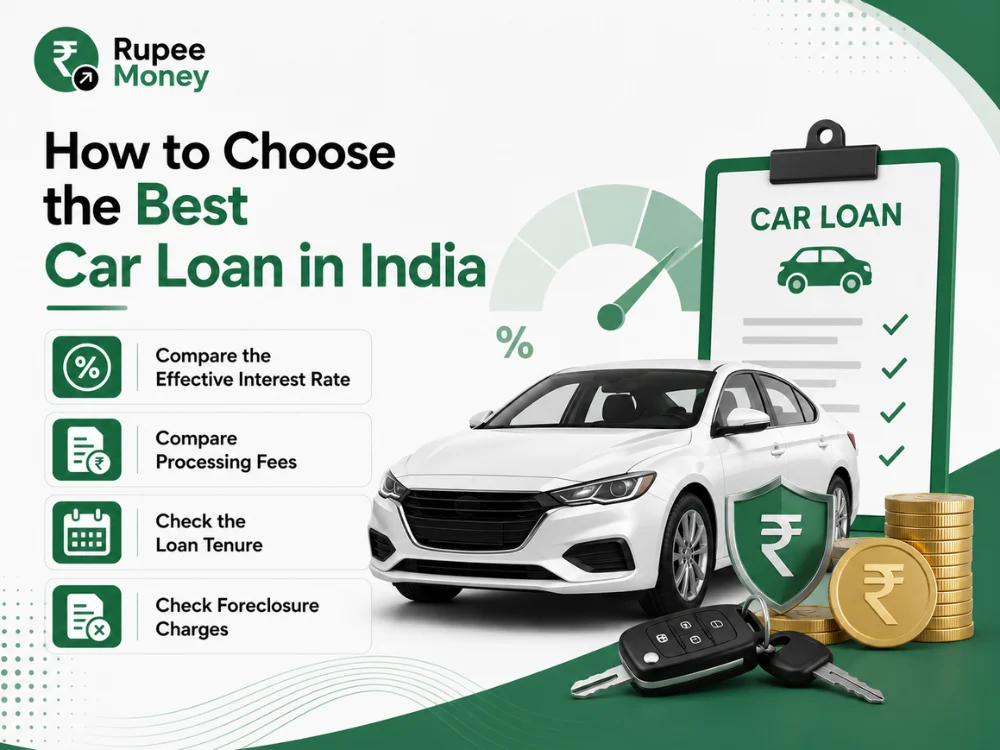
Compare the Effective Interest Rate
Do not choose a lender only because its advertisement says “starting from”.
Ask for the exact rate offered to you.
A lower rate can significantly reduce your total interest.
Compare Processing Fees
A lower interest rate can lose its advantage if the lender charges a large processing fee.
For example, SBI’s new-car processing fee ranges from ₹750 to ₹1,500 plus GST.
Axis Bank can charge up to 2% of the loan amount plus GST.
On a ₹10 lakh loan, a 2% processing fee can mean up to ₹20,000 before GST.
That makes a major difference.
Check the Loan Tenure
Longer tenure reduces your monthly EMI.
However, you pay interest for more months.
A five-year loan can therefore cost considerably less in total interest than a seven-year loan, even though the seven-year EMI looks more comfortable.
Check Foreclosure Charges
If you expect to repay the loan early, foreclosure charges matter.
HDFC Bank currently lists foreclosure charges of 6% within one year, 5% between 13 and 24 months and 3% after 24 months for its stated new-car loan structure.
Axis Bank lists foreclosure charges of 5% of the outstanding principal plus GST.
Always check the agreement applicable to your specific loan.
Essential Tips to Secure the Lowest Interest Rate
Securing the cheapest automotive financing requires proactive financial behavior. Banks view applicants through a lens of risk, meaning the safest borrowers receive the most lucrative discounts.
Leverage Your Credit Score
Your credit score dictates your absolute negotiating power. Banks categorize borrowers into distinct risk brackets. A score above 750 practically guarantees prime interest rates, while a score below 700 triggers higher risk premiums. If your current profile looks weak, take immediate steps to improve your CIBIL score before submitting a loan application.
Optimize Your Down Payment and Loan Tenure
Making a substantial down payment reduces your total principal, directly lowering your EMI and total interest burden. As a general rule, aim to pay at least 20% of the vehicle’s on-road price upfront.
Additionally, carefully select your loan tenure. While a seven-year loan drastically reduces your monthly payment, it keeps you trapped in debt much longer, forcing you to pay significantly more total interest. Always choose the shortest tenure that comfortably fits within your monthly cash flow.
Should You Pay Cash or Take a Car Loan?
If you possess substantial liquid savings, you might wonder if taking a loan makes logical sense. Emptying your bank account to purchase a depreciating asset cash-down eliminates interest expenses entirely. However, doing so instantly wipes out your emergency liquidity.
A well-structured car loan preserves your cash reserves, allowing you to invest those funds into appreciating assets like equity mutual funds. The mathematically correct choice depends entirely on whether your expected after-tax investment returns exceed the car loan’s interest rate. If your portfolio generates a 12% return while your auto loan costs 8.5%, utilizing financing while keeping your cash invested remains the smarter wealth-building strategy.
Conclusion
Identifying the Best Car Loans 2026 demands meticulous comparison. Do not fall victim to promotional “starting from” interest rates. Instead, force the dealership or bank representative to provide a customized quote detailing the exact interest rate, processing fee, and foreclosure conditions applicable to your specific profile.
SBI stands out as a highly transparent option with remarkably low processing fees. ICICI and HDFC provide incredible speed, convenience, and highly competitive rates for premium customers. Ultimately, the finest loan is the one that minimizes your total cash outflow over the entire tenure. Take thirty minutes to compare quotes side-by-side, utilize digital EMI calculators, and ensure that your new vehicle brings you joy rather than financial stress.
FAQs
Which bank currently offers the lowest car loan interest rate in 2026?
While advertised rates fluctuate constantly, SBI, ICICI, and HDFC currently offer some of the most competitive starting rates, often hovering between 7.50% and 8.50% for premium borrowers. However, the lowest rate advertised is practically irrelevant; the actual rate you receive depends entirely on your credit score, employer profile, and chosen loan tenure.
Which bank features the lowest processing fee for new car loans?
Public sector lenders, particularly the State Bank of India (SBI), lead the market in offering minimal processing fees. Unlike private banks that charge a percentage of the loan amount—which can quickly escalate to ₹8,000 or ₹10,000—SBI utilizes a flat-fee structure that typically maxes out at just ₹1,500 plus GST for standard retail car loans.
Is opting for a seven-year car loan a smart financial decision?
A seven-year tenure significantly reduces your monthly EMI, making premium vehicles appear much more affordable. However, stretching the loan increases the total interest you pay to the bank drastically. Furthermore, you will still be paying EMIs on a vehicle that has heavily depreciated in value. It is generally advisable to cap your auto loan tenure at five years whenever possible.
Can I repay my auto loan early to save on interest?
Yes, you can prepay your auto loan, but you must constantly factor in foreclosure charges. While some public sector banks permit penalty-free foreclosures, major private banks like HDFC and Axis often levy a 3% to 6% penalty on the outstanding principal if you close the loan before the designated maturity date.
Disclaimer: Investments in debt and equity markets, as well as the utilization of retail credit facilities, carry inherent financial risks. This article is intended strictly for educational, informational, and comparative purposes. The interest rates, processing fees, foreclosure charges, and eligibility criteria mentioned reflect publicly available banking data for 2026 and are subject to immediate revision by the respective financial institutions without prior notice. The loan terms offered to an individual applicant may differ substantially based on internal banking policies and credit assessments. We strongly advise all readers to demand and review the Key Facts Statement (KFS) from their chosen lender and consult a certified financial advisor before signing any legally binding loan agreements.
ABOUT THE AUTHOR

