
How Do Mazagon Dock Shipbuilders Make Money? Business Model Explained
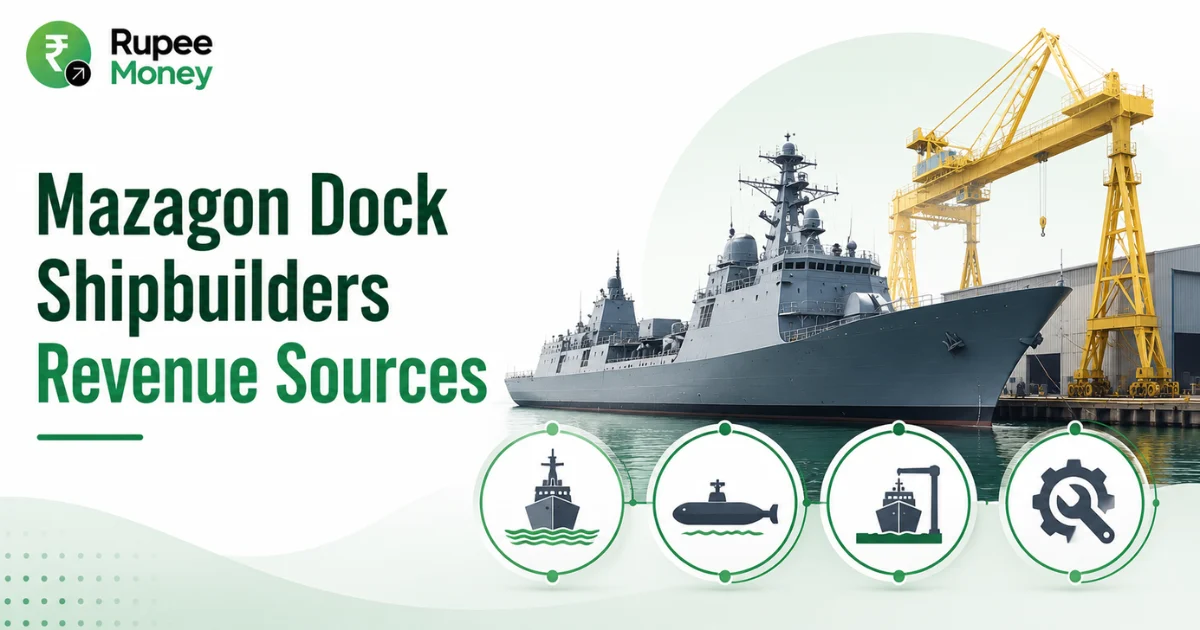
A modern warship takes years to build, but one single contract is worth thousands of crores. This massive scale creates a phenomenal business opportunity for Mazagon Dock Shipbuilders (MDL).
MDL operates as one of India’s largest defence shipyards. The company builds sophisticated warships and submarines, primarily for the Indian Navy. It also earns revenue from ship repairs, refits, offshore platforms, and commercial shipbuilding activities.
MDL closed FY2025-26 with ₹13,006 crore in consolidated operating revenue. Its consolidated profit after tax touched an impressive ₹2,583 crore.
Welcome to RupeeMoney. We simplify complex defence corporate structures for retail investors. Today, we explore how MDL generates its revenue and funds future growth.
How Mazagon Dock Makes Money
MDL earns revenue primarily by constructing and delivering massive naval defence vessels.
Its major revenue streams include:
- Warship construction
- Submarine construction
- Ship repair and refit services
- Offshore platforms and structures
- Commercial shipbuilding
- Technical and marine engineering services
The company works extremely closely with the Indian Navy and the Ministry of Defence. Its primary shipyard in Mumbai provides the complex infrastructure needed for massive naval projects.
Unlike consumer companies selling thousands of small items daily, MDL relies entirely on large, long-term contracts. The company earns massive sums from individual contracts that run for several years.
The Mazagon Dock Shipbuilding Business Model
The core business model operates on a very simple sequence:
Defence Requirement → Contract → Construction → Delivery → Revenue Recognition → Profit
The government identifies a strategic need for a new naval platform. MDL receives the official contract through a strict procurement process. The company purchases high-grade steel and electronics, employs skilled workers, and uses its shipyard to construct the vessel.
The government releases payments based on strict project milestones. As MDL executes the massive project, it recognizes revenue under applicable accounting rules. This structure makes rapid project execution incredibly important for the company’s final profitability.
To understand how public sector companies operate financially, read about how companies go public.
Warship Construction: The Core Business
Warship construction forms the absolute core of Mazagon Dock’s business operations. The company builds stealth destroyers, advanced frigates, and other lethal naval platforms.
These massive projects demand highly specialized design, engineering, and manufacturing capabilities. They involve thousands of precision components sourced from a huge supplier ecosystem.
MDL’s revenue increases significantly as it moves from early-stage construction toward major delivery milestones. This milestone-based system explains why quarterly revenue fluctuates heavily. Project schedules and material availability change the timing of revenue recognition frequently.
How Mazagon Dock Makes Money From Submarines
Submarines represent a highly critical part of MDL’s defence business. The company possesses deep expertise in constructing conventional attack submarines for the Navy.
Submarine construction demands specialized infrastructure and elite technical capabilities. This extreme complexity creates a massive entry barrier for domestic competitors.
For MDL, submarine contracts provide incredible long-term revenue visibility. However, these projects require meticulous planning and take several years to complete safely. Any technical delay affects project execution and damages financial performance instantly.
How Ship Repair and Refits Add Steady Revenue
Mazagon Dock does not just build new ships. It also earns steady money through continuous ship repair and refit activities.
Active naval vessels require periodic maintenance throughout their entire operational lives. MDL undertakes complex repairs, modern upgrades, and scheduled refits for these vessels.
This specific business provides reliable revenue opportunities between major shipbuilding projects. It allows MDL to utilize its technical expertise beyond new vessel construction. This creates an essential secondary revenue stream alongside major shipbuilding contracts.
To evaluate asset efficiency, learn how investors analyze Return on Assets (ROA).
Mazagon Dock Revenue and Profit in FY2026
The latest full-year numbers provide an incredibly clear picture of the business. MDL reported ₹13,006 crore in consolidated operating revenue for FY2025-26. This revenue increased by 13.8% compared to FY2024-25.
Consolidated net profit increased to roughly ₹2,583 crore. That represents a solid 7% year-on-year profit growth.
The March 2026 quarter also displayed excellent growth. Consolidated sales reached approximately ₹3,850 crore. Consolidated net profit reached ₹679 crore, up more than 100% year-on-year. These numbers prove how project execution influences MDL’s quarterly results significantly.
Why the Mazagon Dock Order Book Matters
For defence companies like MDL, the order book matters almost as much as current revenue. The order book represents signed contracts that the company still needs to execute.
At the end of FY2025-26, MDL’s order book stood proudly at approximately ₹20,535 crore. A massive order book provides brilliant future revenue visibility.
However, investors should never treat the entire order book as immediate revenue. MDL must manufacture, test, and deliver the contracted vessels perfectly. Execution timing ultimately influences revenue and profit margins across different financial years.
Why Government Spending Drives Mazagon Dock
Government defence spending dictates MDL’s opportunity pipeline completely. The Indian Navy desperately requires new ships and submarines to modernize its aging fleet.
India’s FY2026-27 defence allocation reached a staggering ₹7.85 lakh crore. The government earmarked significant spending for capital acquisition and the domestic defence industry.
This broad spending environment supports long-term opportunities for companies like MDL. However, smart investors focus strictly on actual contracts rather than relying solely on political budget announcements. Learn how government spending impacts PSU stocks today.
How Mazagon Dock Converts Orders Into Actual Profit
Winning a massive contract never creates immediate profit. MDL first executes the complex project physically. The company purchases expensive equipment, advanced electronics, and components constantly.
As construction progresses rapidly, the company records revenue. The difference between this revenue and project costs contributes to the final operating profit.
Therefore, operating margins depend entirely on specific factors:
- Raw material price fluctuations
- Accurate project mix
- Rising labor costs
- Smooth execution efficiency
- Strict contract terms and penalty clauses
- Unexpected project delays
Investors must always track operating margins carefully alongside top-line revenue growth. If you are starting your investment journey early, read about building wealth in your 20s.
What Drives Mazagon Dock’s Future Growth?
Several critical factors influence MDL’s future revenue pipeline:
- Higher Defence Procurement: India’s rapid naval modernization creates direct opportunities for massive shipbuilding contracts.
- Submarine Projects: Future submarine programmes create substantial long-term revenue opportunities immediately.
- Export Opportunities: International defence exports diversify MDL’s customer base perfectly.
- Ship Repair Demand: A growing naval fleet creates excellent recurring repair and refit opportunities constantly.
What Risks Can Affect Mazagon Dock?
A massive order book does not eliminate standard business risks. The company faces several factors investors must monitor continuously.
Project delays postpone revenue recognition terribly. Supply chain problems delay construction schedules severely. Government procurement delays postpone crucial new orders.
Valuation risk remains extremely relevant today. A company can deliver strong earnings and still produce weak stock returns. This happens if investors already priced in excessive growth expectations previously. You can reduce stock-picking risk by exploring large-cap mutual funds.
If you want a steady wealth creation strategy, consider SIP investing in India.
You can estimate potential investment growth smoothly using our SIP Calculator. Alternatively, check potential returns on one-time investments using our Lumpsum Calculator.
Conclusion
Mazagon Dock makes money primarily by building highly sophisticated naval vessels for India’s defence forces. Its secondary revenue comes directly from ship repairs, refits, and commercial marine activities.
The company’s entire business model revolves around massive, multi-year contracts. Order wins and timely project execution remain the most important drivers of its financial success.
The long-term opportunity depends entirely on India’s naval modernization efforts. MDL must successfully convert these future contracts into profitable physical deliveries. For smart investors, the key question is how much defence spending MDL converts into profitable, timely execution.
FAQs
How does Mazagon Dock make money?
Mazagon Dock makes money by building advanced defence ships and submarines for the Indian Navy. It executes these massive projects at its Mumbai shipyards. It also earns revenue from ship repair, refit work, and commercial shipbuilding.
What is Mazagon Dock's order book size?
Mazagon Dock's total order book stood at approximately ₹20,535 crore at the end of FY2025-26. This represents massive contracts that the company secured but still needs to execute.
Who are Mazagon Dock's main customers?
The Indian government and related defence organizations form the company's most important customer base. The Indian Navy specifically represents the major source of all its naval shipbuilding contracts.
Does higher defence spending benefit Mazagon Dock?
Higher defence spending definitely creates more opportunities for MDL. However, the company benefits only when increased spending translates into actual procurement programmes and signed contracts.
Is Mazagon Dock a PSU?
Yes. Mazagon Dock Shipbuilders operates as a public sector defence company under the Ministry of Defence. The Government of India proudly remains its primary promoter.
Mazagon Dock’s total order book stood at approximately ₹20,535 crore at the end of FY2025-26. This represents massive contracts that the company secured but still needs to execute.
The Indian government and related defence organizations form the company’s most important customer base. The Indian Navy specifically represents the major source of all its naval shipbuilding contracts.
Disclaimer: This article provides general information for educational and informational purposes only. The financial figures and business information derive from company filings and publicly available data up to 2026. Future defence orders and profits fluctuate based on government procurement decisions. Past financial performance does not guarantee future results. This article does not constitute investment advice or a recommendation to buy or sell Mazagon Dock Shipbuilders shares. Always conduct independent research or consult a SEBI-registered advisor before investing.
ABOUT THE AUTHOR

