
How Does ICICI Bank Make Money? Business Model and Revenue Sources
Many people think banks simply store their deposited money. However, banks convert these deposits into lucrative loans and investments. ICICI Bank executes this exact model at a massive scale.
The bank earns money primarily by lending funds at higher interest rates. It pays much lower interest rates on customer deposits. However, interest income represents only one part of its strategy.
ICICI Bank also earns huge revenue through banking fees. It generates income from credit cards and treasury operations. The wider corporate ecosystem includes insurance and asset management businesses.
Welcome to RupeeMoney. We simplify complex banking models for retail investors. Today, we will explore how ICICI Bank generates massive profits.
How Does ICICI Bank Make Money?
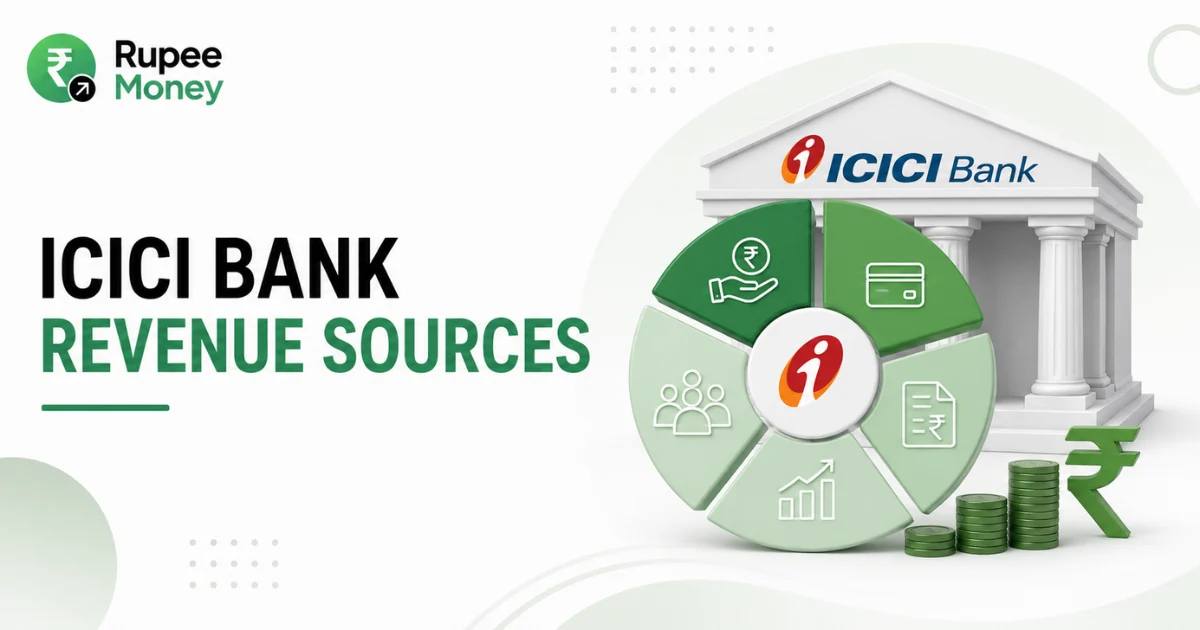
ICICI Bank generates revenue through several major business streams. The most important income sources include the following operations:
- Net interest income from retail and corporate loans
- Fees from daily banking and financial services
- Treasury investments and market trading income
- Digital payments and transaction processing services
- Credit cards and related merchant services
- Corporate banking and trade finance solutions
- Wealth management and investment advisory services
- Dividend income from financial subsidiaries
The bank earns its largest recurring income from interest rate differences. It charges higher interest on loans than it pays on deposits. This critical difference creates Net Interest Income (NII).
How ICICI Bank Earns Interest Income
Interest income forms the absolute foundation of traditional banking. Customers deposit their savings with ICICI Bank every day. They open savings accounts and book fixed deposits.
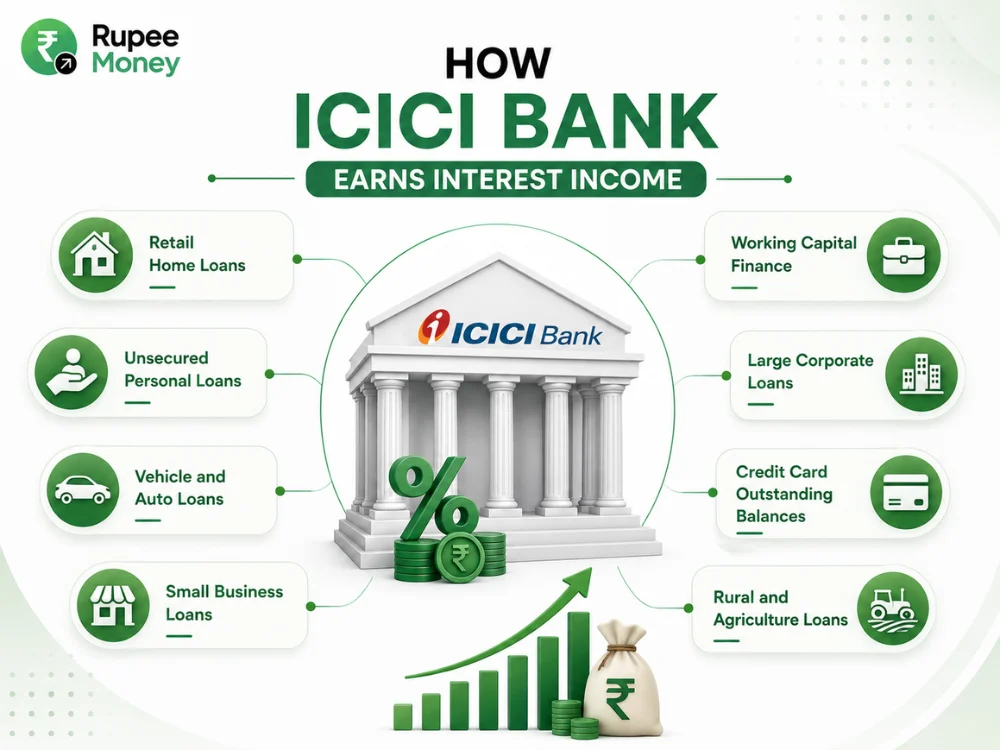
The bank uses these deposited funds to provide loans. It also uses its own capital to fund borrowers. These highly profitable loans include several major categories:
- Retail home loans
- Unsecured personal loans
- Vehicle and auto loans
- Small business loans
- Working capital finance
- Large corporate loans
- Credit card outstanding balances
- Rural and agriculture loans
The bank charges strict interest rates on these loans. Simultaneously, it pays fixed interest to eligible depositors. The calculated difference between these two sides creates the net interest income.
Before taking a loan, you must understand your approval chances. Read our guide on what affects your loan eligibility for more details.
What Is Net Interest Income (NII)?
Net Interest Income reveals the exact difference between interest earned and paid. Let us consider a very simple banking example. Imagine a bank earns ₹10 crore from its loan portfolio. It pays ₹6 crore as interest to its depositors.
The bank effectively generates ₹4 crore of net interest income. This calculation excludes other operating expenses and bad loan provisions. The actual corporate calculation involves a massive financial balance sheet.
ICICI Bank achieved a remarkable NII of ₹24,384 crore in Q1 FY2027. This performance represented a massive 12.7% year-on-year growth. The bank had reported ₹21,635 crore in Q1 FY2026. This massive growth shows why lending remains absolutely central here.
How ICICI Bank Makes Money From Retail Loans
Loans generate consistent interest income over long periods. The bank constantly balances loan growth, interest rates, and credit risk. Retail loans form a highly profitable part of its lending business.
Home loans generate steady interest income over multiple decades. You can estimate your own housing loan costs using our Home Loan Calculator.
Personal loans generate much higher interest income for the bank. These unsecured loans always carry significantly higher interest rates. Business loans allow the bank to finance small and large enterprises.
Credit cards provide another massive lending opportunity for the bank. The bank also earns processing fees from these loan approvals. Therefore, one single customer generates multiple revenue streams simultaneously.
To compare different interest structures, read our guide on fixed vs floating interest rate.
Why Customer Deposits Matter to ICICI Bank
Deposits provide the most important funding base for any bank. Customers keep their money in savings and current accounts. They also invest heavily in long-term fixed deposits.
The bank pays regular interest on many of these deposits. It then deploys these cheap funds into high-yielding loans. The overall cost of deposits directly dictates bank profitability.
If deposit costs rise quickly, the bank faces margin pressure. The bank must increase lending rates to protect its profits. This dynamic makes deposit growth an incredibly important banking metric.
You can project your own deposit returns using our FD Calculator.
What Is Net Interest Margin (NIM)?
Net Interest Margin measures how efficiently a bank earns interest. A higher NIM always supports stronger banking profitability. However, smart investors never evaluate NIM in complete isolation.
Loan growth and asset quality also dictate final bank profits. Operating costs and bad loan provisions influence the bottom line. ICICI Bank reported a robust 4.36% NIM in Q1 FY2027. This figure improved slightly from 4.34% in Q1 FY2026.
How ICICI Bank Earns Massive Fee Income
ICICI Bank never depends entirely on loan interest alone. It charges specific fees for various financial services. These regular fees create massive non-interest income for the bank.
The bank earns lucrative fees from several operational areas:
- Credit card joining and annual fees
- Digital payment processing charges
- Wealth management advisory fees
- Daily banking transaction charges
- Corporate trade finance services
- Wholesale banking syndication fees
- Retail investment distribution services
- Loan processing and documentation fees
- Foreign exchange markup charges
Fee income diversifies the total revenue base effectively. It reduces dangerous dependence on tight lending margins completely. ICICI Bank reported an impressive fee income of ₹7,286 crore in Q1 FY2027.
This performance represented an incredible 23.5% year-on-year growth. Retail and business customers contributed about 72% of total fee income.
How ICICI Bank Makes Money From Credit Cards
Credit cards provide several highly profitable revenue streams. The bank earns high interest when customers carry unpaid balances. It also earns annual fees from premium card services.
Card transactions generate lucrative interchange income within the payment ecosystem. ICICI Bank uses credit cards to deepen existing customer relationships. A customer might use the bank for savings and investments.
This integration creates massive opportunities to cross-sell additional products. However, credit card lending carries significant default risk always. The bank must balance aggressive growth with highly responsible underwriting.
You can calculate your monthly card debt payments using our EMI Calculator.
How ICICI Bank Earns From Business Banking
ICICI Bank serves small enterprises and massive global corporations. Business customers require much more than simple term loans. They demand efficient payment collection and cash management systems.
They also need robust working capital and trade finance services. These corporate services create both interest and fee income simultaneously. For example, a company maintains its primary operating account here.
The company uses the bank for daily vendor payments. The bank earns transaction fees from these continuous corporate payments. It also earns interest from short-term business financing facilities.
These digital supply-chain solutions connect large corporates with small vendors smoothly.
How ICICI Bank Makes Money From Wealth Management
Wealth management helps the bank serve affluent retail customers. These wealthy individuals require highly specialized financial services constantly.
The bank offers several premium investment solutions:
- Mutual fund distribution
- Corporate bond investments
- Life and health insurance
- Portfolio management services
- Structured investment products
- Comprehensive financial planning
The bank earns high commissions from selling these financial products. This advisory business strengthens long-term customer relationships significantly. A basic savings account customer eventually buys multiple investment products.
This strategy increases the total lifetime value of every customer. Young professionals can learn investment strategies by reading about building wealth in your 20s.
How ICICI Bank Makes Money From Treasury Operations
Banks manage massive internal investment portfolios daily. ICICI Bank executes sophisticated treasury operations in the financial markets. The bank trades government securities and corporate bonds actively.
The bank earns income from interest and capital trading gains. Treasury income fluctuates significantly between different financial quarters. Therefore, investors evaluate recurring banking income much more closely.
ICICI Bank reported a treasury income of ₹151 crore in Q1 FY2027. The bank had recorded ₹1,241 crore in Q1 FY2026. This sharp difference highlights the extreme volatility of treasury income.
How ICICI Bank Makes Money From Foreign Exchange
Large Indian businesses conduct international transactions very regularly. They require foreign exchange services for imports and exports. Banks facilitate these complex cross-border transactions safely.
They earn lucrative exchange spreads and transaction fees here. ICICI Bank maintains a strong international presence globally. This global footprint provides another steady source of non-interest income.
How ICICI Bank Benefits From Its Financial Ecosystem
ICICI Bank operates a massive integrated financial services ecosystem. The corporate group manages insurance, securities, and asset management businesses. This ecosystem allows retail customers to access diverse financial products easily.
The bank benefits through massive dividend income from its subsidiaries. ICICI Bank earned ₹1,110 crore as dividend income in Q1 FY2027. This dividend stream provides another powerful layer of corporate income.
Before evaluating subsidiary listings, you should understand primary markets. Read our detailed guide on what is an IPO.
How ICICI Bank Controls Its Operating Costs
Making money requires strict control over operating expenses. Banks spend billions on employees, branches, and digital technology infrastructure. Digital banking helps banks serve millions of customers affordably.
Technology supports automated payments and efficient risk management protocols. ICICI Bank reported massive operating expenses of ₹12,574 crore in Q1 FY2027. These expenses increased by 10.4% compared to the previous year.
The bank must accelerate revenue growth to beat rising costs.
How Bad Loans Affect ICICI Bank Profits
Banks face one specific risk that ordinary businesses avoid completely. Retail and corporate borrowers may fail to repay their loans. These defaulted loans become Non-Performing Assets (NPAs) immediately.
When loan quality drops, the bank must create financial provisions. These mandatory provisions reduce final net profits severely. A bank might grow its loan book rapidly but still lose money.
ICICI Bank reported a gross NPA ratio of 1.38% in June 2026. This critical ratio improved slightly from 1.40% in the previous quarter. The Q1 FY2027 provisions declined to ₹1,260 crore from ₹1,815 crore.
Lower provisions support strong profit growth when asset quality improves. You can evaluate management efficiency by studying Return on Assets (ROA).
How the ICICI Bank Business Model Creates Profit
The basic banking profit formula looks incredibly simple. Customers deposit their hard-earned money into the bank. ICICI Bank uses these funds to provide lucrative loans.
The bank earns high interest from its retail borrowers. It pays much lower interest to its loyal depositors. This calculated difference creates the gross net interest income.
The bank then adds fees and treasury income to this amount. It pays operating expenses and employee salaries from this total income. It sets aside mandatory provisions for potential credit losses.
After paying taxes, the remaining amount becomes the final net profit.
ICICI Bank Q1 FY2027 Financial Performance Highlights
The latest Q1 FY2027 results reveal a highly profitable business model. ICICI Bank reported the following stellar financial numbers:
| Financial Metric | Q1 FY2027 Result |
| Net Interest Income | ₹24,384 crore |
| Total Fee Income | ₹7,286 crore |
| Core Operating Expenses | ₹12,574 crore |
| Bad Loan Provisions | ₹1,260 crore |
| Standalone Profit After Tax | ₹14,805 crore |
| Net Interest Margin (NIM) | 4.36% |
The bank expanded its NII by 12.7% year-on-year impressively. Total fee income grew by a massive 23.5% during this quarter. The standalone profit after tax reached a record ₹14,805 crore.
These stellar numbers prove that ICICI Bank earns from multiple sources. Interest income remains the primary corporate profit engine. Fee income provides a highly reliable secondary growth engine.
What Investors Should Watch in ICICI Bank
Smart investors track much more than simple quarterly profits. You must monitor several critically important financial banking indicators:
- Net interest income growth trajectory
- Net interest margin stability
- Overall retail and corporate loan growth
- Low-cost CASA deposit growth
- Gross and net NPA ratios
- Total operating expenses and credit costs
Investors must compare these exact metrics with other private banks. A bank might report strong profits but suffer severe margin pressure. Another bank might show slower growth but possess excellent asset quality. The complete financial picture matters most for long-term investors.
To understand how macroeconomic factors impact the banking sector, read what is inflation and why does it matter.
Why the ICICI Bank Business Model Wins
ICICI Bank evolved completely from a traditional corporate lending institution. It operates a highly diversified financial services business today. The core model still relies heavily on deposits and loans.
However, fee income and treasury operations add massive revenue streams. The latest FY2027 results highlight this brilliant diversification perfectly. Net Interest Income remained the absolute largest recurring revenue engine.
Fee income also grew phenomenally during this specific quarter. Better asset quality reduced mandatory provisions and boosted net profits. For investors, the bank consistently proves its ability to generate wealth.
The bank grows its income while maintaining strictly controlled operating costs. This unique combination guarantees high-quality and highly sustainable corporate profits.
Conclusion
The RBI’s move to test ₹10 and ₹20 polymer notes marks an important step in improving India’s physical currency system. The proposed notes could offer better durability, moisture resistance and security features than traditional paper notes. However, the RBI still needs to assess their performance through field trials before deciding on wider circulation.
For now, Indians do not need to worry about their existing ₹10 and ₹20 paper notes becoming invalid. The government has not announced any plan to replace paper currency completely. Cash and digital payments such as UPI will continue to serve different needs across India. The polymer-note trial will show whether this new currency format can make everyday cash transactions more durable and efficient.
FAQs
How does ICICI Bank make most of its money?
ICICI Bank makes money primarily through net interest income. The bank accepts deposits and provides loans at higher interest rates. It also earns massive fee income from credit cards and wealth management.
Does ICICI Bank earn money from credit cards?
Yes. ICICI Bank earns high interest on unpaid credit card balances. The bank also collects merchant transaction fees and annual card renewal charges.
What is ICICI Bank's biggest source of income?
Net interest income remains the absolute biggest income source for ICICI Bank. The bank reported ₹24,384 crore of NII in Q1 FY2027 alone.
How do bad loans affect ICICI Bank profits?
Bad loans reduce overall banking profitability significantly. The bank must set aside cash provisions to cover these potential losses. These mandatory provisions lower the final net profit reported by the bank.
Is ICICI Bank dependent only on loans?
No. ICICI Bank diversified its revenue sources brilliantly. It earns massive income from digital payments, wealth management, and treasury operations today.
Disclaimer: This article is strictly for educational and informational purposes only and should not be construed as financial, investment, or legal advice. Stock market investments are subject to market risks. The information provided is based on publicly available data and market conditions as of 2026, which are subject to change. RupeeMoney does not provide buy or sell recommendations. Always conduct your own research or consult a SEBI-registered financial advisor before making any investment decisions.
ABOUT THE AUTHOR

