
How Does HAL Make Money? Revenue Sources and Business Model Explained
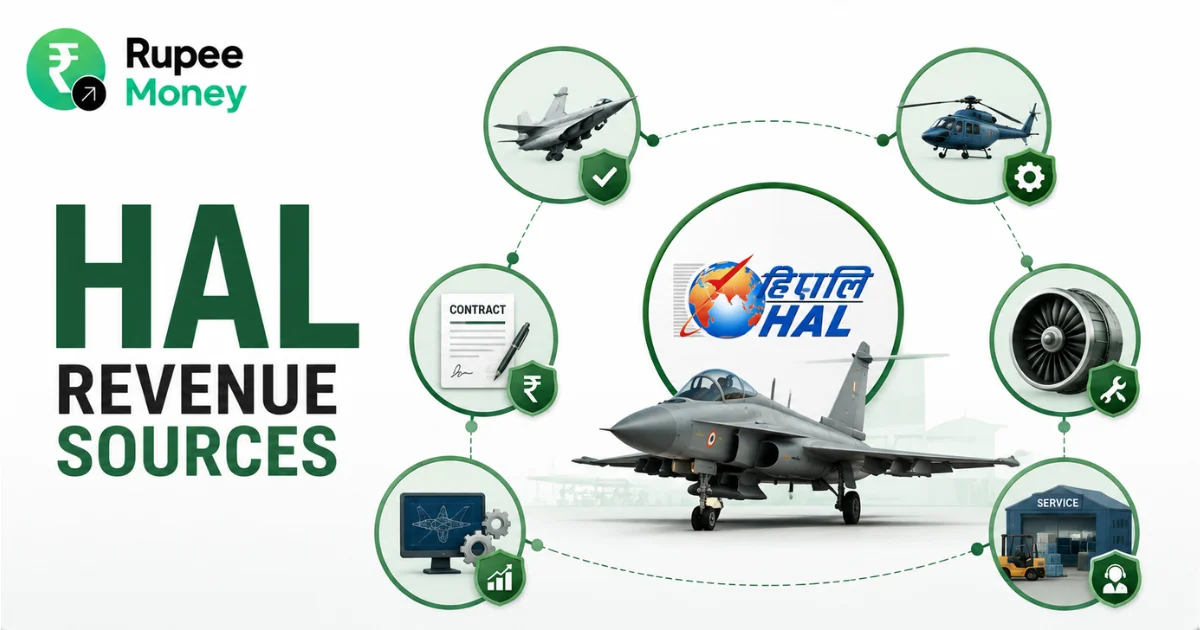
A fighter jet takes years to build. However, HAL does not wait years to receive cash.
This strategy forms a unique part of HAL’s business model. Hindustan Aeronautics Limited builds aircraft, helicopters, and jet engines. It also repairs and overhauls defence equipment throughout its operating life.
Defence customers pay advance money before HAL delivers finished aircraft. This funding model helps HAL operate without heavy bank debt.
At the RupeeMoney. We simplify corporate business models for Indian retail investors.
HAL reported ₹33,050 crore in operating revenue during FY2026. Its total order book reached a record ₹2,54,538 crore in March 2026.
Let us analyze how HAL generates income and funds its massive aerospace projects.
What Does Hindustan Aeronautics Limited (HAL) Do?
Hindustan Aeronautics Limited is India’s premier aerospace and defence manufacturer. The Government of India owns HAL under the Ministry of Defence.
The company designs, develops, manufactures, and maintains aerospace platforms.
Its product portfolio covers major defence sectors:
- Fighter jets and trainer aircraft
- Military and utility helicopters
- Aircraft engines and spares
- Avionics and digital flight controls
- Structural upgrades and modifications
- Repair and Overhaul (ROH) services
- Space launch vehicle hardware
Key aircraft platforms include the LCA Tejas Mk-1A, HTT-40 trainer, Sukhoi-30MKI, and Dornier-228. Its helicopter lineup features Dhruv, Rudra, LCH Prachand, and Light Utility Helicopters.
Investors tracking defence PSUs often analyze blue-chip stock fundamentals through large cap mutual funds.
Primary HAL Revenue Sources in FY2026
HAL earns money through two main operational activities: manufacturing new equipment and providing lifecycle maintenance.
FY2026 Revenue Breakdown
| Revenue Source | FY2026 Revenue |
| Manufacturing | ₹9,227 crore |
| Repair and Overhaul (ROH) | ₹20,524 crore |
| Total Revenue from Operations | ₹33,050 crore |
| Export Revenue (Included in Total) | ₹501 crore |
Manufacturing revenue grew significantly in FY2026. Deliveries of Advanced Light Helicopters and jet engines supported this growth.
However, Repair and Overhaul (ROH) remains HAL’s largest revenue contributor.
1. How HAL Earns Money from Aircraft Manufacturing
Aircraft manufacturing forms HAL’s most visible business segment. HAL manufactures fighter aircraft and basic trainers for the Indian Armed Forces.
The Light Combat Aircraft (LCA) Tejas programme drives manufacturing growth. HAL inaugurated new production lines to accelerate LCA Tejas Mk-1A deliveries.
It also builds Sukhoi-30MKI fighters and Dornier transport planes under production licenses. HAL recognizes manufacturing revenue upon achieving contracted delivery milestones.
Individual aircraft contracts involve large order values. Expanding indigenous platform manufacturing improves HAL’s overall profit margins over time.
2. Helicopter Production Drives Defence Revenue
Helicopters represent another massive revenue generator for HAL. HAL manufactures Dhruv, Rudra, LCH Prachand, and Light Utility Helicopters.
These helicopters serve the Indian Army, Air Force, Navy, and Coast Guard. HAL constantly expands its helicopter assembly capacity.
For example, HAL inaugurated a new LCH Prachand production line recently. It also delivered maritime role helicopters to the Indian Coast Guard.
Helicopter manufacturing provides steady, multi-year revenue streams for the company.
3. Engine Manufacturing and Maintenance Income
Aircraft engines form a critical part of the aerospace supply chain. HAL manufactures jet engines under international technology transfers and indigenous programmes.
During FY2026, AL-31FP and RD-33 engine deliveries boosted manufacturing income. These engine deliveries offset temporary delays in certain aircraft assembly schedules.
Diversified engine manufacturing protects HAL from single-programme delays. Engine sales ensure continuous operational cash flows for the manufacturing division.
4. Repair and Overhaul (ROH) Serves as the Largest Revenue Driver
Repair and Overhaul (ROH) represents HAL’s single largest source of operating revenue. In FY2026, ROH generated ₹20,524 crore.
Military aircraft require continuous maintenance throughout their 30-year operational lives. Jet engines need periodic servicing, component replacements, and complete overhauls.
HAL operates dedicated servicing facilities across India. Aircraft manufacturing generates a one-time sale. However, maintenance services generate recurring revenue for decades.
This recurring demand makes ROH strategically vital for HAL’s financial stability.
To evaluate how efficiently HAL uses its operating assets, investors calculate Return on Assets (ROA).
5. Revenue from Aircraft Upgrades and Avionics
Defence forces upgrade existing aircraft instead of purchasing new fleets immediately. Upgrades extend aircraft service life at a lower cost.
HAL earns revenue by upgrading radar systems, avionics, and mission computers. It executed upgrade programmes for Jaguar and Mirage fighter fleets.
HAL also manufactures sophisticated flight controls, cockpit displays, and electronic warfare suites. Internal avionics development increases profit margins across upgrade contracts.
6. Expanding Space Business and Aerospace Exports
HAL supplies specialized structural hardware to India’s space ecosystem. It manufactures heat shields, nose cones, and propellant tanks for ISRO rockets.
HAL signed technology transfer agreements for Small Satellite Launch Vehicle (SSLV) manufacturing. It also supplied structural hardware for recent heavy-lift LVM3 rocket missions.
Export revenue reached ₹501 crore in FY2026. HAL exports helicopters, structural components, and engine parts globally.
Its partnership with Safran Aircraft Engines covers production for LEAP engine rotating parts. LEAP engines power commercial Airbus A320neo and Boeing 737 MAX jets.
How HAL Funds Operations Without Bank Debt
Aerospace manufacturing requires massive upfront working capital. Building an aircraft takes many months of continuous work. However, HAL operates without traditional bank loans. Defence customers pay advance payments and milestone-linked installments during production. HAL uses customer cash to finance raw material purchases and assembly operations. Accounting rules treat these advances as contract liabilities until final delivery. Customer-funded liabilities create financial leverage without bank interest expenses. This structure reduces external capital requirements and boosts return on equity.
Why Customer Advances Matter for HAL Investors
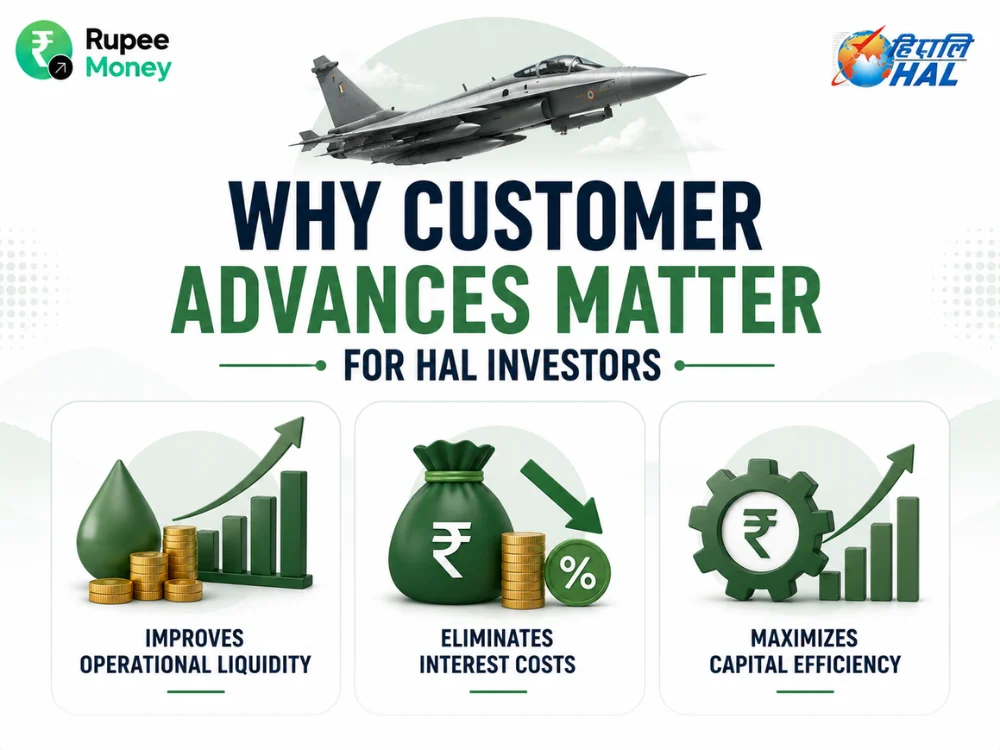
Customer advances provide three core financial benefits:
- Improves Operational Liquidity: HAL receives cash before completing long-duration projects.
- Eliminates Interest Costs: The company avoids expensive bank borrowings for working capital.
- Maximizes Capital Efficiency: Customer funds support active production lines smoothly.
Investors should monitor contract liabilities alongside quarterly revenue growth. Rapidly rising liabilities without revenue growth can indicate project execution delays.
Why HAL’s Record Order Book Drives Future Growth
HAL entered FY2027 with an order book of ₹2,54,538 crore. It received fresh orders worth ₹97,028 crore during FY2026.
Major new orders include 97 LCA Tejas Mk-1A jets for the Indian Air Force. A massive order book offers long-term revenue visibility.
However, HAL must execute orders efficiently to turn contract liabilities into realized revenue.
Young investors building long-term portfolios can explore disciplined wealth creation in building wealth in your 20s.
Evaluating HAL Market Valuation and Investment Risks
Investors must evaluate potential operational risks alongside order book growth:
- Global Supply Chain Disruptions: Delays in imported raw materials can slow aircraft assembly schedules.
- Execution Timelines: Converting order book liabilities into realized revenue requires strict schedule adherence.
- Single-Customer Concentration: The Indian Armed Forces represent HAL’s primary customer base.
To evaluate corporate valuations across listed PSUs, review how is market capitalization calculated.
If you plan to invest systematically in fundamental growth stocks, project your compounding using our SIP Calculator.
To estimate potential returns on one-time stock investments, use our Lumpsum Calculator.
Compare equity investment returns against safe fixed-income assets using our online FD Calculator.
Key Takeaways
- HAL earns revenue from aircraft manufacturing, helicopters, engines, avionics, and space hardware.
- Repair and Overhaul (ROH) represents HAL’s largest and most profitable revenue stream.
- Defence customers pay advance payments that fund manufacturing operations without bank debt.
- A record order book of ₹2,54,538 crore provides multi-year revenue visibility.
- Timely project execution remains critical for converting order liabilities into realized revenue.
Conclusion
Hindustan Aeronautics Limited operates a resilient defence business model. While new aircraft manufacturing drives top-line visibility, Repair and Overhaul services deliver massive recurring cash flow.
Customer advances allow HAL to fund multi-year aerospace projects without debt. A record order book secures long-term revenue visibility for the company.
Investors should monitor order execution schedules, margin stability, and contract liabilities when analyzing HAL’s financial growth.
Before buying individual defence stocks, review key primary market concepts like what is an IPO to understand public market equity listings.
Frequently Asked Questions:
How does HAL make money in simple terms?
HAL makes money by manufacturing military aircraft, helicopters, jet engines, and space hardware. It also earns recurring revenue by repairing, overhauling, and upgrading defence platforms.
What is HAL’s largest revenue stream?
Repair and Overhaul (ROH) services form HAL’s largest revenue stream. ROH generated ₹20,524 crore in FY2026 compared to ₹9,227 crore from new manufacturing operations.
How does HAL operate without traditional bank debt?
HAL receives advance payments and milestone funding directly from defence customers. HAL uses this cash to finance manufacturing operations without taking commercial bank loans.
What is HAL’s current order book size?
HAL’s order book touched a record ₹2,54,538 crore at the end of March 2026. Fresh orders included 97 LCA Tejas Mk-1A aircraft for the Indian Air Force.
Disclaimer: This article is strictly for educational and informational purposes. Financial figures and order book disclosures reflect publicly available data as of 2026. Conduct independent research before making investment decisions.
ABOUT THE AUTHOR

