
How Does HDFC Bank Make Money? HDFC Bank Business Model and Revenue Streams
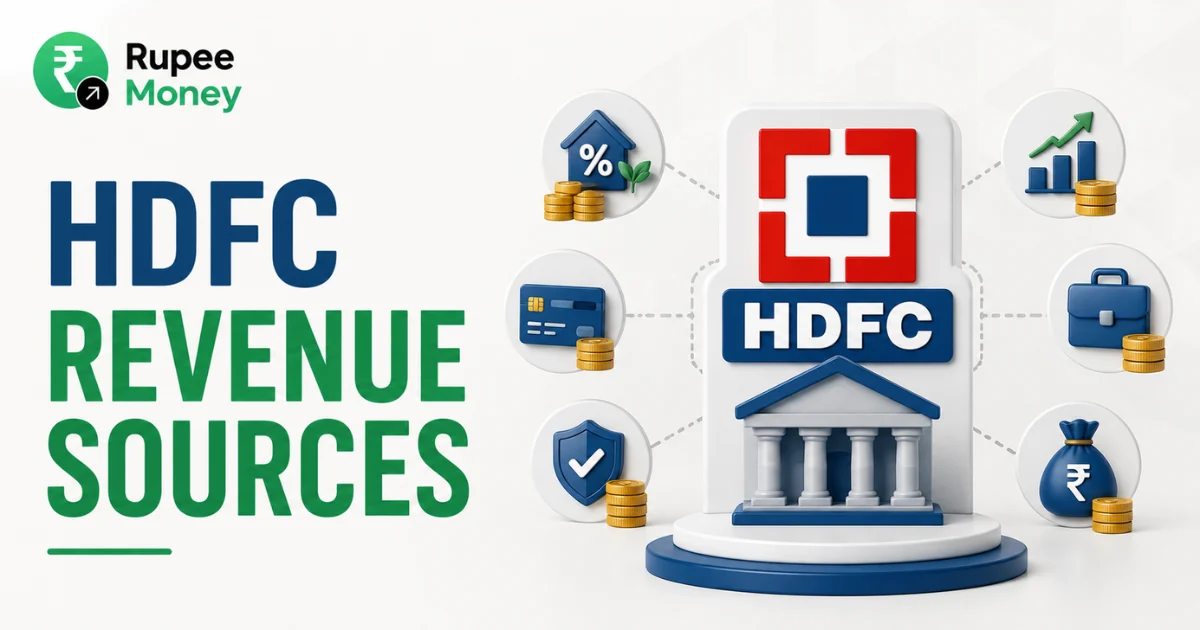
Millions of Indians interact with HDFC Bank every single day. They deposit savings, pay utility bills, swipe credit cards, and take home loans.
However, many people wonder how HDFC Bank earns thousands of crores in profit every year. The answer extends far beyond charging simple interest on personal loans.
HDFC Bank operates multiple revenue streams across diverse financial sectors. This strategy makes it one of India’s most profitable private banks.
At RupeeMoney, we break down financial concepts to help you understand how India’s top institutions create value. Macroeconomic shifts impact central bank interest rates directly. You can read our guide on what is inflation and why does it matter to see how inflation shapes banking interest margins.
In this guide, you will discover the primary sources of HDFC Bank income, its post-merger profit engine, and its digital growth drivers.
What Services Does HDFC Bank Provide?
Before examining how HDFC Bank generates revenue, let us review its primary business activities. HDFC Bank provides comprehensive financial services to retail consumers, small businesses, and large corporations.
Key service categories include:
- Consumer savings accounts and current accounts
- Term deposits and fixed income products
- Personal, home, vehicle, and education loans
- Commercial lending and working capital facilities
- Credit cards, debit cards, and UPI payment gateways
- Treasury management and foreign exchange services
- Wealth management and investment advisory
- Insurance policy and mutual fund distribution
Each operational division contributes directly to total operating revenue.
How HDFC Bank Earns Interest Income
Interest income forms the core foundation of HDFC Bank’s financial model.
The underlying mechanism remains straightforward:
- The bank accepts deposits from retail and corporate customers.
- The bank pays a lower interest rate on these deposits.
- The bank lends capital to qualified borrowers at higher interest rates.
The spread between interest earned on loans and interest paid on deposits defines Net Interest Income (NII).
Net Interest Income (NII) = Total Interest Earned on Assets – Total Interest Paid on Liabilities
For example, savings accounts earn modest annual interest rates. Meanwhile, unsecured personal loans carry higher interest charges due to credit risk.
Loan interest rates depend heavily on benchmark structures. Read our analysis on choosing between a fixed vs floating interest rate to understand how banks structure long-term debt.
Net Interest Income contributes the vast majority of HDFC Bank’s net operating revenue. Following its mega-merger with HDFC Limited, long-term mortgage assets expanded its total loan book significantly.
To estimate your monthly installments before applying for credit, try our online Home Loan Calculator.
How Deposits and Loans Fuel HDFC Bank Revenue
Customer deposits provide the primary capital source for HDFC Bank’s lending operations.
Deposit accounts fall into four main categories:
- Savings Accounts
- Current Accounts
- Fixed Deposits
- Recurring Deposits
Current Account and Savings Account (CASA) deposits remain highly valuable for the bank. CASA balances carry significantly lower funding costs compared to long-term fixed deposits. Low-cost CASA capital allows the bank to maintain healthy Net Interest Margins (NIM).
To learn how small savers build disciplined wealth through bank deposits, explore our guide on recurring deposit (RD).
Before issuing loans, the bank evaluates credit risk, income stability, and repayment capacity. Learn what underwriters check by reviewing what affects your loan eligibility.
To calculate potential returns on fixed-term deposits, try our easy-to-use FD Calculator.
How HDFC Bank Earns Money from Credit Cards and Retail Banking
HDFC Bank stands as one of India’s top credit card issuers. Its card division generates substantial non-interest income through distinct channels:
- Interest on Revolving Balances: Customers who roll over unpaid monthly balances pay interest charges on outstanding debt.
- Merchant Discount Rate (MDR): Whenever cardholders purchase goods online or in physical stores, merchants pay transaction processing fees.
- Annual Fees and Service Charges: Premium credit cards generate revenue through annual renewal fees, joining fees, late payment charges, and cash advance fees.
Beyond credit cards, retail banking collects service fees from processing demand drafts, locker rentals, account maintenance, forex transactions, and debit card issuances.
To evaluate short-term borrowing costs before taking personal or retail credit, use our EMI Calculator.
How HDFC Bank Generates Fee and Commission Income
Fee-based revenue strengthens total bank profitability without expanding balance sheet risk. HDFC Bank collects processing fees and service commissions across multiple operations:
- Loan processing fees and documentation charges
- Credit and debit card annual service fees
- Trade finance and cash management service fees
- Foreign exchange and cross-border remittance charges
- Demat account and investment management services
Additionally, HDFC Bank acts as a distributor for third-party financial products, including life, health, and general insurance policies, alongside mutual fund schemes.
The bank collects distribution commissions directly from asset management companies and insurance underwriters.
To understand the core protection products distributed by retail banks, read our guide explaining what is health insurance.
How HDFC Bank Earns Revenue from Treasury Operations
HDFC Bank’s treasury department manages investment assets, liquidity reserves, and financial market risks.
Treasury teams allocate capital into regulatory and market instruments:
- Central and state government securities
- Short-term treasury bills
- High-grade corporate bonds
- Money market instruments
Treasury specialists manage interest rate risk and foreign currency exposure. Trading gains from bond sales and currency markets provide supplementary income.
To understand sovereign debt instruments held in bank portfolios, read our article on government securities in India.
How Digital Banking and Payment Solutions Drive Revenue
Digital transformation reshapes modern banking operations across India. Millions of retail customers use HDFC Bank’s mobile application, net banking portal, and UPI infrastructure daily.
Digital channels generate non-interest revenue through specialized channels:
- Merchant payment gateway infrastructure
- Corporate cash management platforms
- Cross-border digital remittances
- Commercial merchant processing solutions
High digital adoption lowers transaction costs, improving overall operational efficiency.
Other Revenue Streams of HDFC Bank
HDFC Bank relies on a diversified business strategy to maintain stable earnings across changing market cycles:
- Wealth Management: Collects advisory fees from high-net-worth clients for portfolio management.
- Mutual Fund Distribution: Earns distribution commissions from asset management companies for facilitating retail mutual fund investments.
- Corporate Banking Services: Generates interest income and fee revenue from trade credit, working capital loans, and corporate payroll management.
This diversified model protects the bank’s profitability when an individual business segment faces temporary economic pressure.
Core Drivers of HDFC Bank Profit Growth
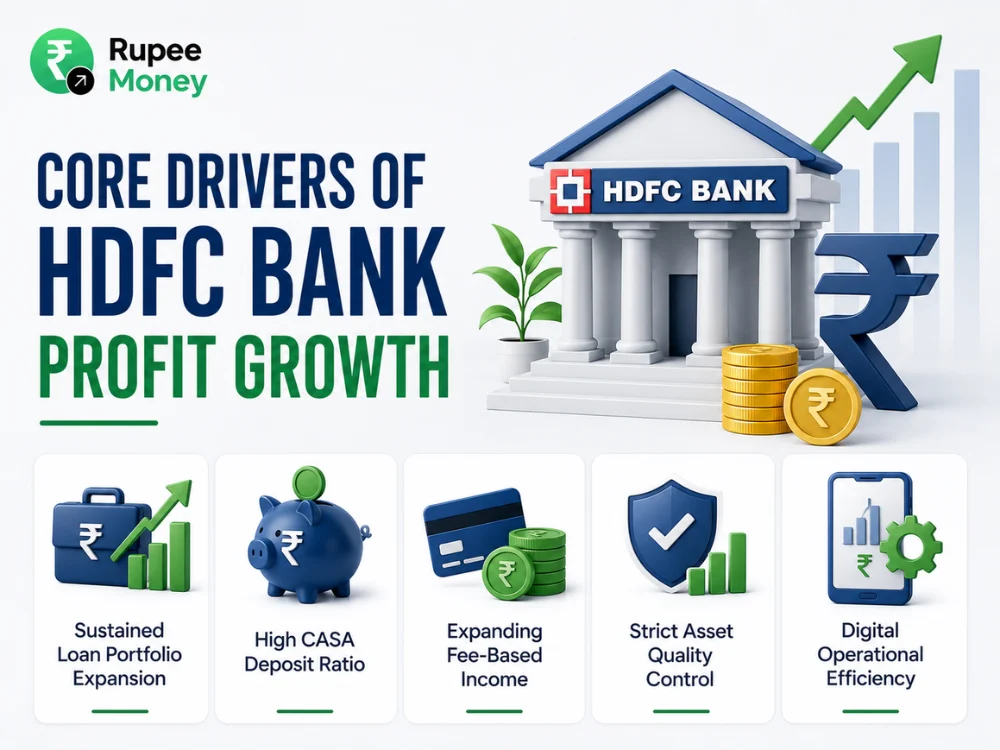
Long-term profit growth depends on specific operational strengths:
- Sustained Loan Portfolio Expansion: Higher lending volumes increase total interest collections.
- High CASA Deposit Ratio: Low-cost deposits reduce overall cost of capital, expanding net interest margins.
- Expanding Fee-Based Income: Regular fee collections from cards, payments, and wealth services create steady non-interest cash flow.
- Strict Asset Quality Control: Controlling Non-Performing Assets (NPAs) minimizes credit losses and bad debt provisions.
- Digital Operational Efficiency: Automation reduces branch handling expenses, increasing net operating margins.
Risks Facing the HDFC Bank Business Model
Like all commercial banks, HDFC Bank faces clear operational and macroeconomic risks:
- Interest Rate Volatility: Rapid rate changes can compress interest margins or reduce borrowing demand.
- Credit Default Risk: Economic downturns may cause borrower defaults, increasing bad loan provisions.
- Regulatory Compliance Updates: Reserve Bank of India (RBI) mandates regarding capital reserves or lending caps can alter operational margins.
- Market Competition: Fintech platforms, public sector banks, and specialized lenders compete aggressively for retail deposits and loan market share.
Summary Key Takeaways
- Interest earned on loans represents HDFC Bank’s primary source of revenue.
- Net Interest Income (NII) forms the main foundation of net operating income.
- Low-cost CASA deposits keep funding costs low, supporting healthy net interest margins.
- Credit cards, merchant processing, and third-party fee commissions deliver strong non-interest income.
- Treasury operations generate investment income while managing liquidity and market risk.
Conclusion
Understanding the HDFC Bank business model reveals how modern financial institutions generate sustainable profits. While retail and corporate lending drive core interest income, diversified fee operations, treasury investments, credit card processing, and digital payments strengthen long-term profitability.
This multi-stream strategy mitigates economic risks and supports consistent financial performance. Evaluating how a bank earns income, manages asset quality, and scales digital operations helps investors make informed financial decisions.
Frequently Asked Questions:
How does HDFC Bank make money in simple terms?
HDFC Bank earns money primarily through the interest spread between customer deposits and loan disbursements. It also generates revenue from credit card fees, merchant processing, wealth management, insurance commissions, and treasury investments.
What is Net Interest Income (NII) in banking?
Net Interest Income represents the difference between the total interest a bank earns on its loans and investments and the total interest it pays out to depositors. NII serves as the primary revenue metric for commercial banks.
How does HDFC Bank earn money from credit cards?
HDFC Bank earns credit card income from revolving interest charges on unpaid monthly balances, annual card membership fees, late payment charges, and Merchant Discount Rate (MDR) processing fees collected from merchants.
Does HDFC Bank make money by selling insurance and mutual funds?
Yes. HDFC Bank acts as a corporate agent and distributor for partner insurance firms and mutual fund houses. The bank earns distribution commissions on financial products sold through its branches and digital channels.
Disclaimer: This article is strictly for educational and informational purposes. Financial figures and business operations reflect publicly available disclosures as of 2026. Conduct independent research or consult a certified financial advisor before making investment decisions.
ABOUT THE AUTHOR

