
What Is Free Float Market Capitalisation? Meaning, Formula and Why It Matters

Have you ever wondered why some companies carry more weight in the Nifty 50 than others? The answer often comes down to Free Float Market Capitalisation, not total company size. Two companies can have identical market values, yet influence the index very differently.
Do you follow index and stock market updates on RupeeMoney? You’ve probably seen this term mentioned in Nifty and Sensex discussions regularly. Understanding it helps you read index movements and stock weightage far more accurately.
This guide explains what Free Float Market Capitalisation means, how exchanges calculate it, and why it genuinely matters to Indian investors today.
What Is Free Float Market Capitalisation?
Free Float Market Capitalisation measures the value of only those shares available for public trading. It excludes shares held by promoters, the government, and other strategic or locked-in holders. In simple words, it represents the portion of a company genuinely up for grabs on the open market.
Regular market capitalisation works differently. It counts every single outstanding share, including promoter and locked-in holdings. Free float strips those out, focusing purely on shares that actually change hands regularly.
How Do Exchanges Calculate Free Float Market Capitalisation?
The calculation happens in two simple steps.
First, exchanges determine the Free Float Factor, a decimal representing the public’s actual share of total equity. NSE calls this the Investible Weight Factor, or IWF. Both NSE and BSE calculate it using quarterly shareholding patterns companies file under SEBI regulations.
The formula looks like this: Free Float Factor = (Total Outstanding Shares − Excluded Shares) ÷ Total Outstanding Shares. Excluded shares typically cover promoter holdings, government stakes, and other locked-in shares that rarely trade.
Once you have that factor, the final calculation is straightforward: Free Float Market Capitalisation = Full Market Capitalisation × Free Float Factor.
Here’s a practical example. Say a company has a full market cap of ₹2 lakh crore, with promoters holding 70% of equity. Its free float market cap works out to just ₹60,000 crore. Compare that to a smaller company worth ₹1 lakh crore, with promoters holding only 30%. Its free float market cap reaches ₹70,000 crore instead, actually higher than the bigger company’s. This is exactly why total size and index weightage don’t always line up.
SEBI also enforces a Minimum Public Shareholding rule here, generally requiring listed companies to keep at least 25% of equity in public hands. This rule protects genuine liquidity and keeps price discovery honest across the market.
Free Float Market Capitalisation vs Market Capitalisation
Many beginners confuse these two terms, since they sound quite similar. They actually serve genuinely different purposes.
| Basis | Free Float Market Capitalisation | Market Capitalisation |
| Includes promoter shares | No | Yes |
| Includes public shares | Yes | Yes |
| Used for index calculation | Yes | Rarely |
| Shows tradable company value | Yes | No |
| Used by Nifty 50 and Sensex | Yes | No |
In simple words, market capitalisation measures the value of all outstanding shares together. Free Float Market Capitalisation measures only shares actually available for public trading.
Advantages of Free Float Market Capitalisation
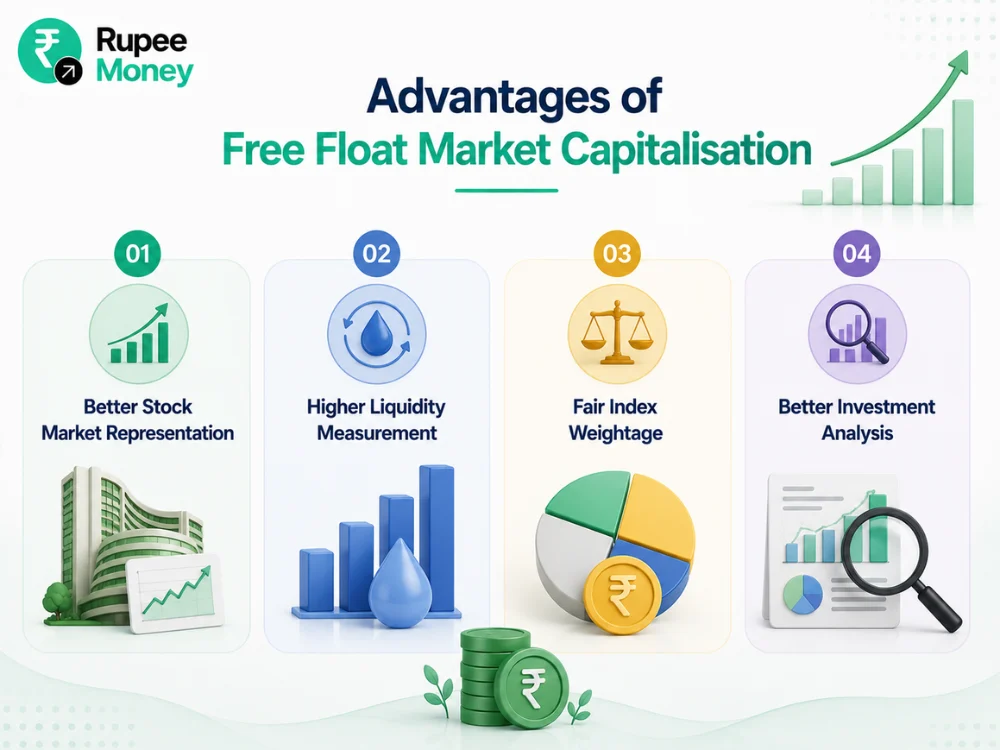
This method has become the genuine global standard, since it reflects real market conditions accurately. Major providers like MSCI, FTSE, S&P, and Dow Jones all use this same approach today.
Better Stock Market Representation
The calculation considers only actively traded shares specifically. This makes market indices genuinely more accurate representations of real trading activity.
Higher Liquidity Measurement
Companies with more public shareholding generally see stronger trading volumes too. Free float captures this liquidity difference far more effectively than raw market cap does.
Fair Index Weightage
A company with very high promoter ownership can’t dominate an index purely through total value. This keeps Nifty 50 weightage genuinely tied to tradable shares, not paper size.
Better Investment Analysis
Investors gain a clearer sense of how much equity actually sits available for trading. This helps you judge real liquidity before committing money to a stock.
Limitations of Free Float Market Capitalisation
This method offers real advantages, but it carries certain limitations too.
It ignores total company ownership. A company may carry a very high total market value, yet have relatively low free float, simply because promoters hold most shares.
Public shareholding can shift constantly. Promoters may sell shares or raise their holdings over time. Such changes directly affect free float market capitalisation, requiring regular recalculation by exchanges.
It’s not the only factor for investment decisions. Free float alone can’t determine whether a stock makes a good investment. You should also weigh revenue growth, profitability, and debt levels together. Corporate governance, industry outlook, and future growth plans matter just as much. Metrics like Return on Assets round out a genuinely complete picture here.
Why Investors Should Know About Free Float Market Capitalisation
You don’t need to calculate free float market capitalisation every single time you buy a stock. Understanding the concept, though, genuinely helps you make sharper investment decisions.
It helps you understand why certain companies carry higher weightage in the Nifty 50 and Sensex. It lets you compare companies more accurately, beyond just headline market cap. It also teaches you how stock market indices actually get built and rebalanced. Analysing liquidity before investing becomes far easier too, once you grasp this concept. You’ll also understand why some stocks move the overall market more than others do. Even long-term investors genuinely benefit from knowing how these indices work under the hood. Once you understand these stock market fundamentals, it’s worth exploring how SIP investing lets you gain exposure to index-weighted companies without picking individual stocks yourself.
Key Takeaways
- Free Float Market Capitalisation measures only shares available for public trading.
- It excludes promoter holdings, government stakes, and other locked-in shares.
- NSE and BSE both use this method to calculate major stock market indices.
- Nifty 50 and Sensex both follow the free float methodology, using NSE’s Investible Weight Factor.
- SEBI requires listed companies to maintain at least 25% minimum public shareholding.
- It provides a more realistic measure of market influence than total market capitalisation.
- Combine this metric with proper financial analysis before making any investment decision.
Frequently Asked Questions (FAQs)
What is Free Float Market Capitalisation in simple words?
It’s the total market value of shares investors can freely buy and sell on an exchange. It excludes promoter holdings and other restricted shares that rarely trade. This approach gives a more realistic picture of a company’s actual market presence.
Why do Nifty 50 and Sensex use Free Float Market Capitalisation?
Because it reflects the value of shares genuinely available for trading. If indices used total market capitalisation instead, companies with very high promoter ownership could get excessive weightage, despite limited public participation. The free float method creates a more balanced, practical index.
What is the difference between Market Capitalisation and Free Float Market Capitalisation?
Market Capitalisation considers all outstanding shares, including promoter holdings. Free Float Market Capitalisation includes only shares available for public trading. As a result, free float gives a more accurate measure for index construction and liquidity analysis.
Does Free Float Market Capitalisation affect stock prices?
Not directly, no. It does, though, affect a company’s weight in indices like the Nifty 50 and Sensex. Stocks with higher free float generally see better liquidity, which makes buying and selling considerably easier.
Should beginners learn Free Float Market Capitalisation?
Yes, genuinely. It explains how major stock market indices actually work, and why some companies influence the market more than others. It also helps you interpret market movements more confidently while comparing listed companies.
Conclusion
Free Float Market Capitalisation gives you a genuinely more accurate lens on a company’s real market presence than total market cap alone. It shapes index weightage, reflects true liquidity, and helps you compare companies more fairly. If you’re building your broader investing knowledge, Building Wealth in Your 20s pairs well with concepts like this one. Once you understand these fundamentals, try the SIP Calculator to estimate how regular investments could grow over time, the Lumpsum Calculator for a one-time investment, or the FD Calculator to compare equity investing against a fixed-income alternative.
Disclaimer
This article is intended for educational and informational purposes only. Investing in the stock market involves market risk. Free Float Market Capitalisation is only one factor to consider while analysing a company. Always conduct your own research or consult a qualified financial advisor before making any investment decisions.
ABOUT THE AUTHOR

