
What Is the Nifty 50 and Why Does It Matter to Investors?
When people discuss the Indian stock market, two names come up first. The Nifty 50 and the Sensex. If the Nifty rises, headlines say the market closed higher. If it falls sharply, investors assume a weak day. But what exactly is the Nifty 50, and why does it get so much attention?
If you follow finance updates on RupeeMoney, you’ve likely seen the Nifty 50 mentioned often. It shows up in stock market news, mutual fund performance, and investment discussions. Understanding this index helps you read the market’s overall direction. You won’t need to track hundreds of individual companies.
This guide explains what the Nifty 50 is, how it works, and how it’s calculated. You’ll also learn why every investor should understand its importance.
What Is the Nifty 50?
The Nifty 50 is the benchmark stock market index of the National Stock Exchange (NSE). It represents 50 of the largest, most actively traded companies listed on the NSE.
These companies span different sectors of the Indian economy. Think banking, IT, energy, autos, pharma, FMCG, telecom, financial services, and manufacturing.
Instead of following hundreds of stocks individually, investors use the Nifty 50 as a quick market indicator. If most Nifty companies gain value, the index generally moves higher. If major companies decline, the Nifty usually falls too. This makes it one of India’s most widely followed performance indicators.
Why Was the Nifty 50 Created?
India has thousands of listed companies. Tracking every single stock would overwhelm most investors.
The Nifty 50 simplifies this problem. It represents a carefully selected group of large companies across different sectors.
The index helps you measure overall market performance and compare your portfolio returns. It also helps you track economic trends and evaluate mutual fund performance. Many investors use it to build passive investment strategies too. These companies account for a large share of total NSE trading value. This gives the Nifty a reliable picture of the broader equity market.
How Is the Nifty 50 Calculated?
The Nifty 50 uses the Free Float Market Capitalisation method. This method considers only shares available for public trading. It excludes shares held by promoters, government bodies, strategic investors, and company management.
The calculation follows four basic steps. First, calculate each company’s free float market cap. Second, combine the free float values of all 50 companies. Third, divide the total using a predefined index divisor. Finally, this generates the Nifty index value.
Larger companies carry higher free float market capitalisation. This gives them a bigger impact on index movement. If a large banking company rises sharply, it can move the Nifty more than several smaller companies combined.
Which Companies Make Up the Nifty 50?
The Nifty 50 consists of large-cap companies from different industries. This list changes periodically. Even so, it generally includes leading names from banking and financial services. IT, energy, FMCG, autos, and pharma feature heavily too, alongside telecom, metals, and consumer goods.
The composition shifts whenever companies fail to meet eligibility criteria. Stronger companies then qualify for inclusion instead. This periodic review keeps the index relevant to India’s changing economy.
Who Decides the Nifty 50 Companies?
NSE Indices Limited selects the companies in the Nifty 50. It uses predefined eligibility criteria for this process.
The selection weighs free float market capitalisation and liquidity. Trading frequency, listing history, and sector representation matter too.
This review happens periodically. Companies that no longer meet requirements may leave the index. New qualifying companies replace them instead. This keeps the Nifty representing India’s strongest, most actively traded businesses.
Why the Nifty 50 Matters to Investors
The Nifty 50 is more than a number on a screen. It plays a real role in investment decisions. Here’s why investors follow it so closely.
It Shows Overall Market Direction
The Nifty reflects the combined performance of India’s largest listed companies. Consistent gains usually signal positive investor confidence. A sharp decline may point to weak market sentiment instead. Individual stocks can move differently, but the Nifty still offers a useful market snapshot.
It Helps Compare Investment Performance
Many investors compare their own returns against the Nifty. Say your portfolio earned 10% over one year. If the Nifty delivered 15% in that same period, you underperformed the market. If your portfolio returned 18%, you beat the benchmark instead. This comparison helps you judge whether your strategy actually works.
It Supports Passive Investing
Many mutual funds and ETFs simply aim to match Nifty performance. These products are called index funds. Rather than picking individual stocks, they invest across the same 50 companies. This approach offers diversification with relatively low management costs. Many investors use SIPs to invest regularly in these Nifty index funds.
Nifty 50 and the Indian Economy
The Nifty includes companies from sectors that shape India’s economy significantly. As these businesses grow and improve profitability, the index often reflects that progress.
Still, the Nifty doesn’t represent every listed company. It mainly covers India’s large-cap segment. Mid-cap and small-cap companies can perform quite differently during certain cycles. Treat the Nifty as an important benchmark, not a complete picture of the entire market.
Factors That Move the Nifty 50
Several economic and business factors shape the Nifty each trading day. Corporate earnings and RBI monetary policy matter a lot here. Understanding what the repo rate means helps explain how RBI decisions ripple through the index. Inflation and interest rates play a role too, alongside global market performance.
Foreign and Domestic Institutional Investor activity shifts the index constantly. Government policies and overall economic growth matter as well. Understanding what inflation is and why it matters adds useful context here too. Investor sentiment rounds out the list. Since these factors keep changing, the Nifty moves throughout every trading session.
Nifty 50 vs Sensex
The Nifty 50 and Sensex are India’s two most popular indices. Both help investors read market performance. They differ in composition and which exchange they represent.
| Feature | Nifty 50 | Sensex |
| Stock Exchange | National Stock Exchange (NSE) | Bombay Stock Exchange (BSE) |
| Number of Companies | 50 | 30 |
| Calculation Method | Free Float Market Capitalisation | Free Float Market Capitalisation |
| Market Representation | Covers more companies across sectors | Represents 30 leading companies |
| Popular Use | Index funds, ETFs, derivatives | Common market benchmark |
Both indices reflect India’s leading companies. Our detailed guide on what the Sensex is and how it’s calculated covers the BSE side in full.
How Can Beginners Use the Nifty 50?
Many beginners assume they need to buy all 50 stocks to benefit. That’s simply not true. Several practical options exist instead.
Track market performance. Checking the daily Nifty movement helps you read overall sentiment. You can observe broader trends instead of reacting to single stocks.
Invest through index funds. These funds aim to replicate Nifty performance. Both include almost the same companies in nearly identical weightages. This suits investors who want diversification without picking individual stocks.
Invest through ETFs. Nifty-tracking ETFs trade on exchanges just like regular shares. You can buy and sell them anytime during market hours.
Compare portfolio returns. The Nifty works as a benchmark here. Compare your own performance against it to judge your strategy.
Advantages of Following the Nifty 50
The Nifty offers real benefits for investors. It gives a quick snapshot of the Indian stock market. Nifty 50 represents leading companies across multiple industries too. It helps you compare portfolio performance and supports passive investing through funds and ETFs. It cuts down the need to track hundreds of stocks individually. Nifty 50 reflects investor sentiment and broader economic trends, and stands as a widely accepted benchmark for equity investing.
Limitations of the Nifty 50
The Nifty remains an important benchmark, but it has real limits too.
It covers only large-cap companies. The index mainly represents large businesses. It doesn’t fully reflect mid-cap or small-cap performance.
Individual stocks can perform differently. A stock outside the Nifty may outperform it easily. Some Nifty companies can underperform even as the index rises.
The index changes over time. Companies enter and leave after periodic reviews. Don’t assume the current list stays fixed forever.
Market performance isn’t guaranteed. A rising Nifty doesn’t guarantee profits for everyone. Returns still depend on your allocation, timing, and stock selection.
Common Myths About the Nifty 50
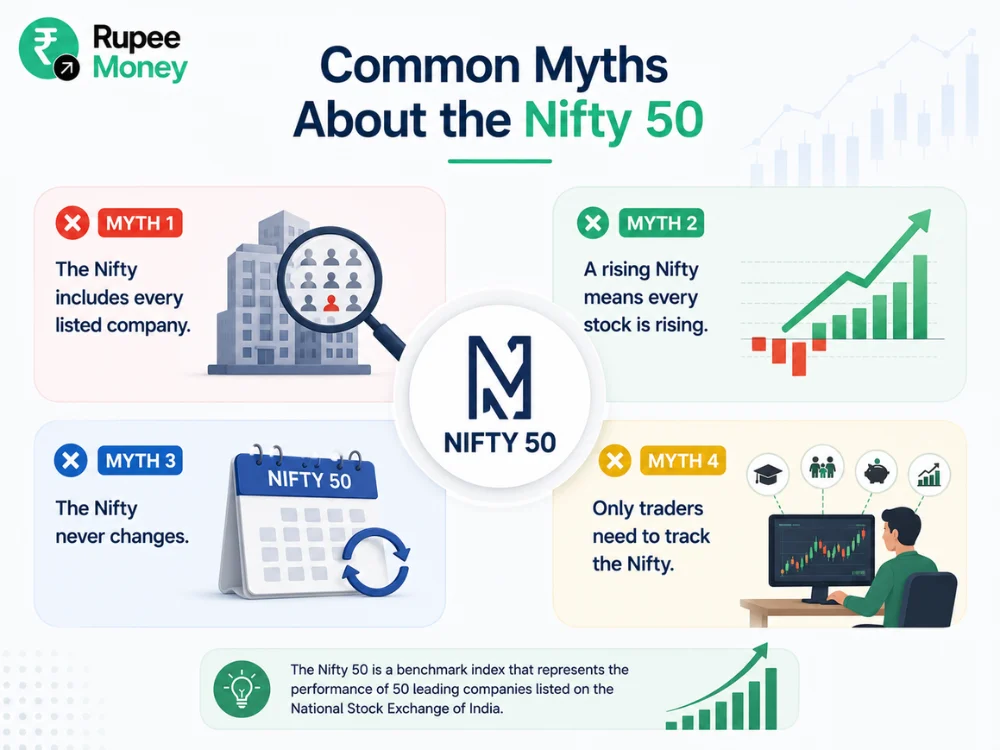
Beginners often misunderstand how the Nifty actually works.
Myth 1: The Nifty includes every listed company. No, it contains only 50 selected large-cap companies.
Myth 2: A rising Nifty means every stock is rising. Not necessarily. Some stocks can decline even as the Nifty climbs.
Myth 3: The Nifty never changes. Incorrect. NSE Indices reviews it periodically, replacing companies that no longer qualify.
Myth 4: Only traders need to track the Nifty. Long-term investors benefit too, since it helps them read trends and evaluate performance.
Key Takeaways
The Nifty 50 stands as one of India’s most important market indicators. It represents 50 large, actively traded companies on the NSE. The index helps you read market direction, compare investment performance, and build diversified strategies. Whether you invest through stocks, mutual funds, or ETFs, understanding the Nifty helps you decide better. Focus on it as a long-term benchmark rather than a source of daily anxiety.
Frequently Asked Questions (FAQs)
What is the Nifty 50 in simple words?
The Nifty 50 is the NSE’s benchmark stock index. It tracks 50 large, actively traded companies across different sectors. Investors use it to read the market’s overall direction without analysing every listed company individually.
Who manages the Nifty 50?
NSE Indices Limited manages it, reviewing the index periodically. It uses criteria like free float market capitalisation, liquidity, trading activity, and sector representation. Companies that no longer qualify get replaced by eligible ones.
Can I invest directly in the Nifty 50?
No. An index is only a market benchmark, so it cannot be purchased directly. You can invest in Nifty Index Funds or Nifty ETFs instead, which replicate the index by holding the same companies.
Why does the Nifty rise and fall daily?
The Nifty moves with the combined price changes of its 50 companies. Corporate earnings, economic growth, inflation, interest rates, RBI policy, global markets, and investor sentiment all drive these shifts.
Is the Nifty 50 suitable for beginners?
Yes. Beginners often use it as a benchmark to read market performance. Many first-timers also choose Nifty Index Funds, since they offer diversification without requiring individual stock picks.
Which is better, the Nifty or the Sensex?
Neither is universally better. Both track leading Indian companies and help measure market performance. The Nifty covers 50 NSE-listed companies, while the Sensex covers 30 BSE-listed ones. Many investors follow both together.
Conclusion
The Nifty 50 plays a central role in the Indian stock market. It reflects the performance of India’s leading companies. Fund managers, financial institutions, and everyday investors all trust it as a benchmark.
Understanding how the Nifty works helps you interpret market moves confidently. It also makes comparing investment products, like index funds and ETFs, much easier. For a broader look at how markets work, read our guide on how the stock market works in India. Building disciplined habits early matters too — our guide on building wealth in your 20s can help.
Instead of chasing daily market swings, use the Nifty as a long-term indicator. Focus on disciplined investing, diversification, and your own financial goals. You can estimate your own growth using our SIP Calculator or Lumpsum Calculator. Or explore a safer, government-backed route through our PPF Calculator.
Disclaimer: This article is intended for educational and informational purposes only. It does not provide investment, financial, legal, or tax advice. Investing in the stock market involves market risk, and historical performance should not be viewed as a guarantee of future returns. Always do your own research or seek advice from a qualified financial advisor before investing.
ABOUT THE AUTHOR

