
What Is a Demat Account? A Simple Guide for Beginners
If you’re planning to invest in the stock market, buy shares, apply for an IPO, or invest in government securities, the first thing you’ll actually need is a Demat Account. Gone are the days when investors held physical share certificates and worried constantly about loss, theft, or damage. Today, almost all securities in India are held electronically through a Dematerialised Account, making investing genuinely safer, faster, and more convenient.
Whether you’re a first-time investor or someone looking to understand the basics of the Indian stock market, knowing how a Demat Account actually works matters. It functions as a secure digital vault where your financial securities are stored, while letting you buy, sell, and transfer investments seamlessly.
At RupeeMoney, we believe understanding the foundation of investing is the real first step toward building long-term wealth. This guide explains what a Demat Account is, how it works, the roles of SEBI, NSDL, CDSL, and Depository Participants, what your DP ID and Client ID mean, and why opening a Demat Account matters before you start investing in India’s financial markets.
What Is a Demat Account?
A Demat Account, short for Dematerialised Account, is an electronic account used to hold financial securities in digital form. Instead of receiving paper share certificates, investors hold their shares, bonds, mutual funds, exchange-traded funds (ETFs), government securities, and other eligible investments securely inside a Demat Account.
Dematerialisation refers to the process of converting physical securities into electronic records. This system has genuinely simplified investing by eliminating paperwork and cutting out the risks that came with physical certificates.
A Demat Account has become essential for most stock market investing in India today. Whether you’re investing through the NSE, BSE, or applying for an IPO, your securities land directly in your Demat Account once allotment is confirmed.
What Is a Dematerialised Account?
A Dematerialised Account is simply another name for a Demat Account — both terms refer to the exact same account used to hold financial securities electronically.
Before dematerialisation existed, investors had to maintain physical certificates for every single investment. Buying or selling shares meant lengthy paperwork, manual transfers, and a genuinely higher risk of loss or forgery along the way.
With India’s electronic holding systems now run through the depositories, investors manage their investments entirely digitally. That’s made transactions quicker, more transparent, and considerably more secure than the old paper-based system ever was.
A Dematerialised Account doesn’t just store your investments — it also records every credit, debit, and transfer of securities, letting you track your holdings with real accuracy.
How Does a Demat Account Work?
A Demat Account works as a secure electronic repository for your investments. When you buy eligible securities through a registered broker, they get credited to your Demat Account after the settlement process completes. When you sell, they’re debited from your account and transferred to the buyer on the other side.
The general process runs like this: you open a Demat Account with a registered Depository Participant (DP), link it to a Trading Account and your bank account, place a buy or sell order through your trading platform, and once the trade executes and settles, securities are credited or debited electronically. You can monitor all your holdings anytime through your DP’s website or mobile app.
Because everything happens electronically, investors no longer need to worry about maintaining physical certificates or working through lengthy transfer procedures.
Role of SEBI, NSDL, CDSL and Depository Participants
Several organisations work together to keep India’s dematerialised investment system safe and running smoothly.
SEBI
The Securities and Exchange Board of India (SEBI) is the country’s capital market regulator. It sets the rules that protect investors, regulate intermediaries, and ensure transparency across the securities market — overseeing stock exchanges, depositories, brokers, and other market participants to keep the system fair and efficient.
NSDL
The National Securities Depository Limited (NSDL) is one of India’s two central securities depositories. It maintains electronic records of securities, letting investors hold investments safely in digital form, and works through authorised Depository Participants to actually deliver Demat Account services to investors nationwide.
CDSL
The Central Depository Services (India) Limited (CDSL) is the second authorised depository in India. Like NSDL, it provides secure electronic holding and transfer facilities through registered Depository Participants, ensuring smooth settlement of every securities transaction that runs through it.
Depository Participant (DP)
A Depository Participant (DP) acts as the intermediary between investors and the two depositories — NSDL and CDSL. Banks, stockbrokers, and financial institutions registered with SEBI can operate as DPs, and investors open their Demat Accounts through them, receiving account maintenance, transaction processing, and customer support in the process. Choosing a reliable DP genuinely matters, since it directly shapes your everyday investing experience.
What Are DP ID and Client ID in a Demat Account?
Every Demat Account carries unique identification numbers that identify both the Depository Participant and the individual investor.
Your DP ID is the unique identification number assigned to your Depository Participant by either NSDL or CDSL — it identifies the specific institution through which your Demat Account is maintained.
Your Client ID is a unique number your Depository Participant assigns specifically to you as an investor.
Together, your DP ID and Client ID form your complete Demat Account number. These identifiers ensure accurate transaction processing and proper account holder identification — you’ll typically need both when transferring securities, updating records, or completing certain investment formalities.
Benefits of a Demat Account
A Demat Account offers several real advantages that make investing more convenient and secure.
Safe storage of securities. There’s no need to store physical certificates, so the risks of theft, damage, loss, or forgery drop dramatically.
Faster transactions. Electronic transfers mean quicker settlement of buy and sell orders, with securities landing directly in your account without lengthy paperwork.
Easy portfolio management. You can view all your eligible investments in one place through your DP’s online portal or app, which genuinely simplifies tracking.
Reduced paperwork. Dematerialisation has eliminated manual documentation for most securities transactions, cutting down administrative hassle considerably.
Easy transfer of securities. Moving securities between accounts has become far simpler through the electronic depository system, with no complicated physical transfer procedures involved.
Corporate benefits, automated. When companies announce dividends, bonus shares, stock splits, or rights issues, eligible securities and benefits typically get credited straight to your Demat Account — a process worth understanding further through Bonus Shares Explained if you’re curious how that mechanism actually works.
Better transparency. Every transaction gets recorded electronically, letting you monitor holdings, account activity, and investment history with real accuracy.
Types of Demat Account in India
Investors can choose from different Demat Account types depending on their residency status and investment needs. Picking the right one matters for smooth investing and staying compliant with Indian regulations.
Regular Demat Account
A Regular Demat Account is built for Indian residents investing in the stock market. It’s the most common type, letting investors hold shares, mutual funds, bonds, ETFs, government securities, and other eligible investments electronically — suited to most retail investors trading through the NSE and BSE.
Repatriable Demat Account
A Repatriable Demat Account is meant for Non-Resident Indians (NRIs) who want to transfer their investment proceeds abroad. It’s generally linked to an NRE (Non-Resident External) bank account and must comply with applicable foreign exchange regulations, letting NRIs participate in Indian securities while keeping the flexibility to repatriate eligible funds.
Non-Repatriable Demat Account
A Non-Repatriable Demat Account is also available to NRIs, but it’s linked to an NRO (Non-Resident Ordinary) bank account instead. Funds held here generally can’t be freely transferred outside India, except as specifically permitted under applicable rules — commonly used by NRIs earning income in India who also want to invest in Indian securities.
Basic Services Demat Account (BSDA)
A Basic Services Demat Account (BSDA) is a special category SEBI introduced to encourage small investors into the stock market, offering reduced or zero annual maintenance charges within prescribed holding limits. Under SEBI’s current framework (effective since September 1, 2024), a BSDA carries zero AMC for holdings up to ₹4 lakh, a capped AMC of ₹100 plus GST for holdings between ₹4 lakh and ₹10 lakh, and automatically converts to a regular Demat Account if your holdings cross ₹10 lakh at any point. You’re also only allowed one BSDA across all depositories, and it must be a single or first-holder account. For first-time investors with relatively modest portfolios, a BSDA is a genuinely cost-effective way to get the same basic Demat facilities at a fraction of the cost.
Documents Required to Open a Demat Account
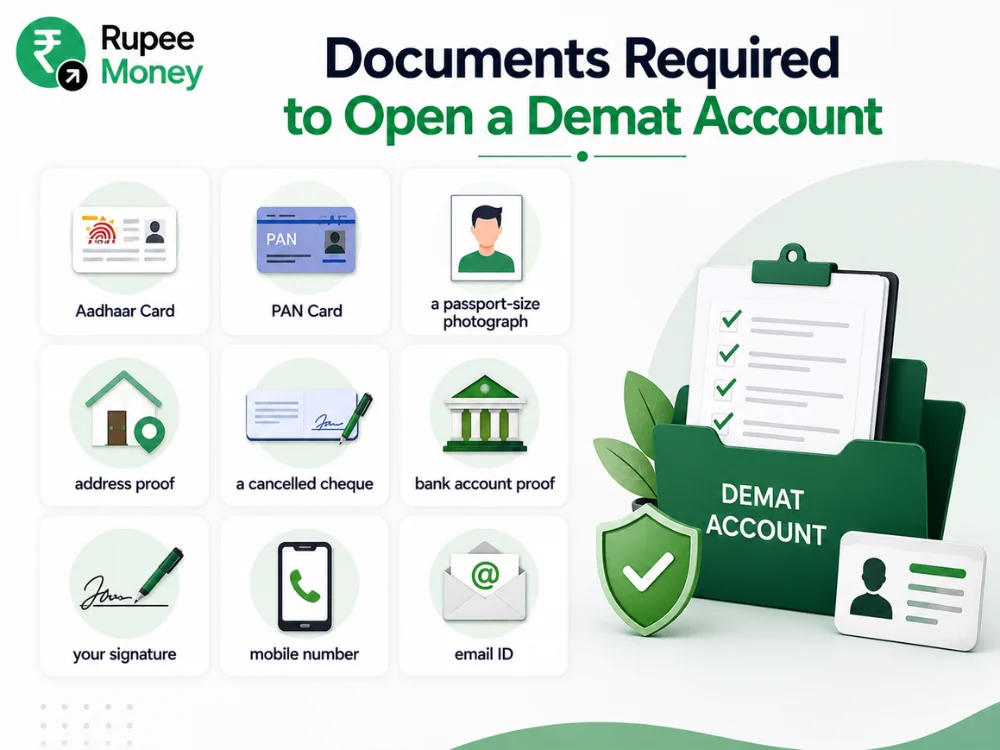
Opening a Demat Account is a genuinely simple process, though investors do need to complete standard Know Your Customer (KYC) formalities. Commonly required documents include your Aadhaar Card, PAN Card, a passport-size photograph, address proof, a cancelled cheque or bank account proof, your signature, mobile number, and email ID.
Many Depository Participants now offer fully digital account opening through Aadhaar-based e-KYC and video verification, which speeds up the whole process considerably.
How to Open a Demat Account in India
Opening a Demat Account has become genuinely straightforward thanks to digital onboarding offered by most registered brokers and financial institutions.
The general process runs as follows: choose a SEBI-registered Depository Participant, complete the online or offline application form, submit your KYC documents, complete identity verification (including video KYC where required), and link your bank account and Trading Account. Once verification succeeds, your Demat Account activates and is ready to use — from there, you can begin investing in eligible securities through your linked Trading Account.
Demat Account Charges
Many brokers advertise zero account opening fees, but investors should understand the full range of charges tied to actually maintaining a Demat Account.
Account opening charges are increasingly waived by DPs, though some still charge a nominal fee depending on the services bundled in.
Annual Maintenance Charges (AMC) apply to most Demat Accounts, though eligible BSDA holders enjoy the reduced or waived charges outlined above within their specified limits.
Transaction charges may apply when securities get debited from your account during sales or transfers, and these vary meaningfully across DPs — worth comparing before you commit to one.
Other service charges can apply for account modification, pledge creation, rematerialisation, or duplicate statements. It’s genuinely worth reviewing your chosen DP’s full tariff schedule before opening an account, rather than discovering these fees later.
Who Should Open a Demat Account?
A Demat Account is useful for pretty much anyone planning to invest in Indian financial markets. Consider opening one if you want to invest in shares listed on the NSE or BSE, plan to apply for IPOs, intend to invest in ETFs, want to hold government securities electronically, wish to invest in certain mutual funds available through the Demat route, or simply prefer keeping your investments digitally in one secure place. If you’re planning to apply for an IPO specifically, it’s also worth understanding the IPO lock-in period and what happens to your shares once allotment lands in your Demat Account.
Even as a complete beginner, opening a Demat Account early can help you start your investment journey with genuine confidence rather than scrambling to set one up right when an opportunity comes along.
Latest Demat Account Trends in India
India has seen genuinely significant growth in the number of Demat Accounts over the past few years, driven by rising financial awareness, simplified digital onboarding, and growing retail investor participation across the country.
More young investors are entering the stock market through mobile-first investment platforms, while broader financial literacy efforts have encouraged first-time investors to explore equity investing directly. Paperless account opening, faster settlement systems, and stronger digital security have all reinforced investor confidence further. On the regulatory side, SEBI’s 2024 BSDA overhaul specifically widened access for smaller investors by raising the zero-AMC threshold to ₹4 lakh — a meaningful shift that’s made holding a Demat Account genuinely more affordable for first-time and smaller investors. If you’re weighing direct equity investing against a more hands-off approach, it’s also worth comparing that against mutual fund investing through an SIP.
As India’s capital markets keep expanding, Demat Accounts are set to remain the actual foundation for investing in listed securities and other market-linked financial products.
Key Takeaways
- A Demat Account stores financial securities electronically, eliminating the need for physical certificates.
- A Trading Account is used to buy and sell securities, while a Demat Account holds them after settlement.
- SEBI regulates India’s securities market, while NSDL and CDSL operate as the country’s two depositories.
- Every Demat Account includes a DP ID and a Client ID for identification.
- Investors can choose from Regular, Repatriable, Non-Repatriable, and BSDA accounts based on their needs.
- Under SEBI’s 2024 rules, BSDA holders get zero AMC up to ₹4 lakh in holdings, and a capped ₹100+GST AMC up to ₹10 lakh.
- Opening a Demat Account is one of the first genuine steps toward investing in India’s stock market.
Frequently Asked Questions (FAQs)
Is a Demat Account mandatory for investing in shares in India?
Yes, generally. Since securities are now held in dematerialised form, you need a Demat Account to receive, store, and transfer shares after settlement. Without one, you can’t hold most listed equity shares electronically. You’ll also typically need a linked Trading Account if you want to actively buy and sell.
What is the difference between a Demat Account and a Trading Account?
A Demat Account is your digital locker, holding shares and eligible securities after purchase. A Trading Account is what actually lets you place buy and sell orders on the exchange. The Trading Account handles the transaction; the Demat Account safely holds what you end up owning.
Can I open more than one Demat Account?
Yes, you can open multiple Demat Accounts across different Depository Participants, provided each complies with applicable regulations and is linked to your valid PAN with complete KYC. Some investors use separate accounts to keep long-term holdings apart from active trading, or to access different brokerage services — just be mindful of the maintenance charges that come with holding more than one.
What is a BSDA and who can open one?
A Basic Services Demat Account is designed for small investors meeting SEBI’s eligibility conditions — a single or first-holder account, with no other BSDA held elsewhere. Under current rules, holdings up to ₹4 lakh carry zero AMC, holdings between ₹4 lakh and ₹10 lakh carry a capped ₹100+GST AMC, and crossing ₹10 lakh converts the account to a regular Demat Account automatically.
Is a Demat Account safe?
Yes, generally. Securities are held electronically through recognised depositories — NSDL and CDSL — which eliminates most risks tied to physical certificates, including theft, loss, and damage. You can further strengthen your account’s security with strong passwords, two-factor authentication where available, and by monitoring account activity regularly. It’s also worth staying alert more broadly, since AI-powered financial fraud is rising, including scams targeting Demat and trading credentials specifically.
Conclusion
A Demat Account has become a genuinely essential part of investing in India’s financial markets. Whether you plan to buy shares, invest in IPOs, hold government securities, or build out a diversified portfolio, a Demat Account gives you a safe, convenient way to manage your investments entirely electronically.
Understanding the roles of SEBI, NSDL, CDSL, Depository Participants, your DP ID, and how Trading Accounts fit in can help you invest with real confidence from day one. Before opening an account, compare the services, charges, and customer support across a few different Depository Participants to find the one that genuinely matches your investment needs — and once you’re set up, it’s worth reading Building Wealth in Your 20s for the bigger financial picture beyond just your first Demat Account.
Disclaimer: This article is for informational and educational purposes only and should not be considered financial, investment, or legal advice. Rules relating to Demat Accounts, BSDA eligibility, charges, and securities transactions may change over time. Investors should verify the latest guidelines issued by SEBI, NSDL, CDSL, and their chosen Depository Participant before opening or operating a Demat Account. Consider consulting a qualified financial advisor if you require personalised investment guidance.
ABOUT THE AUTHOR

