
Gold and US Dollar Relationship: Why Gold Prices Move When the Dollar Changes
Why does gold often get expensive right when the US dollar weakens? And why does a strong dollar sometimes drag gold prices down? The gold and US dollar relationship is one of the most closely tracked patterns in global finance, and it quietly shapes what Indian buyers pay for jewellery, what digital gold investors earn, and how Gold ETF returns move.
At RupeeMoney, we try to break down exactly this kind of connection: the stuff that shows up in the news every week but rarely gets explained simply. If you buy gold coins during Dhanteras, hold Gold ETFs in your portfolio, or just keep an eye on daily rates before a wedding purchase, understanding why gold and the dollar tend to move in opposite directions can help you time your decisions a little better.
Interest rate decisions from the US Federal Reserve, global inflation trends, and geopolitical tension all pull on this relationship from different directions. Let’s break down how it actually works and why it matters even if you’ve never bought a single dollar in your life.
Gold and the US Dollar: An Old, Complicated Relationship
Gold has functioned as a store of value for thousands of years, long before any modern currency existed. The US dollar, by contrast, is the world’s dominant reserve currency the one central banks, oil traders, and international investors rely on most for cross-border trade and reserves.
Because gold is priced internationally in dollars, any meaningful shift in the dollar’s value ripples through gold prices everywhere, India included.
Broadly speaking, the two tend to move in opposite directions, what’s usually called an inverse correlation. But this isn’t an iron law. During periods of serious global stress, both can rise together, and we’ll get to why later in this article.
What Does “Inverse Correlation” Actually Mean Here?
This is one of the more searched finance terms, and it sounds more complicated than it is.
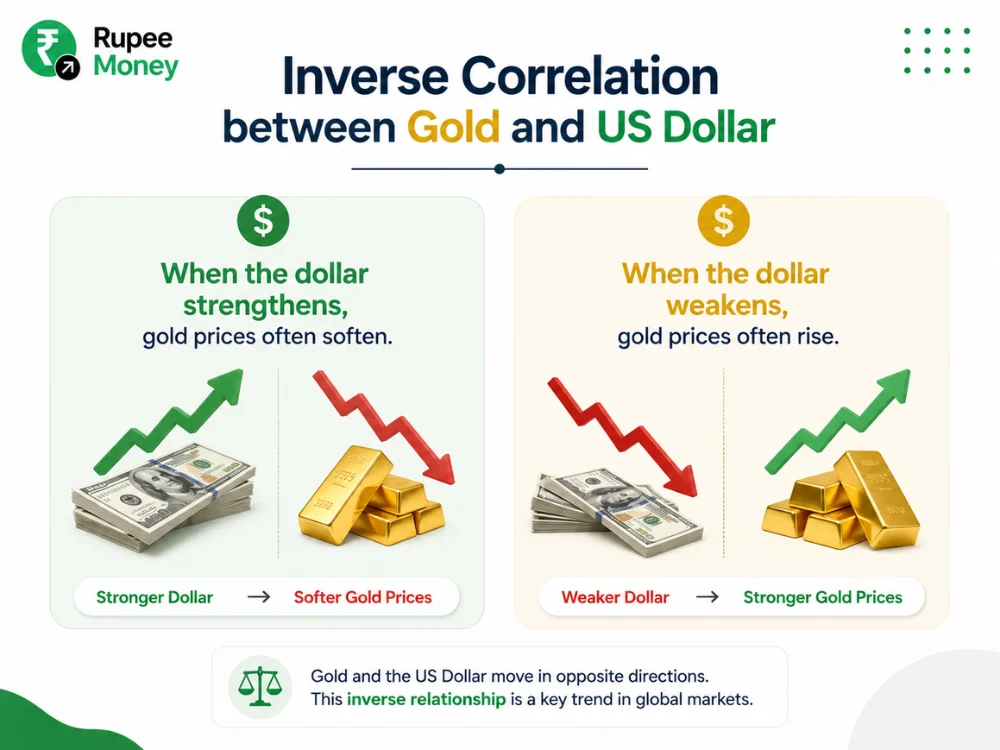
An inverse correlation simply means that when one asset climbs, the other tends to fall not always, but often enough to be a useful pattern.
With gold and the dollar, that plays out like this:
- When the dollar strengthens, gold prices often soften.
- When the dollar weakens, gold prices often rise.
The mechanism is fairly straightforward. Since gold is priced in dollars worldwide, a stronger dollar makes gold costlier for anyone buying with euros, rupees, yen, or any other currency so demand can cool off. A weaker dollar does the opposite: gold becomes cheaper for international buyers, demand tends to pick up, and prices often follow.
That said, this pattern loosens during major crises, when investors sometimes buy both gold and dollar assets at once, purely for safety.
Why Gold Prices Lean on the Dollar
A few structural reasons explain why these two assets stay so tightly linked.
Gold Trades in Dollars, Everywhere
The bulk of global gold trading from bullion markets to futures contracts happens in US dollars. If the dollar gains strength against other currencies, buyers outside the US end up paying more in their own currency for the same quantity of gold, which can dampen demand and put downward pressure on prices.
When the dollar loses strength, the reverse happens: gold gets relatively cheaper for international buyers, often lifting demand.
The Dollar’s Role as the World’s Reserve Currency
The dollar holds its “reserve currency” status because central banks worldwide keep large dollar holdings as part of their foreign exchange reserves. Since global trade, oil transactions, and most international investment flows run through dollars, any major shift in the dollar’s strength has knock-on effects across commodities and gold.
How the Federal Reserve and Interest Rates Move Gold Prices
Few institutions influence gold as directly as the Federal Reserve, the US central bank responsible for setting American interest rates.
Interest rates affect borrowing costs, deposit returns, and how attractive it is to hold non-yielding assets like gold.
When the Fed raises interest rates, bonds and bank deposits typically start paying more, which nudges some investors to shift money out of gold, an asset that earns no interest of its own and into these higher-yielding options. That shift often coincides with a stronger dollar and softer gold prices.
When the Fed cuts rates, the opposite tends to unfold. Fixed-income returns lose some of their appeal, gold becomes relatively more attractive again, the dollar can soften, and gold prices often get a lift.
How Inflation Plays Into the Gold-Dollar Equation
Inflation refers to the steady rise in prices of everyday goods and services, which chips away at the purchasing power of money over time.
Gold has long been viewed as a hedge against inflation, the idea being that when currency loses value, a tangible asset like gold tends to hold its value better. When inflation runs high, more investors turn to gold, demand rises, and prices often follow.
But there’s a twist: if high inflation pushes the Federal Reserve to raise rates sharply in response, the resulting stronger dollar can partly offset or even reverse gold’s gains. This is exactly why market watchers track both inflation data and Fed announcements together rather than in isolation.
Why Gold Keeps Its “Safe-Haven” Reputation
Gold is widely described as a safe-haven asset, something investors turn to specifically because it tends to hold value better than riskier assets during turbulent times.
That reputation gets tested (and usually reinforced) during events like:
- Economic slowdowns
- Stock market crashes
- Wars and geopolitical flare-ups
- Banking sector stress
- Currency instability
During these periods, capital often flows into gold as a way of protecting wealth.
Curiously, the dollar carries some of the same reputation. In severe crises, both gold and the dollar have been known to rise together, as investors chase safety wherever they can find it regardless of the usual inverse pattern.
Whatever Happened to the Gold Standard?
The gold standard was a monetary system where a country’s currency value was tied directly to a fixed quantity of gold. The US operated under a version of this system until the early 1970s, when President Nixon effectively ended dollar-gold convertibility, pushing the world toward the fiat currency system we use today where a currency’s value rests on government and institutional trust rather than a physical gold backing.
Even without that formal link, most central banks including many in Asia and Europe still hold sizable gold reserves alongside their dollar holdings, treating gold as a strategic buffer rather than a relic of the past.
What This Means for Indian Gold Buyers
If you’ve ever wondered why events in Washington affect what you pay for gold in Mumbai or Chennai, here’s the short version: India imports the vast majority of the gold it consumes. That means domestic prices are shaped by several moving pieces at once
- International gold prices (set largely in dollars)
- The strength or weakness of the dollar itself
- The rupee-dollar exchange rate
- Import duties and applicable taxes
Even if global gold prices barely move, a weaker rupee alone can push up what you pay locally. That’s precisely why serious Indian gold buyers not just traders, but anyone planning a large jewellery purchase or a Gold ETF investment keep half an eye on the dollar and the rupee, not just the gold rate itself.If you’re planning to build your gold exposure gradually, our SIP calculator can help you estimate how a monthly investment in Gold ETFs or gold mutual funds could grow over time. Prefer investing a one-time amount instead? Our lumpsum calculator shows how a single upfront gold investment could grow depending on your expected returns.
The Bigger Picture: Where Things Stand Now
Markets continue to watch the Federal Reserve’s rate decisions closely, and inflation trends remain a live concern in several major economies even where price pressures have eased from earlier peaks. At the same time, geopolitical tension, steady central bank gold buying, and lingering uncertainty about global growth keep supporting gold’s safe-haven appeal.
For Indian investors, the dollar’s movement, international gold prices, and the rupee-dollar rate will likely stay the key variables shaping domestic gold prices in the months ahead. As always with fast-moving markets, it’s worth checking current rates directly from RBI updates or a trusted financial data source before making any decision. If you’re weighing gold against a fixed deposit instead, you can use our FD calculator to check your expected returns first .
Key Takeaways
- Gold and the US dollar generally move in opposite directions, an inverse correlation, not an absolute rule.
- Gold is priced in dollars internationally, so dollar strength directly affects global gold demand.
- Federal Reserve interest rate decisions influence both gold and the dollar simultaneously.
- Rising inflation tends to boost gold demand, though Fed responses can offset this.
- Gold’s safe-haven status means it can rise alongside the dollar during severe crises.
- Indian gold prices depend on international rates, the dollar’s strength, the rupee-dollar exchange rate, and import duties, not gold prices alone.
Frequently Asked Questions (FAQs)
Why do gold and the US dollar usually move in opposite directions?
Because gold trades globally in dollars, a stronger dollar makes gold pricier for buyers using other currencies, which can cool demand. A weaker dollar makes gold relatively cheaper internationally, often supporting demand and prices. It’s a common pattern, though not a guarantee in every situation.
How exactly does the Federal Reserve affect gold prices?
Mainly through interest rates. Higher rates make bonds and deposits more attractive relative to gold, which pays no interest, so demand for gold can soften. Lower rates tend to do the reverse, making gold relatively more appealing.
Why is gold called a safe-haven asset?
Because investors often buy it during economic uncertainty, financial crises, geopolitical conflict, or high inflation, on the belief that it preserves value better than riskier assets during turbulent periods.
Why does the dollar’s value affect gold prices in India?
India imports most of the gold it uses, and international gold prices are set in dollars. So both the dollar’s strength and the rupee-dollar exchange rate directly influence what Indian buyers pay, alongside import duties and taxes.
Can gold and the dollar rise at the same time?
Yes. While they usually move in opposite directions, both can climb together during major crises, when investors treat both as safe places to park money.
Is gold still worth holding during high inflation?
Gold has traditionally been treated as an inflation hedge because it tends to preserve value over long stretches. That said, no asset is risk-free; gold prices still respond to interest rates, currency swings, and investor sentiment, so it’s worth weighing your own financial goals before deciding.
Disclaimer: This article is for educational and informational purposes only and should not be treated as financial, investment, tax, or legal advice. Gold prices, currency values, interest rates, and broader economic conditions change constantly. Please verify current figures from official sources the Reserve Bank of India, the US Federal Reserve, or a qualified financial advisor before making any investment decision.
ABOUT THE AUTHOR

