
PMEGP Loan 2026: Eligibility, Subsidy, Project Cost & How To Apply Online
Securing capital is often the first major hurdle when launching a business. The Prime Minister Employment Generation Programme loan (PMEGP loan) is a highly effective, government-supported financing option tailored for individuals looking to establish new micro-enterprises in the non-farm sector. By combining traditional bank finance with a lucrative government margin money subsidy, PMEGP actively encourages self-employment and grassroots job creation across both rural and urban India.
Administered by the Ministry of Micro, Small and Medium Enterprises (MSME), the Khadi and Village Industries Commission (KVIC) serves as the national nodal agency. State KVIC Directorates, State Khadi and Village Industries Boards (KVIBs), District Industries Centres (DICs), and participating banks collaborate to successfully implement the scheme.
What Is the Prime Minister Employment Generation Programme?
The Prime Minister Employment Generation Programme (PMEGP) is a premier credit-linked subsidy scheme specifically designed to help eligible individuals and groups set up new micro-enterprises.
Its primary objective is to generate sustainable employment opportunities, particularly targeting unemployed youth and traditional artisans. By creating viable livelihood options at the community level, the scheme actively helps curb mass migration to urban centers, directly reflecting how small businesses help India’s economy.
PMEGP Meaning
In simple terms, the PMEGP meaning revolves around a co-financing model. Under this scheme, an eligible entrepreneur contributes a minor fraction of the total project cost, a participating bank sanctions the required loan balance, and the government injects a “margin money subsidy” based on the beneficiary’s demographic category and unit location.
It is crucial to understand that PMEGP is not a completely interest-free loan or a 100% government-funded grant. The borrower remains responsible for repaying the bank’s portion of the loan.
PM Employment Generation Programme Loan: How Does It Work?
The PM employment generation programme loan operates on a structured credit-linked subsidy mechanism. For eligible new projects, the funding is divided as follows:
- The applicant contributes 10% of the project cost (General category) or 5% (Special categories).
- The lending bank finances the remaining eligible project balance.
- The government subsequently routes a margin money subsidy ranging from 15% to 35% through the banking system, which effectively reduces the borrower’s overall debt burden.
PMEGP Project Cost and Subsidy
| Category | Own Contribution | Rural Subsidy | Urban Subsidy |
| General | 10% | 25% | 15% |
| Special Category | 5% | 35% | 25% |
Currently, the scheme framework covers projects up to ₹50 lakh in the manufacturing sector and ₹20 lakh in the service/business sector for calculating the eligible subsidy. The subsidy is not handed out as liquid cash to the applicant; it is locked in the loan account and adjusted strictly according to PMEGP guidelines over time.
PMEGP Eligibility: Who Can Apply?
Understanding what affects your loan eligibility is essential before applying. The baseline requirements include:
- The applicant must be over 18 years old.
- There is no upper income ceiling to apply for a PMEGP project.
- Only brand-new projects are considered for fresh assistance (existing units cannot apply).
- For manufacturing projects exceeding ₹10 lakh and service projects exceeding ₹5 lakh, the applicant must possess at least an VIII standard pass educational certificate.
- The project must include definitive capital expenditure.
- Only one person per family (defined as self, spouse, and unmarried children) is eligible to receive assistance.
PMEGP Loan for SC/ST and Other Special Categories
The PMEGP loan for SC/ST applicants is govern by highly favorable special-category provisions. This umbrella also covers OBCs, women, minorities, ex-servicemen, transgender applicants, physically challenged individuals, and residents of aspirational districts.
These applicants benefit immensely from a lowered upfront contribution of just 5%. Furthermore, they qualify for a robust 35% margin money subsidy in rural areas and 25% in urban areas, which drastically lowers their initial financial risk and capital requirement.
PMEGP Service Sector: What Businesses Can Apply?
The PMEGP service sector encompasses a vast array of service-based micro-enterprises and certain authorized trading activities. For instance, retail outlets that are directly backward-linking to manufacturing facilities are generally eligible across the country. Eligible transport activities, such as purchasing tourist cabs, vans, or passenger boats for the general public, can also qualify, provided they meet specific scheme guidelines.
Financial Assistance Under Prime Minister Employment Generation Programme
Financial assistance under the Prime Minister Employment Generation Programme seamlessly blends the promoter’s contribution, institutional bank finance, and the government margin money subsidy. However, final loan approval rests entirely on the bank’s independent appraisal of your project’s viability, documentation, and your personal repayment capacity. PMEGP eligibility does not automatically guarantee bank sanction.
PMEGP Loan Application Form: How to Apply Online?
Entrepreneurs must submit the Prime Minister Employment Generation Programme loan application form digitally through the official online system to ensure transparency and faster processing.
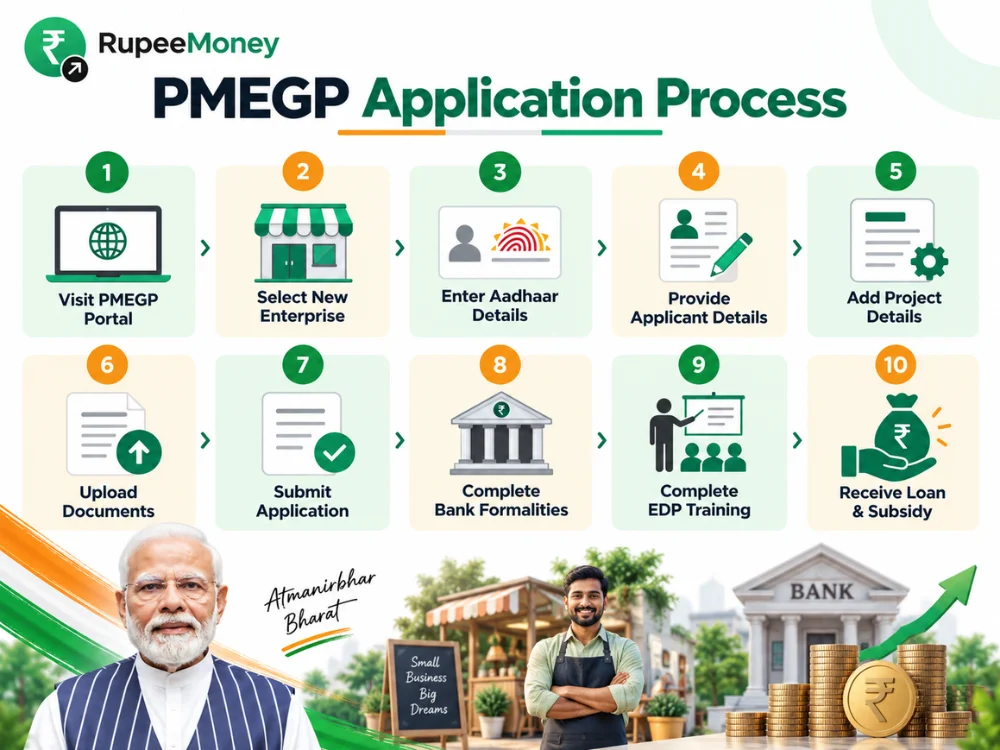
PMEGP Application Process
- Navigate to the official PMEGP e-portal.
- Select the application module designated for setting up a new enterprise.
- Enter your Aadhaar details for mandatory authentication, along with applicant demographic data.
- Input your proposed business model and estimated PMEGP project cost.
- Upload the necessary KYC and educational documents.
- Submit the application. It is then routed to the implementing agency and the bank for rigorous evaluation.
- Once the bank sanctions the loan, complete any required formalities or Entrepreneurship Development Programme (EDP) training before final disbursement and subsidy processing.
PMEGP Project Report: What Should It Include?
A highly detailed Prime Minister Employment Generation Programme project report is vital for convincing the bank to approve your loan. It should comprehensively cover:
- Promoter background and product/service description.
- Market analysis and customer acquisition strategy.
- Machinery, capital expenditure, and working capital requirements.
- Total project cost and exact loan requirement.
- Employment generation and profitability projections.
Applicants must use realistic financial estimates; artificially inflating project costs to extract a higher subsidy is heavily discouraged and usually leads to application rejection.
MSME PMEGP Registration: Is Udyam Registration Required?
Yes. While MSME PMEGP registration and standard Udyam Registration are distinct processes, they are connected. Generating an Udyam Registration certificate is mandatory for new PMEGP units before physical verification occurs and the margin money is officially adjusted into the beneficiary’s loan account.
PMEGP Rojgar Yojana: How Does It Generate Employment?
The PMEGP Rojgar Yojana acts as a massive catalyst for self-employment. According to official MSME dashboard statistics, between FY 2021-22 and FY 2026-27, the scheme actively assisted over 4.03 lakh units, generating a phenomenal 36.33 lakh employment opportunities across India as of June 2026.
RupeeMoney View
The PMEGP government loan is a highly advantageous financial tool for aspiring founders who need institutional backing coupled with a margin money subsidy. However, applicants must realize that this scheme should not be viewed as “free money” or an automatic loan approval.
Securing this loan requires a bankable, realistic project report, solid documentation, and demonstrable repayment capacity. Before applying, it is a smart move to understand how to improve your CIBIL score to ensure the lending bank views your financial profile favorably. Always verify the latest MSME guidelines directly through the official government portals before committing to any major financial decisions.
FAQs
What is PMEGP?
It is a credit-linked subsidy initiative designed to fund the establishment of new micro-enterprises in the non-farm sector.
What is the maximum PMEGP project cost?
The current limits for subsidy calculation are ₹50 lakh for manufacturing units and ₹20 lakh for service/business operations.
Can SC/ST applicants apply for PMEGP?
Yes, they fall under the special category, qualifying for a higher subsidy (up to 35%) and a reduced 5% personal contribution requirement.
Is PMEGP available for service businesses?
Yes, a wide range of service-sector activities are eligible under the scheme's conditions.
Is Udyam Registration required?
Yes, securing Udyam Registration is mandatory for new units before physical verification and the final adjustment of the margin money.
Yes, a wide range of service-sector activities are eligible under the scheme’s conditions.
Disclaimer: This article is strictly for educational and informational purposes only and does not constitute financial, investment, tax, or legal advice. Government scheme guidelines, eligibility criteria, interest rates, and application processes are subject to frequent updates by the respective authorities. While we strive to provide accurate and up-to-date information, RupeeMoney makes no guarantees regarding the completeness or accuracy of the content. Readers are strongly advised to independently verify all details through official government portals and consult qualified financial advisors before making any investment or borrowing decisions.
ABOUT THE AUTHOR

