
CGTMSE Scheme 2026: MSME Loan Eligibility, Charges, Benefits & How To Apply

Starting or expanding a small business requires substantial capital, but many micro and small enterprises struggle to secure business loans due to a lack of collateral or third-party guarantees. The Credit Guarantee Fund Trust for Micro and Small Enterprises (CGTMSE) addresses this critical issue by providing credit guarantee support to eligible lenders for loans extended to qualifying Micro and Small Enterprises (MSEs).
This scheme is fundamentally designed to improve access to institutional credit and drastically reduce a business’s dependence on collateral security. It is important to note that CGTMSE does not directly disburse loans to businesses. Instead, eligible lending institutions provide the credit and obtain guarantee coverage from CGTMSE under the applicable scheme guidelines.
What Is the Credit Guarantee Fund Scheme for Micro and Small Enterprises?
The Credit Guarantee Fund Scheme for Micro and Small Enterprises is a robust credit guarantee mechanism established by the Government of India and the Small Industries Development Bank of India (SIDBI). Its primary objective is to strengthen credit delivery to the MSE sector.
Under the CGTMSE guarantee scheme, eligible lending institutions can acquire guarantee coverage for credit facilities provided to qualifying MSE borrowers. This empowers businesses that lack sufficient collateral to easily access formal business finance. CGTMSE covers a wide range of eligible manufacturing, service, and trading activities. Retail trade and wholesale trade are also fully covered under the current framework.
CGTMSE Eligibility: Who Can Get the Guarantee?
Basic CGTMSE eligibility depends on the nature of your enterprise, the specific credit facility, and the lending institution.
Eligible businesses generally include Micro and Small Enterprises engaged in manufacturing, services, and eligible trading activities. Additionally, the lending institution you approach must be a registered Member Lending Institution (MLI) under the scheme. Understanding what affects your loan eligibility is a crucial step before applying, as CGTMSE is not a separate loan that a business can independently apply for. The borrower approaches an eligible lender for credit, and the lender handles the entire guarantee process on their behalf.
CGTMSE for Startups
CGTMSE for startups is highly relevant when a new business falls within the eligible MSE framework and successfully meets the lender’s credit requirements.
However, being a startup does not automatically guarantee loan approval or CGTMSE coverage. The business must qualify under the applicable scheme guidelines, and the lending institution must independently approve the credit proposal based on the startup’s viability.
What Is the CGTMSE Guarantee Cover?
The CGTMSE guarantee cover refers to the specific portion of an eligible credit facility for which CGTMSE provides guarantee support to the lender. For guarantees approved on or after April 1, 2025, the maximum coverage (up to ₹10 crore) varies according to the borrower category and the credit amount:
| Borrower category | Credit facility | Maximum guarantee coverage |
| Micro Enterprises | Up to ₹5 lakh | 85% |
| Micro Enterprises | Above ₹5 lakh to ₹50 lakh | 75% |
| Micro Enterprises | Above ₹50 lakh to ₹10 crore | 75% |
| Women entrepreneurs / MSEs promoted by Agniveers | Applicable facilities | Up to 90% |
| SC/ST entrepreneurs, PwD, Aspirational District, ZED-certified | Applicable facilities | Up to 85% |
| Other borrowers | Applicable facilities | Up to 75% |
An additional 5% coverage may apply to MSEs located in RBI-identified Credit Deficient Districts, subject to scheme conditions. The most important takeaway is that the CGTMSE guarantee acts as protection for the lender—it is not a subsidy or a loan waiver for the borrower.
CGTMSE for Retail Trade: Is Retail Business Covered?
Yes. CGTMSE for retail trade is actively available under the current framework, subject to the applicable eligibility and standard lending conditions.
The scheme covers eligible trading activities, and CGTMSE has specifically mandated that the revised guarantee fee structure applies uniformly to retail and wholesale trading activities as well. Eligible retailers can confidently explore CGTMSE-backed business credit through participating lenders.
CGTMSE Fees, Premium and Risk Premium Explained
When securing a loan through this scheme, there are specific fees associated with the guarantee that borrowers must understand.
What Does CGTMSE Fees Meaning?
The CGTMSE fees meaning generally refers to the Annual Guarantee Fee (AGF) charged to maintain the guarantee coverage. For guarantees approved or renewed from April 1, 2025, the standard annual rates are highly subsidized:
| Guaranteed amount slab | Standard AGF |
| Up to ₹10 lakh | 0.37% |
| Above ₹10 lakh to ₹50 lakh | 0.55% |
| Above ₹50 lakh to ₹1 crore | 0.60% |
| Above ₹1 crore to ₹2 crore | 0.85% |
| Above ₹2 crore to ₹5 crore | 1.00% |
| Above ₹5 crore to ₹8 crore | 1.10% |
| Above ₹8 crore to ₹10 crore | 1.20% |
The AGF is calculated on the guaranteed amount during the first year and on the outstanding principal amount for the remaining tenure of the credit facility.
What Is CGTMSE Premium or Risk Premium?
The CGTMSE premium (or Risk Premium) is an additional charge that can modify the standard Annual Guarantee Fee depending on the lending institution’s risk category.
CGTMSE stipulates that Member Lending Institutions with excellent portfolios may receive a 10% discount on the standard rate. Conversely, higher-risk MLIs can attract a risk premium of up to 70% of the standard rate. The lender has the discretion to decide whether the incidence of this fee is passed on to the borrower or absorbed internally.
CGTMSE Benefits for Small Businesses
Understanding how small businesses help India’s economy highlights why the government heavily backs this scheme. Major CGTMSE benefits include:
- Easier access to institutional business credit.
- Reduced dependence on traditional collateral security and third-party guarantors.
- Support for eligible first-generation entrepreneurs seeking capital.
- Comprehensive guarantee coverage for manufacturing, service, and trading businesses.
- Higher guarantee coverage ratios for women entrepreneurs and specified underserved groups.
The ultimate objective is to improve the flow of formal credit to MSEs that might otherwise face extreme difficulty accessing finance.
How Does the CGTMSE Policy Work?
The CGTMSE policy works strictly through participating lending institutions. A simplified view of the process includes:
- The business approaches an eligible bank or participating lender.
- The borrower submits the required business, KYC, and financial documents.
- The lender rigorously evaluates the business model, repayment capacity, and loan proposal.
- If the loan is sanctioned and qualifies under the scheme, the lender processes the applicable CGTMSE guarantee coverage.
The guarantee starts after the payment of the applicable guarantee fee. For term credit, the guarantee runs for the agreed loan tenure, while working-capital facilities generally secure a five-year guarantee period.
How to Apply for a CGTMSE Loan?
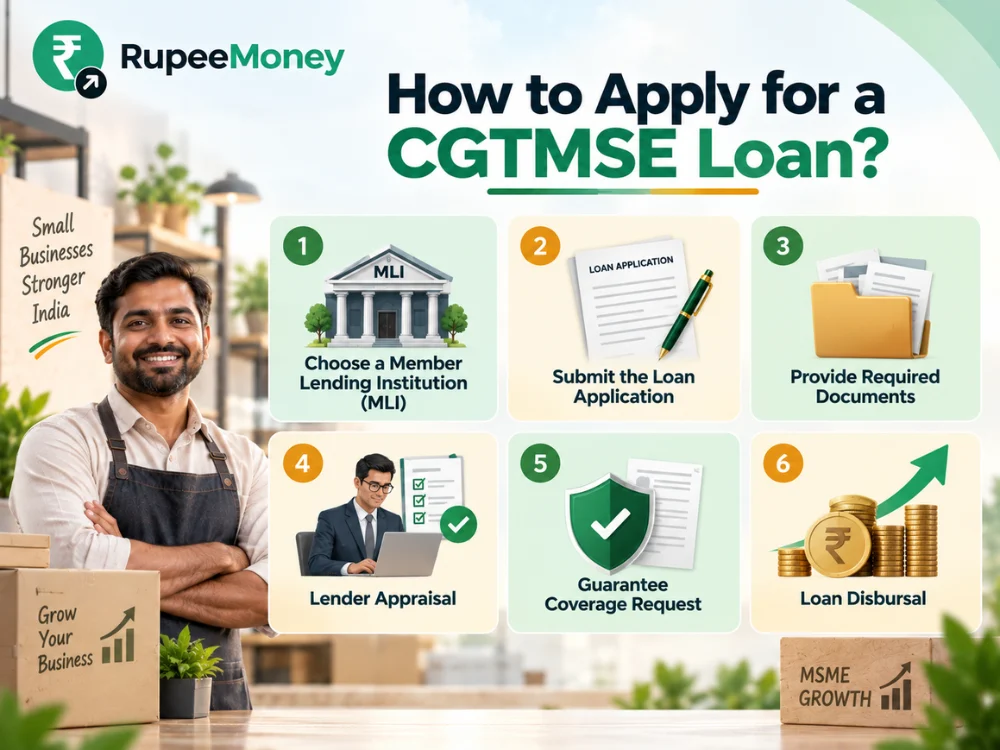
Borrowers cannot apply directly to the CGTMSE Trust. To secure a CGTMSE-backed loan, you must route your application through a participating lender. Here is the step-by-step process:
- Choose a Member Lending Institution (MLI): Select an authorized bank, NBFC, or Small Finance Bank that actively offers CGTMSE-backed loans.
- Submit the Loan Application: Fill out the lender’s MSME business loan application form. You must present a clear business plan and project report detailing your funding requirements.
- Provide Required Documents: Submit essential paperwork, including your Udyam Registration, PAN, Aadhaar, GST returns (if applicable), the last 6-12 months of bank statements, and audited financial statements (Profit & Loss and Balance Sheet).
- Lender Appraisal: The bank conducts a rigorous credit appraisal to assess your business’s viability, cash flow, and repayment capacity.
- Guarantee Coverage Request: If your loan proposal is approved by the bank, the lender will automatically apply to the CGTMSE portal for guarantee coverage on your behalf.
- Loan Disbursal: Once the coverage is approved and the Annual Guarantee Fee is settled, the lender disburses the collateral-free loan to your business account.
Conclusion
CGTMSE is a phenomenal financial tool for eligible micro and small businesses that urgently need formal credit but have limited collateral. However, borrowers must remember that CGTMSE is purely a credit guarantee mechanism to protect the bank; it is not a direct government loan, subsidy, or loan waiver.
Before signing a CGTMSE-backed loan, meticulously compare the lender’s interest rate (evaluating a fixed vs floating interest rate), processing charges, and the passed-on guarantee fee. You can use an EMI calculator to forecast your exact monthly obligations. Remember, eligibility for the guarantee does not mean automatic loan approval, and you remain entirely responsible for repaying the credit as agreed.
FAQs
Does CGTMSE give loans directly?
No. CGTMSE does not directly provide business loans. Loans are disbursed by eligible lending institutions, while CGTMSE provides guarantee support to the lender.
Is CGTMSE available for startups?
Yes, eligible startups that qualify as MSEs can explore CGTMSE-backed credit through participating lenders, subject to the lender's independent credit assessment.
Does CGTMSE cover retail trade?
Yes. Eligible retail and wholesale trade activities are covered under the applicable CGTMSE framework.
What is the CGTMSE guarantee cover?
The guarantee covers a specified percentage of the credit facility. Under the framework applicable from April 1, 2025, coverage ranges from 75% to 90%, depending on the borrower category and loan size.
What is CGTMSE risk premium?
It is an additional percentage applied to the standard Annual Guarantee Fee based on the risk category of the Member Lending Institution.
Yes, eligible startups that qualify as MSEs can explore CGTMSE-backed credit through participating lenders, subject to the lender’s independent credit assessment.
Disclaimer: This article is for educational and informational purposes only. CGTMSE eligibility, guarantee coverage caps, fee slabs, and lending conditions are subject to change by the government. Borrowers should verify the latest scheme guidelines and applicable terms directly with CGTMSE and their lending institution before making any financial decisions.
ABOUT THE AUTHOR

