
Fixed vs Floating Interest Rate: Which One Should You Choose?
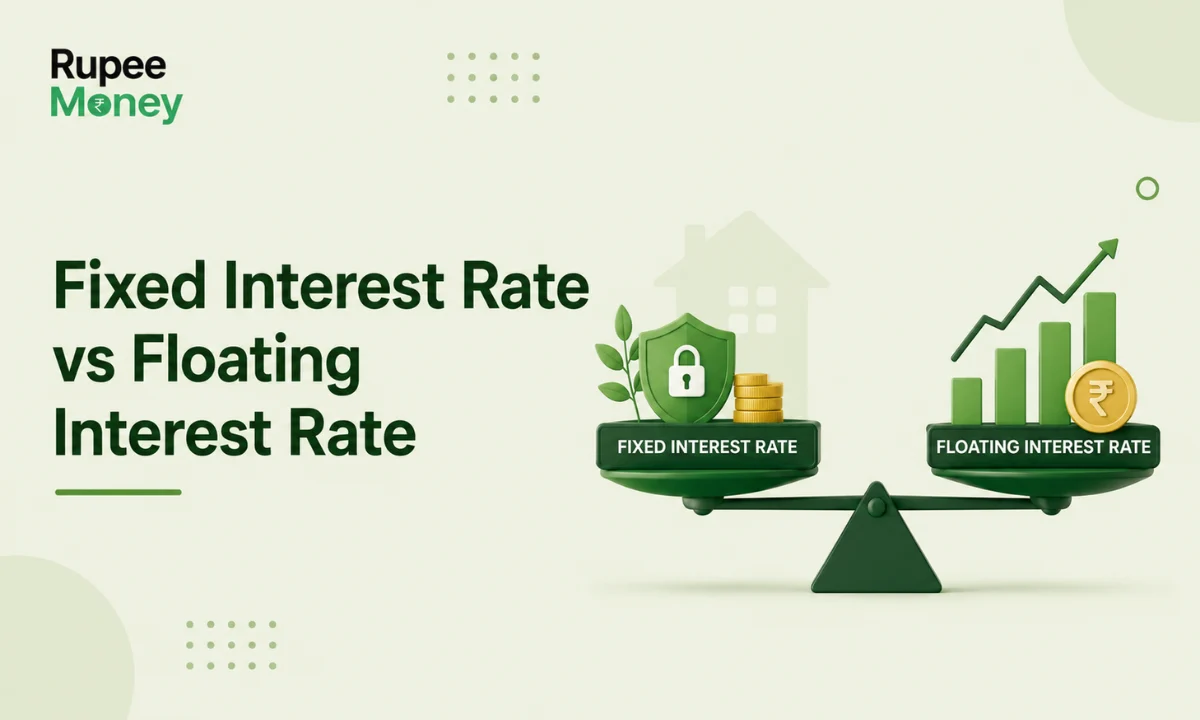
Two homebuyers take a ₹40 lakh home loan from different banks on the same day, same tenure, similar incomes. A year later, one person’s EMI hasn’t budged. The other’s has shifted, because the Reserve Bank of India (RBI) revised its policy rate in between.
What explains the gap? The type of interest rate each of them picked, fixed or floating. Many borrowers fixate on the loan amount or starting EMI and barely glance at this choice, but it can meaningfully affect both your monthly outgo and the total cost of the loan over the years. If you’re about to take a home loan or any long-term loan, understanding fixed versus floating rates is worth the ten minutes it takes.
What Is an Interest Rate, Exactly?
An interest rate is simply the cost of borrowing money, expressed as a percentage of the loan amount. Borrow ₹10 lakh, and you repay that amount plus interest over your loan tenure. Whether that interest, and your EMI, stays constant or shifts over time comes down to which rate type you choose.
What Is a Fixed Interest Rate?
A fixed interest rate stays unchanged for a set period, or sometimes for the entire loan tenure, depending on the lender. That means your EMI generally stays the same throughout that period, which is exactly why many borrowers prefer it: predictability makes budgeting a lot easier.
The trade-off is that if market rates fall, you typically don’t benefit automatically. You’d keep paying the rate you locked in, unless your lender allows a switch, usually at a cost.
What Is a Floating Interest Rate?
A floating interest rate moves with the lender’s benchmark, in India, most floating-rate loans are linked to the RBI’s Repo Rate, the rate at which the RBI lends to commercial banks. As of June 2026, the repo rate stands at 5.25%, having last been revised in December 2025, and the RBI’s Monetary Policy Committee reviews it roughly every two months (the next meeting is scheduled for early August 2026).
When the RBI adjusts this rate, banks typically pass on the change to floating-rate borrowers, which means your EMI or loan tenure can rise or fall depending on where policy rates head next.
Fixed vs Floating: Key Differences
| Feature | Fixed Interest Rate | Floating Interest Rate |
| Interest Rate | Stays fixed during the applicable period | Moves with market/benchmark rates |
| Monthly EMI | Usually stays the same | Can rise or fall over time |
| Budget Planning | Easier, repayments are predictable | Needs more flexibility |
| Benefit if Rates Fall | Usually none automatically | Borrowers can benefit |
| Risk if Rates Rise | Protected during the fixed period | EMI or tenure may increase |
| Best Suited For | Borrowers who value certainty | Borrowers comfortable with market swings |
Advantages of Fixed Rate
- A fixed interest rate provides stability, making it easier to plan long-term finances.
- One major advantage is that your monthly EMI generally remains unchanged throughout the fixed-rate period. This is particularly useful for salaried individuals who prefer predictable monthly expenses.
- Fixed rates also protect borrowers if market interest rates rise. Since your agreed interest rate does not change during the applicable period, sudden increases in lending rates may not immediately affect your loan repayments.
- However, fixed-rate loans often start with a slightly higher interest rate than floating-rate loans because lenders price in the certainty they offer.
Limitation of Fixed Rate
- Although a fixed interest rate offers stable EMIs, it may not always be the most cost-effective option.
- One limitation is that fixed-rate loans often start with a higher interest rate than floating-rate loans. This means you may pay more interest from the beginning of the loan.
- Another drawback is that if market interest rates fall, you may not automatically benefit from the lower rates. Your EMI generally remains unchanged during the fixed-rate period unless your lender allows you to switch to a floating rate, which may involve additional charges.
- Some lenders also offer fixed interest rates only for an initial period, after which the loan may automatically convert to a floating interest rate. It is important to read the loan agreement carefully before signing.
Advantages of Floating Rate
- A floating interest rate gives borrowers the opportunity to benefit when market interest rates decline.
- For example, if the RBI reduces the Repo Rate and your lender passes on the benefit, your loan may become less expensive. Depending on your lender’s policy, this could reduce your EMI or shorten your repayment tenure.
- Floating-rate loans often begin with lower interest rates compared to fixed-rate loans, making them attractive for borrowers who are comfortable with some uncertainty.
- The main drawback is that repayments may increase if interest rates rise in the future.
Limitation of Fixed Rate
- A floating interest rate can help reduce borrowing costs when market rates fall, but it also comes with uncertainty.
- Since the interest rate changes according to market conditions, your EMI or loan tenure may increase if interest rates rise. This can make monthly budgeting more difficult, especially for borrowers with fixed incomes.
- Another challenge is that borrowers have little control over market movements. Even if you make all your repayments on time, changes in benchmark rates, such as the RBI’s Repo Rate, may still affect your loan.
Which One’s Better for a Home Loan?
There’s no universal answer, it depends on your finances and your appetite for change. A fixed rate tends to suit you if you want stable EMIs, work with a tight monthly budget, expect rates to climb, or simply value certainty. If you’re weighing this alongside other borrowing decisions, it also helps to understand what affects your loan eligibility in the first place. A floating rate tends to suit you if you can absorb some repayment variation, expect rates to hold steady or fall, or are taking a long-tenure loan and are comfortable riding out market cycles. Either way, compare rates, terms, and switching options across lenders before deciding.
Factors Worth Weighing Before You Choose
Match the rate type to your finances, not to market predictions. Consider your income and whether your budget could absorb a higher EMI if rates rise. If you’re taking this loan for a vehicle rather than a home, our Car Loan Calculator works the same way to help you compare fixed vs floating scenarios. Factor in tenure too, home loans often run 15–30 years, long enough for rates to shift multiple times. And be honest about your risk tolerance: if EMI fluctuations would genuinely stress your finances, a fixed rate likely offers more peace of mind.
Many banks and housing finance companies also let you switch between fixed and floating rates later, subject to their terms. Some charge a conversion fee; others set eligibility conditions. Weigh the potential savings against whatever charges apply before requesting a switch.
Common Mistakes to Avoid
Picking a rate purely because it looks lower today is a common trap, a lower starting rate doesn’t always mean a lower total cost. Skimming the loan agreement is another, always understand how rate revisions, EMI changes, and prepayment rules actually work. And resist basing this decision on predictions about where rates are headed; even seasoned economists get that wrong fairly often. A healthy credit score also plays a big role in the rate you’re offered in the first place
FAQs
Which is better, fixed or floating? Neither wins outright. Fixed gives you certainty; floating gives you a shot at benefiting from falling rates.
Does floating always lower my EMI? No. It falls when rates fall and rises when rates rise, tracking the RBI’s repo rate.
Can I switch from fixed to floating later? Many lenders allow it, subject to their terms and applicable charges.
Why do floating rates change? They’re tied to benchmarks like the RBI Repo Rate (5.25% as of mid-2026); when the RBI moves, lenders typically follow.
Which is better for first-time homebuyers? It depends on your income stability and comfort with changing EMIs, compare options carefully rather than defaulting to either.
Conclusion
Choosing between fixed and floating isn’t a minor detail, it can shape your total borrowing cost over 15, 20, or even 30 years. A fixed rate buys predictability; a floating rate offers a chance to gain when rates fall, with the risk of paying more when they rise. Look past the headline rate and weigh your budget, financial goals, tenure, and appetite for repayment swings. Get that right, and you’ll land on a loan that fits your life, not just your loan sanction letter. If you’re early in your career and taking on your first big loan, our roadmap on building wealth in your 20s can help you plan around it.
Disclaimer: This article is for educational purposes only and shouldn’t be considered financial advice. Interest rates, loan terms, and conversion policies vary across lenders and can change with future RBI monetary policy decisions. Always confirm current rates and terms with your lender before borrowing.
ABOUT THE AUTHOR

