
UPI Transaction Charges From October 15, 2026: Who Will Pay, MDR Rates & What Changes
The digital payment landscape in India is gearing up for a major update. Effective October 15, 2026, the National Payments Corporation of India (NPCI) is rolling out a revised Merchant Discount Rate (MDR) structure for specific merchant transactions.
While the news of “UPI charges” has sparked concerns, the crucial takeaway for the general public is that individual consumers will continue using UPI for free. The revised charges target certain Person-to-Merchant (P2M) transfers exceeding ₹2,000, meaning the financial burden of the MDR falls squarely on the merchant accepting the payment.
UPI Transaction Charges From October 15, 2026
Under the recently announced NPCI framework, an MDR of 0.4% will be levied on eligible P2M UPI transactions that cross the ₹2,000 threshold.
To protect merchants receiving very large payments, the fee comes with a ceiling: any transaction of ₹75,000 or above will incur a maximum charge of exactly ₹300.
| UPI Transaction | New MDR |
| P2P payments | No charge |
| Merchant payment up to ₹2,000 | No MDR |
| Specified P2M payment above ₹2,000 | 0.4% |
| P2M payment of ₹75,000 or more | Maximum ₹300 |
| Small merchants under P2PM category | Zero MDR, subject to conditions |
This updated fee ecosystem will take effect from October 15, 2026.
Will UPI Users Have to Pay Transaction Charges?
No. Consumers will not pay the new MDR.
The charge is impose on the merchant side and cannot be pass on to customers. NPCI has also clarified that UPI apps cannot impose a platform fee or hidden charge on customers for these transactions.
So, if you pay a merchant ₹5,000 through UPI, you will still pay ₹5,000, not ₹5,020.
The MDR is a cost for the merchant and is settle within the payment ecosystem.
What Is UPI MDR?
MDR, or Merchant Discount Rate, is a fee charge on certain digital payments made to merchants.
Under the new UPI framework, the standard MDR for specified P2M transactions above ₹2,000 will be 0.4%, subject to the ₹300 maximum cap.
For example:
- ₹3,000 UPI payment → 0.4% MDR = ₹12
- ₹10,000 UPI payment → 0.4% MDR = ₹40
- ₹50,000 UPI payment → 0.4% MDR = ₹200
- ₹1,00,000 UPI payment → 0.4% would be ₹400, but the ₹300 cap applies.
The MDR is not a tax collect by the government. It is distribute among participants in the payments ecosystem. Managing these back-end costs will become an essential aspect of corporate financial planning for growing businesses.
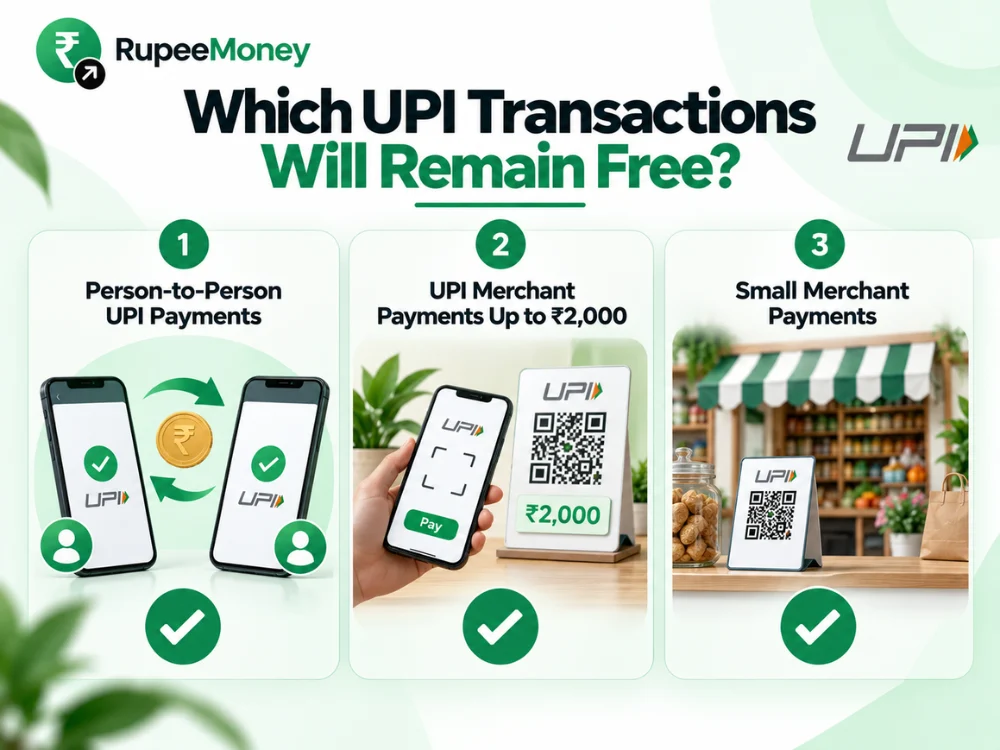
Which UPI Transactions Will Remain Free?
Most everyday UPI transactions will continue without MDR.
1. Person-to-Person UPI Payments
Money transfers between individuals will remain completely free, regardless of the amount transferred. This means sending ₹5,000 or ₹50,000 to a friend or to another person’s savings account through UPI will not attract the new MDR.
2. UPI Merchant Payments Up to ₹2,000
P2M transactions up to ₹2,000 will remain free of MDR. The government has stated that approximately 95% to 96% of merchant transactions will remain unaffected by the new framework.
3. Small Merchant Payments
Small merchants operating under the specified P2PM category (such as those receiving up to ₹1 lakh a month) will continue to receive zero-MDR treatment, subject to the applicable conditions. The framework specifically protects small merchants such as street vendors and neighbourhood businesses.
Which UPI Transactions Will Attract MDR?
The new MDR mainly affects specified person-to-merchant payments above ₹2,000.
However, not every transaction above ₹2,000 will necessarily attract the standard 0.4% rate. Certain categories have separate rates under the framework.
For example, specified transactions involving railways, telecom, insurance, and fuel payments above ₹2,000 will attract a flat ₹5 MDR.
Capital-market transactions have also been assigned a separate 0.02% MDR, subject to the applicable ₹300 cap.
Will Merchants Pay UPI Charges?
Yes, eligible merchants will bear the MDR on transactions covered by the new framework.
For example, if a customer makes a ₹10,000 eligible merchant payment through UPI, the standard MDR would be ₹40.
The merchant cannot add this ₹40 as a separate UPI charge to the customer’s bill. Banks have been advised to ensure that merchants do not pass the MDR on to customers.
Why Is UPI Introducing Transaction Charges?
The new framework creates a revenue mechanism for parts of the UPI payment ecosystem while keeping individual users and small-value transactions protected.
The government has said the framework is intended to support the long-term sustainability and expansion of the UPI ecosystem without affecting person-to-person payments and most small merchant transactions.
NPCI has also stated that revenue from the framework will support areas such as infrastructure resilience, cybersecurity, fraud prevention, innovation, and customer service.
Will UPI Become Expensive for Consumers?
For normal UPI users managing their personal finance, the direct impact is expected to be limited because customers will not be charged MDR.
A person paying ₹500 at a shop, transferring ₹10,000 to a friend, or making another covered free transaction will continue to use UPI without a transaction fee. The major change is entirely on the merchant side for specified higher-value P2M payments.
UPI Transaction Charges: What Changes From October 15?
| Parameter | Before October 15, 2026 | From October 15, 2026 |
| No MDR on UPI merchant payments | Free | MDR on specified P2M transactions above ₹2,000 |
| P2P transactions free | Free | P2P transactions remain free |
| Small-value payments free | Free | Payments up to ₹2,000 remain free |
| No standard merchant MDR | N/A | 0.4% MDR, subject to ₹300 cap |
| No separate MDR framework for selected categories | N/A | Some categories have special rates |
The new framework therefore does not mean that all UPI transactions will become chargeable. The changes are strictly limited to specified merchant transactions.
RupeeMoney View
The new UPI framework does not mean UPI is becoming a paid service for consumers. Person-to-person transfers remain free, payments up to ₹2,000 remain free for merchants, and small merchants covered under the zero-MDR framework remain protected.
The key change is that specified higher-value merchant transactions will carry an MDR from October 15, 2026. For consumers, there is no direct UPI transaction fee under this framework. For merchants, however, the new MDR becomes an additional payment-processing cost on applicable transactions that must be factored into their margins.
FAQs
Will UPI payments be charged from October 15, 2026?
No. Consumers will continue to make UPI payments without transaction charges. MDR will apply to specified merchant transactions and will be paid by merchants.
Is UPI free below ₹2,000?
Yes, P2M transactions up to ₹2,000 will remain free of MDR. P2P transactions will remain free regardless of the amount.
What is the new UPI MDR rate?
The standard MDR for specified P2M transactions above ₹2,000 is 0.4%, capped at ₹300 per transaction.
Can merchants charge customers for UPI MDR?
No. The MDR cannot be passed on to customers under the new framework.
When will the new UPI charges start?
The revised UPI MDR framework will take effect from October 15, 2026.
Disclaimer: This article is based on the UPI MDR framework announced in September 2026 and is intended for informational purposes. Specific rates and exemptions should be verified against the latest NPCI circulars and official government updates before making business or financial decisions.
ABOUT THE AUTHOR

